Dwell time
The length of time a visitor stays on a page after clicking through from search before returning to the results, used as a signal of how well the page met their intent.
What dwell time means
Dwell time is the length of time a visitor spends on a page after clicking through from a search result, measured up to the moment they return to the results. It sits between a click and a bounce back: a long dwell suggests the page answered what the searcher came for, while a quick return suggests it didn't. Unlike metrics in your own analytics, dwell time is a search-session signal, inferred from how people move between the results page and your content.
In content marketing and SEO, dwell time is read as a proxy for whether a page actually satisfies the query it ranks for. A page can win the click with a strong title and still lose the visitor in seconds if the content underneath doesn't match the search intent that brought them there.
Why dwell time matters
- It reflects content-intent fit. Long dwell time usually means the page matched what the searcher wanted, which is the outcome every other on-page choice is meant to produce.
- It's a quality signal, not a vanity metric. It captures whether people found value, not just whether they arrived, which makes it harder to game than raw organic traffic.
- It pairs with the click. A high click-through rate with short dwell time points to a title that overpromised relative to the content beneath it.
- It differs from bounce. Dwell is tied to the search journey specifically, so it tells a sharper story than a generic abandonment rate about whether a query was answered.
- It exposes content decay. Falling dwell time over months is an early sign of content decay, where a page that once satisfied a query no longer does.
One way to make sense of dwell time is to read it next to click-through rate rather than on its own:
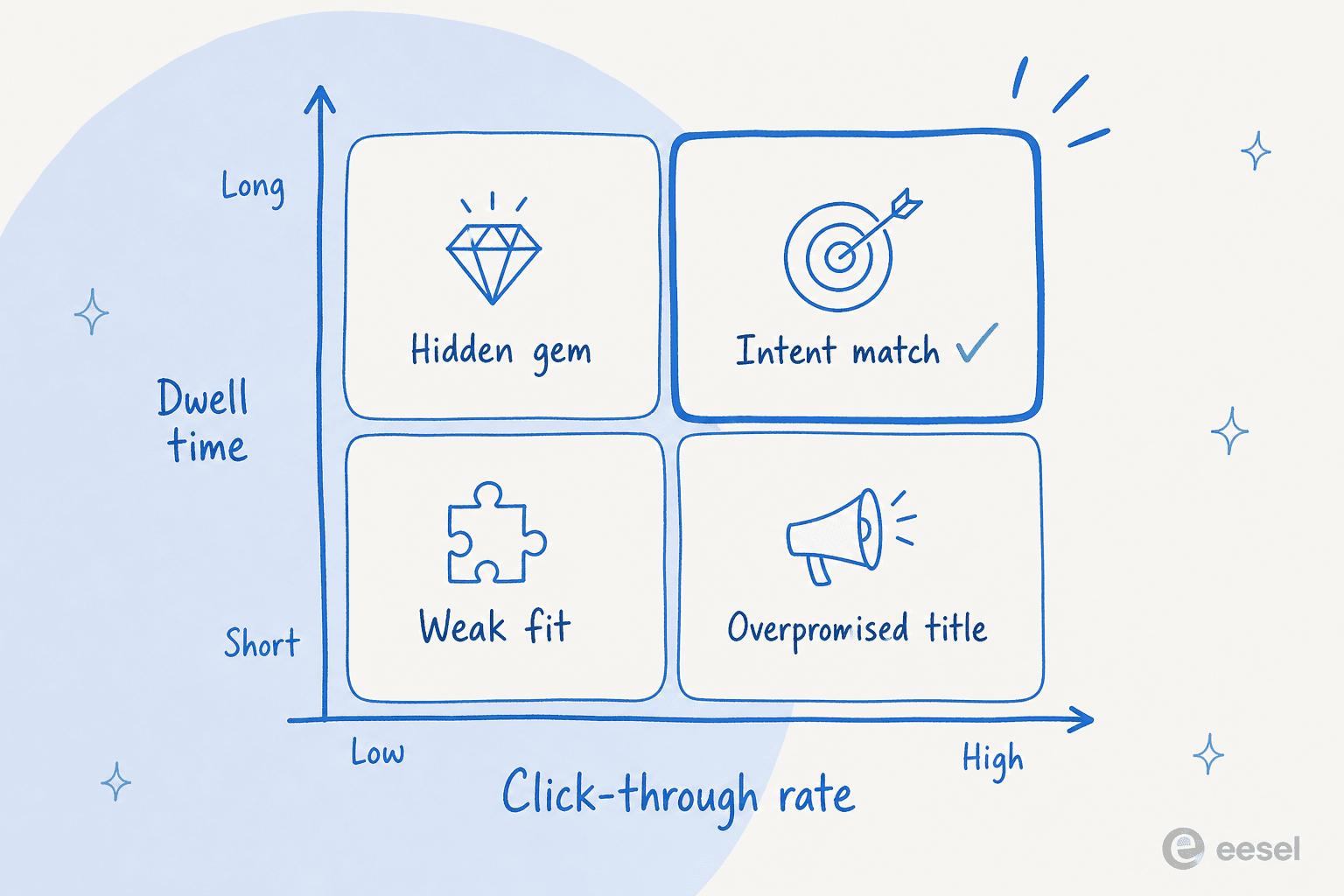
The diagonal tells the story. A page that wins clicks but loses people fast lands in the overpromised-title corner, while the page you want sits top-right, where a strong title and matching content keep visitors reading. The low-CTR, long-dwell quadrant is the hidden gem worth a better title.
How dwell time works
The mechanism is straightforward from the searcher's side:
- The search and the click. A person searches, scans the results, and clicks a listing that looks like it answers their question.
- The evaluation. They land on the page and quickly judge whether it addresses what they came for, often within the first few seconds.
- Stay or return. If the page delivers, they keep reading, scroll, and maybe click deeper. If it doesn't, they hit back and try another result.
- The signal. A fast return to the results is read as a sign the page underdelivered, while a long stay implies the opposite.
An AI blog writer like eesel AI influences this upstream: by drafting content that reads the query's intent and answers it directly, the page gives visitors a reason to stay rather than bounce. Dwell time is downstream of intent fit, so the fix is almost always in how well the content matches the query, not in surface tweaks.
Dwell time in practice
The catch is that dwell time is not a number you can open and watch in your own dashboard, so treat it as a lens rather than a KPI. When a page ranks but loses people fast, the cause is nearly always an intent mismatch or a buried answer: the visitor had to dig for the thing they searched for, and gave up first. The durable fix is to lead with the answer, structure the page so it scans, and make sure the format matches what the query actually called for.
Write posts people actually stay on
eesel AI drafts content built around the query's intent, so visitors find their answer instead of bouncing back to search.