Click-through rate (CTR)
Click-through rate is the percentage of people who click a link, ad, or search result out of the total number who saw it.
What click-through rate means
Click-through rate (CTR) is the percentage of people who click a link, ad, or search result out of the total number who saw it. It is calculated by dividing clicks by impressions and multiplying by 100, so a result shown 1,000 times and clicked 80 times has an 8% CTR. It is one of the most widely used metrics in digital marketing because it isolates a single question: of everyone given the chance to act, how many did?
CTR shows up across many surfaces (paid ads, email campaigns, internal links, and call-to-action buttons) but in SEO it most often refers to organic CTR: the share of searchers who click your result on the search engine results page. Here it captures something rankings alone miss. A page can rank well and still earn few visits if its listing fails to attract the click, and a page can rank a position lower yet pull more traffic because its title and description do a better job of promising the answer.
Why click-through rate matters
- It turns visibility into traffic. Ranking only earns an impression; CTR is what converts that impression into an actual visit, so it is the bridge between position and organic traffic.
- It is one of the few SERP levers you control. You cannot dictate your rank, but you can rewrite the title tag and meta description that decide whether searchers choose your result.
- It reveals intent mismatch. A low CTR on a high-ranking page is a signal that the listing promises something the searcher did not want, even when the ranking looks healthy.
- It compounds with rich results. Featured snippets, FAQ markup, and review stars make a listing physically larger on the page, which lifts CTR before any copy changes.
- It feeds every funnel below it. A higher CTR raises the volume entering the page, so downstream conversion and revenue scale with it even if nothing else changes.
Position is the single biggest driver of organic CTR, and the drop-off down the page is steep:
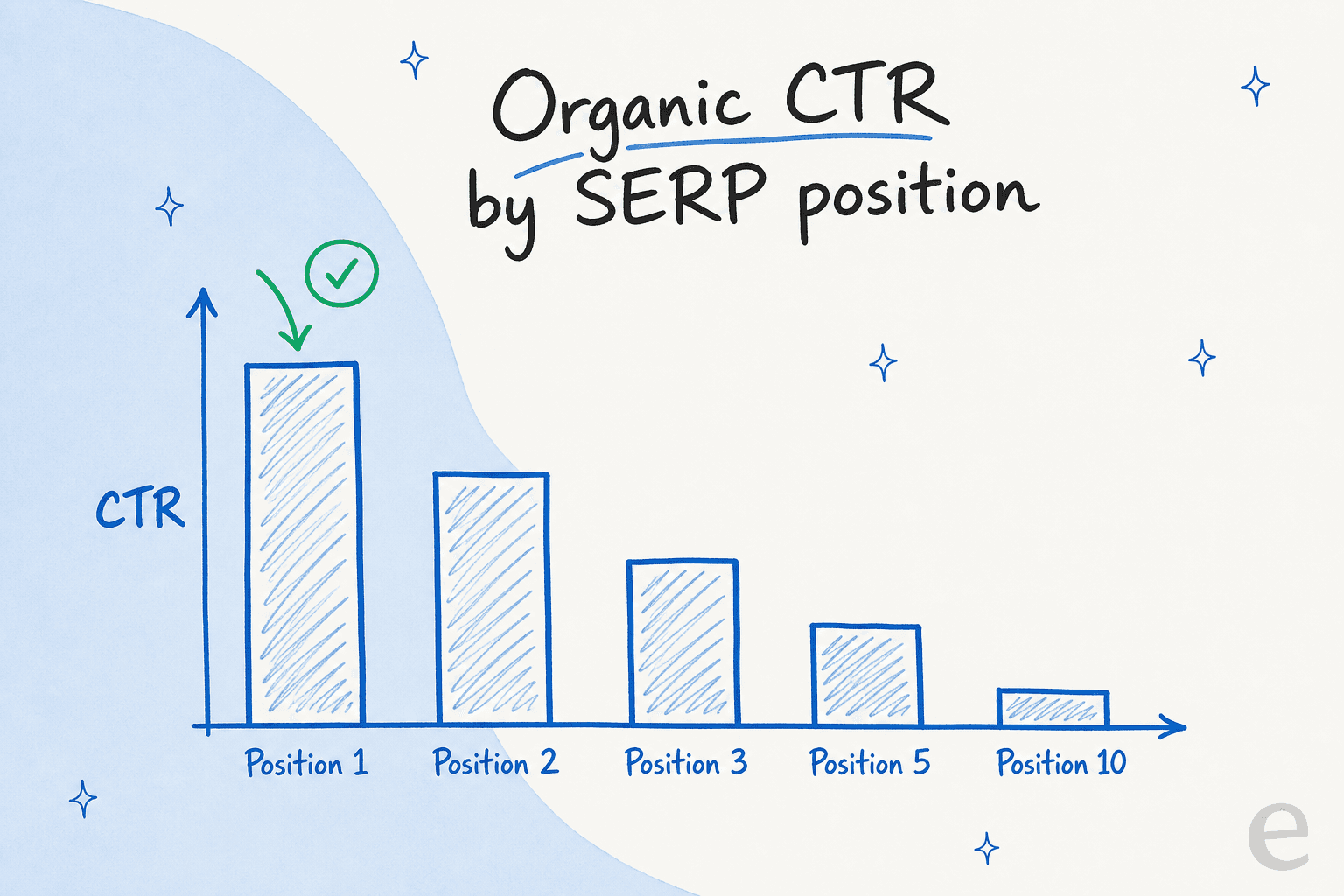
The top result takes the lion's share of clicks, and CTR falls off fast as you move down. That is why a one-position climb near the top moves far more traffic than the same climb lower on the page, and why a strong listing at any given rank is worth fighting for.
How click-through rate works
In an SEO context, improving CTR follows a measure-and-rewrite loop:
- Pull the data. Search Console reports impressions, clicks, and CTR per query and per page, showing where you rank well but get clicked little.
- Find the gap. Pages ranking in the top few positions with a below-average CTR are the highest-leverage targets, since the traffic is already in reach.
- Rewrite the listing. Sharpen the title to match the query's intent, write a description that previews the answer, and add structured data that can earn a richer result.
- Re-measure. CTR changes show up within days as the new listing accumulates impressions.
This is where content quality and the SERP listing meet. A draft from eesel's AI blog writer is built around the actual search query, so the title and meta description it proposes read as a direct answer to what the searcher typed rather than a generic headline, which is exactly the kind of listing that earns the click.
Click-through rate in practice
The most common mistake is treating CTR as a vanity number rather than a diagnostic. Read on its own, it tempts teams toward clickbait titles that win the click and lose the trust, which shows up later as a bounce. Read alongside ranking position and on-page behavior, it tells you something useful: a page ranking third with a weak CTR is leaving traffic on the table, while a page with a high CTR but quick exits has a content problem the listing cannot fix. The operators who use CTR well pair it with what happens after the click, and optimize the listing and the page together rather than gaming one in isolation.
Titles that earn the click
eesel's AI blog writer drafts titles and meta descriptions built to win the click on the SERP, not just the ranking.