Support quality assurance
The process of reviewing support interactions against a defined standard to measure and improve the quality of the service customers receive.
What support quality assurance means
Support quality assurance (QA) is the process of reviewing customer interactions against a defined standard to measure, and then improve, the quality of the service customers receive. Reviewers score a sample of tickets, chats, or calls on a rubric covering accuracy, adherence to process, tone, and whether the issue was actually resolved, and the findings feed coaching, training, and process fixes. The discipline borrows its name from manufacturing QA but applies it to conversations rather than products.
In customer support, QA is the difference between assuming the team is doing good work and knowing it. A satisfaction score tells you how the customer felt; QA tells you whether the answer was correct, the policy was followed, and the resolution would hold up to scrutiny, which are separate questions that a happy customer can still get wrong.
Why support quality assurance matters
QA earns its place because it catches the problems that outcome metrics alone miss:
- It separates correct from merely pleasant. A friendly agent can give a confidently wrong answer, and QA is the only check designed to catch that gap.
- It keeps service consistent. A scorecard applied across the team holds every agent and every channel to the same bar, so quality does not depend on who happened to pick up the ticket.
- It turns review into coaching. QA findings point to the specific skills or knowledge gaps to fix, rather than vague feedback to "do better."
- It links to outcomes. Done well, QA scores correlate with customer satisfaction and first-contact resolution, so improving one moves the others.
- It protects against silent failure. Wrong answers that the customer never flags are invisible to CSAT but visible to QA, which is exactly where the risk hides.
The catch is how much of the queue ever gets looked at. Here is the same review program run two ways:
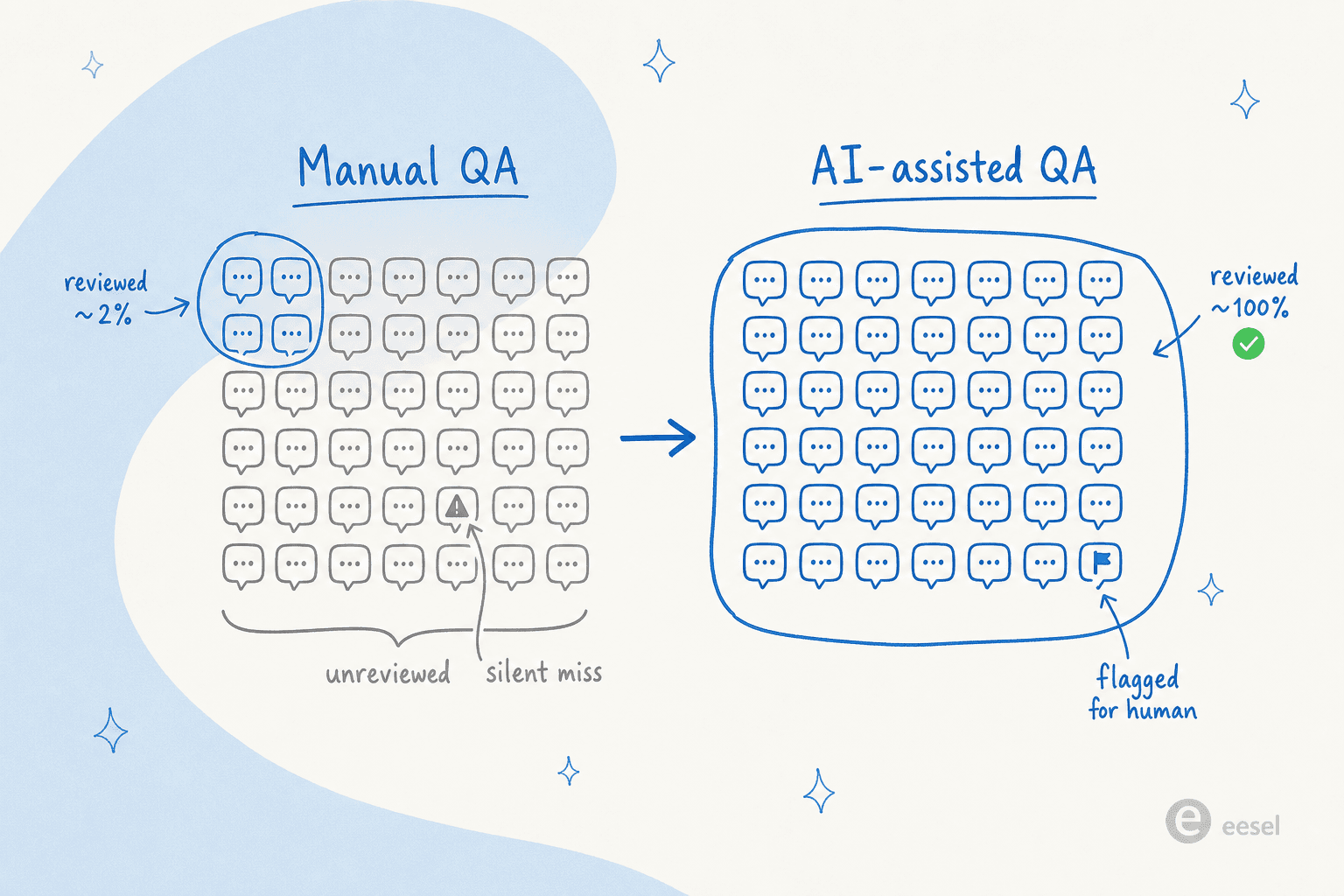
Manual review can only sample a sliver of conversations, so a wrong answer the customer never complained about often sits in the unreviewed majority. Letting AI take the first pass widens coverage toward the full queue and surfaces the risky cases for a human to confirm.
How support quality assurance works
A QA program tends to run through a repeatable loop:
- Define the standard. Build a scorecard that names what a good interaction looks like for your team.
- Sample. Select interactions to review, ideally a representative slice across agents, channels, and topics.
- Score. A reviewer rates each interaction against the rubric and notes what went right and wrong.
- Coach. Findings go back to agents as specific, actionable feedback.
- Improve the system. Recurring misses point to fixes in the knowledge base, macros, or process, not just individual coaching.
For AI agents, QA shifts earlier in the timeline. An AI support agent like eesel AI grounds every answer in your help center and past tickets so it replies with your facts, and it simulates against historical tickets before go-live, which is QA run on thousands of cases before a single customer sees a reply. The same instinct, checking quality before it reaches the customer, just applied at a scale manual review cannot match.
Support quality assurance in practice
The trap most QA programs fall into is reviewing too few conversations to be representative. Sampling two percent of tickets and extrapolating gives a comforting number and a misleading one. The teams that get QA right widen the sample, often with AI doing the first pass so humans focus on the flagged cases, and they treat a wrong answer the customer never complained about as the most important thing to catch, because it is the failure that quietly erodes trust while every dashboard still looks green.
Want the full playbook? See our guide to support QA with AI.
Hold every answer to the same standard
eesel AI grounds replies in your own knowledge and simulates against past tickets before go-live, so quality is checked before customers see it.