Proactive support
Proactive support is the practice of reaching out to customers about an issue or need before they have to contact you about it.
What proactive support means
Proactive support is the practice of anticipating a customer's question or problem and reaching out to address it before the customer has to contact you. Instead of waiting for an inbound ticket, the company identifies a likely issue, a shipping delay, a service outage, a confusing step in onboarding, and gets ahead of it with information or a fix.
The opposite is reactive support, where help only begins once the customer raises a hand. Proactive support flips that order: the signal that something needs attention comes from the business watching its own data, not from a frustrated message.
In customer support, this shows up as the status page that updates during an incident, the email that tells a customer their order is delayed before they ask, and the in-product nudge that appears exactly where users tend to get stuck. The goal is to resolve the need before it becomes a ticket.
Why proactive support matters
Reactive-only support means every issue costs you a contact, and the customer feels the friction before you ever help. Proactive support changes that math because it can:
- Cut whole categories of tickets by answering predictable questions, like delivery status or known bugs, before customers open a conversation.
- Reduce frustration, since the customer learns about a problem from you rather than discovering it themselves and feeling ignored.
- Smooth demand on the queue, by heading off the spike of identical tickets a single outage or shipping issue would otherwise create.
- Build trust, because a company that warns you about its own problems reads as honest rather than evasive.
- Surface needs you would never see, since many customers who hit friction never write in, they just leave quietly.
The practical result is fewer inbound contacts and a customer base that feels looked after rather than left to fend for itself.
Few teams jump straight to proactive, though. It tends to be a climb through stages:
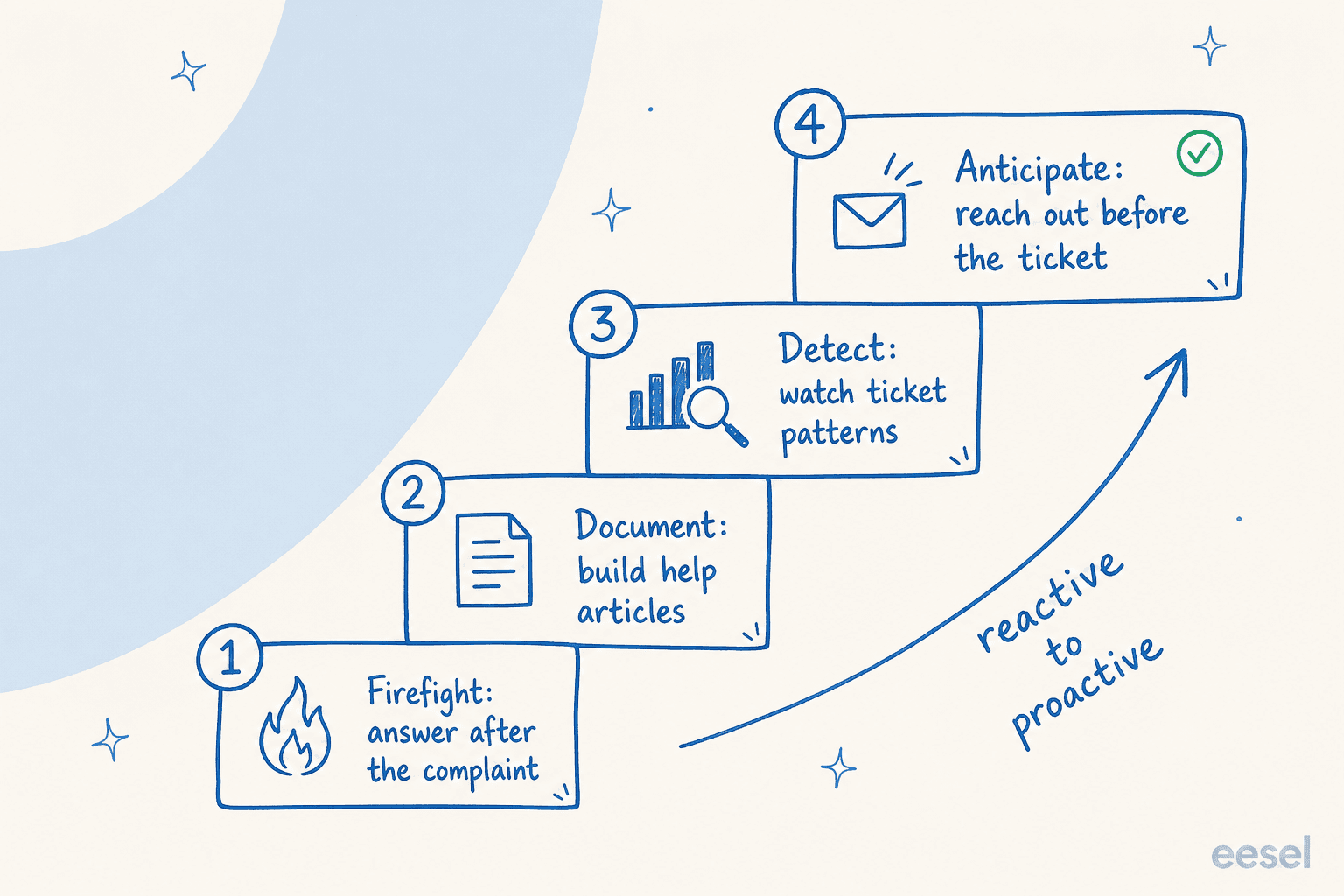
Most teams start by firefighting every complaint, then document the common ones, then learn to spot patterns in their ticket data. Only the top rung reaches out before the ticket lands, and eesel AI helps a team move up by surfacing the recurring questions early.
How proactive support works
Most proactive support follows the same loop:
- Detect a signal. A spike in similar tickets, a failed payment batch, a delayed shipment, or a known incident flags a likely problem.
- Identify who is affected. The team scopes which customers will hit the issue, the ones with that order, on that plan, in that region.
- Reach out with the right message. A status update, an apology with a fix, or a link to the relevant article goes out before the customer asks.
- Deflect the follow-up. Good outreach answers the next question too, so the customer does not need to reply.
A support agent like eesel AI feeds this loop from two directions. It reads patterns across incoming tickets so recurring problems become visible early, and it grounds its replies in your help center and past tickets so the moment a customer does ask, the answer is already accurate. Used alongside self-service and a strong knowledge base, it turns the questions you can predict into answers customers find before they ever reach an agent.
Proactive support in practice
The hard part of proactive support is not sending messages, it is knowing which signals are worth acting on. Reach out too often and the outreach becomes noise customers tune out; reach out too late and you have already lost the trust you were trying to protect. The teams that do this well treat their ticket volume data as an early-warning system, watch for the same question arriving three times in an hour, and fix the root cause once rather than answering it a hundred times.
We go deeper on this in proactive customer engagement.
Catch issues before the ticket lands
eesel AI spots patterns in your tickets and knowledge so common problems get answered before they pile up in the queue.