Core Web Vitals
Core Web Vitals are a set of standardized metrics from Google that measure a web page's loading speed, interactivity, and visual stability as experienced by real users.
What Core Web Vitals means
Core Web Vitals are a set of standardized metrics, defined by Google, that measure how a web page performs for real users along three dimensions: loading speed, interactivity, and visual stability. They are designed to capture the parts of page experience a visitor actually feels, rather than abstract server timings that say little about what loading a page is like.
There are three metrics. Largest Contentful Paint (LCP) measures how long the main content takes to appear. Interaction to Next Paint (INP) measures how quickly the page responds to a tap or click. Cumulative Layout Shift (CLS) measures how much the page jumps around as it loads. Each has a "good" threshold, and Google reports them from field data collected from real Chrome users. In content marketing and SEO, Core Web Vitals are the performance layer beneath the words on the page: they decide whether a fast, stable reading experience reinforces your content or quietly works against it.
Why Core Web Vitals matter
- They are a real, if minor, ranking signal. Google uses them as part of its page-experience inputs, acting as a tiebreaker between pages of comparable relevance.
- They measure perceived speed, not raw speed. LCP, INP, and CLS track what a human notices (when content shows up, whether taps respond, whether things shift) rather than back-end metrics that do not match the felt experience.
- They use field data, not lab guesses. The scores that affect search come from real users in the wild, so a page that looks fine in a test can still fail on slower devices and networks.
- Poor scores cost conversions directly. A slow or shifting page drives visitors away before they read or convert, an effect that often matters more than the ranking nudge.
- They scale across templates. Because most pages share a template, one layout or asset fix can lift the scores of an entire section of a site at once.
It helps to picture the three metrics as separate gauges, each with its own good band:
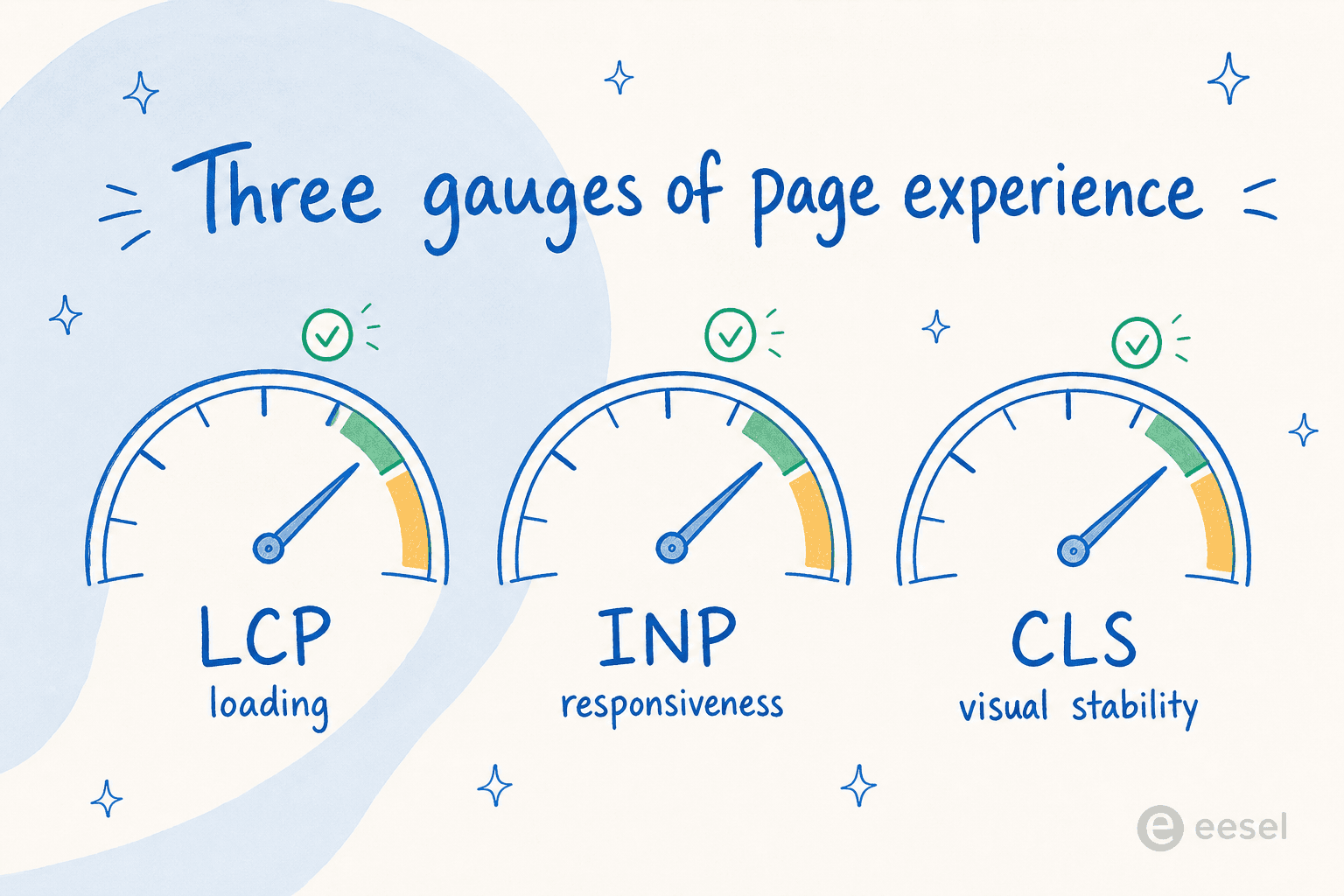
LCP tracks how fast the main content loads, INP how quickly the page responds to a tap, and CLS how much the layout shifts as it settles. A page passes only when all three needles sit in the green zone, so one slow metric can drag the whole page-experience grade down.
How Core Web Vitals works
Improving Core Web Vitals runs as a measure-diagnose-fix cycle:
- Read the field data. Search Console and the Chrome User Experience Report show how real visitors experience each group of pages, flagging which metric is failing.
- Diagnose in the lab. Tools like Lighthouse break a single page down into the specific causes: a heavy hero image hurting LCP, a blocking script delaying INP, an unsized embed causing CLS.
- Fix the cause. Common fixes include compressing images, deferring scripts, reserving space for media, and trimming unused code.
- Re-measure. Field data updates over a rolling window, so a fix takes days to weeks to show up in the reported scores.
The honest tie to content here is indirect. Core Web Vitals are largely a front-end and engineering concern, so a writing tool does not move them on its own. What a clean draft can do is avoid making them worse: a post from eesel's AI blog writer ships as lightweight, well-structured markup rather than a tangle of heavy embeds, so the content does not add weight that the page then has to fight.
Core Web Vitals in practice
The trap teams fall into is chasing a perfect lab score while ignoring the field data that actually feeds search. A page can score well in a desktop test and still fail for the mobile users on slower connections who make up most real traffic. Teams that treat Core Web Vitals seriously watch the rolling field scores per template, fix the worst-offending metric first, and accept that the payoff is a better reading experience more than a ranking jump. It is infrastructure hygiene, not a growth lever, and it is most valuable as the thing that stops great content from being undermined by a slow page.
Fast pages start with clean content
eesel's AI blog writer drafts lightweight, well-structured posts so the pages your team ships do not fight your Core Web Vitals scores.