Contact center
A contact center is a centralized team and system that manages customer interactions across multiple channels such as phone, email, chat, and social.
What a contact center means
A contact center is a centralized team and the supporting technology that manages customer interactions across multiple channels, including phone, email, live chat, social media, and messaging. It evolved from the traditional call center, which handled voice only, into a hub that coordinates every way a customer might reach out. The defining feature is breadth: a contact center is built to handle interactions at scale and across channels, rather than serving a single line of communication.
In customer support, a contact center is the operation behind high-volume, multi-channel service. It combines the people who handle interactions, the routing and queuing infrastructure that distributes them, and the reporting that tracks performance. For larger organizations, the contact center is where support strategy meets day-to-day execution, and where consistency across channels either holds together or falls apart.
What makes a contact center different
A contact center is distinguished by scale and channel breadth, not just by having support staff:
- Multi-channel by design. It unifies phone, email, chat, and social so a customer's history follows them across channels, the core of omnichannel support.
- Voice infrastructure. Many contact centers run telephony, call queuing, and an IVR menu, which a chat-only support team does not need.
- Workforce management. Forecasting, scheduling, and staffing to demand are central, because under-staffing a queue at peak is immediately visible to customers.
- Performance metrics. It runs on operational numbers like average handle time and service level, measured continuously.
- Scale and routing. Sophisticated routing distributes interactions across large teams so the right person handles the right contact.
These traits are why "contact center" usually implies a bigger, more formal operation than a small support team.
The shift from its call-center ancestor is easiest to see laid out side by side.
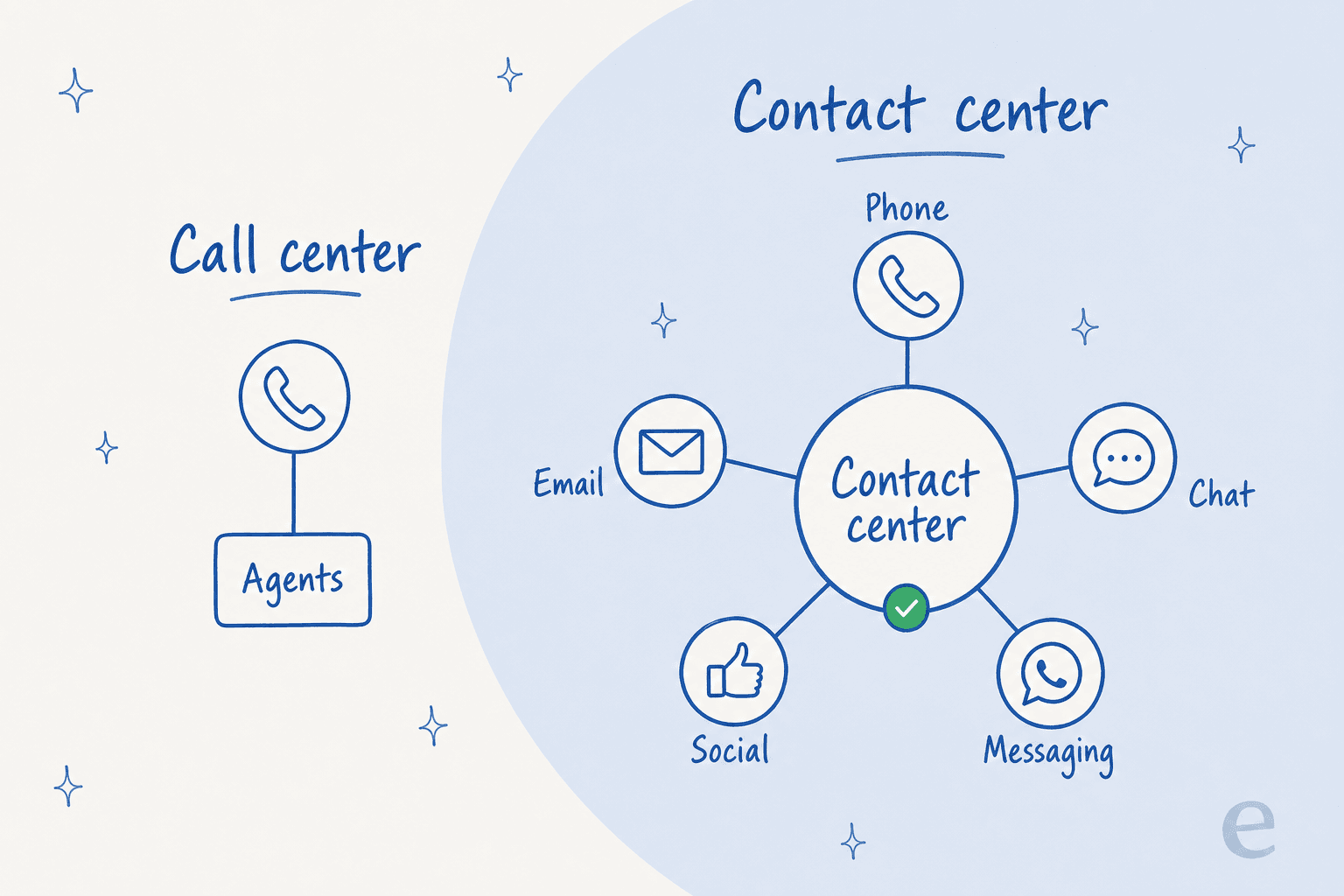
A call center is a single phone line into a team, while a contact center is a hub that pulls phone, email, chat, social, and messaging into one place. That convergence is the whole point: every channel feeds the same operation instead of running as its own island.
How a contact center works
A contact center coordinates interactions through a consistent pattern:
- Receive. A customer reaches out on any channel, and the interaction enters a unified system.
- Route. It is queued and directed to an available agent with the right skills, or to an automated responder.
- Handle. The agent resolves the interaction, pulling up the customer's history across channels.
- Resolve or escalate. The contact is closed, or moved to a specialist or supervisor when needed.
- Measure. Every interaction feeds reporting on volume, handle time, and satisfaction.
An AI layer like eesel AI fits into the digital side of this operation: it resolves common interactions automatically from your own knowledge, assists human agents with drafts and summaries, and routes anything it should not handle to a person with context attached.
A contact center in practice
The recurring challenge in a contact center is consistency across channels. A customer who gets one answer on chat and a different one on the phone loses trust fast, and at contact-center scale that inconsistency multiplies across thousands of interactions a day. The operations that run well anchor every channel to the same source of truth for answers, watch their queues in real time, and roll out automation gradually against proven ticket history, so adding channels and volume does not quietly fragment the customer experience.
Add AI to your contact center
eesel AI resolves common interactions across your contact center channels and routes the rest to agents with context.