

Most AI-generated content sounds robotic. It’s generic, a bit bland, and usually misses the unique spark that makes your brand your brand. That’s a real problem. A consistent brand voice isn’t just a fluffy marketing goal; it can actually boost revenue by building trust and connecting with your audience.
So, how do you get an AI to sound less like a machine and more like a person on your team?
You have a few paths you can take. You can get into the weeds with detailed prompts, create reusable style guides, or even go deep into the technical world of fine-tuning. We’ll cover all three. Or, you could use a tool that learns your voice automatically, like the eesel AI blog writer. Let's get into it.
What does a writing style mean to an AI?
Before you can teach an AI to write like you, you need to be clear on what "style" even is. It's not just about picking "formal" or "casual." It's the combination of things that makes your content feel like it came from you.
For an AI to get it right, it needs to grasp four key pieces:
- Voice: Think of this as your brand's personality. Is it witty and a little cheeky? Or is it more straightforward and educational? This personality should stay pretty consistent across all your content.
- Tone: This is your attitude about a specific topic. Your voice might always be helpful, but your tone could be urgent for a product update and more relaxed for a how-to guide.
- Style: This is the nitty-gritty of your writing. It’s about the words you choose, how you build your sentences, and whether you lean on things like analogies or humor.
- Structure: This is all about how you organize your thoughts. Do you like to open with a personal story? Do you use a lot of headings and lists? The way you lay out your content is a big part of your signature style.
Method 1: Using prompt engineering
The most direct way to shape an AI's writing is through prompt engineering. It sounds technical, but it just means giving the AI specific instructions and examples in your prompt.
A step-by-step guide to style prompting
Getting good results this way involves some back-and-forth, but here’s a reliable process to get you started, based on a framework from the GetPrompted.ai prompt blueprint.
- Grab your best writing samples. Find 3-5 articles that you feel really nail the voice you want.
- Break down your style. Read your samples and make notes on what you see. Are your sentences short? Do you stay away from jargon? Is your tone assertive or more questioning? The more specific you are, the better.
- Write a detailed prompt. Start by assigning the AI a role, like "Act as an expert content marketer." Then, give it your style notes and instructions. Finally, paste in one of your writing samples as a clear example. This is sometimes called "few-shot" prompting, and it gives the AI a solid template to work from.
- Give feedback and refine. The first draft likely won't be perfect. Tell the AI what worked and what didn't ("This is good, but be more concise," or "Simplify the language here"). You'll have to tweak your prompt as you go.
Challenges of manual prompting
While prompt engineering gives you a lot of control, it has some challenges.
- Consistency can be a challenge. An AI might "forget" instructions during a long conversation, causing the tone to drift from the beginning of a piece to the end.
- There are memory limits. AI models have what's called a "context window," which is like a short-term memory. Big models like ChatGPT don't actually read every single word of a long document you give them. They use a method called Retrieval-Augmented Generation (RAG) to pick out what seems most important. This means the AI can easily miss key style details if your examples are too long.
- The process can be repetitive. Writing detailed instructions for each new piece of content can be time-consuming, especially for teams that need to create content regularly.
Method 2: Creating a reusable style blueprint
If you're tired of typing out the same detailed prompt every time, a "style blueprint" can save you some hassle. This idea, inspired by concepts from Harvard Business Publishing Education, is all about creating one perfect, reusable paragraph that defines your style. You can then just drop it into any prompt you write.
How to generate your personal style blueprint
You can get an AI to help you build your blueprint by asking it to "reverse engineer" your own writing.
Take some of your premium texts, compile them into a document, and add it to your private GPTS. Then, insert this prompt: 'Respond in a style that emulates the provided text from the retrieved documents.' For enhanced results, activate Poe's custom robot, utilize models like Claude2 or GPT-4, and insert the document for exceptionally effective outcomes.

- Gather some of your best work. Same as before, find a few pieces that you feel represent you well.
- Ask an AI to analyze it. Prompt the AI to act like a writing expert and break down your text. Tell it to look at things like conciseness, word choice, sentence length, and assertiveness.
- Turn the analysis into a command. After the AI gives you its breakdown, ask it to summarize everything into a single paragraph of instructions. That paragraph is your blueprint. It might end up looking something like this: "Write with a confident tone. Use clear, concise language and short sentences. Break complex ideas into simple steps. Avoid jargon and keep the voice professional but approachable."
Limitations of the blueprint approach
A style blueprint is a good step up from one-off prompts, but it has certain limitations.
- It requires manual application. While reusable, the blueprint must be manually added to each new prompt or saved in a tool's "custom instructions," which is an extra step in the workflow.
- It lacks business context. A blueprint is effective at replicating surface-level writing characteristics. However, it doesn't know what your company does, what your products are, or what your unique take on the industry is. It functions as a style filter rather than a knowledge base.
Method 3: Advanced customization with fine-tuning
If you want the most control, there’s fine-tuning. This is the most powerful option, but it's also the most complicated and expensive. Fine-tuning means you're actually retraining a base AI model using a custom dataset of your own writing, a process you can read about in OpenAI's official documentation.
A look at the fine-tuning process
Fine-tuning is a significant undertaking that takes a lot of time and technical skill.
- Preparing the data: This is the biggest part of the job. You need to build a dataset with hundreds or thousands of high-quality examples formatted as "prompt-completion" pairs. That usually means writing out a "generic text" (the prompt) and then rewriting it into "your on-brand version" (the completion), over and over. It's a ton of work.
- Training the model: Once your dataset is built, you upload it to a platform like OpenAI to train a custom version of their model. This isn't a quick process. The AI has to review your data multiple times (in what are called epochs) to learn your style, and each pass adds to the cost.
- The cost and technical hurdles: Fine-tuning costs real money. You pay for the training itself, and then you pay a higher rate every time you use your custom model. Based on OpenAI's pricing, a fine-tuned model costs quite a bit more than a standard one. You also need someone on your team who knows how to work with APIs and format data properly.
| Model Type | Training Cost (per 1M tokens) | Input Cost (per 1M tokens) | Output Cost (per 1M tokens) |
|---|---|---|---|
| GPT-4.1 mini (Base) | N/A | $0.25 | $2.00 |
| GPT-4.1 mini (Fine-Tuned) | $5.00 | $0.80 | $3.20 |
When to consider alternatives to fine-tuning
For many marketing teams, the resources required for fine-tuning may not align with their goals. While it's a powerful tool for large-scale, specific projects, it's often more than is needed for tasks like writing blog posts.
This has led to the development of context-aware AI platforms that aim to provide the benefits of a custom model without the extensive manual setup.
The simpler way: Letting an AI learn your style automatically
Instead of spending hours writing prompts or weeks building datasets, an alternative is to use an AI that can learn your style by itself. That’s the idea behind the eesel AI blog writer. It's designed to automate the style-learning process, allowing users to focus on content creation.
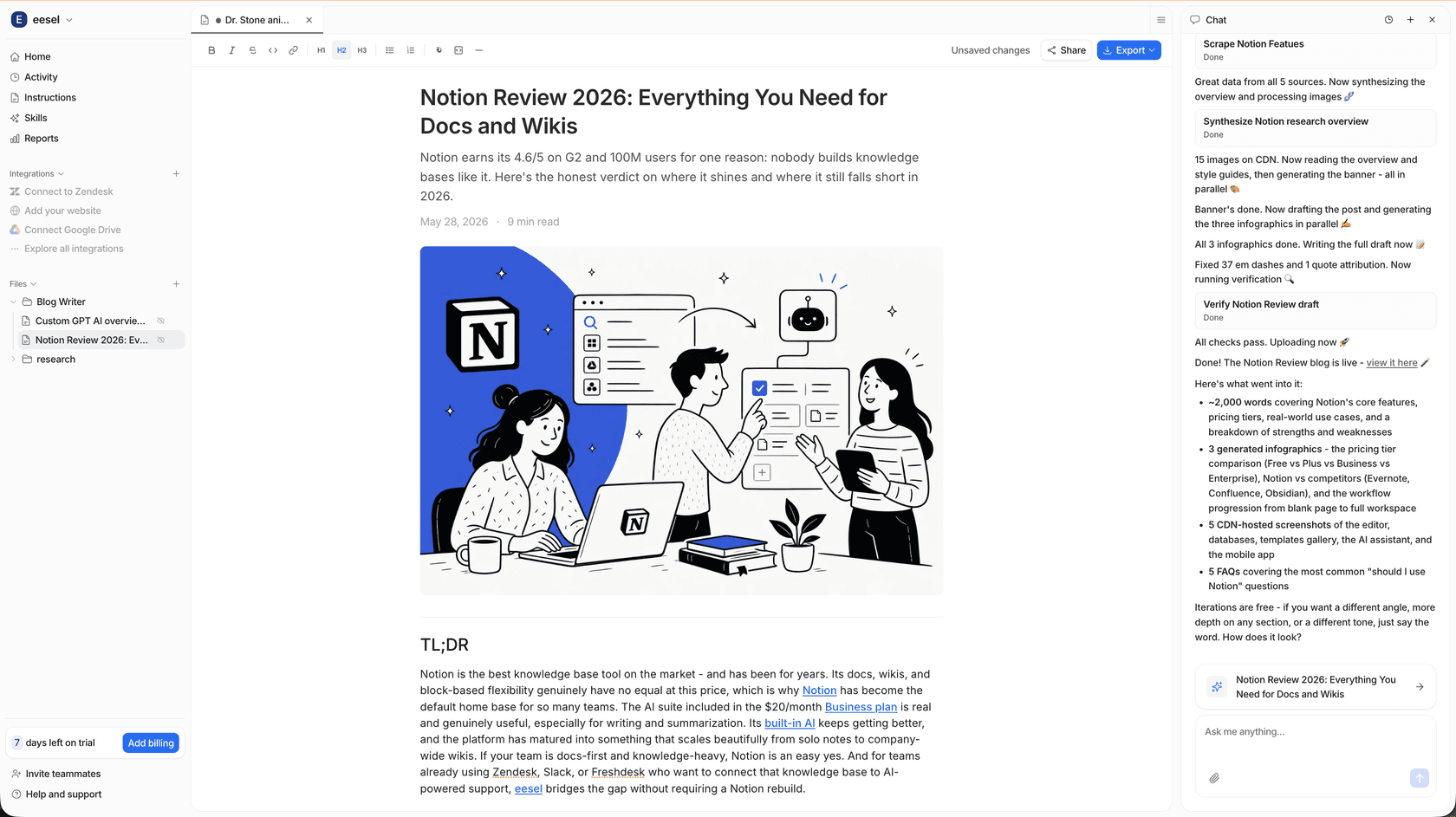
With eesel AI, you don't train the AI, it learns from you. You just give it your website URL. It then analyzes your existing content to figure out your brand voice, tone, product details, and messaging.
But it goes deeper. Tools that just scrape a homepage only get a surface-level view. eesel AI can connect directly to your actual business knowledge by integrating with help desks like Zendesk or knowledge bases like Confluence. This means it learns the substance of your brand: your features, customer pain points, and internal processes, not just the stylistic flair.
This approach addresses some of the challenges found in other methods:
- It gets the full context. You don't have to make style guides or datasets. eesel AI learns your voice from your website and internal documents, so it understands your products and can mention them naturally in the content.
- It sounds human. The model has been refined for over a year to produce less generic AI content and create writing that resonates with readers.
- You get a complete post, not just text. It provides more than just text. It generates a fully structured blog post with assets like infographics and tables, and even finds relevant Reddit quotes to add some real-world perspective.
Choosing the right method for your needs
Getting an AI to match a specific writing style is a process with several possible paths. Manual prompting offers a high degree of control but can sometimes yield inconsistent results.
Style blueprints improve efficiency but may not capture the full depth of brand knowledge. Fine-tuning offers deep customization but requires significant technical and financial resources.Thank you for the detailed response. I actually tried most of these things with little improvement so I think training a model seems like a good call. I have to prepare a lot of data in required format that I am dreading lol
For a visual walkthrough of some of these prompting techniques, the following video offers a great step-by-step guide to training ChatGPT on your own writing samples.
The real goal isn't just to copy a style; it's to create on-brand content that helps your business grow. That's what we focused on at eesel AI. Using our own tool, we took our blog from 700 to 750,000 impressions in only three months.
If you want to spend your time on strategy instead of training an AI, give the eesel AI blog writer a try. It's the fastest way to scale up your content without losing your brand's voice. And it’s completely free to get started.