AI blog writer vs staff writer: Which is right for your content strategy?

Katelin Teen
Katelin Teen
Last edited February 1, 2026
The demand for high-quality content feels endless, doesn't it? Your audience has questions, Google wants fresh articles, and your marketing goals depend on a steady stream of both. This pressure forces a big question for marketing teams: do you stick with a traditional staff writer, or do you embrace a modern AI blog writer?
The truth is, it’s not a simple either/or choice. The smartest content strategy in 2026 is a lot more nuanced and, honestly, much more effective.
What is an AI blog writer?
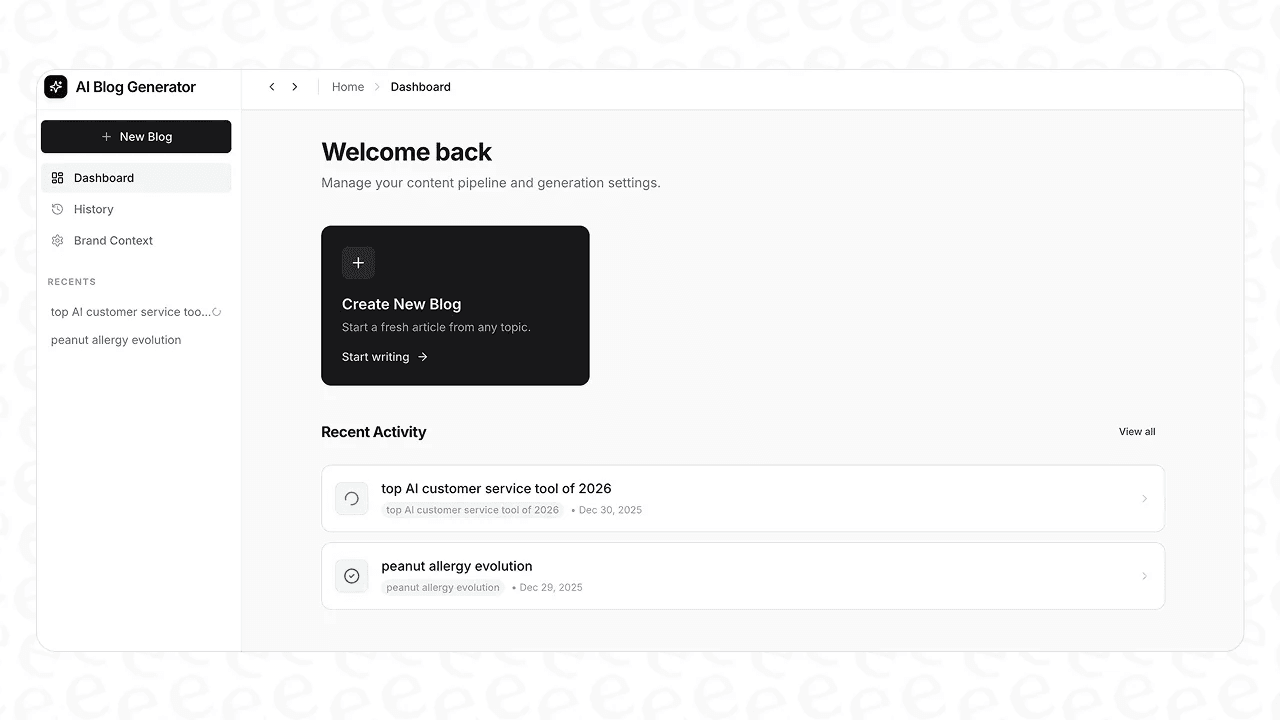
But these tools have come a long way from the clunky text generators of the past. Today's AI blog writers are platforms that can do research, create a logical article structure, write in a specific tone, and even generate posts with images and tables. They’re designed to take a simple brief and turn it into a nearly-finished draft that’s already optimized for search engines.
And in case you're wondering, Google is fine with AI-generated content. According to their own guidelines, what matters is that the content is helpful and high-quality, not how it was created. They’ve made it clear they’ll reward great content, regardless of its origin, as long as it's not being used just to manipulate search rankings.
What is a staff writer?
A staff writer is exactly what it sounds like: an in-house employee responsible for creating written content. This can be anything from blog posts and white papers to website copy and email newsletters.
Their real value goes far beyond just stringing words together. A great staff writer is the keeper of your brand's voice. They have deep company knowledge, can share original insights, and help shape the overall content strategy. They’re the ones conducting interviews with experts, weaving in personal anecdotes, and making sure every piece of content aligns with your goals.
Most importantly, they provide the firsthand experience and unique perspective that Google is looking for. They represent the "E" in Google's famous E-E-A-T guidelines (Experience, Expertise, Authoritativeness, and Trustworthiness), and that human touch is incredibly hard to fake.
AI blog writer vs. staff writer: A data-driven comparison
Instead of just going with a gut feeling, let's look at the numbers. A study that analyzed over 1,000 articles compared pure AI content, pure human content, and a hybrid approach across the metrics that actually matter. The results point to a clear winner, but it might not be what you think.
| Metric | AI Writers | Human Writers | Hybrid Approach |
|---|---|---|---|
| Average Cost per 1000 words | $0.48 | $60 | $12 |
| Average Time to Complete | 3 minutes | 4 hours | 45 minutes |
| SEO Optimization Score | 87/100 | 71/100 | 92/100 |
| Avg. Time on Page | 1:42 | 2:31 | 2:48 |
| Conversion Rate | 2.1% | 3.4% | 4.7% |
| Organic Traffic (6 months) | 412 visits/article | 487 visits/article | 683 visits/article |
Speed and scalability
When it comes to raw speed, AI has a clear advantage. An AI can produce a first draft in a few minutes, allowing a single person to scale up content production in a way that was previously unimaginable. This is a huge advantage for covering large topic clusters or quickly reacting to new trends.
A staff writer, on the other hand, is limited by human bandwidth. A well-researched article takes a person about four hours to complete, and that doesn't count time spent on brainstorming, research, and editing. If you want to scale up, your only option is to hire more writers.
Verdict: AI offers unmatched speed and scale. Our own success story of publishing over 1,000 blogs to achieve massive impression growth was only possible because of AI.
Quality and E-E-A-T
This is where human writers have always shined. They are the gold standard for authenticity and bringing the "Experience" factor to the table. They can share personal stories, conduct original research, and offer unique perspectives that build real trust with an audience. The data backs this up, showing that purely human content keeps readers engaged longer, with a higher average time on page (2:31 vs. 1:42 for AI).
AI has gotten much better, but it can still create generic content that lacks a genuine voice or, even worse, contains factual errors (often called "hallucinations"). Since Google's main focus is on helpful, people-first content, that human touch is still vital.
Verdict: Staff writers still have the edge in delivering deep, authentic content that resonates with readers. But look at the data again: the hybrid approach achieves the highest time on page, blending AI's efficiency with the depth that only a human can provide.
Cost considerations
A full-time staff writer is a big investment. You're not just paying a salary; you're also covering benefits, equipment, and other overhead costs.
AI, on the other hand, completely changes the economics of content creation. It’s a dramatically lower operational expense. For example, the eesel AI blog writer gives you 50 complete blog posts for just $99. This allows you to reallocate your budget from pure production to other critical areas like strategy, promotion, and link-building. The market is already shifting, with some content mills now paying freelancers as little as $10 for a 1,000-word article if it's AI-assisted.
Verdict: AI offers an incredible cost advantage, making it possible for teams of any size to produce content at a scale that was once reserved for massive corporations.
SEO performance
AI excels at technical SEO. The data shows it: AI-generated content achieves a higher SEO optimization score (87/100) than purely human content. This is because it can consistently place keywords, ensure a perfect heading structure, and format content in a way that search engine crawlers love. It's also fantastic for Answer Engine Optimization (AEO), which involves creating concise, direct answers designed to be featured in AI Overviews.
A staff writer is often better at understanding the subtle nuances of search intent. They can read between the lines of a keyword to figure out what a user is really looking for, leading to content that is more satisfying and ultimately converts better.
Verdict: The hybrid approach achieves the highest SEO score (92/100), combining AI's technical precision with a human's understanding of user intent.
The winning strategy: A hybrid approach
The data couldn't be clearer: the most effective content teams don't choose one or the other. They use a hybrid model that leverages the unique strengths of both AI and human writers. This approach combines the incredible speed, scale, and technical precision of AI with the strategic oversight, creativity, and firsthand experience of a human.
AI gets you 80% there, but that last 20%, the voice, nuance, personality and still needs a human touch. AI is a time-saver, but final check to inject our tone and perspective is very important.

So, what does this actually look like in practice?
This completely transforms the writer's role. Instead of spending hours on the tedious parts of content creation, they become strategic editors. Their impact is multiplied, allowing them to produce more high-quality content than ever before. The result? The best performance across every single metric, from organic traffic to conversion rates.
How the eesel AI blog writer supports this workflow
Here’s how it works:
- It delivers a publish-ready draft: eesel doesn't just give you a wall of text. It creates a complete post with a logical structure, AI-generated images, tables, and infographics.
- It adds real-world context: To make content feel more authentic, eesel automatically embeds relevant YouTube videos and pulls real quotes from Reddit threads. This adds a layer of social proof and human experience that most AI tools miss.
- It's brand-aware: Just give the eesel AI blog writer your company's URL, and it will learn your brand's voice and products. It then naturally weaves in product mentions where they make sense, turning every blog post into a valuable marketing asset.
- It's optimized for the future: All content is structured for AEO, aiming to become the source for answers in new AI-powered search engines. This is important, as Gartner predicts these new search experiences will significantly reduce traffic to traditional web pages.
To see just how powerful a dedicated AI agent can be in generating content, the video below demonstrates how a simple headline can be transformed into a complete, structured blog post, ready for a human writer to refine.
Let AI build the engine and humans steer
The debate shouldn't be AI blog writer vs staff writer. The real question is how to combine them to get results that neither could achieve alone. Think of it this way: AI is the engine, and your human writers are the expert drivers.
AI tools handle the scale, speed, and technical groundwork needed to compete in the crowded world of modern SEO. They build the foundation for you.
But it's your human writers who provide the strategy, the storytelling, and the firsthand experience that builds a loyal audience and satisfies Google's strict E-E-A-T principles. They take that foundation and turn it into something truly special.
By adopting a hybrid model, you get the best of both worlds. You get a content engine that is both incredibly efficient and deeply authentic. You get more traffic, higher engagement, and better conversion rates. You get a content strategy that actually delivers.
Ready to build your hybrid content engine? Try the eesel AI blog writer for free and see for yourself. You can generate your first publish-ready article in just a few minutes.

Frequently Asked Questions
Share this article

Article by
Katelin Teen
Katelin is an operations specialist at eesel where she uses her psychology training and education experience to optimize B2B SaaS processes. Outside of work, she unwinds with story-driven games, writing, and keeping up with latest tech innovations.
