A practical guide to original blog writing

Katelin Teen
Katelin Teen
Last edited January 20, 2026
Ever feel like you're scrolling through an endless feed of blog posts that all sound the same? You’re not imagining it. We're all drowning in a sea of look-alike content, and the pressure to publish something to stay relevant is real. But in today's crowded digital space, "just another blog post" isn't going to move the needle. The real challenge is creating content that's not just new, but genuinely original.
This guide is here to break down what "original blog writing" actually means in a world full of AI tools. It’s about more than just passing a plagiarism check; it’s about crafting content that gives people real value, stands out, and makes them want to come back for more.
What is original blog writing, really?
Let's get one thing straight: original blog writing isn't just about making sure your sentences are different from someone else's. That's the bare minimum. True originality is about providing unique value that your readers can't get anywhere else. It’s about bringing something new to the conversation.
So what does unoriginal content look like? You’ve seen it. It’s the blog post that just rephrases the top five articles on Google for a keyword. It's the shallow, AI-generated text that, as one Redditor perfectly put it, says "a lot but so little." It’s the endless list of obvious facts ("to succeed, you need a good strategy") without any fresh insights or advice you can actually use. This kind of content doesn't help anyone, and it certainly doesn't help you rank.
Original content, on the other hand, does one or more of these things:
- Offers a unique perspective: It takes a stand, challenges a common assumption, or connects dots that others haven't.
- Shares personal experiences or case studies: It grounds abstract ideas in real-world stories that build trust and credibility.
- Presents new data or research: This could be from a survey you ran, an internal analysis, or even just a fresh synthesis of existing studies.
- Develops a distinct brand voice: It sounds like a real person with a personality, not a robot stringing sentences together.
An infographic detailing the four key components of successful original blog writing: unique perspective, personal stories, new data, and a distinct brand voice.
Why does this matter so much? Because Google's entire goal is to satisfy searchers with content that shows expertise, authority, and trustworthiness. Original, in-depth content does exactly that. It’s what builds a loyal audience that seeks you out, not just because you popped up on the first page of search results. In a world where basic, AI-generated pages can see their impressions fall to zero, originality isn't just a nice-to-have, it is your best defense.
The core components of original blog writing
So, how do you actually make content that feels original? It comes down to a few key "human" elements that most basic AI tools just can't replicate on their own.
Developing a unique voice for original blog writing
Your "voice" is the personality of your writing. Are you funny and a bit irreverent? Authoritative and educational? Empathetic and supportive? Your voice should reflect your brand and how you want your audience to feel. To find it, think about who you're talking to. What do they care about? What kind of conversation would they want to have?
Once you have your voice, you can develop a perspective. This means taking a clear stance on a topic instead of just summarizing what everyone else is saying. Don't be afraid to be a little controversial (as long as you can back it up). A strong perspective is what makes your content memorable. This is where human writers have a huge advantage. AI often lacks a true "human touch" and the emotional intelligence needed to craft a voice that connects with people.
The role of deep research in original blog writing
There’s a big difference between surface-level research and deep research. Surface-level is quickly scanning the top three Google results and rewording their main points. It’s easy, fast, and completely unoriginal.
Deep research means digging for credible sources, citing academic studies, interviewing experts, or even gathering your own data through surveys or internal analysis. Originality doesn't always mean inventing something from scratch. Sometimes, the most valuable thing you can do is pull together complex information from various sources and present it in a new, clearer way. Backing up your claims with hard data and credible sources shows your audience you’ve done your homework and that they can trust what you're saying.
Weaving stories into your original blog writing
Facts and data are important, but stories are what make them stick. Weaving anecdotes, case studies, and personal experiences into your writing is one of the best ways to make your content original and relatable.
For example, instead of just saying, "Consistent content creation is key to SEO growth," you could tell a story: "When we first started our blog, we were publishing here and there and saw almost no traffic. But once we committed to a schedule of three deeply researched posts a week, our impressions shot up from 700 to 750,000 a day in just 90 days." See the difference? The story makes the point real and memorable. This is another area where human writers shine. AI doesn't have personal experiences, so it can't add that layer of authenticity that makes content truly connect.
When it comes to the actual prose, or the writing itself, I use essentially no AI. I don’t like how AI writes. You can push and tweak endlessly and get it... kind of close? But even after a bunch of adjustments it still isn’t there.

The challenges of scaling original blog writing
Okay, so we know what original content is and why it matters. But if it were easy, everyone would be doing it. The truth is, creating high-quality, original content on a consistent basis is really hard.
The time and resource sink of manual original blog writing
Let's be real: the manual process of creating a single, well-researched blog post takes a ton of time. It’s not just the writing. It’s the hours spent brainstorming, digging for unique data, outlining, drafting, editing, and then creating all the visuals, such as images, charts, and infographics, to go with it.
For many companies, this means either hiring expensive writers or trying to build an in-house content team. Both options are costly and can make it nearly impossible for smaller teams to keep up the kind of consistent publishing schedule that search engines like to see.
Overcoming writer’s block in original blog writing
Even for the most creative writers, the well of ideas can run dry. The pressure to constantly come up with fresh angles on topics in your niche is exhausting. This creative drain often leads to writer’s block, where you just find yourself staring at a blank screen, unable to start.
When you're under pressure to hit a deadline, this fatigue can lead you to take shortcuts, fall back on generic ideas, and produce the very unoriginal content you were trying to avoid. This can lead to burnout and an inconsistent publishing schedule, which stalls your SEO momentum before it ever gets going.
The issue is when the content is 70% AI or more. AI should really be used as an Assistive Interface for writing great content, not producing mechanical bastardized word slop by running and rerunning paragraphs through GPT-3.
Understanding the fundamentals of blog writing is crucial before you can effectively scale the process. Many creators have shared their manual workflows, which can provide a solid foundation for what a great blog post looks like before you introduce AI to speed things up.
A modern approach to original blog writing with AI
This is where things get interesting. For years, the process has been manual and slow. But today, AI offers a way to break through these scaling challenges, if you use the right tools.
The promise and peril of generic AI for original blog writing
When people think of AI writing, they usually think of general-purpose chatbots.
-
General-Purpose Chatbots (e.g., ChatGPT): These tools are great for brainstorming ideas, creating rough outlines, or getting past that initial blank-page paralysis. They can be a solid creative partner. However, they have big limitations when it comes to producing finished blog content. Users often find that the content sounds "wordy" and generic, lacks any built-in SEO optimization, and needs heavy fact-checking to avoid "hallucinations" (when the AI makes things up). You get a text draft, but you still have to do all the heavy lifting of research, optimization, and creating assets.
A screenshot of the ChatGPT landing page, a tool used for brainstorming ideas for original blog writing. -
Specialized Writing Assistants (e.g., Jasper): Tools like Jasper are a step up. They're designed for marketing teams and come with features like templates and Brand IQ to help maintain a consistent voice. But even these tools have their limits. To get a truly SEO-optimized post, you often need to pair them with another paid tool like Surfer, adding another subscription and layer of complexity to your workflow. And with pricing that starts at $59 per month per seat (when billed annually), the costs can add up fast, especially for growing teams.
A screenshot of the Jasper AI landing page, a specialized writing assistant that helps with original blog writing.
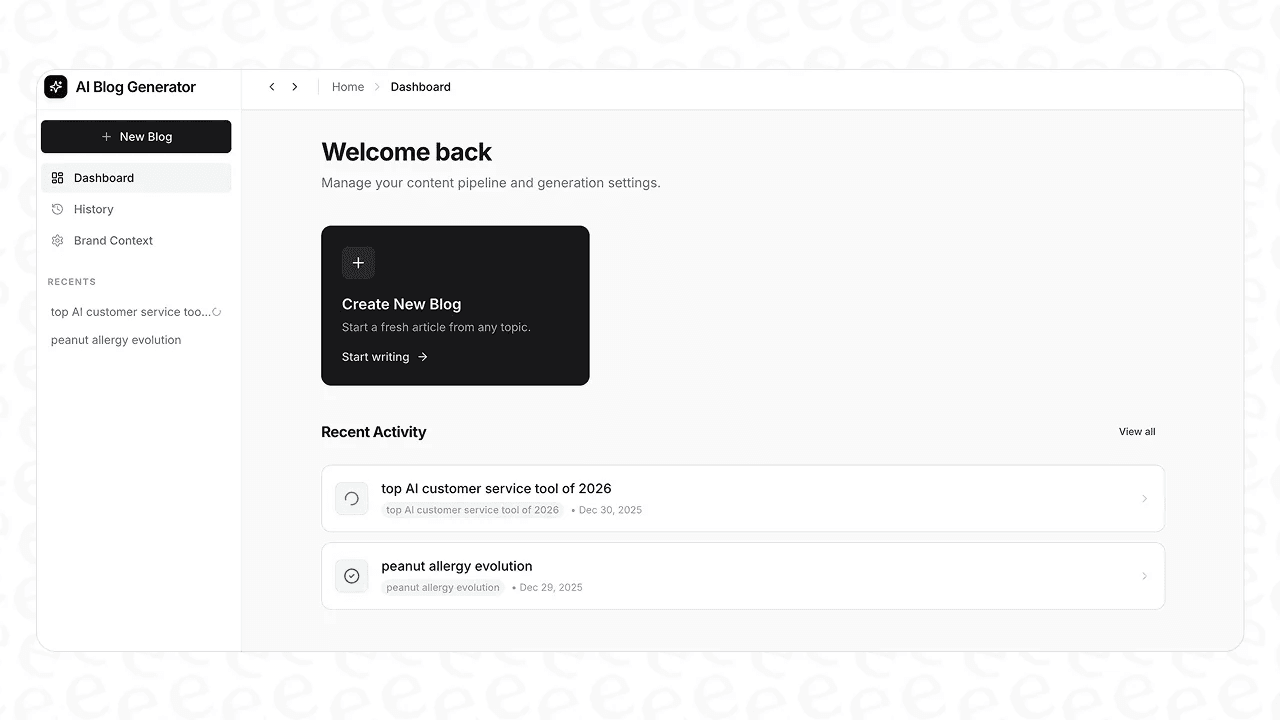
A context-aware approach with the eesel AI blog writer
An alternative is to use an AI tool designed to be a content partner that delivers a more complete, publish-ready article.
Here’s what makes this approach different and more effective:
-
Context-Aware Research: eesel doesn't just scrape the top search results. It understands the intent behind your keyword. If you're writing a comparison post, it automatically pulls pricing and features. For a product review, it finds the tech specs. To add real-world credibility, it even integrates actual Reddit quotes from relevant discussions, bringing genuine user perspectives into your content.
-
Automatic Asset Generation: The platform doesn't just give you a wall of text. It produces a fully structured post complete with AI-generated images, infographics, charts, and tables. It even finds and embeds relevant YouTube videos to make your content more engaging. This directly solves the "time and resource sink" problem by handling the most time-consuming parts of content creation for you.
-
Built-in SEO and AEO: Every piece of content is structured with SEO best practices in mind, from headings and meta descriptions to internal linking suggestions. But it also looks to the future with AEO (Answer Engine Optimization). Gartner predicts that traditional search volume will drop by 25% by 2026 as people get their answers directly from AI Overviews. eesel optimizes your content to be the source for those answers, protecting your future traffic.
-
Deep Brand Context: You don't have to spend hours training the AI on your brand. Just add your website URL, and it instantly learns your brand context. This allows it to make natural, contextual mentions of your own services within the content, turning every blog post into a subtle and effective marketing asset.
A workflow diagram illustrating the process of using the eesel AI blog writer for efficient and scalable original blog writing.
This is the exact platform we used to grow our impressions from 700 to 750,000 per day in just three months. There's no recurring monthly subscription; you just buy credits as you need them. It’s just $99 for 50 blog posts, and it's completely free to try.
Your next steps in original blog writing
Originality in 2026 isn't about avoiding technology; it's about using it smartly. We've seen that true originality is a mix of a unique perspective, deep research, a personal voice, and compelling storytelling. While creating this kind of content at scale has traditionally been a slow, expensive grind, the right AI platform can completely change the game.
Smart, context-aware AI tools like the eesel AI blog writer handle much of the heavy lifting, including research, drafting, SEO structure, and asset creation. This frees you and your team up to focus on the final 20%: adding the strategic insights, personal stories, and unique perspective that make content truly great and unmistakably yours.
Don't let the blank page win. It’s time to move from struggling to create content to strategically scaling it. See for yourself how quickly you can generate a complete, SEO-optimized post. Generate your first blog free with the eesel AI blog writer and publish something original today.

Frequently Asked Questions
Share this article

Article by
Katelin Teen
Katelin is an operations specialist at eesel where she uses her psychology training and education experience to optimize B2B SaaS processes. Outside of work, she unwinds with story-driven games, writing, and keeping up with latest tech innovations.