A complete guide to AI blog writer customization

Stevia Putri

Katelin Teen
Last edited January 15, 2026
Let's face it, a lot of AI-generated content sounds like a robot wrote it. It’s generic, lacks personality, and after reading a few articles, it all starts to sound the same. If you've ever felt a sense of déjà vu reading an AI blog post, you know exactly what I mean.
The issue is when the content is 70% AI or more. AI should really be used as an Assistive Interface for writing great content, not producing mechanical bastardized word slop by running and rerunning paragraphs through GPT-3.

For your content to get noticed, rank on Google, and actually connect with people in 2026, it needs to sound like it came from you. It has to feel authentic, be genuinely helpful, and align perfectly with your brand's voice. This is where you need to get smart about AI blog writer customization. It’s how you turn a generic text generator into a real content partner for your brand.
This guide will walk you through everything you need to know. We’ll cover why customization is so important and break down the different ways you can do it, from getting your hands dirty with prompt engineering to using specialized tools like the eesel AI blog writer, which is built to do the heavy lifting for you.
What is AI blog writer customization?
AI blog writer customization is the process of teaching an AI model to write content that follows your brand’s specific rules. Think of it like bringing a new writer onto your team. You wouldn’t just hand them a topic and hope for the best. You’d give them your style guide, fill them in on your products, and explain your tone of voice.
Customizing an AI is the same idea. It’s much more than just telling the AI to sound "friendly" or "professional." Real customization involves fine-tuning several key areas to make sure the content is a perfect match for your brand.
Here are the core pillars of what that looks like:
- Voice and Tone: This is all about capturing your brand’s personality. Are you witty and informal? Or more buttoned-up and academic? Customization makes sure the AI’s output is consistent and sounds like it came from your team, not a machine.
- Knowledge Base: A generic AI doesn't know the first thing about your business. A customized one does. By learning from your company’s internal documents, help articles, and past support tickets, the AI can write with real authority about your products and your industry.
- Structural and SEO Rules: This part involves teaching the AI how you like your articles put together. Do you follow a certain heading structure? Have specific rules for placing keywords to rank well? A customized AI can follow these guidelines every single time.
- Style: Every brand has its own writing quirks. This pillar is about the little things, like the rhythm of your sentences, the words you prefer, and the overall vibe of your content.
Why is AI blog writer customization no longer optional?
A few years ago, using AI to write a blog post was a cool trick. Now, it's just the baseline. With so much AI-generated content flooding the internet, churning out generic articles simply won't work anymore. Customizing your AI blog writer is a must for any brand that wants to stand out and get real results from its content. Here’s why it matters so much.
Build brand consistency and trust
When all your content, from blog posts to support emails, has a consistent voice, you build a brand that people recognize and trust. They start to feel like they know you. As Eddie Stephens from CartonCloud mentioned, a customized AI can help create "well-formed responses with consistent, ‘on-brand’ tone," which builds a much stronger connection with your audience.
Without customization, you risk your content sounding all over the place. One article might be formal, the next one super casual. One marketer in a popular Reddit discussion noted how easy it is to accidentally adopt the tone of other content you've been reading. Customization keeps you on track, ensuring your brand’s unique voice always comes through.
Improve content quality and relevance
Generic AI models pull from the general knowledge of the internet. They don't know the details of your products or the specific problems your customers have. When you customize your AI by feeding it your company's own knowledge, the quality of the content goes way up.
The AI can suddenly write articles that are not just surface-level but are deeply insightful and genuinely helpful. It can turn your scattered internal docs from places like Zendesk and Google Docs into a powerful asset, producing content that is accurate, detailed, and truly valuable to your readers.
Stand out in a sea of AI-generated content
As more companies use AI for content, a huge chunk of the internet is starting to sound exactly the same. A unique, customized brand voice is one of the best ways to cut through that noise.
When your blog posts have a distinct personality and offer real, expert-level insights based on your company's data, you immediately stand out. It keeps your blog from becoming just another echo in the AI content chamber and helps you grab and hold your audience's attention.
Gemini feels like a tool built by engineers for content farms, not for writers. It can draft copy, sure but it often lacks edge, intuition, or emotional rhythm. The more I use it, the more I realize it’s not a co-writer; it’s a mirror.
Boost SEO and answer engine optimization (AEO) performance
Customization isn't just about branding; it's also a smart move for SEO. A customized AI can strategically include long-tail keywords and use the specific language your audience uses when they search, helping you better match what they're looking for.
More importantly, search itself is changing. With the rise of AI-powered search features like Google's AI Overviews, the rules are different. Gartner predicts that traditional search engine volume will drop by 25% by 2026 as people get answers directly from AI. This is where Answer Engine Optimization (AEO) becomes important. Content that is trained on your data and structured to give clear, direct answers is perfectly set up to be featured in these new answer engines, driving a new kind of organic traffic.
Different approaches to AI blog writer customization
So, you're on board with customizing your AI blog writer. But how do you actually do it? There are a few different ways to go about it, each with its own pros and cons. Let's look at the main approaches, from fully integrated platforms to more hands-on methods.
The integrated approach: Using the eesel AI blog writer
One approach is to use a specialized tool built specifically for this purpose. Platforms like the eesel AI blog writer are designed to make deep customization incredibly easy.
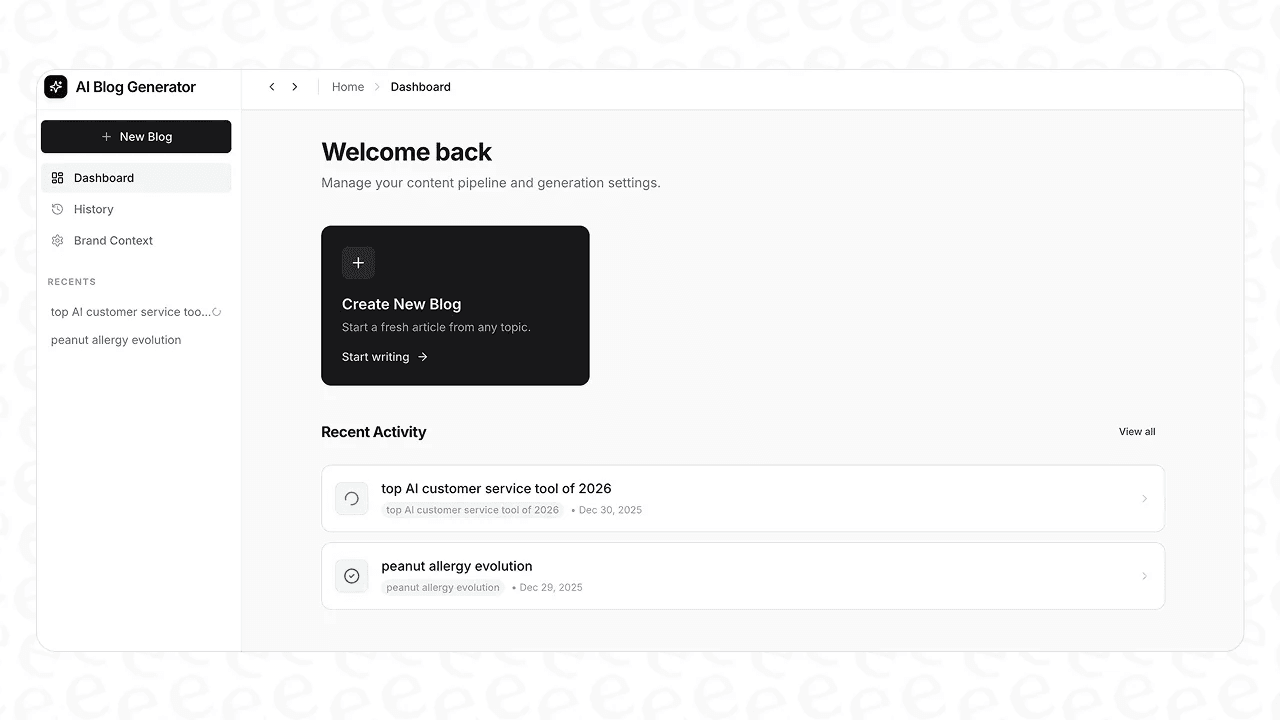
How it works: Instead of spending hours crafting complex prompts, you just give it a keyword and your website URL. The tool then gets to work, automatically analyzing your site to learn your brand context, voice, and product details. From there, it generates a complete, publish-ready blog post that sounds like it was written by someone on your team.
Key Differentiators:
- Context-Aware Research: The AI is smart enough to know what kind of blog post it's writing. If you ask for a comparison post, it will automatically find pricing data and feature lists. If you're writing a product review, it will dig up the relevant technical specs.
- Automatic Asset Generation: This is a massive time-saver. It doesn't just give you a wall of text. It delivers a fully structured article with AI-generated images, tables, and infographics that are ready to publish.
- Social Proof Integration: To make the content feel more authentic, it can embed relevant YouTube videos and pull real quotes and insights from Reddit forums related to your topic.
- AEO Optimization: The content is automatically structured with clear, direct answers, making it easy for AI answer engines like Google's AI Overviews to pick it up and feature it.
Proven Results: We don't just talk about it; we used this exact tool to grow our own organic traffic at eesel AI. We went from 700 to over 750,000 daily impressions in just three months by publishing over 1,000 optimized blog posts.
Pricing: The eesel AI blog writer uses a simple pay-as-you-go model. It costs $99 for 50 blog posts, and you can buy more credits whenever you need them. Best of all, it's completely free to try, so you can see the quality for yourself.
The manual approach: Customizing prompts in general AI tools
This is the DIY route. It involves using a general-purpose AI tool like ChatGPT and guiding it with very detailed instructions, a process known as "prompt engineering."
How it works: You basically have to "train" the AI from scratch in every single chat. As some helpful guides on Reddit explain, this means you act as a "brand strategist" for the AI, defining all the rules for its tone, style, and structure in a huge initial prompt. Then, you usually work section by section, feeding it information and correcting its output as you go.
However, this approach has several limitations:
- The process can be time-consuming, as it requires significant upfront work to write and refine prompts for each blog post.
- Results can be inconsistent, as the quality of the output depends heavily on the prompt. General models can also introduce inaccuracies, requiring extra fact-checking.
- This method generates text only. Any visuals, tables, or videos must be created and added manually.
- General AI tools do not have a built-in understanding of SEO, so all instructions for structure, keyword placement, and formatting must be provided in the prompt.
Pricing: A subscription like ChatGPT Plus is $20 per month. This cost doesn't include the time required for prompting, editing, and manually creating assets.
The platform-specific approach: Using built-in AI writers
Many large marketing and writing platforms, like HubSpot and Grammarly, have started adding their own AI writing features into their software.
How it works: These tools often have features designed to help with brand consistency. For example, HubSpot's brand voice tool, part of its AI collection called Breeze, can analyze a sample of your writing to learn your brand's tone. Similarly, Grammarly's brand tones feature lets you set up a custom tone profile that gives your team real-time feedback as they write.
Some limitations of this approach include:
- These AI writers are often one feature within a larger product, so they may not have the same dedicated functionality as a standalone blog generation tool.
- The customization capabilities are often focused on maintaining a consistent tone rather than tapping into a company's specific knowledge base to write with authority.
- Access to these AI features is typically bundled with the platform's premium subscriptions, which may include many features beyond what is needed for blog writing.
Key elements for your AI blog writer customization strategy
No matter which path you choose, there are a few key things you need to have in place to successfully customize your AI's output. Thinking through these will make your content better and also shows why a platform that automates these steps can be so valuable.
Define your brand voice, tone, and persona
Before you can teach an AI, you need to know what you want to teach it. Clearly document your brand's personality. Are you an expert guide, a quirky friend, or a serious professional? If you're going the manual route, you'll need to write this out in detailed prompts, like the ones described in that Reddit guide for ChatGPT.
Create a comprehensive style guide
Think of this as your list of "do's and don'ts" for the AI. This guide should include things like preferred terms (e.g., "customers" vs. "clients"), words you want to avoid, rules for formatting, and your policies on linking. The more specific you are, the more consistent the AI will be.
Supply a dedicated knowledge base
This is the most important step for creating truly valuable content. To write with authority, the AI needs access to your information. The best way to do this is to let it learn from your company's existing materials. Platforms like eesel AI are built to do this automatically by connecting to your help center articles, support replies, Google Docs, and Confluence pages. This gives the AI the deep context it needs to write like a true expert on your team.
Set clear SEO and structural parameters
You need to give the AI a blueprint for what a successful article looks like. This means instructing it on your SEO strategy, including target keywords and the heading structure you prefer (H2s, H3s, etc.). A specialized tool like the eesel AI blog writer is built with this in mind, automatically optimizing every article for both traditional SEO and the new world of AEO.
Getting started with AI blog writer customization
In the crowded content world of 2026, generic AI articles just don't cut it. They don't build trust, they don't rank well, and they definitely don't help you stand out. AI blog writer customization is now an essential practice for any brand that wants to create high-performing content that connects with its audience.
While manual prompting with tools like ChatGPT or using the built-in AI features of larger platforms can give you some control, they often require a significant investment of time and effort. A dedicated platform designed for deep customization, automatic research, and one-click asset generation can be an efficient and effective way to create content that drives real growth.
Ready to stop writing generic content? Try the eesel AI blog writer for free and see the power of true customization for yourself.

Frequently Asked Questions
Share this article

Article by
Stevia Putri
Stevia Putri is a marketing generalist at eesel AI, where she helps turn powerful AI tools into stories that resonate. She’s driven by curiosity, clarity, and the human side of technology.
