

Using AI for writing isn't a novelty anymore; it's pretty much standard practice. The real trick isn't just using an AI, but using it well enough to create something that doesn't sound like a robot wrote it. If you've ever used one, you know what I mean. You get a wall of text that's technically correct but has zero personality.
Most AI-generated content is shallow, sometimes gets facts wrong, and just doesn't have that authentic voice that connects with people and gets you ranked on search engines. That gap between a rough AI draft and a finished article is where all the real work is, and it can be a real headache.
This guide gives you a straightforward plan for working with AI as a writing partner. We’ll go over how to set up your workflow, pick the right tools, and clean up AI-generated text to keep your brand voice intact. We'll also look at how specialized tools like the eesel AI blog writer are designed to handle this quality issue for you, turning a simple keyword into a full article automatically.
What are AI content writing tools?
AI writing tools are just apps that use large language models (LLMs) to create human-like text from your prompts. You can think of them as a super-advanced autocomplete that gets context, tone, and structure.
People generally use them for a few things:
- Brainstorming topics and creating outlines.
- Drafting the first version of articles, emails, or social media posts.
- Rewriting or rephrasing existing text for a different tone or better clarity.
- Summarizing long documents or research papers.
When they work well, they're a great way to speed things up, get past writer's block, and take care of the initial heavy lifting.
A practical framework for writing content with AI
Step 1: Ideation and outlining
Before you write anything, you need a solid plan. AI can be a surprisingly good partner here. General tools like ChatGPT or Gemini are great for kicking around blog topic ideas, exploring different angles, and finding sub-topics you might have overlooked.
Once you have a topic, ask the AI to create an outline based on a target keyword and your audience. This saves a lot of time and gives your content a solid structure from the start. The trick is to refine what the AI gives you, adding your own perspective and making sure the flow works for your readers.
This manual process can involve significant back-and-forth. Alternatively, platforms like the eesel AI blog writer are designed to handle this step by building a complete, SEO-friendly structure from a keyword.
Step 2: Generating the first draft
With a good outline, you can now feed it to an AI tool to generate the body of the article. This is where AI really helps, taking care of the initial work of getting words down and saving you hours of drafting.
But the output is almost never perfect. AI-generated text often has a "plastic feel," because it doesn't have real experiences or emotions to draw from. It's just repeating patterns from its training data. It can also make up facts, known as "hallucinations," and present them as if they're true.
Personally, I wouldn’t put my book into AI. A lot of readers are unwilling to read books that have been touched by AI and I think we’ll see that pick up steam so I wouldn’t risk it even for edits personally.
You also need to think about copyright. The Authors Guild states that text generated only by AI isn't original to you and can't be copyrighted. If you're writing for a client, using a lot of unedited AI text could get you into trouble. So, human editing isn't just for quality; it's a professional requirement.
Step 3: The essential human edit
This is where you turn the raw AI output into something genuinely valuable that sounds like your brand. Think of the AI draft as raw material, not the finished piece.
First, fact-check everything. Every claim, statistic, and data point needs to be verified against a reliable source. This is non-negotiable if you want to build trust with your audience. Don't just assume the AI is right, because it frequently isn't.
Next, add your own voice and expertise. This is the most important part. Rewrite sentences to match your brand's tone. Add personal stories, original thoughts, and expert opinions that an AI could never come up with. This is what will make your content stand out from all the generic stuff out there.
Finally, polish it up. Tools like Grammarly are good for a final check on spelling and grammar. Some advanced platforms, like the eesel AI blog writer, even have AI-powered editing features like "vibe edits," which let you tweak specific sections to better fit the tone you're going for.
Step 4: Optimizing with rich media and SEO
A great blog post is more than just words. To keep readers engaged and rank well, you need to add on-page SEO and rich media.
Start by checking the draft to make sure your target keywords are used naturally in headings, the body, and the meta description. The content should directly answer the question behind your keyword.
Next, add visuals. Nobody wants to read a wall of text. If you're using a basic AI writer, you'll have to find or create your own images, tables, and charts to break things up and explain your points.
Specialized tools can streamline this process. The eesel AI blog writer, for example, automatically includes these elements. It generates relevant images and tables, embeds related YouTube videos, and finds real Reddit quotes to add social proof. This approach reduces the manual work of creating and finding assets.
Choosing the right AI writing tool
Not all AI writers are the same. The tool you pick has a big effect on your workflow and the final quality. Here’s a look at the main types to help you figure out what you need.
General-purpose chatbots (ChatGPT & Gemini)
These tools are flexible and easy to access, which makes them a common starting point.
- Best for: Brainstorming, rephrasing sentences, summarizing text, and getting quick answers.
- How they work: You chat with them. You give a prompt, and the AI gives you a text response. The free version of ChatGPT is powerful enough for basic tasks.
- Limitations: The output can be generic and wordy, often needing a lot of editing to sound human. They don't have built-in SEO features or create visuals. While they can search the web, the feature can be hit-or-miss. Plus, their knowledge has a cutoff date (like July 2023 for some models), so they might use outdated information if a web search doesn't work.
Specialized content marketing platforms (Jasper & Copy.ai)
- Best for: Creating short-form copy like ads, social media posts, and product descriptions with templates.
- How they work: They guide you through specific tasks. Jasper's "Brand Voice" feature helps keep your content consistent, and Copy.ai bills itself as a "GTM AI Platform" for go-to-market teams.
Keep in mind those AI tools are just built on top of OpenAI, Anthropic etc, so you're getting the same results, just in a different interface for a marked up price.
 Reddit
 - Limitations: Their long-form blog content can feel a bit cookie-cutter and still needs a lot of human editing. Important features often cost extra. For example, to optimize content in Jasper, you need a separate, paid Surfer SEO integration. Jasper doesn't have a free plan, and Copy.ai's free plan is capped at 2,000 words per month, which is enough for about one blog post.
The eesel AI blog writer: A comprehensive approach
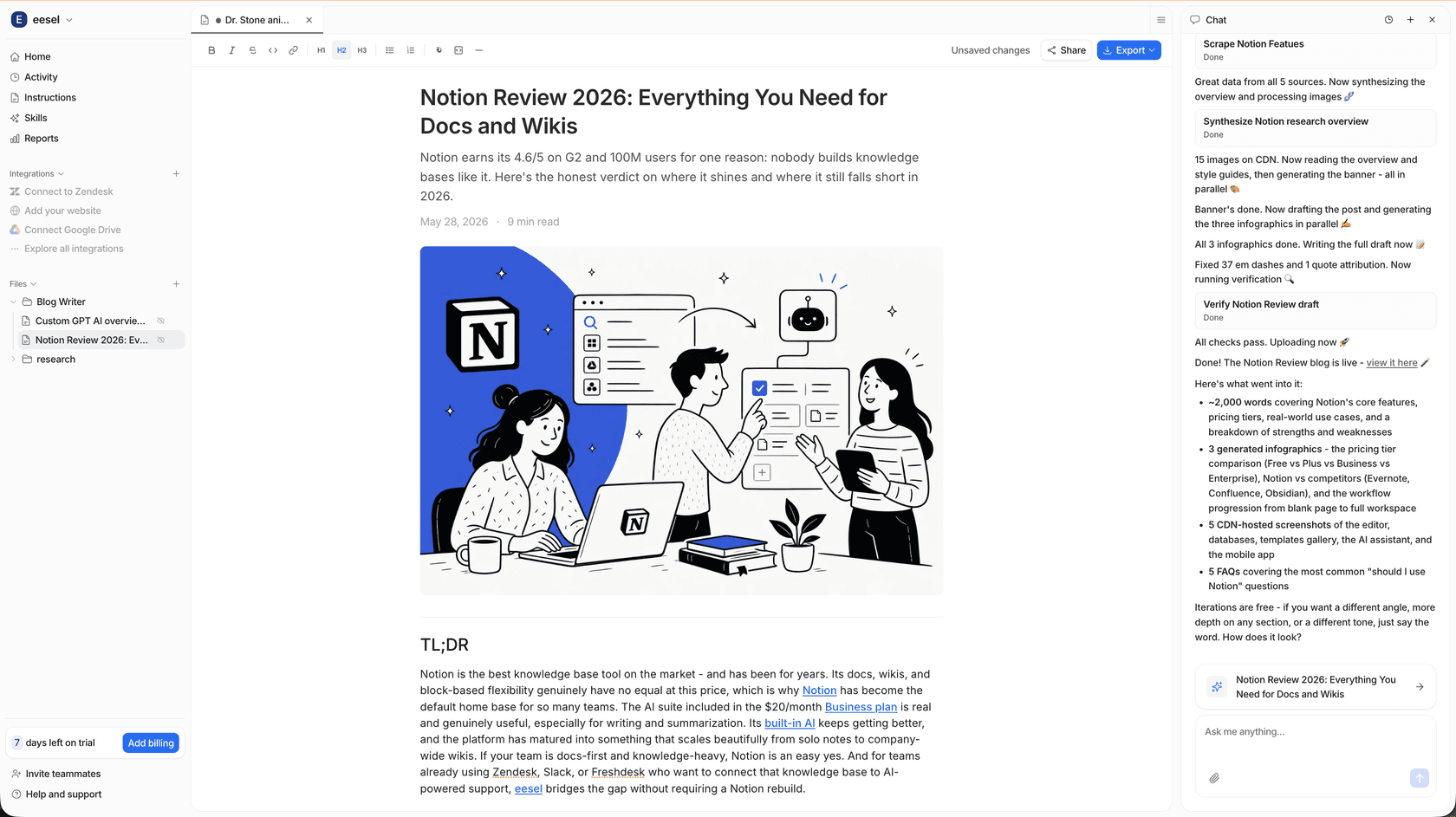
- Best for: Marketers and content teams who need to produce high-quality, SEO-optimized, and media-rich blog posts at scale without a ton of editing.
- How it works: You give it a keyword and your website URL. The eesel AI blog writer then handles the whole workflow: it does in-depth research, creates an outline, writes the article, optimizes it for SEO, and generates all the assets.
- Key Differentiators: eesel AI is designed to deliver a complete content package that includes text and other assets.
- Deep Research with Citations: It automatically researches the topic and includes links to external sources, which adds credibility.
- Automatic Assets: It generates and embeds relevant images, tables, and infographics right into the post, saving you hours of design work.
- Authentic Social Proof: It embeds relevant YouTube videos and finds real quotes from Reddit to add a human touch and build trust.
- Proven Results: We used this tool at eesel AI to grow our organic traffic from 700 to 750,000 daily impressions in just three months.
Best practices for writing AI prompts
- Define the Goal: Be clear about what you want. Instead of "write about SEO," try "Write a 500-word introduction for a blog post about the importance of on-page SEO."
- Specify the Audience: Tell the AI who you're writing for. This helps it adjust the language. For example, add "...for an audience of beginner marketers who are new to the topic."
- Set the Tone and Style: Give clear instructions on the voice. For instance, "Use a confident, factual, and practical tone. Avoid marketing jargon and keep the language simple."
- Provide Context and Examples: Give the AI some background information or a sample of text to copy. As users have noted, providing good context dramatically improves output quality.
In the time it took me to come up with adequate prompts that generated decent responses, I could've written a better response myself.
Reddit
While prompt engineering is a valuable skill, it can be time-consuming. Some platforms, like the eesel AI blog writer, are designed to simplify this. It automatically understands context from your website and requires only a keyword to generate a structured article.
To see these concepts in action, it can be helpful to watch an expert walk through their entire AI-powered writing workflow. The video below provides a complete walkthrough of building an AI writing system, showing how to train the AI and create a self-improving feedback loop for consistently high-quality content.
AI as your partner, not your replacement
Writing good content with AI is a partnership. The AI gives you speed and a solid starting point, but the human writer provides the strategy, authenticity, and final quality control that makes content great. The best way to work is to let AI handle the heavy lifting-ideation, outlining, and first drafts-and focus your own efforts on high-value tasks like editing, adding unique insights, and fact-checking.
The real work happens in the gap between a raw AI draft and an excellent piece of content. If you want to skip the tedious parts and go straight from a keyword to a publish-ready draft that's already filled with research, assets, and social proof, give the eesel AI blog writer a try for free.