
What FLUX 3 Action actually is
Let me clear up the naming first, because it trips people up. FLUX 3 is a single multimodal foundation model from Black Forest Labs, the same lab behind the FLUX image models. It is trained jointly across image, video, and audio, and the company describes it as "one multimodal model for Image, Video, Audio and Action-Prediction."
Action-Prediction is that fourth capability. It takes visual observations plus a text instruction and predicts physical outcomes as robot control actions. So "FLUX 3 Action" is not a separate product you download. It is a capability of the FLUX 3 backbone, and the version built for real robots, in partnership with mimic, is called FLUX-mimic.
The framing BFL uses is the interesting part. In their words, a model that can both generate video and control robots "was never really only a content creation model. It is a model of how the world behaves, and content creation is one thing one can do with it." That is a big claim, so it is worth walking through why it might be true.
Why a video model can drive a robot
Here is the mechanism, because this is the whole idea. When you train a model to generate realistic video, it has no choice but to learn physics. Get the weight of an object wrong, or the way a hand closes around it, or what happens when two things collide, and the video looks obviously fake. So learning to render the world accurately is, under the hood, learning how the world behaves.
BFL puts real numbers on this. Video prediction accounts for over 95% of FLUX 3's total training compute. Audio, by comparison, is less than 0.5% of the tokens in a 720p clip, because once you understand video, matching sound to lip movement and impacts is comparatively easy. Actions follow the same shape: a robot's state is a low-dimensional signal tightly coupled to what the camera sees. Frames, audio, and actions are all partial views of one underlying physical reality, so once the model has learned that reality from video, action prediction is not a new departure.
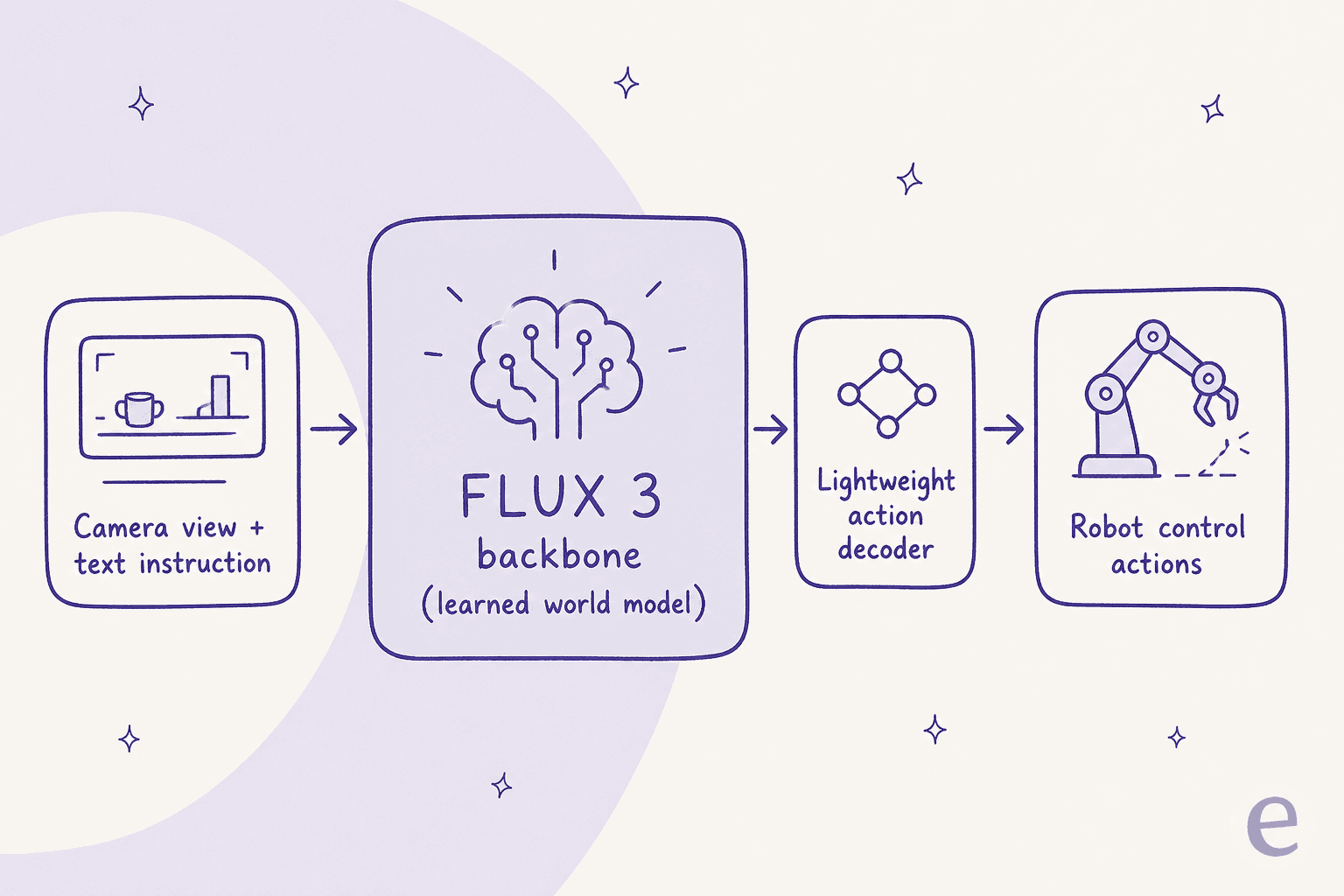
The pipeline is deliberately lean. A camera view and an instruction go into the FLUX 3 backbone, which holds the learned world model. A small action decoder reads intermediate features straight out of the video-prediction path and turns them into control actions. The expensive part, understanding the world, is already done before the robot ever moves. This is a distinct approach from most vision-language-action models, which are trained end to end to spit out actions rather than reusing a generative backbone.
What it cost to add actions
If actions really are just another view of the same world, teaching FLUX 3 to predict them should be cheap and shouldn't damage what it already does. That is exactly what BFL reports. When they added action prediction to a large training run, human ratings on text-to-video and image-to-video initially fell by up to 10% as the model absorbed the new modality. After 3,500 steps, video quality was fully back to where it started, now with action prediction on top.
That recovery is the evidence for the "one backbone, two jobs" thesis. The model didn't permanently trade video quality for robot control. It just had to figure out how the new modality mapped onto the world it already knew, then the penalty vanished. The research this builds on is called Self-Flow, which unifies generation and representation learning so that improving one improves the other.
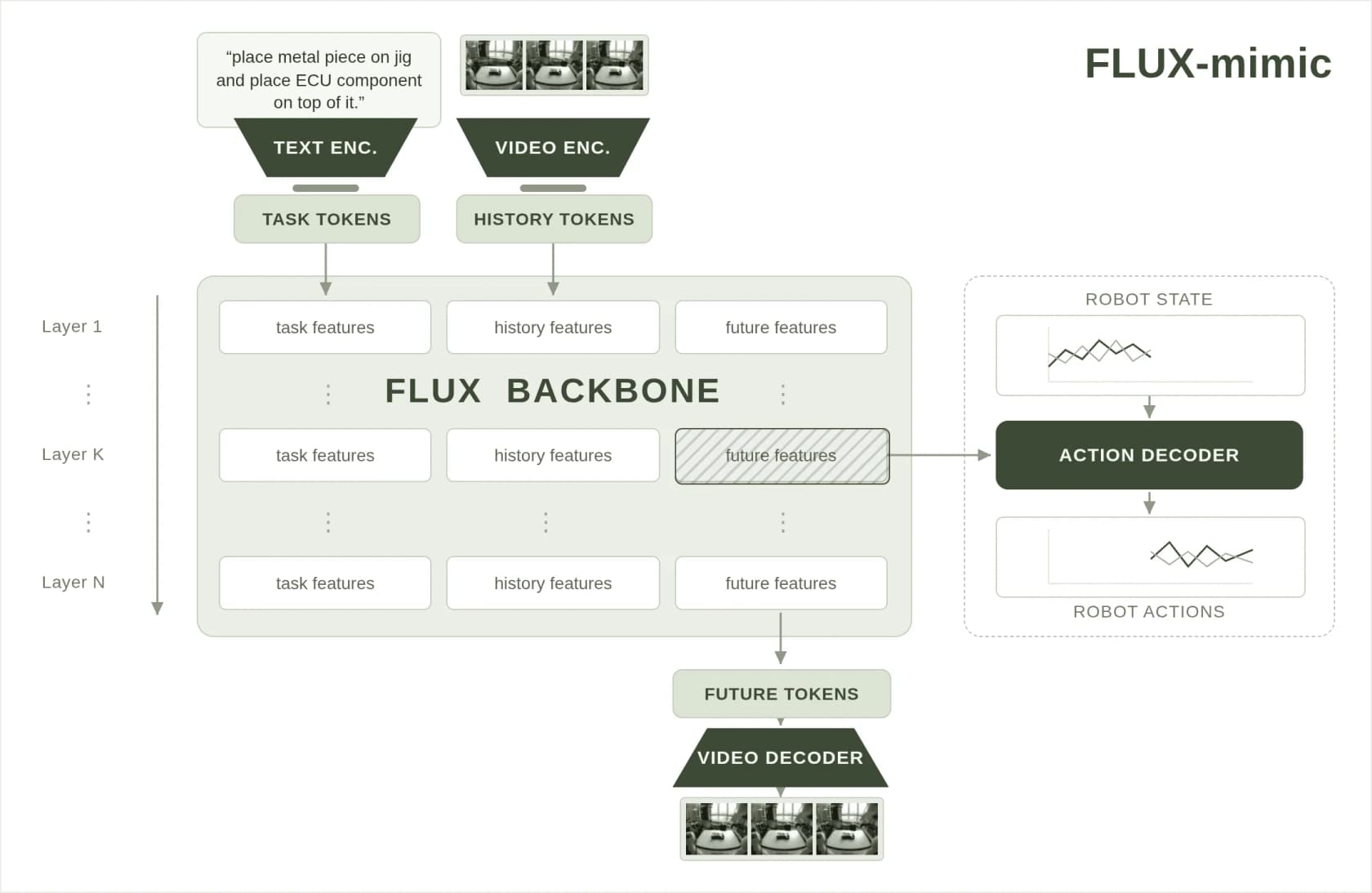
You can see the split in BFL's own architecture diagram. The text and video encoders feed the shared FLUX backbone, and the same layers produce future features two ways: through a video decoder to generate frames, and through a lightweight action decoder to output robot actions. One trunk, two heads.
What the benchmarks actually show
This is where FLUX 3 Action gets surprising, so I want to sit with the numbers rather than wave at them. On a soft-body kitting task (the kind of flexible-material handling conventional automation has always struggled with), BFL measured median success over 20 autonomous trials per model.
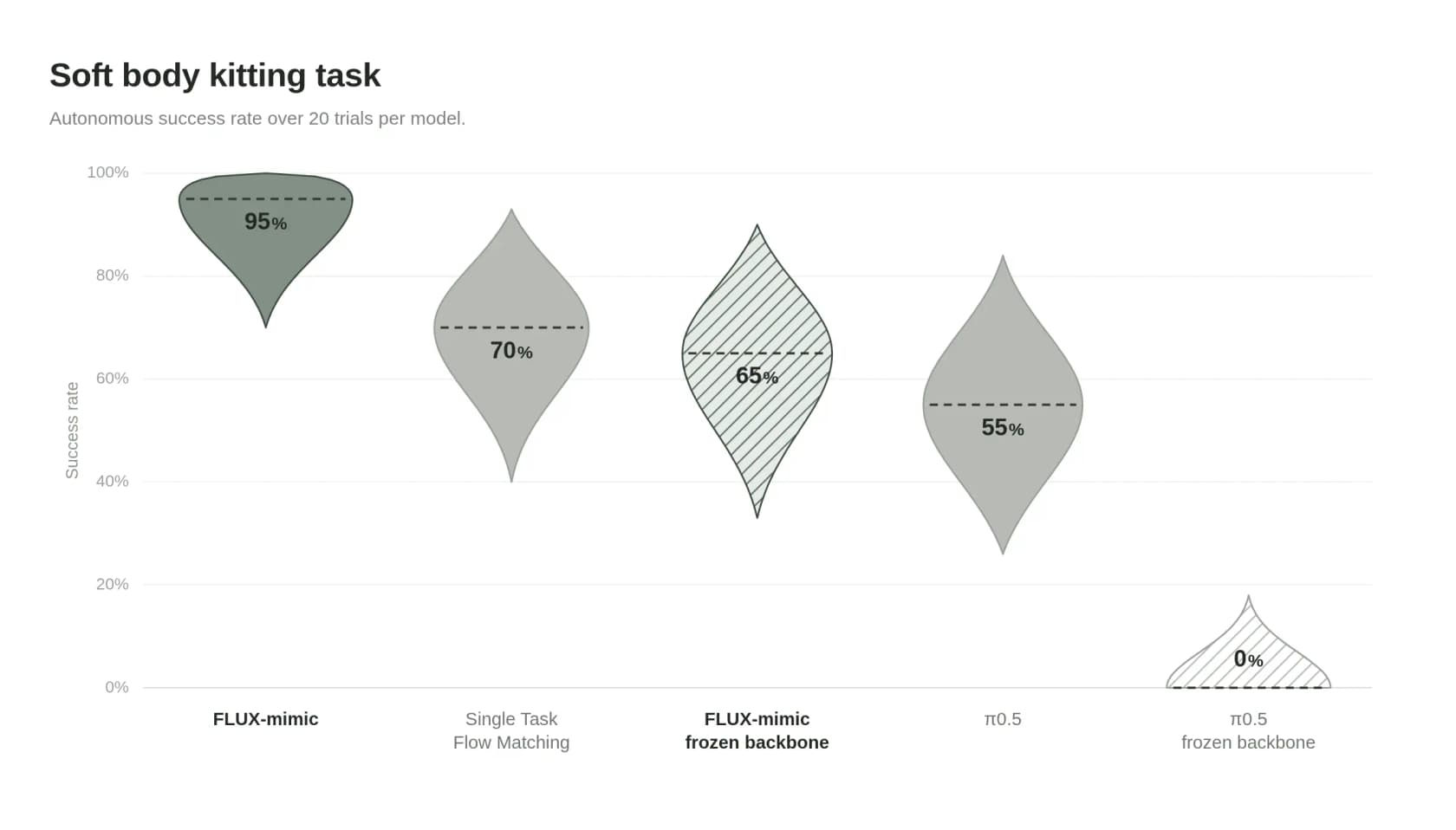
FLUX-mimic landed at 95%. A single-task flow-matching baseline hit 70%, and π0.5, a strong prior vision-language-action model, hit 55%. The number that matters most, though, is the frozen-backbone column. When you freeze FLUX-mimic's backbone (no fine-tuning, just the pretrained world model with a decoder on top), it still scores 65%. Do the same to π0.5 and it scores 0%. In other words, FLUX 3's pretrained representation is good enough to drive a robot with almost no task-specific training, which is not something earlier models could claim.
A few more findings worth pulling out, because they compound:
- Sample efficiency. The mimic-video work reports up to 10x fewer examples than a vision-language-action model to reach the same capability, because the physics is already in the representation.
- Self-recovery. A robot that misses a grasp corrects itself and tries again, even though no demonstration showed that recovery. It comes from the world model, not the training set.
- Speed. The backbone runs from camera input to world representation in under 80ms on a single NVIDIA RTX 5090, and mimic's full robot loop reacts in 101ms, roughly human visual reaction time.
The speed point is subtle but important. Because better representations mean more capability per parameter, BFL can run a smaller (and therefore faster) backbone and still hit the accuracy bar. In robotics, latency is the constraint that kills deployments, so a smaller backbone that keeps up with the real world is a bigger deal than the raw success rate.
From the lab to the factory floor
None of this would matter if it only worked in simulation, so the Audi deployment is the proof point. Audi runs one of the most automated production networks in the car industry, which means it has a precise view of where conventional robots still stop: flexible parts, fine manipulation, and the variant diversity of premium production that makes hand-programmed robot cells too expensive to re-engineer per case.
"In partnership with mimic, Audi has been testing and deploying FLUX-mimic. We have seen these robots solve complex soft-body manipulation work that would have been simply impossible with conventional robotics."
The tasks BFL names are concrete: kitting parts into structured trays, inserting electronic control units into tight fixtures, assembling components, and handling soft, flexible materials like seals and cables. That last category is the one that has stayed stubbornly manual for decades, so it is a fair signal of where this approach earns its keep.
Can you actually use FLUX 3 Action?
Here is the honest status, because the excitement outruns the availability. Black Forest Labs is shipping FLUX 3 in phases, and action prediction is not one you can buy.
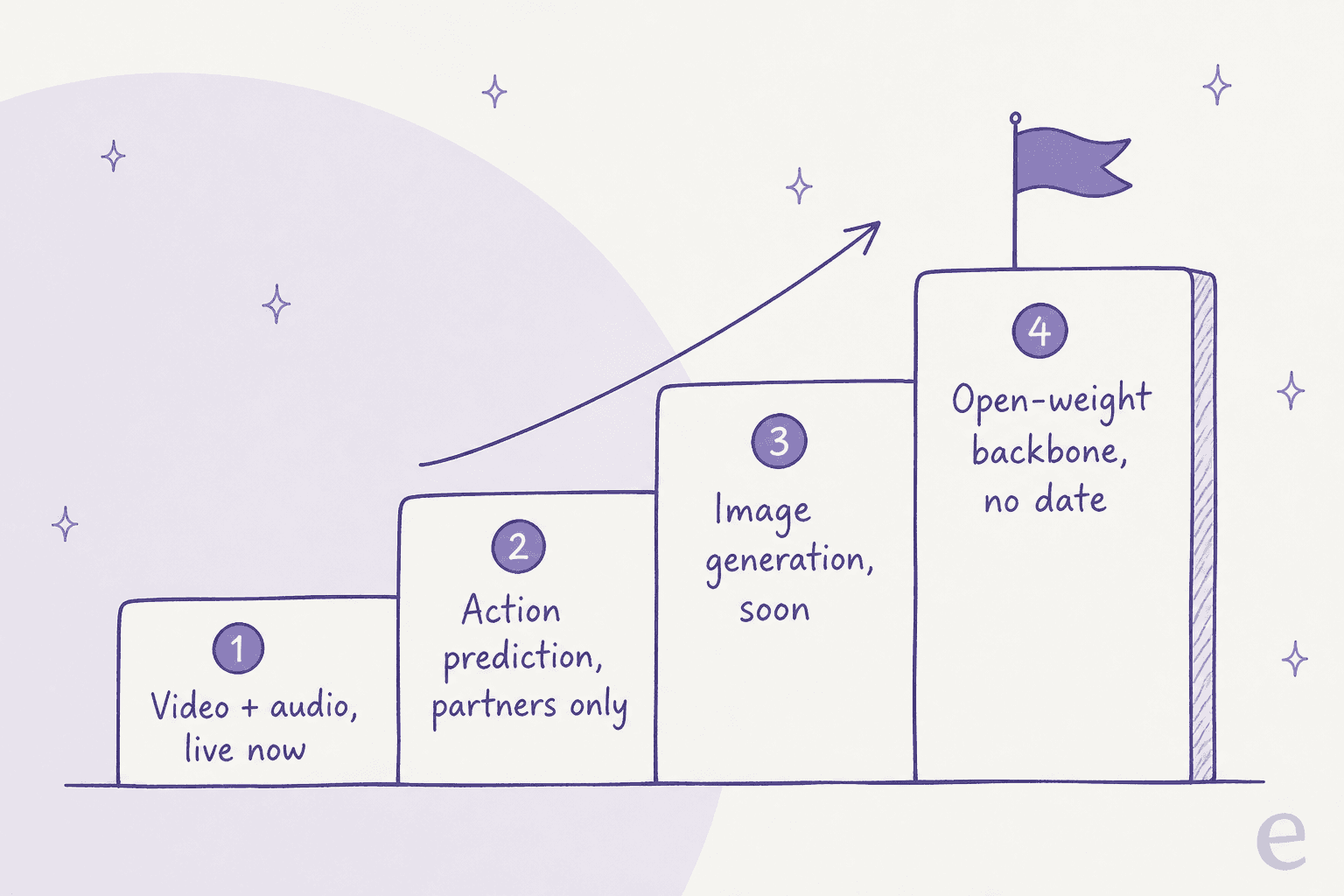
The rollout order BFL published is: video generation and editing first, action prediction with selected partners, then image synthesis, then open-weight access to the backbone. Today only video-with-audio is generally available. Action prediction is partner-gated (mimic has early access), with no public API, no published price, and no open weights. FLUX 3 image generation is still marked "soon," and the open-weight backbone has no date at all.
So if you want to touch FLUX 3 today, what you can actually pay for is video: text-to-video, image-to-video, and video-to-video up to 20 seconds, with native synchronized audio, on pay-as-you-go BFL API pricing with no subscription. For anything robot-related, you are watching a research preview and a partner program, not a product. That is not a criticism, it is just where the frontier is. Physical AI moves from selected partners to general availability slowly for good reasons.
Infrastructure versus the teammate you actually hire
I want to zoom out, because "FLUX 3 Action" and phrases like "AI agent" get thrown into the same bucket, and they belong on completely different shelves.
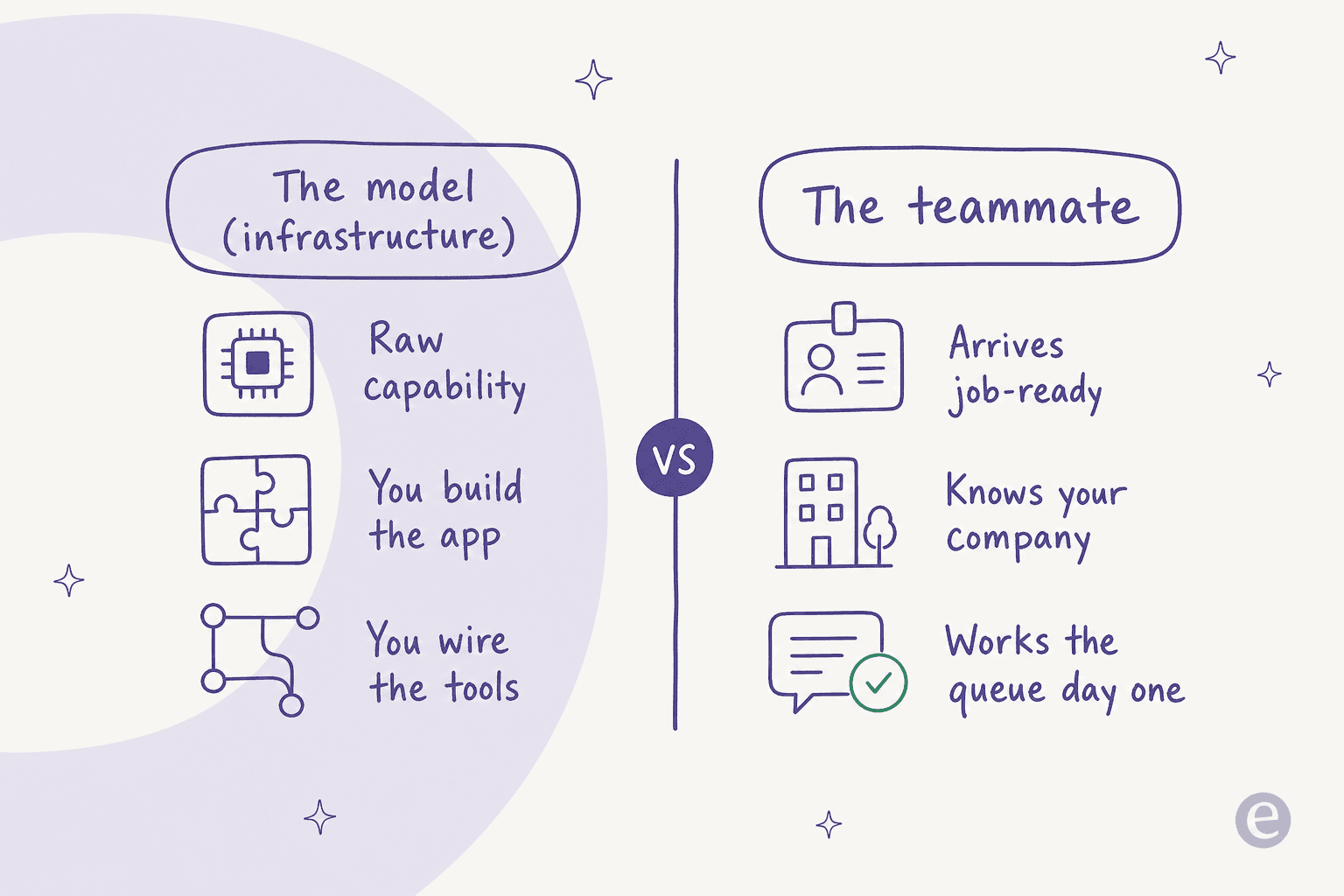
A foundation model like FLUX 3 is infrastructure. It is raw capability. To get value out of it you build the application, wire up the tools, handle deployment, and (in this case) attach it to physical robots. That is exactly the right shape for a robotics lab or an automotive production team with engineers. It is the wrong shape for a support lead who just needs tickets answered.
The other shelf is the AI teammate: something that arrives job-ready, already knows your company, and starts working on day one. You don't build an app around it, you brief it like a new hire. That is the layer I work on, and it is worth being clear that a model is not a teammate, any more than an engine is a car. FLUX 3 Action is a remarkable engine for physical AI. It is just not the thing you hire.
How this maps to eesel
At eesel, we take the "employee, not infrastructure" side of that line seriously. eesel is an AI teammate platform: instead of handing you a raw model to build on, you hire ready-to-work teammates for specific jobs. The current roster is an AI helpdesk teammate and an AI blog writer, each arriving with the skills, integrations, and company context its role needs.
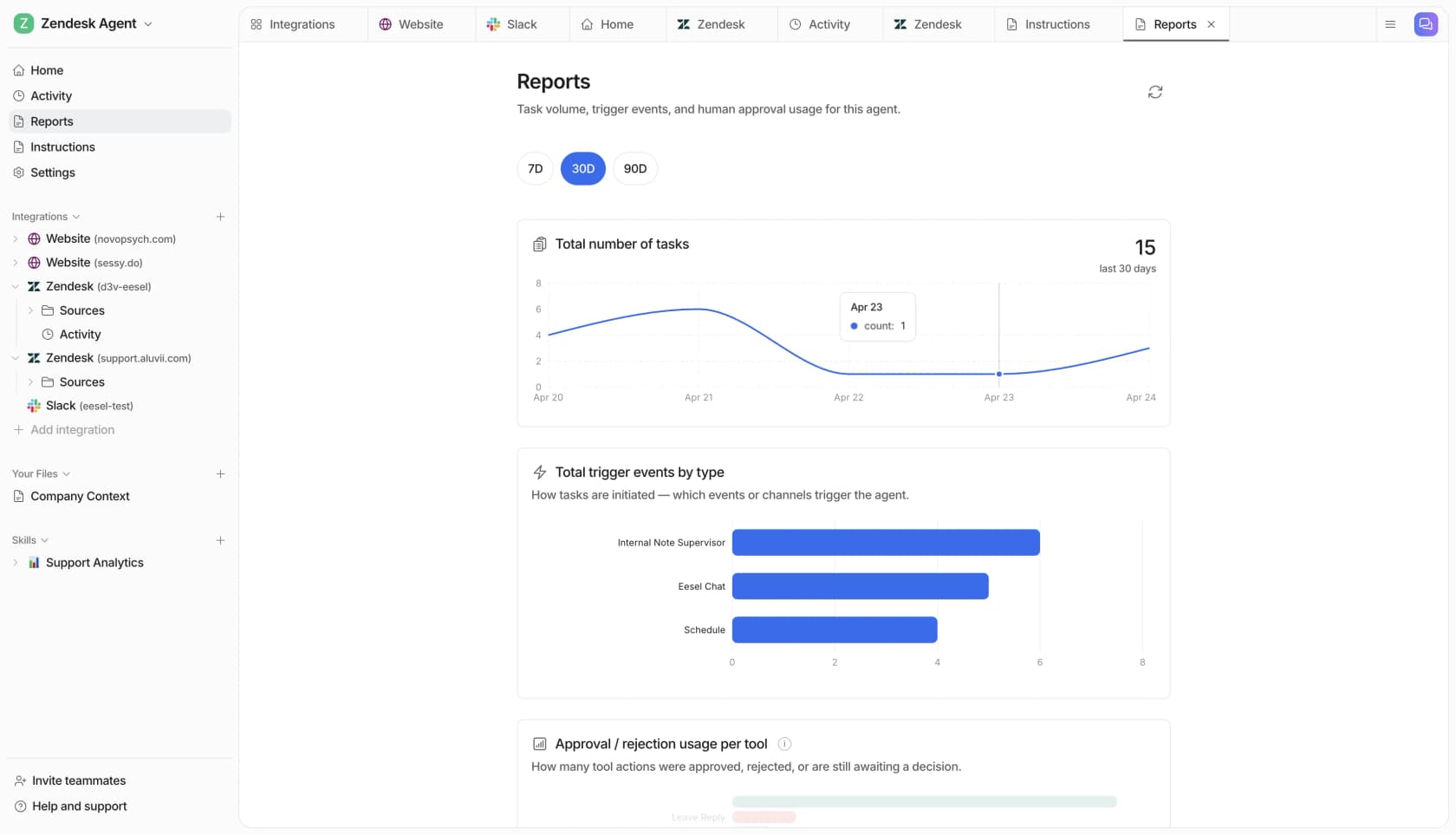
Because the model underneath is a moving target (FLUX today, something else next quarter), the useful abstraction is the teammate, not the raw capability. The helpdesk teammate learns from your past tickets and help center, drafts replies for review, and you can simulate it against your own historical tickets before it ever goes live, because I have watched confident-sounding bots quietly give wrong answers and would rather catch that in a dry run. If you like driving things from a terminal, the eesel CLI and its MCP server let you (or a coding agent like Claude Code) set up integrations, upload knowledge, and approve actions as JSON, so the same teammate is programmable without the dashboard. It won't fold your laundry or man a factory line. For answering customers and writing content, though, it is the hire, not the infrastructure. It is free to try.
Frequently Asked Questions
What is FLUX 3 Action?
Can I use FLUX 3 Action yet?
How is FLUX 3 Action different from a normal robotics model?
What is FLUX-mimic?
Is FLUX 3 Action an AI agent I can hire for my business?


Article by
Alicia Kirana Utomo
Kira is a writer at eesel AI with a Computer Science background and over a year of hands-on experience evaluating AI-powered customer service tools. She focuses on breaking down how helpdesk platforms and AI agents actually work so that support teams can make better buying decisions.