

What A.Team actually sells, and why the price is complicated
Before the pricing makes sense, you have to know what you're buying, because A.Team isn't one product. It started in 2020 as a members-only network of senior "builders" (engineers, AI specialists, product, design, data) that companies hire on demand. As of 2026 the homepage leads with something broader: "production-ready agentic teammates, built by forward deployed engineers." It now sells custom agentic AI systems, embedded engineers who ship them, and the original talent marketplace, all under one brand.
That matters for a pricing post because there's no single meter to point at. A.Team's "agentic teammate" is a bespoke consulting deliverable for marketing and planning workflows, not a self-serve app you connect to a helpdesk and pay per use. So when someone asks "what does A.Team cost," the honest answer is a question back: which of the three things are you buying? Let's take them in order.
A.Team's three pricing models, side by side
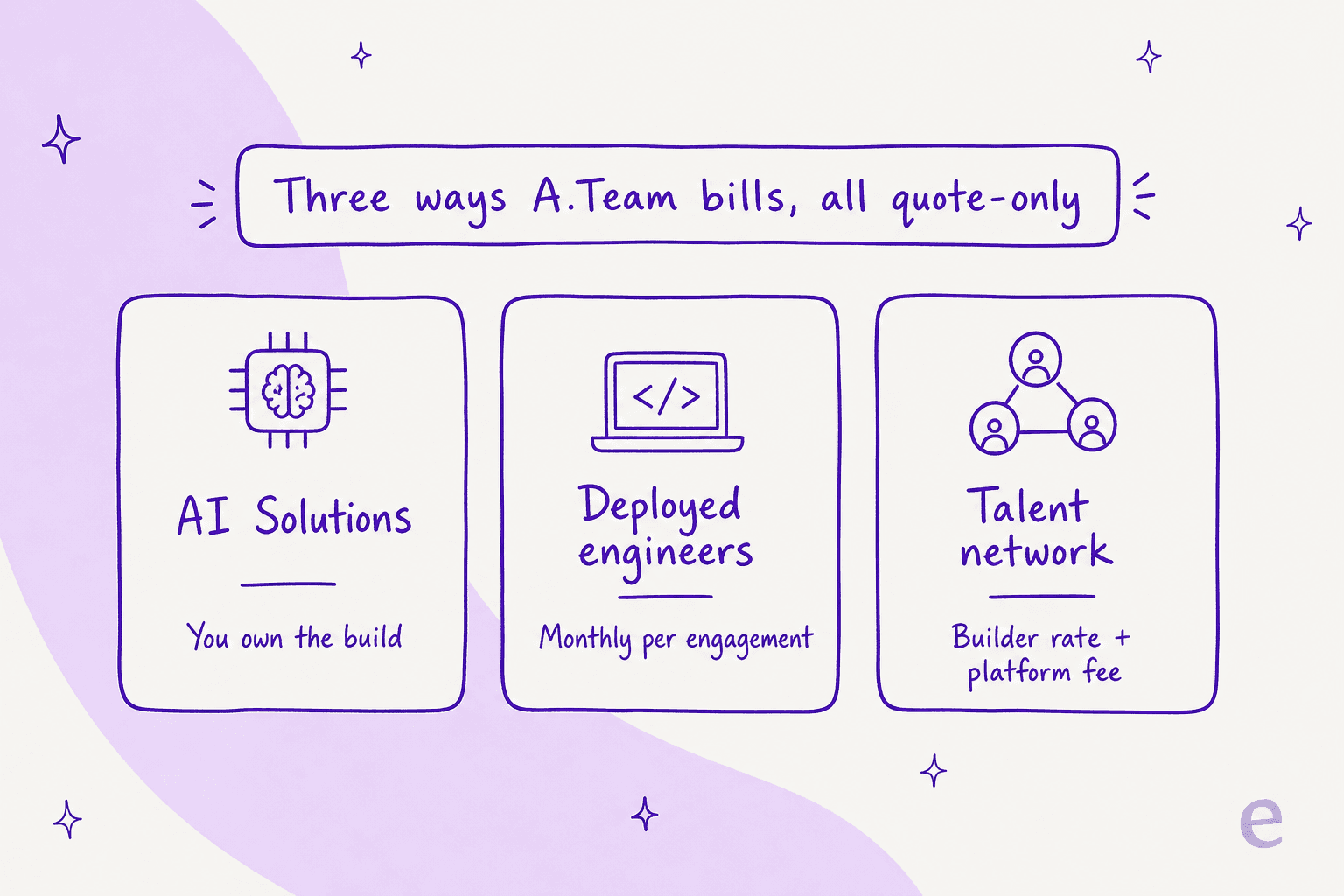
Here's the shape of it before the detail. Same brand, three genuinely different ways the bill gets built, and none of them carries a public number.
| Line | Billable unit | Public price? | Free trial? | Commitment | You own the output? |
|---|---|---|---|---|---|
| AI Solutions | Fixed-scope engagement | No | Lighthouse pilot (paid) | Pilot, then expansion | Yes, outright |
| Forward Deployed Engineers | Per engineer, monthly | No | No | Per engagement, ramps down | You keep the shipped work |
| Talent network | Builder rate + platform fee | No | No | Missions ~12-18 months | You employ the output |
The through-line: every cell in the "public price" column is a no. Whatever you buy, the number arrives in a proposal after a call. That's normal for enterprise services, but it's worth naming plainly, because it's the single biggest difference between A.Team and any tool you can price yourself in a browser tab.
1. AI Solutions: you pay to own the build
This is A.Team's flagship 2026 offering, and its pricing philosophy is the most distinctive of the three. Instead of renting you access to software, A.Team builds a custom agentic system and hands you the keys. Their AI Solutions page puts it bluntly:
Yours when it's built, not rented. Not a seat, not a subscription, not a per-token bill.
The commercial model is a fixed-scope engagement, quoted per project, and the entry motion is what A.Team calls the Lighthouse Method: a contained pilot on one brand, one market, or one workflow, with "first insights in 48 hours" and a "production system live within 90 days." The idea is to prove ROI on a small, bounded build before you commit to broader (larger) work.
For pricing, that means the first paid unit is effectively a lighthouse project, and the real spend comes in the expansion engagements after it. A.Team publishes no dollar figure for either a lighthouse or a full build. What you're buying is closer to a custom software project with a consultancy attached than a SaaS subscription, so the number scales with scope, data complexity, and how much of the "last mile" (real workflows, compliance, integrations) A.Team has to own.
The upside of the model is real: you end up owning the system, with no recurring per-seat or per-token meter running against you afterward. The trade-off is equally real: you're funding a build, and you won't know the size of that check until you've had the conversation.
2. Forward Deployed Engineers: monthly, per engagement
The second line is A.Team's staffing-forward option, marketed as A.Team Deployed: senior engineers who embed in your environment, often white-labeled under your brand, to ship the last mile of an AI rollout. As someone who ships integrations for a living, this is the part of A.Team I find easiest to price mentally, because it behaves like dedicated senior contractors.
The pricing language here is the clearest A.Team gives anywhere:
Priced against the delivery. Monthly, per engagement, sized to the delivery your customer is expecting. No placement fees, no severance, and no permanent org to justify once the rollout is done.
So the billable unit is a dedicated engineer, monthly, for as long as the engagement runs. You bring one on when a deal closes and step them down when it wraps, which A.Team frames as ramping "with your pipeline, not your payroll." There's still no per-hour or per-month rate card published, but the structure is familiar: if you've ever budgeted a senior contractor, you know roughly what a senior US engineer costs, and you can sanity-check any quote against that.
3. The talent network: builder rates plus an unpublished fee
The original A.Team business is the marketplace: post what you need, and A.Team returns a curated two-to-three-person shortlist, typically within about 72 hours, drawn from a network of 11,000+ vetted builders with a sub-2% acceptance rate.

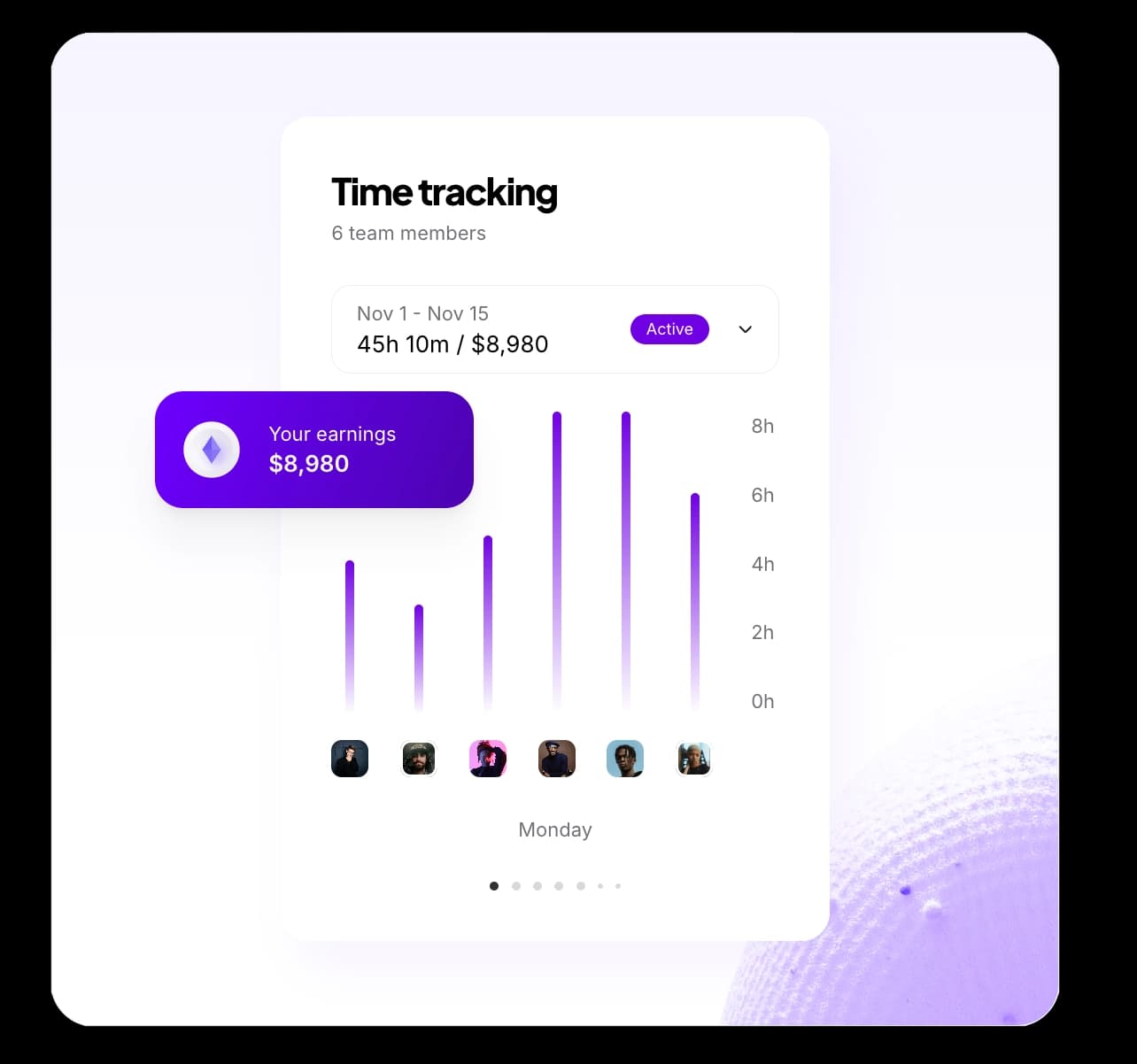
The pricing detail that's easiest to document is on the builder side. A.Team tells builders they set their own rate and that A.Team "doesn't skim it," paying twice monthly on a Net-15 cycle from the first mission hour. Missions typically run 12 to 18 months, and hours are tracked against the mission for billing.
Here's the catch for a buyer: if builders set their rate and A.Team doesn't take a cut of it, the client price almost certainly carries a separate platform or service fee, and that fee isn't published anywhere. So the marketplace number you'll actually pay is the builder's rate (visible to you in a shortlist) plus a margin you only learn on the call. It's a fair model for the builder; it's just not a transparent one for the buyer comparing options up front.
What a real engagement might cost
A.Team gives you no numbers, so anything specific has to be framed as market context, not an A.Team quote. For reference only: dedicated senior development teams generally run in the range of $8,000 to $45,000+ per month for a small-to-mid team, with US senior specialists landing around $150 to $250+ per hour. That's the ballpark the deployed-engineer and marketplace lines live in, and it's a reasonable anchor to bring into a call.
The AI Solutions line is harder to anchor, because "own a custom-built agentic system in 90 days" isn't priced like a contractor, it's priced like a software project with a delivery team behind it. Expect it to sit meaningfully above the staffing lines, because you're paying to have something designed, built, deployed, and handed over, not just to rent a person's time. The honest summary: plan for enterprise-scale spend, and treat the lighthouse pilot as the way to find out the real number before the big commitment.
What the quote won't show you
A few things are worth flagging before you walk into that consultation, because they shape the total cost of ownership more than the headline number does.
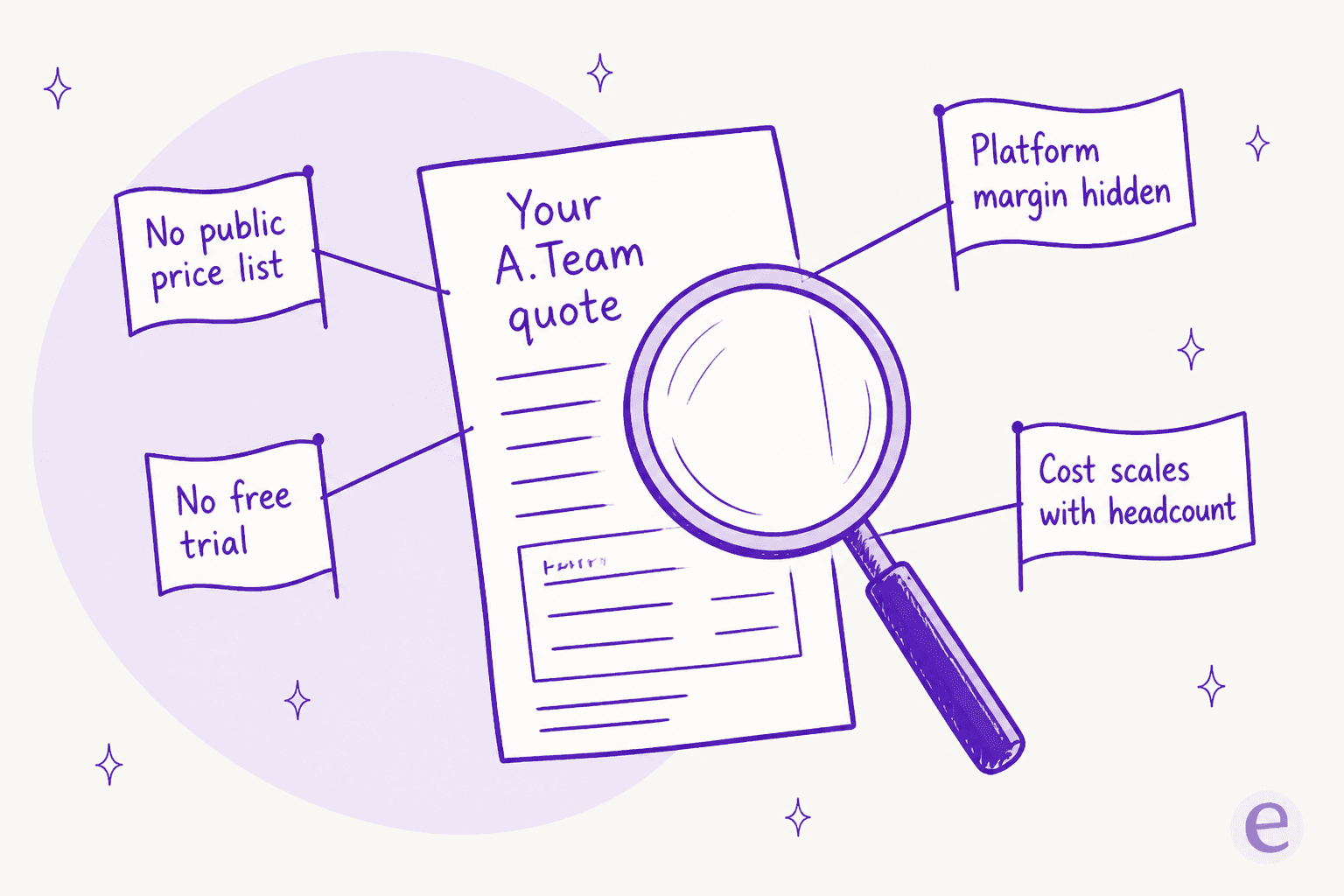
- No public price list. You can't compare A.Team on price without booking a call, which makes fast, side-by-side evaluation hard.
- No free trial or self-serve path. There's no way to try a scoped-down version yourself before money changes hands. The lighthouse pilot is the closest thing, and it's paid.
- The marketplace margin is undisclosed. On the talent side you see the builder's rate but not A.Team's fee on top.
- Cost scales with headcount and scope. Both the deployed-engineer and marketplace lines are ultimately priced against people and time, so the bill grows with the size of the team you run, not with the outcomes it produces.
None of this makes A.Team a bad choice. For a genuinely bespoke build or a hard-to-hire senior team, this is a sensible way to buy. It's just a model where the price is a conversation, and the meter is people, not results.
Build vs buy: when a fixed price beats a quote
Here's the reframe I'd offer anyone pricing A.Team. The question isn't really "how much does A.Team cost." It's "is the work I need done novel enough to justify funding a build or staffing a person, or is it a defined, repeatable job I could just buy the outcome of?"
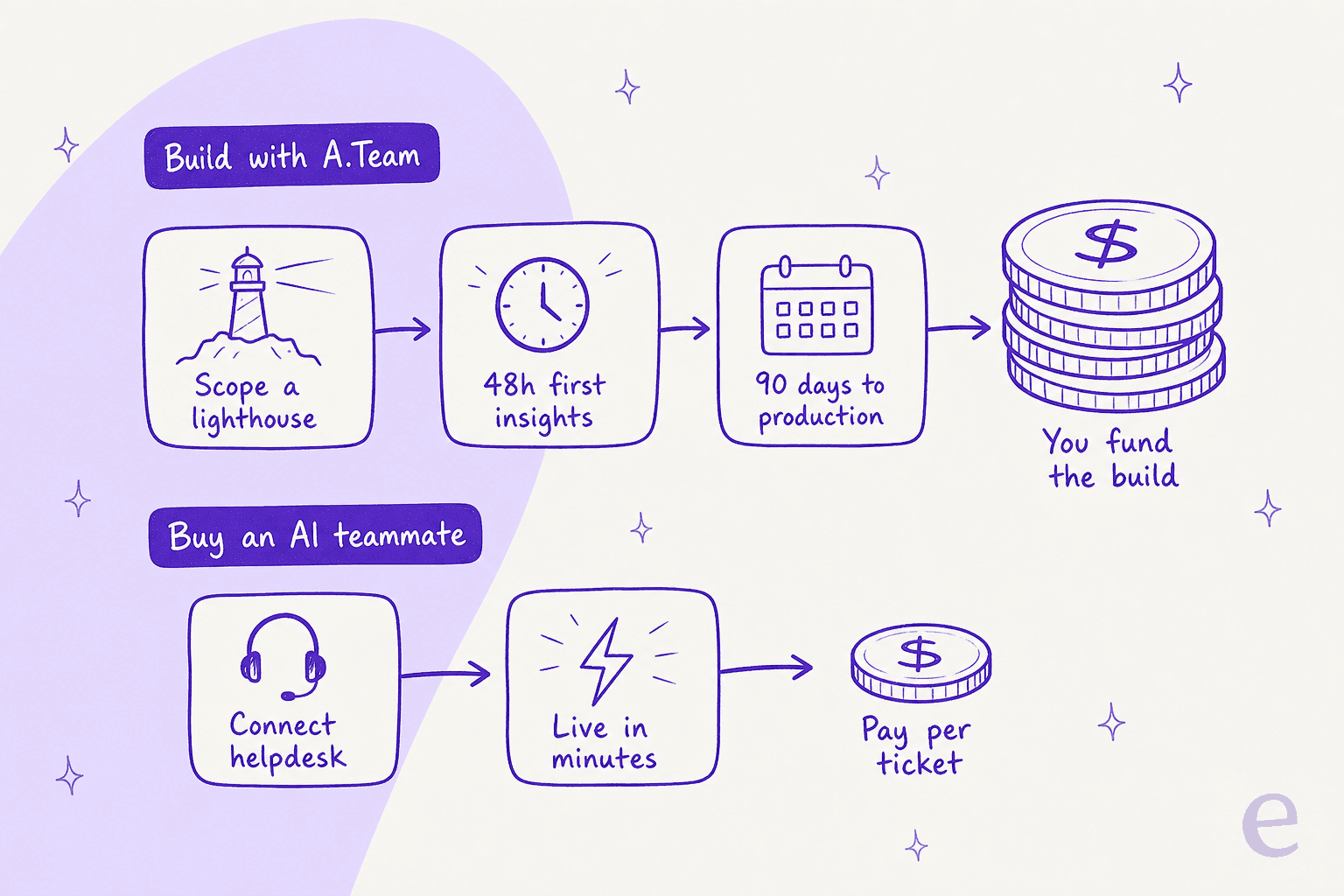
If the work is green-field, one-off, or needs human judgment a model can't own, A.Team's build-and-own model is a fair fit, and worth the quote. But a lot of what companies reach for "agentic teammates" to do is neither novel nor one-off. Resolving tier-1 support tickets, drafting content, answering the same product questions a thousand times, that work is defined and repeatable, and it's exactly the kind of job where a 90-day custom build is the expensive way to solve a solved problem. For that, an off-the-shelf AI teammate with a published per-outcome price gets you live in minutes at a fraction of the spend, and you know the number before you commit.
Try eesel
If the job you're actually pricing is support or content, that's where I'd reach for eesel instead of a bespoke build. eesel is an AI teammate platform, and you hire ready-to-work teammates for specific jobs, currently an AI helpdesk teammate and an AI blog writer. Each one arrives already knowing the skills, integrations, and company context for its role, so there's no build phase to fund and no engineer to embed.

The contrast with A.Team's model is the whole point. Where A.Team quotes you and builds over 90 days, the helpdesk teammate plugs into the Zendesk, Freshdesk, Gorgias, or Front queue you already run, learns from your past tickets and knowledge base, and you can simulate it on your past tickets before it answers a single live customer. Pricing is one fixed monthly price from $299 for 500 credits (1 credit per ticket or chat), with no seats and no platform fee, and the free plan gives you 100 credits with no credit card. The number is on the page, not on a call.
That doesn't make A.Team wrong for what it does. It just means if your job is defined, you can skip the quote entirely, see the price, and be live before A.Team's lighthouse pilot would have finished its first 48 hours.