Suggested reply
A suggested reply is an AI-drafted response shown to a support agent, who can edit, approve, or discard it before it reaches the customer.
What a suggested reply means
A suggested reply is an AI-drafted response shown to a support agent, who can edit, approve, or discard it before it reaches the customer. Rather than sending automatically, the draft sits in the agent's workspace as a starting point: the system has done the reading and the first pass at an answer, and the human makes the final call. It is the assistive middle ground between an agent writing every word and an AI replying with no review.
In customer support, suggested replies are how teams get the speed of automation while keeping a person accountable for what goes out. The agent stays in the driver's seat, but the blank page is gone: instead of composing from scratch, they react to a draft, which is faster and keeps tone and accuracy consistent across a team.
Why suggested replies matter
- They remove the blank page. Agents edit a draft instead of composing every reply from zero, which is the slowest part of the job.
- They keep a human accountable. Nothing ships without review, so the team holds the human-in-the-loop on every message.
- They standardize quality. New and experienced agents send from the same grounded baseline, so tone and accuracy stay consistent.
- They beat static templates. Unlike a canned response, each draft is written for the specific ticket in front of the agent.
- They build trust gradually. Teams often start with suggestions, watch the quality, and only then let the system send directly for well-understood requests.
It helps to see where a suggested reply sits on the scale of who actually writes the message:
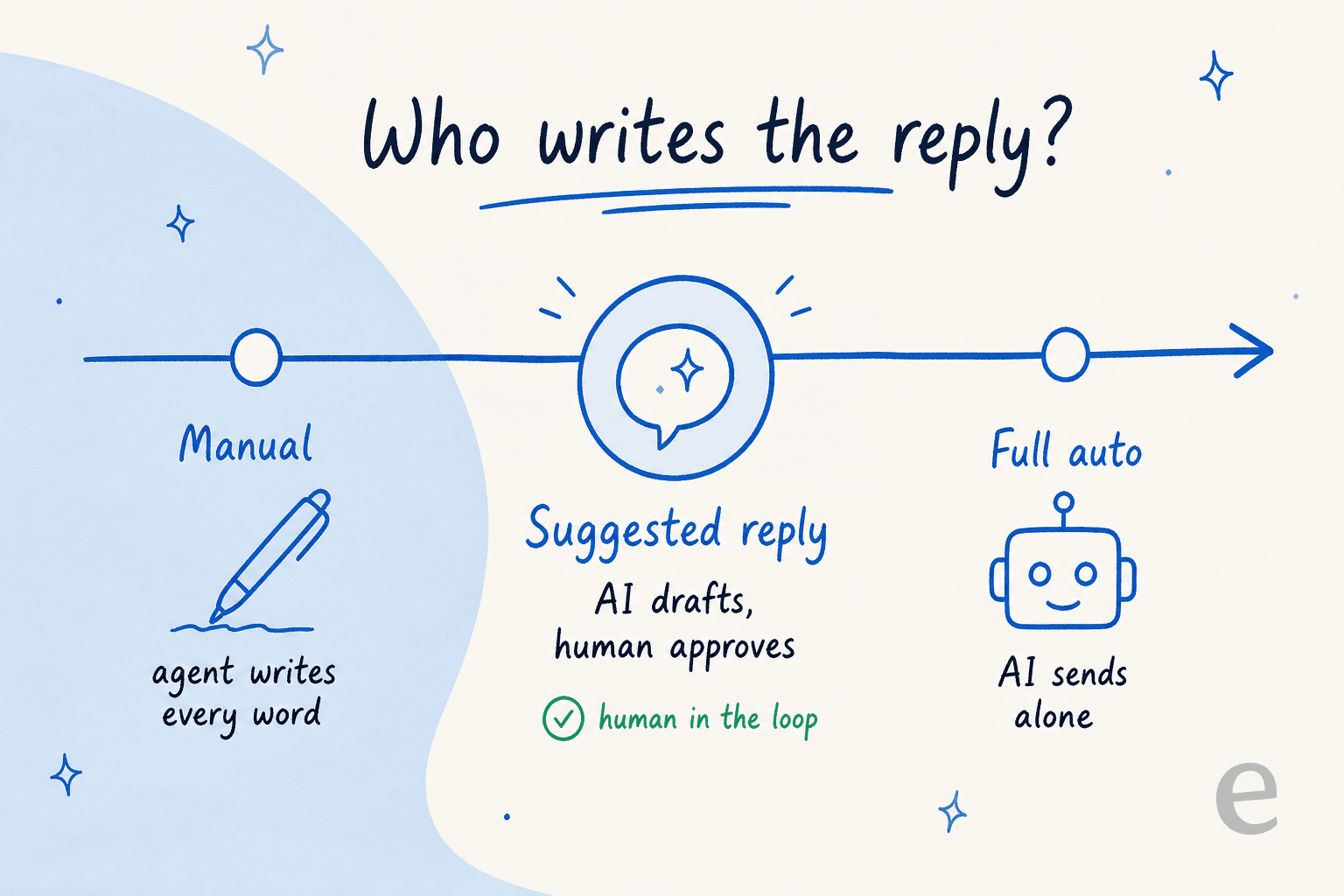
The point is the middle stop. A suggested reply is neither the agent typing every word nor the AI sending unsupervised; it is the spot where the AI does the drafting and a human still owns the send button, which is what keeps the human in the loop.
How a suggested reply works
The flow is the same loop a fully automated agent runs, paused one step before sending:
- Read the conversation. The model interprets the customer's question and the thread's context.
- Retrieve the answer. It pulls relevant facts from your help center, docs, and past tickets rather than guessing.
- Draft the reply. It writes a response grounded in those sources, matched to the question and the team's tone.
- Surface it to the agent. The draft appears in the agent's view with its sources, ready to edit or approve.
- Agent decides. The agent sends as-is, tweaks it, or discards it, and that choice can feed back into future suggestions.
An AI support agent like eesel AI can run in exactly this mode: it drafts a grounded reply for the agent to approve, and because every draft cites the source it came from, the agent can verify the answer before sending instead of trusting it blind. The same engine can graduate to sending autonomously once a team trusts it on a given topic.
Suggested replies in practice
The deciding factor for a suggested reply is not how fluent it sounds, it is whether the agent can trust it at a glance. A confident draft built on the wrong article costs more time than no draft at all, because the agent has to catch the error before it ships. That is why grounded drafts that show their sources work better in the long run than slick prose with no citation: the agent can confirm the answer in seconds, approve it, and move on, which is the entire point of the feature.
Draft replies your agents can trust
eesel AI drafts grounded replies from your help center and past tickets, so agents edit and send instead of writing from scratch.