I track what people actually search for around new AI tools, and "Sora 2 pricing" went vertical the moment OpenAI's video model started showing up in everyone's feed. The honest answer has changed a lot since launch, when it was an invite-only iOS app and the only real question was whether you could get in.
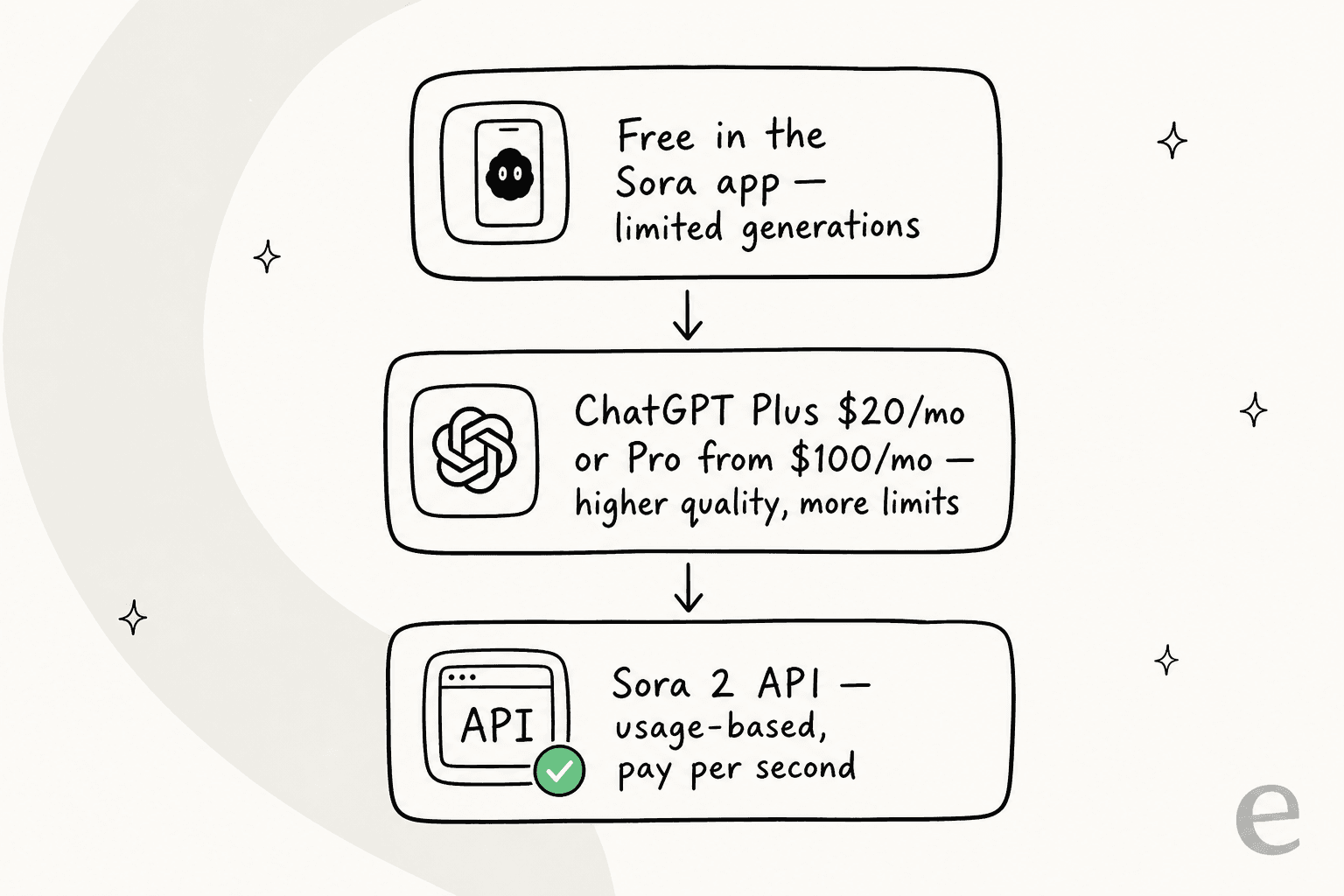
In 2026, the simple version is this: you can use Sora 2 for free inside the Sora app (with limits), get a better version through a ChatGPT subscription, or call it directly via a usage-based API. The full story, as you might expect, is a little more nuanced.
I’ll dig into everything you need to know about Sora 2 pricing. I’ll cover what this model is, how the free, ChatGPT, and API paths work, how its costs stack up against other tools, and where the real "hidden" costs live, the part that matters most if you’re thinking about using it for a business.
What is OpenAI’s Sora 2?
Sora 2 is OpenAI’s text-to-video model, and you can think of it as a huge leap forward from the original. It's capable of creating realistic videos from just a text prompt, complete with synchronized dialogue and sound effects. The official Sora 2 announcement calls it a major step up in simulating the real world with more accuracy and control.
One of the features getting a lot of attention is "cameos." This lets you pop yourself or your friends into AI-generated scenes, which really starts to blur the line between what's real and what's created.
Instead of just being a tool on a website, OpenAI launched Sora 2 through a dedicated social app on iOS called "Sora," positioning it as a direct competitor to feed-based platforms like TikTok, with a big focus on creating, remixing, and sharing content. At launch it was invite-only in the U.S. and Canada, but access has since opened up well beyond that first waitlist.
The current Sora 2 pricing model: Is it really free?
Yes, there’s a genuine free path: you can generate videos inside the Sora app without paying. But there are a few things to keep in mind about this "free" access.
The free tier comes with generation limits that OpenAI ties to available compute, which is a fancy way of saying that if a lot of people are using it, you might find your creative session cut short. It’s best to think of the free app as the front door, great for experimenting, not a permanently unlimited service.
Understanding the pricing tiers: Sora 2 vs. Sora 2 Pro
Once you’re in, there are a few different levels of access, and this is where the actual Sora 2 pricing lives.
-
The free app tier: This is what most people start with. It gives you access to the core features, video and audio generation plus the cameo function, with capped generations. It's the perfect place to start experimenting and see what the model can do.
-
Sora 2 via ChatGPT: If you subscribe to ChatGPT Plus ($20/month), you get video generation with more headroom than the free app. Sora 2 Pro, the experimental, higher-quality version, is bundled with ChatGPT Pro, which now starts at $100/month (the original launch tier was $200/month). For creators who need the best output, that ChatGPT Pro subscription effectively sets the baseline price for top-tier Sora 2 videos.
-
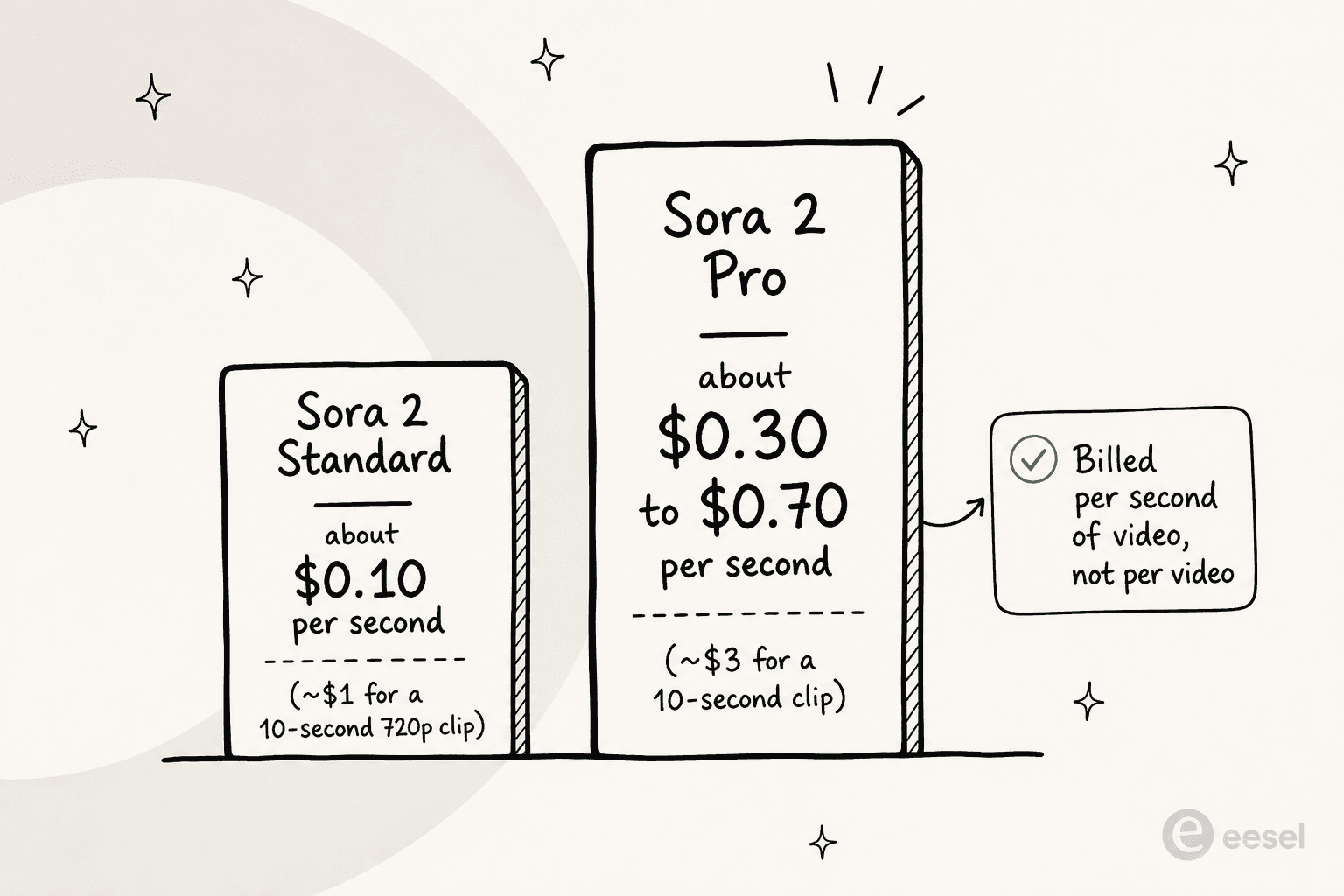
The Sora 2 API: The biggest change since launch is that developers can now call Sora 2 directly. Pricing is usage-based and billed per second of video, consistent with OpenAI’s other API models. Standard Sora 2 runs around $0.10 per second at 720p, roughly $1 for a 10-second clip, while Sora 2 Pro costs more per second as resolution climbs, landing closer to $3 for a comparable 10-second clip.
What future Sora 2 pricing changes look like
OpenAI was always open about the free ride not lasting forever, and the developer API is the proof. Now that per-second pricing exists, the levers OpenAI can pull are the in-app free limits and the exact API rates, both of which will move as demand and compute costs change.
For a casual creator, that means the free app stays the easiest on-ramp. For anyone generating video at volume, the per-second API model gives you flexibility, but it also makes costs hard to predict, which is the exact tension that matters once a business gets involved.
How Sora 2 pricing compares to the competition
Sora 2 isn't the only AI video tool out there, and the competition gives us good clues about where the whole category is heading. Its main rivals already have set prices for different types of users.
Here’s a quick rundown of how the top platforms compare:
| Feature | OpenAI Sora 2 | Google Veo | Meta Vibes |
|---|---|---|---|
| Key Capability | Hyper-realistic video & audio, "cameo" feature | Cinematic realism, synchronized audio | Social-focused, remixing, cross-posting |
| Current Pricing | Free app / ChatGPT Plus ($20/mo) & Pro (from $100/mo) / usage-based API (~$0.10/sec) | Bundled into Google's Gemini plans | Free (integrated into Meta AI apps) |
| Primary Audience | Creative professionals, social media creators, developers | Professional creators, filmmakers | Casual social media users |
| Availability | Sora iOS app, ChatGPT, and API | Via Gemini / Google AI | Integrated into Meta apps |
Sora 2's free-to-start app is a smart way to build a big user base fast, similar to what Meta is doing with Vibes. The difference now is that OpenAI has also opened the usage-based API, so it's serving casual creators and developers at the same time. If none of these click, it's worth scanning the wider field. I keep running notes on Runway, Synthesia pricing, and the Imagine vs Sora comparison. The fast-moving end of the category now includes Dreamina and Grok Imagine too.
The hidden costs: Limitations and other considerations
The headline rate is just one piece of the puzzle. Using any generative AI tool, especially for creative projects, comes with some "hidden costs" and hurdles you should think about.
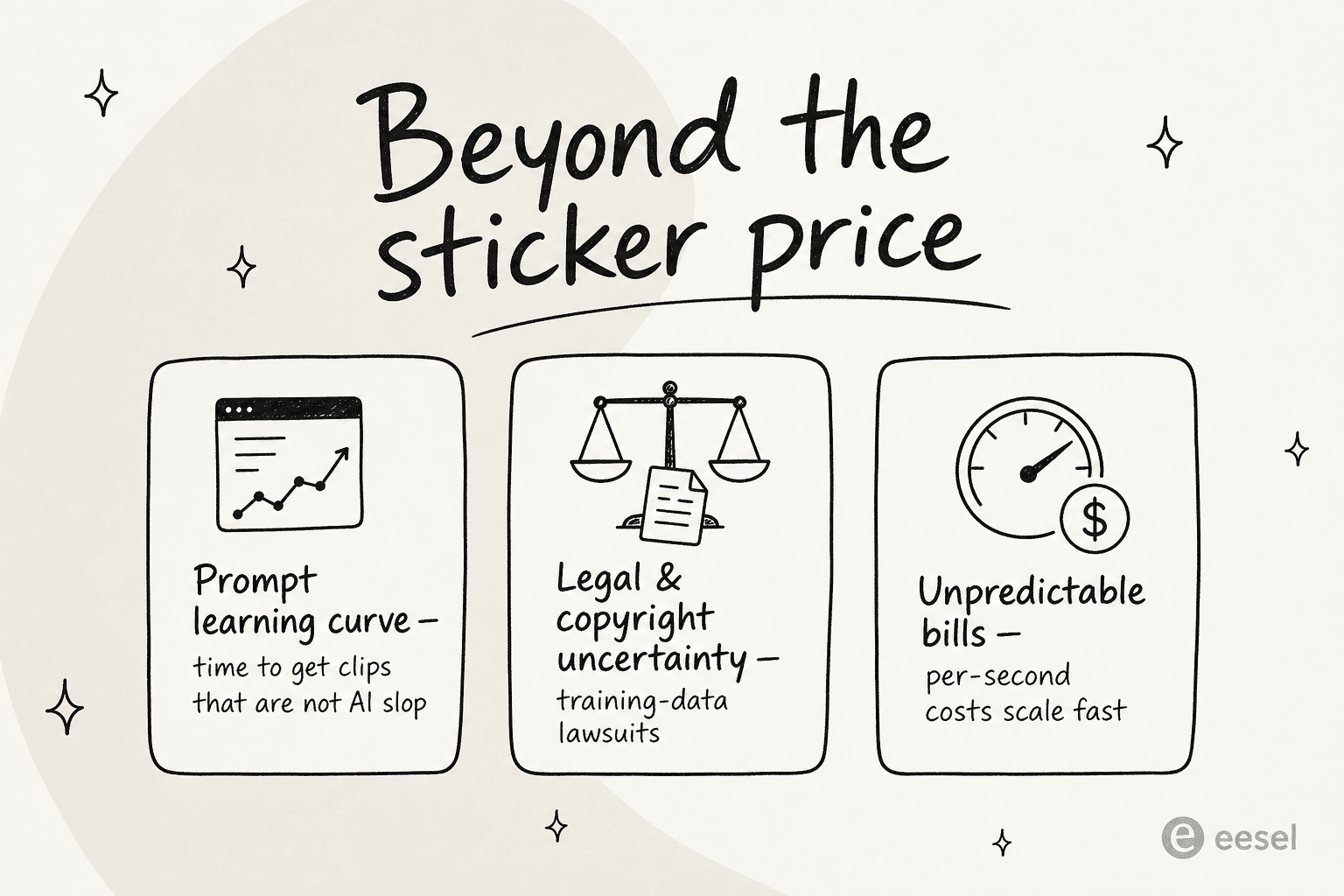
First off, there’s the learning curve. Anyone who's played with AI image generators knows that the secret to a great result is writing a great prompt. The same goes for video.
Learning how to engineer good prompts takes time and practice, which is an investment of its own.As people are discovering on forums like Reddit, there's a very fine line between an amazing cinematic clip and something people are calling 'AI slop.'

Then there's the messy legal and ethical side of things. Generative AI models are trained on huge datasets, and the conversation around copyright is far from over. OpenAI has been through high-profile litigation over its training data, which shows a potential risk for anyone trying to build a business on top of these tools. These unresolved questions are a kind of hidden cost because the rules could change at any moment.
Beyond Sora 2 pricing: Get predictable AI results where it counts
The creative possibilities of Sora 2 are exciting, but its per-second costs and shifting limits create a lot of uncertainty. For a business, predictability is everything, especially for something as important as customer support. You just can't afford to deal with wild cost swings or a bill that balloons after a busy month.
This is where a tool like eesel AI makes a lot of sense. It’s an AI agent built specifically for the high-stakes world of customer service, where a clear return on investment and stable costs are must-haves. I’ve seen plenty of teams get burned by usage-based AI tools where every interaction is a coin flip on cost, so this is the angle I care about most.
Here’s how it tackles the same challenges you see in the creative AI space:
-
Transparent, usage-based pricing: With Sora 2, your bill scales with every second of video. eesel AI is also usage-based, but the rate is simple and flat, you pay per AI interaction with no per-seat fees and no surprise per-resolution surcharges, so you can actually forecast the bill before the month starts.
-
Go live in minutes, not months: eesel AI is completely self-serve. You can connect it to your helpdesk (like Zendesk or Freshdesk), train it on your knowledge from sources like Confluence or Google Docs, and have it running the same day, all without talking to a salesperson.
-
Test with confidence: Creative AI is fun to experiment with, but business AI is all about managing risk. eesel AI comes with a simulation mode that runs your setup on thousands of your past tickets, so you see exactly how it will perform and get solid forecasts on resolution rate, CSAT, and cost savings before you turn it on for customers. One team, Gridwise, watched it resolve 73% of their tier-1 requests in the first month.

The future of Sora 2 pricing
Sora 2 is a fascinating tool, and its pricing is a perfect snapshot of where it sits in its journey: a free app for casual creators, a better experience for ChatGPT subscribers, and a usage-based API for developers who want to build on top of it. All the signs suggest the per-second rates and free limits will keep moving as OpenAI balances demand against compute.
The world of AI video is moving incredibly fast, but it’s also full of the kind of volatility that businesses need to steer clear of in their day-to-day operations. When it comes to something as vital as customer service, you want a tool that's reliable, predictable, and built for business from the ground up.
Ready to use AI with predictable costs and a clear ROI? Try eesel and see how you can automate your support in minutes, not months.
Frequently asked questions
How does Sora 2 pricing work for new users today?
You can start for free inside the Sora app, which gives you a capped number of generations subject to OpenAI's available compute. For higher quality and more headroom, you go through a ChatGPT subscription, and developers can call the Sora 2 API directly with usage-based, pay-per-second pricing.
What is the Sora 2 pricing for the Pro tier, and who can access it?
Sora 2 Pro, the higher-quality version of the model, is bundled with ChatGPT Pro, which now starts at $100/month. ChatGPT Plus ($20/month) also includes video generation with tighter limits. Neither is a separate Sora charge, it's part of the existing subscription.
What are the Sora 2 pricing changes in 2026 and beyond?
The big change since launch is that the developer API is now live, so Sora 2 pricing is no longer just "free with an invite." Expect OpenAI to keep tuning per-second API rates and in-app generation limits as demand and compute costs shift.
How does Sora 2 pricing stack up against competitor AI video tools?
Sora 2's free-app-plus-ChatGPT model contrasts with subscription-bundled tools like Google's Veo (sold through its Gemini plans) and Meta Vibes, which is free inside Meta's apps. If Sora doesn't fit, my roundups of Pika alternatives and Runway are good next stops.
What is the Sora 2 API pricing model for developers?
The Sora 2 API is usage-based and billed per second of video, consistent with OpenAI's other models. Standard Sora 2 runs around $0.10 per second at 720p (about $1 for a 10-second clip), while Sora 2 Pro costs more per second for higher resolutions.


Article by
Kurnia Kharisma Agung Samiadjie
Kurnia is a software engineer and writer at eesel AI with two years of SEO experience, writing about AI tools, helpdesk software, and customer support. He pairs a developer's understanding of how these products are built with search-driven research into what actually ranks and resonates with the people searching for them.