
You want to automatically add an account manager as a follower whenever a ticket comes in from their assigned organization. Or maybe you need to loop in a technical specialist based on a product field. It seems like something Zendesk triggers should handle natively, right?
Here's the problem: Zendesk's "Add follower" action only lets you pick specific users. You can't point it at a custom field and say "add whoever is in this field." It's a static selection in a world that needs dynamic automation.
This guide walks you through three ways to solve this. We'll start with the simplest approach for small teams, move to a scalable webhook solution for growing operations, and show you how we handle this at eesel AI for teams that want intelligent automation without writing code.
What you'll need
Before diving in, make sure you have:
- A Zendesk Suite or Support plan (Team, Growth, Professional, or Enterprise)
- Admin permissions to create triggers, webhooks, and API tokens
- For the webhook approach: basic comfort with JSON and Liquid markup
- The CCs and followers feature enabled in your Admin Center settings
To check if followers are enabled, head to Admin Center > Objects and rules > Tickets > Settings. Look for the "Allow followers" checkbox under the CCs and followers section.
Understanding the Zendesk trigger add follower by custom field limitation
Let's clarify what doesn't work. You might think you could create a trigger with conditions like "Organization is Acme Corp" and then use a placeholder like {{ticket.organization.custom_fields.account_manager}} in the "Add follower" action. It makes sense conceptually, but Zendesk doesn't support it.
The "Add follower" action presents a dropdown of specific users. You pick one. You can't use placeholders or dynamic values to select who gets added. This is the core limitation that sends admins hunting for workarounds.
What triggers CAN do is read custom field values as conditions. You can check if a field has a value, compare it to specific text, or verify it's not empty. But the action side (what actually happens) can't use those dynamic values for follower selection.
This creates a real operational headache. If you have 50 organizations each with their own account manager, you'd need 50 separate triggers without a workaround. That's not maintainable.

Method 1: Individual triggers for each organization
The simplest solution works best for small operations with fewer than 20 organizations.
How it works
Create one trigger per organization that needs automatic follower assignment. Each trigger has a hardcoded follower selection.
Setting it up
- Go to Admin Center > Objects and rules > Business rules > Triggers
- Click "Create trigger"
- Set conditions: "Ticket is Created" AND "Organization is [Specific Org]"
- Add action: "Add follower" and select the specific agent
- Save and repeat for each organization
Pros and cons
| Pros | Cons |
|---|---|
| No technical complexity | Doesn't scale beyond ~20 organizations |
| Works immediately | Maintenance nightmare when staff changes |
| Easy to understand | Requires admin access for every update |
| No API tokens or webhooks | No audit trail of who made changes |
When to use this
This approach makes sense for proof-of-concept implementations, very small teams, or situations where account assignments rarely change. If you're testing whether automatic follower assignment improves your workflow, start here before investing in more complex solutions.
For more on setting up basic triggers and macros, see our guide on how to add followers automatically with triggers or macros in Zendesk.
Method 2: Webhook and API approach (scalable)
For teams managing 20+ organizations or dealing with frequent account reassignments, the webhook approach provides a scalable solution. It uses organization custom fields to store follower emails, then calls the Zendesk API to add them dynamically.
Step 1: Create organization custom fields
First, you need a place to store the follower email addresses on each organization record.
Navigate to Admin Center > People > Configuration > Organization Fields. Click "Add field" and select "Regex" as the field type.
Configure the field:
- Display name: Auto Follow
- Field key: auto_follow
- Description: Comma-separated email addresses of agents to add as followers
- Validation regex:
^([\w+-.%]+@[\w.-]+\.[A-Za-z]{2,4})(,[\w+-.%]+@[\w.-]+\.[A-Za-z]{2,4})*$
This regex validates comma-separated email addresses without spaces. For example: manager1@company.com,manager2@company.com
Step 2: Create a Zendesk API token
Your webhook needs authentication to call the Zendesk API.
Go to Admin Center > Apps and integrations > APIs > Zendesk API. Click "Add API token" and give it a descriptive name like "Follower Automation Webhook."
Copy the token immediately (you can't see it again). Store it securely in your password manager. You'll use this token in the format: your-email@company.com/token:{api_token}
Step 3: Create the webhook
Now create the webhook that will receive trigger notifications and call back to the Zendesk API.
Navigate to Admin Center > Apps and integrations > Webhooks > Create webhook. Select "Trigger or automation" as the connection type.
Configure these settings:
- Name: Add auto_follow followers
- Endpoint URL:
https://{yoursubdomain}.zendesk.com/api/v2/tickets/{{ticket.id}}.json - Request method: PUT
- Request format: JSON
- Authentication: Basic Authentication
- Username: Your agent email with
/tokenappended (e.g.,admin@company.com/token) - Password: The API token you created
Step 4: Create the trigger
The trigger detects when a ticket needs followers added and calls your webhook.
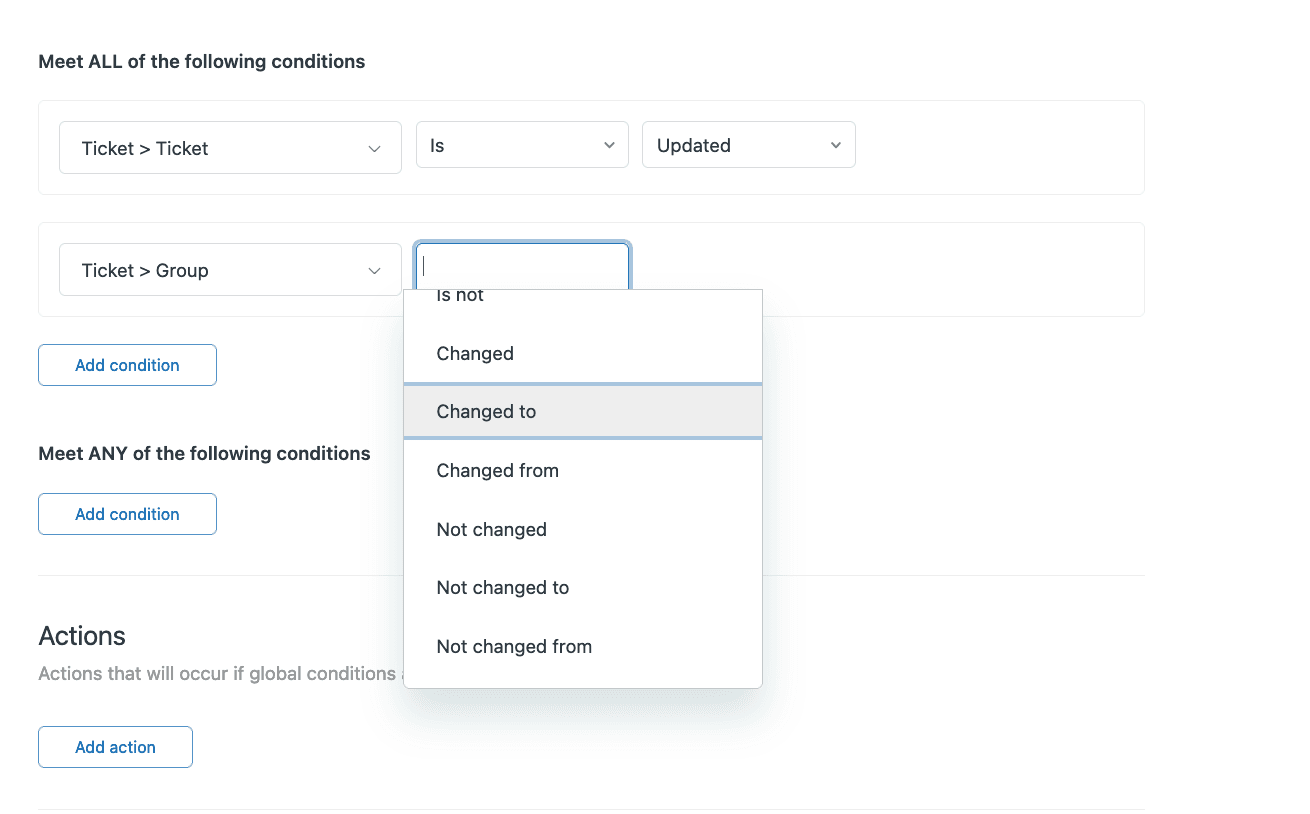
Create a new trigger with these conditions:
- Meet ALL: Ticket is Created
- Meet ANY: Organization > Auto Follow is present
Add this action:
- Notify by: Active Webhook (select the webhook you created)
- JSON body:
{"ticket": {"followers": [
{% assign emails = ticket.organization.custom_fields.auto_follow | split: ',' %}
{% for email in emails %}{"user_email": "{{ email | strip }}", "action": "put"}{% unless forloop.last %},{% endunless %}{% endfor %}
]}}
This Liquid markup parses the comma-separated emails from your custom field and formats them as JSON objects for the API.
Testing and validation
Before going live:
- Test in your Zendesk sandbox first
- Create a test organization with your own email in the Auto Follow field
- Submit a ticket as an end user
- Verify you were added as a follower
- Check the webhook logs in Admin Center for any errors
Troubleshooting common issues
Race conditions: If multiple webhooks fire simultaneously updating the same ticket, you might encounter update conflicts. The API returns a 409 Conflict error when this happens. For high-volume instances, consider using ZIS (Zendesk Integration Services) flows instead of webhooks, as they guarantee execution after the trigger cycle completes.
Email validation failures: If the regex allows invalid emails through, the API silently ignores non-existent users. Double-check your validation pattern and test with various email formats.
Webhook timeouts: Zendesk webhooks timeout after 10 seconds. If your instance is slow or the API is experiencing latency, you might see failed webhook calls. Implement retry logic or use a middleware service for critical workflows.
Method 3: AI-powered automation with eesel AI
For teams wanting intelligent follower assignment without managing webhooks and JSON payloads, we offer a different approach. Our platform connects to Zendesk and handles follower automation through natural language rules rather than technical configuration.
How we complement Zendesk
We integrate directly with Zendesk to:
- Read ticket content, organization data, and custom fields
- Apply intelligent rules to determine who should follow each ticket
- Add followers automatically via the same API webhooks use
- Handle errors, retries, and edge cases without manual intervention
Advantages over the webhook approach
| Feature | Webhook Method | eesel AI |
|---|---|---|
| Setup complexity | Requires JSON/Liquid coding | Natural language rules |
| Error handling | Manual monitoring required | Built-in retry logic |
| Logic complexity | Limited to field matching | AI-powered routing decisions |
| Maintenance | Technical admin required | Business user friendly |
| Scalability | Manual webhook management | Automatic scaling |
Instead of writing Liquid markup, you define rules like: "Add the enterprise account manager as a follower for tickets from organizations with over 500 employees" or "Include the technical lead when the product field contains 'Enterprise Suite.'"
Our AI Triage reads ticket content to understand context, not just match field values. This means you can route based on sentiment, urgency signals, or complex combinations of factors that would be impossible with standard triggers.
Setup overview
- Connect your Zendesk account to eesel AI
- Define follower rules in plain English
- Test against historical tickets
- Deploy with confidence
When to choose this approach
Consider eesel AI if:
- The webhook approach feels too technical for your team
- You need AI-powered routing beyond simple field matching
- You want built-in error handling without custom development
- Your follower logic involves complex business rules
- You're already using AI tools and want unified automation
Best practices for Zendesk trigger add follower by custom field automation
Regardless of which method you choose, keep these principles in mind:
Security: Store API tokens in secure credential managers, not shared documents. Rotate tokens quarterly. Use dedicated service accounts rather than personal admin credentials for webhook authentication.
Performance: Webhooks add a slight delay (usually 1-3 seconds) to ticket processing. For instances handling thousands of tickets per hour, consider ZIS flows or batch processing to avoid API rate limits.
Notification timing: Followers don't receive immediate notification when added. They get notified on the next public or internal comment. Set expectations accordingly with your team.
Testing: Always validate in sandbox first. Test edge cases like empty fields, malformed emails, and concurrent updates before deploying to production.
Documentation: Document your custom field naming conventions, webhook logic, and any Liquid markup. The next admin will thank you when they need to troubleshoot or extend the automation.
Monitoring: Set up alerts for webhook failures. Zendesk logs webhook attempts in Admin Center, but proactive monitoring catches issues before they impact operations.
Scalability: Plan for growth. Individual triggers break down around 20-30 organizations. Webhooks scale further but require more maintenance. Choose an approach that fits your 12-month growth projection.
For a broader understanding of business rules in Zendesk, check out our complete guide to Zendesk business rules.
Choosing the right approach for your team
Here's a simple framework to help you decide:
| Team Size | Technical Resources | Recommended Approach |
|---|---|---|
| 1-10 organizations | Any | Individual triggers |
| 10-50 organizations | Technical admin available | Webhook method |
| 50+ organizations | Any | eesel AI or custom development |
| Complex routing needs | Limited | eesel AI |
Start simple. You can always migrate from individual triggers to webhooks, or from webhooks to AI automation as your needs evolve. The key is getting value quickly without over-engineering for future scenarios that might never materialize.
Start automating your follower assignments
You've now got three viable paths to solve the Zendesk trigger add follower by custom field limitation. Whether you choose the simplicity of individual triggers, the scalability of webhooks, or the intelligence of AI automation, the goal remains the same: get the right people looped in on tickets without manual work.
The operational benefits add up quickly. Account managers stay informed about their clients. Technical specialists get visibility into relevant issues. Escalations happen faster because the right people are already following.
If you're ready to implement intelligent follower automation without managing webhooks and JSON, try eesel AI. We handle the technical complexity so you can focus on delivering better customer experiences.


