
How to create Zendesk Explore satisfaction trend reports
Customer satisfaction data tells you whether your support team is actually helping people or just closing tickets. But raw scores don't reveal much. You need to see how satisfaction changes over time, which agents are excelling, and whether your improvements are working. Satisfaction trend reports give you this visibility.
Zendesk Explore gives you the tools to build these reports, but the recipes are scattered across help articles. This guide brings together the most useful satisfaction trend reports in one place: year-over-year comparisons, agent-level tracking, and the classic Satisfaction tab views you might be missing from older Zendesk versions.
What you'll need
Before building these reports, make sure you have:
- Zendesk Explore Professional or Enterprise the custom reporting features aren't available on lower tiers
- Editor or Admin permissions in Explore to create and save reports
- Ticket data with satisfaction ratings enabled in Zendesk Support (the native CSAT survey must be active)
- About 15-30 minutes per report type for setup and customization
Step 1: Build a Zendesk Explore satisfaction trend report for year-over-year comparison
Year-over-year trending shows whether your customer satisfaction is improving, declining, or holding steady. It accounts for seasonal fluctuations and gives you a long-term view of team performance.
Here's how to build it:
Create date range calculated metrics
- In Explore, click the reports icon, then New report
- Select Support > Support - Tickets, then click Start report
- In the Calculations menu, choose Date range calculated metric
- Name your first metric "% CSAT This Year"
- From the Original metric dropdown, select % Satisfaction score
- Set Defined on to Ticket solved
- On the Simple tab, select This year, then save
- Repeat steps 3-7 to create "% CSAT Last Year", choosing Last year instead
Build the report structure
- In the Metrics panel, click Add and select both calculated metrics you just created
- Set the aggregator to AVG for each metric
- In the Columns panel, add Ticket > Ticket solved - Month
- From Chart configuration, select Trend line and choose your preferred calculation type
The result shows two lines: one for this year's satisfaction scores and one for last year's, plotted month by month. You can extend this approach to compare quarter-over-quarter or create rolling 90-day comparisons by adjusting the date ranges in your calculated metrics.
Step 2: Create agent-level satisfaction reports
Individual agent performance varies, and satisfaction reports help you identify your top performers, spot agents who need coaching, and ensure fair workload distribution.
Set up the basic report
- Create a new report using the Support - Tickets dataset
- In the Metrics panel, add:
- Tickets > Solved tickets
- Customer satisfaction > % Satisfaction rated
- Customer satisfaction > % Satisfaction score
- In the Columns panel, add Assignee > Assignee name
Configure the visualization
- Set the chart type to Column
- Click % Satisfaction rated and change the axis to Dual
- Do the same for % Satisfaction score
- From Chart configuration > Secondary axes, set the type to Column
- Under SUM(% Satisfaction rated), set the Max value to 1 (this displays as 100%)
- Hide titles under each metric and hide one axis to reduce visual clutter
- Set display format to % for both satisfaction metrics
- Enable Show value under Displayed values
The dual-axis approach lets you see both the satisfaction score (quality) and the percentage of tickets rated (response rate) for each agent. An agent with a 95% satisfaction score but only 30% response rate might be cherry-picking easy tickets, while someone with 85% satisfaction and 80% response rate is handling tougher cases consistently.
Step 3: Replicate legacy Satisfaction tab reports
If you used Zendesk before Explore, you might remember the Satisfaction tab in the old interface. It showed surveys sent, ratings received, and comments in a clean dashboard. You can recreate this in Explore with two custom reports and some pre-built components.
Create the "Surveys sent" report
- New report, Support - Tickets dataset
- Add the metric Customer satisfaction > Surveyed satisfaction tickets
- Save this as "Surveys sent"
Create the "Feedback" report
- Create another new report with the same dataset
- Add the metric Customer satisfaction > Rated satisfaction tickets
- In the Rows panel, add:
- Assignee > Assignee name
- Customer satisfaction > Ticket satisfaction rating
- Ticket satisfaction comment
- Ticket satisfaction reason
- Reorder columns so they appear as: Assignee name, Ticket ID (clickable link), Rating, Reason, Comment
- Set Text interpretation to HTML and enable Clickable URL
- Save as "Feedback"
Build the dashboard
- From the Dashboards library, click Create dashboard
- Add these reports:
- Your custom "Surveys sent" report
- Your custom "Feedback" report
- Pre-built Satisfaction: Satisfaction score [default]
- Pre-built Satisfaction: Good satisfaction tickets [default]
- Pre-built Satisfaction: Bad satisfaction tickets [default]
- Pre-built Satisfaction: Satisfaction rated ratio [default]
- Add filters for Time, Ticket satisfaction rating, Ticket satisfaction comment, and Ticket satisfaction reason
This dashboard gives you the complete picture: how many surveys went out, what ratings came back, and the actual comments behind those ratings. The clickable ticket links let you drill into specific conversations when you spot patterns.
Interpreting your satisfaction trends
Building reports is only half the battle. Here's how to read what they're telling you:
Year-over-year patterns
A steady upward trend means your training and process improvements are working. Flat lines suggest you've hit a ceiling with current approaches. Declining trends need immediate investigation. Look for correlations: did satisfaction drop after a product launch, policy change, or team restructuring?
Seasonal fluctuations
Retail businesses often see satisfaction dip during holiday rushes. SaaS companies might see drops during major releases. These aren't necessarily problems to fix, they're patterns to anticipate and staff for.
Agent-level insights
Top performers aren't just those with high scores. They're agents maintaining high satisfaction while handling significant volume. Use these reports for recognition, not punishment. An agent with lower scores might be working on your most complex tickets.
Connecting to business outcomes
Satisfaction trends correlate with retention and churn. A 5-point satisfaction drop often precedes increased cancellations by 30-60 days. Use your reports to spot early warning signals.
For a deeper dive into CSAT strategy, see our practical guide to Zendesk CSAT measurement and reporting.
Common pitfalls and how to avoid them
Even well-built reports can mislead if you misread them. Watch out for these issues:
Low survey response rates
If fewer than 20% of your solved tickets get rated, your data might not represent your customer base. Zendesk's binary Good/Bad scale helps here, it's designed to maximize responses. Consider follow-up automations for customers who don't respond initially.
Confusing satisfaction rated vs satisfaction score
"Satisfaction rated" is the percentage of tickets that received any rating. "Satisfaction score" is the percentage of those ratings that were positive. An agent with 50% rated and 90% score is different from one with 90% rated and 50% score. Make sure your reports distinguish these clearly.
Ignoring ticket volume
An agent who solved 10 tickets with 100% satisfaction looks better than one who solved 200 tickets with 85% satisfaction. But the second agent handled more complex work. Always consider volume alongside scores.
Missing qualitative feedback
The numbers tell you what happened. The comments tell you why. Schedule time to read through satisfaction comments weekly. Look for patterns in what customers mention, product issues, process friction, or agent behaviors.
Failing to act
The biggest pitfall is building beautiful reports that nobody uses. Set a cadence: review trends weekly, dig into anomalies immediately, and share insights with your team monthly.
Enhancing satisfaction insights with AI
Explore shows you what happened after tickets closed. AI can help you understand what's happening while conversations are still active.
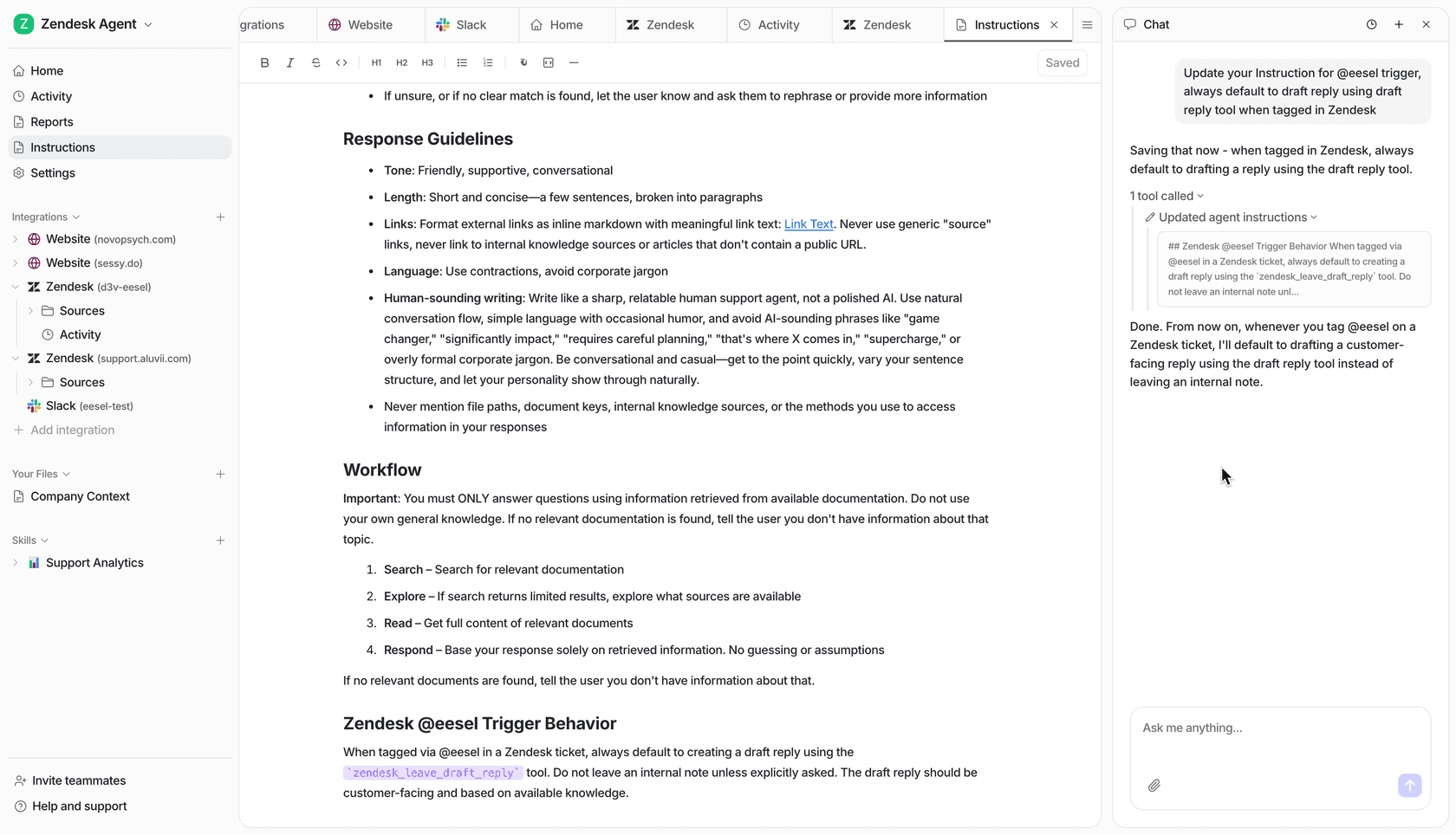
Real-time sentiment analysis identifies frustrated customers before they receive satisfaction surveys. Instead of discovering a problem through a bad rating days later, you can intervene during the conversation. Tools like eesel AI can monitor tone and flag at-risk tickets for manager review.
AI also helps close knowledge gaps that drive negative satisfaction. By analyzing tickets with poor ratings, you can identify missing help center articles or unclear documentation. Our Zendesk integration learns from your ticket history and help center to suggest improvements.
The combination works well: Explore for historical trending and reporting, AI for real-time intervention and proactive improvements. You get the full picture of satisfaction, past and present.
Start building your Zendesk Explore satisfaction trend reports today
You now have three essential report types: year-over-year trends for long-term tracking, agent-level reports for team management, and the classic Satisfaction tab view for daily operations. Start with whichever addresses your most pressing question. You can always build the others later.
The key is consistency. A report you build but never check is wasted effort. Set calendar reminders to review your trends weekly. Share dashboards with stakeholders who need visibility. And most importantly, act on what you learn.
If you're looking to complement your Explore reports with real-time AI insights, check out our pricing to see how eesel AI integrates with your existing Zendesk setup.