
File sharing is a core part of customer support. Whether it's a screenshot of an error, a PDF invoice, or a video demonstrating a bug, customers need to send files to get help. But every support platform has limits, and Zendesk is no exception.
If you're hitting Zendesk's file attachment limits and wondering what your options are, this guide breaks down exactly what you need to know. We'll cover the specific limits across different channels, explain why they exist, and walk through practical workarounds.
For a broader look at file limits across all Zendesk channels, you might also find our guide on Zendesk messaging file attachment limits helpful.
Understanding Zendesk email attachment size limits by channel
Here's the key thing to remember: Zendesk's attachment limits vary significantly depending on how customers contact you. These limits are fixed. You can't pay more or upgrade to a higher plan to increase them. Zendesk explicitly states that "it is not possible to increase the attachment size limits" across all subscription tiers.
Inbound email and web form limits
For tickets created via email or web forms, the limits are:
| User Type | File Size Limit | File Count Limit |
|---|---|---|
| Authenticated users | 50MB per file | Up to 500 files |
| Unauthenticated users | 50MB per file | 5 attachments |
Authenticated users (those logged into your help center) can attach up to 500 files per ticket, with each file capped at 50MB. This accommodates most business use cases, though it still blocks very large files like uncompressed videos or large datasets.
Unauthenticated users submitting through web forms face a stricter 5-attachment limit. This is a spam prevention measure that Zendesk doesn't allow admins to change.
Outbound email limits (the hidden constraint)
This is where many support teams get caught off guard. While Zendesk accepts inbound attachments up to 50MB, the outbound limits are much tighter:
- 7MB per single file
- 10MB total for all attachments in one email
When these limits are exceeded, Zendesk automatically converts attachments to linked attachments instead. The file is still accessible, but customers receive a download link rather than the actual file. This creates an inconsistent experience that can confuse customers.
Help center and messaging limits
For content in your help center, the limits differ by content type:
| Content Type | File Size Limit | Notes |
|---|---|---|
| Article images and attachments | 20MB per file | No limit on number of attachments |
| Community posts and comments | 2MB per image | Lower limit for user-generated content |
Messaging has the same 50MB file size limit as tickets, but with an important constraint: only one attachment per message. If a customer needs to send three screenshots, they must send three separate messages.
Why Zendesk enforces these limits
Understanding the reasoning behind these constraints helps explain why they're non-negotiable.
Email client compatibility. Even if Zendesk allowed larger attachments, email clients impose their own limits. Gmail converts attachments over 25MB to Google Drive links automatically. Outlook limits vary by organization but typically cap out around 20MB. Many corporate email servers block attachments over 10-20MB entirely. This means even if Zendesk allows a 50MB attachment, the recipient's email system may reject it.
Storage cost management. In November 2023, Zendesk began enforcing storage limits with overage charges. File Storage (attachments) is allocated separately from Data Storage (tickets, metadata). Higher-tier plans include more storage, but the per-file size limits remain the same across all tiers.
Platform performance and security. Large files can slow down ticket loading times and increase bandwidth costs. Zendesk also scans all email attachments for malware before sending notifications, which becomes more resource-intensive with larger files.
What happens when Zendesk email attachment size limits are exceeded
The user experience varies depending on which limit is hit:
Files over 50MB (inbound): The file is rejected and the user sees a warning. For email submissions, the ticket may be created without the attachment, leaving agents to follow up and request the file through another channel.
Outbound emails over 7MB/10MB: Attachments convert to links automatically. As one Zendesk user noted in the community forums: "It's not very professional to send an attachment today and a link tomorrow." This inconsistency can make your support look unpolished.
Customer confusion: When attachments appear as links instead of files, customers may not realize they need to click to download. Some email clients flag external links as suspicious, creating friction in the support process.
Impact on ticket creation: In some cases, emails with attachments that exceed limits may not create tickets at all. One user reported: "We received a video of about 110MB from our customer in our Outlook. Zendesk did not even let this mail through their system. No ticket has been created."
Workarounds for handling large files
Since Zendesk's limits are fixed, here are practical approaches for handling larger files.
Cloud storage links
The simplest workaround is hosting files externally and sharing links:
- Google Drive: Automatically converts files over 25MB to shareable links in Gmail
- OneDrive: Integrated with Microsoft ecosystems, supports files up to 250GB
- Dropbox: Direct sharing links with password protection options
- Box: Popular for business use with enterprise security features
Best practices when using cloud storage:
- Set appropriate permissions (view-only vs download)
- Use expiration dates for sensitive files
- Include the link in your Zendesk response rather than the attachment field
- Consider requiring authentication for access to sensitive documents
Third-party solutions
Several apps in the Zendesk Marketplace extend file handling capabilities:
SendSafely
SendSafely offers a Zendesk integration that supports files up to 10GB with end-to-end encryption. Unlike standard Zendesk attachments, files never touch Zendesk's servers. They're encrypted client-side and stored on SendSafely's infrastructure.
Key features:
- 10GB file size limit (vs Zendesk's 50MB)
- End-to-end encryption using OpenPGP with AES-256
- Identity verification via one-time passcode
- Files never stored on Zendesk servers
Box for Zendesk
Box integration allows agents to access and share Box files directly from tickets. While it doesn't increase attachment size limits, it streamlines the workflow of sharing large files stored in Box.
Attachment Storage Offload
This category of apps moves attachments from Zendesk to external cloud storage (AWS S3, Azure Blob, etc.) while keeping reference links in tickets. This reduces File Storage usage without losing access to the files.
Customer communication templates
Here are ready-to-use responses for explaining attachment limits to customers:
For files that are too large:
Thanks for reaching out. The file you've attached exceeds our system's size limit (50MB). Could you please upload it to a cloud storage service like Google Drive or Dropbox and share the link with us? This will help us assist you more quickly.
For explaining the link vs attachment behavior:
We've sent you a file via a secure download link rather than an attachment. This is because the file size exceeds email attachment limits. Please click the link to download your file. The link will remain active for [X days].
Proactive guidance (add to your help center):
When contacting support, please keep file attachments under 50MB. For larger files, we recommend using Google Drive, Dropbox, or similar services and including the sharing link in your message.
Managing storage to avoid overages
Beyond per-file size limits, Zendesk enforces total storage allocation based on your plan and agent count. Here's how the storage allocation works:
| Plan | Data Storage | File Storage |
|---|---|---|
| Support Team / Suite Team | 10GB + 50MB/agent | 10GB + 2GB/agent |
| Suite Professional | 10GB + 100MB/agent | 10GB + 5GB/agent |
| Suite Enterprise | 10GB + 200MB/agent | 10GB + 10GB/agent |
If you exceed your allocated storage, Zendesk displays a notice in the Admin Center. You then have two options: reduce usage by deleting old tickets or redacting attachments, or purchase additional Storage Units (500 MB Data + 25 GB File) on a per-unit, per-month basis.
Proactive management strategies:
- Monitor your storage dashboard regularly
- Set up automated ticket deletion for resolved tickets after a certain period
- Use the Zendesk API to identify and redact large attachments from old tickets
- Consider Attachment Storage Offload apps to move files to cheaper external storage
How eesel AI handles file sharing differently
While Zendesk provides a reliable platform for customer support, the rigid attachment limits can create friction. Teams that frequently handle large files may want to consider approaches that don't treat file sharing as an afterthought.
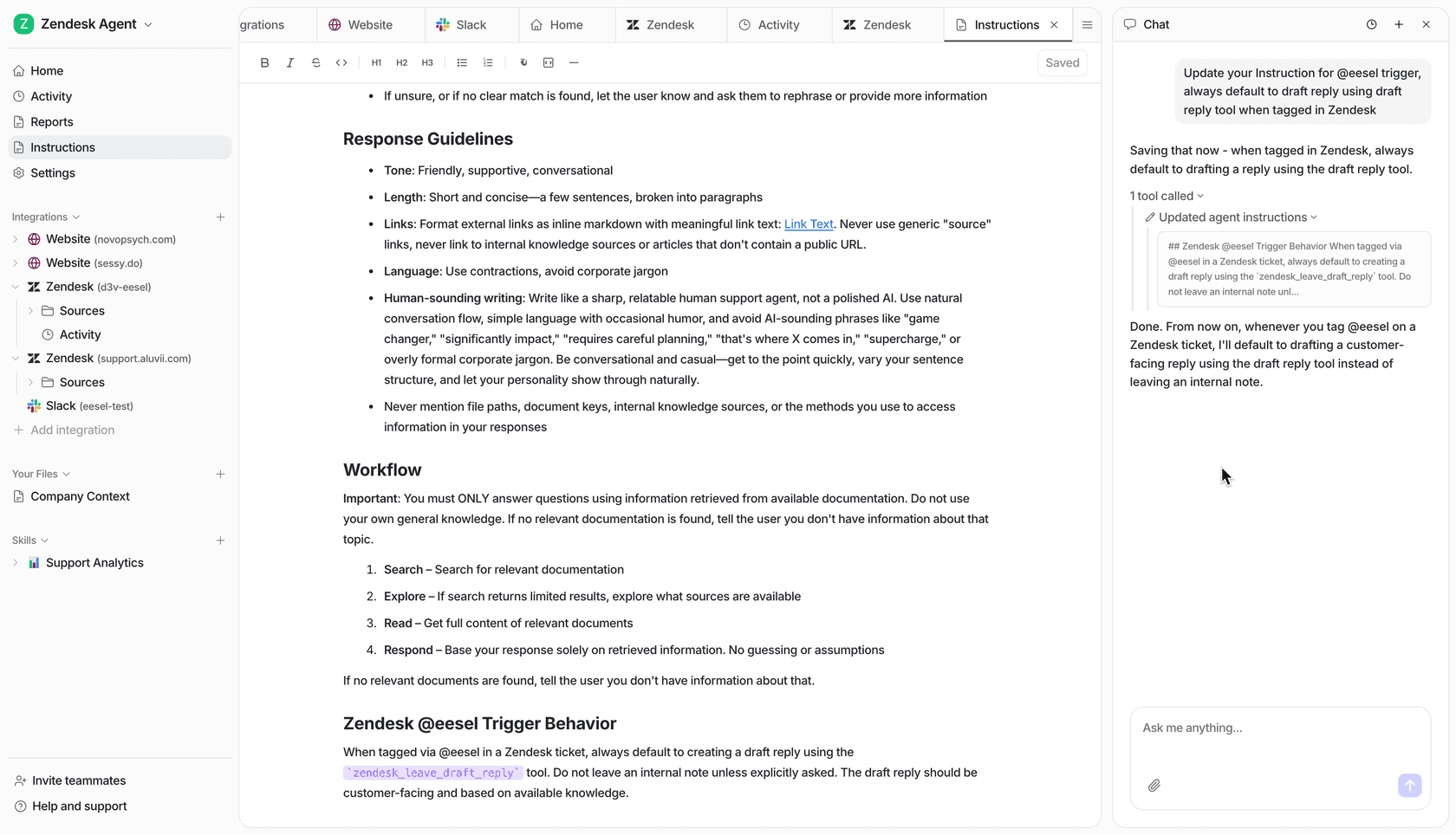
At eesel AI, we approach this differently. Rather than bolting file sharing onto a ticketing system, our AI agent for Zendesk integrates with your existing workflows and handles file sharing through the channels you're already using.
When you invite eesel AI to your team, it connects to your existing tools (including Zendesk, if that's what you use) and learns from your past conversations, help center articles, and documentation. It can then handle customer inquiries across channels without the same attachment constraints.
For file sharing specifically, eesel AI can:
- Guide customers to upload large files through appropriate channels based on file type and size
- Process and analyze attachments within conversations without hard size limits
- Integrate with cloud storage providers to handle file transfer workflows
- Maintain context across conversations even when files are hosted externally
The key difference is flexibility. Rather than working within rigid system limits, eesel AI adapts to how your team actually works. You can start with eesel drafting replies for review, then expand to more autonomous handling as it learns your business.
For teams already using Zendesk, eesel AI can work alongside your existing setup, handling conversations that involve complex file sharing while your Zendesk system continues managing standard tickets. You can explore how eesel AI integrates with Zendesk on our integration page.


