6 best Zendesk alternatives for ecommerce in 2026

Stevia Putri

Katelin Teen
Last edited May 21, 2026

Zendesk is used by 22,000+ service teams worldwide, handles 830 million AI interactions annually, and has a 2025 Gartner Magic Quadrant Leader designation. It is genuinely powerful. It is also, for many ecommerce teams, the wrong tool.
The core problem is structural. Zendesk was designed around IT helpdesks and enterprise support operations - a model that assumes dedicated support-ops staff, a full admin to configure automations, and annual headcount growth as the pricing baseline. Ecommerce support does not work that way. Ticket volume spikes at Black Friday and drops in February. Support staff numbers are small but the ticket types are deeply specific: order status, return requests, discount questions, product recommendations. And the tools that make support easy in ecommerce - a live Shopify order sidebar, the ability to issue a refund inside a ticket, AI that knows what a customer ordered yesterday - are either absent in Zendesk or locked behind add-ons with no public price.
One r/helpdesk thread from an ecommerce owner put it plainly:
"zendesk can feel like using a spaceship to deliver pizza." -- u/bonniew1554, r/helpdesk
This post covers six Zendesk alternatives that fit ecommerce workflows better, with full pricing tables and the tradeoffs you need to know before switching.
Why ecommerce teams look beyond Zendesk
Before jumping to alternatives, it helps to be specific about what the complaints are. Not every frustration applies to every team.
Per-seat pricing escalates fast. Zendesk Suite Professional runs $115 per agent per month on annual billing. A 10-agent team lands at $1,150/month before any add-ons. Add QA ($35/agent = $350), Copilot ($50/agent = $500), and you're at $2,000/month for a modest mid-market team. AI resolution overages run $1.50-$2.00 per automated resolution above the per-plan included amount. For ecommerce brands whose ticket volume surges seasonally, the annual per-seat commitment means paying for 10 seats in slow February at the same rate as peak December.
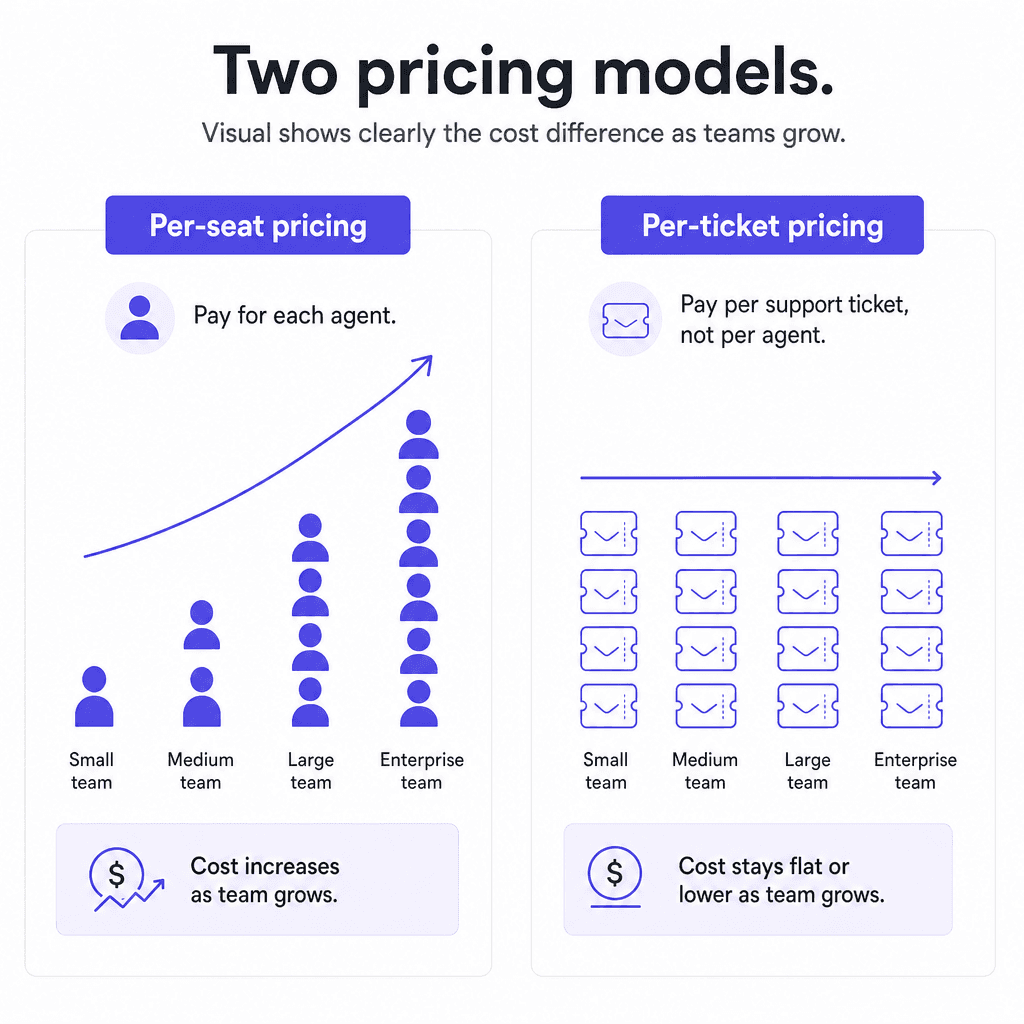
The Shopify integration is shallower than advertised. Zendesk's Shopify integration shows order data in the ticket sidebar - agents can see what a customer ordered. But taking action (canceling an order, issuing a refund, editing a shipment address) requires switching tabs to Shopify Admin. Zendesk's AI agents cannot take those order-level actions without the Advanced AI Agents add-on, which has no public price and requires contacting sales. For ecommerce teams where 40-60% of tickets are WISMO or return-related, this matters.
AI has a cold-start problem. Zendesk's AI requires roughly 1,000 resolved tickets to reach reliable automation rates - a real barrier for teams migrating from another tool or starting fresh. Most ecommerce-specific alternatives train AI from your product catalog and help articles on day one.
Configuration takes a dedicated admin. Zendesk's flexibility is its most-praised feature, and its most-criticized one. Reddit threads consistently describe it as "incredibly flexible but needing someone to configure it well, and a small team does not have that person." For brands under $5M revenue with 2-5 support staff, that person simply does not exist.
That said, Zendesk is not wrong for everyone. If your team exceeds 50 agents, handles multi-product lines across dozens of channels, and has a support-ops function to manage configuration, Zendesk's depth justifies the complexity. For most ecommerce brands, the six tools below are a better starting point.
What to look for in a Zendesk alternative for ecommerce
The requirements are more specific than "cheaper Zendesk." The tools that serve ecommerce well share these properties:
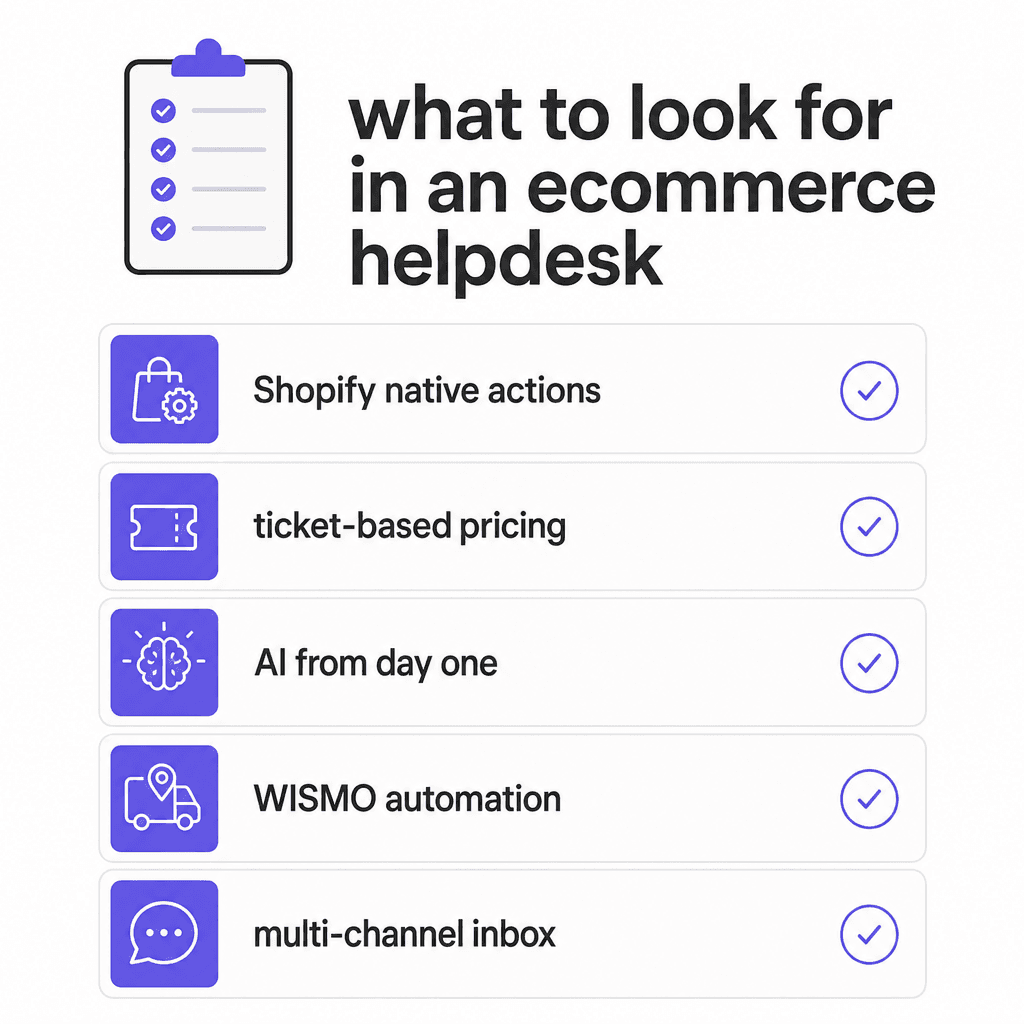
Native ecommerce actions, not just data views. Surfacing order data in a sidebar is table stakes. The real differentiator is whether the tool can act - cancel an order, issue a refund, apply a discount code, edit a subscription - without leaving the support interface.
Per-ticket or usage-based pricing. Per-seat pricing misaligns with how ecommerce support actually scales. Seasonal ticket surges mean you need capacity when volume is high, not year-round headcount commitments. Per-ticket or per-conversation pricing means you pay for actual work done.
AI that works from the first week. Ecommerce AI needs to answer "where is my order?" on day one, not after accumulating 1,000 resolved tickets. The better tools train on your product catalog and help docs immediately.
WISMO automation. Order status questions account for a large portion of ecommerce support volume. Automated WISMO handling - real-time order status, tracking links, delivery estimates - directly reduces agent workload.
Peak season scalability. Black Friday ticket volume can be 5-10x normal levels. Tools with per-seat annual plans charge the same either way. Tools with usage-based or per-ticket pricing let you scale up and down without renegotiating a contract.
6 best Zendesk alternatives for ecommerce in 2026
1. Gorgias - best for Shopify-native ecommerce brands
Gorgias is the most widely used ecommerce-specific helpdesk, serving 17,000+ ecommerce brands and claiming to power 40% of Shopify brands. It combines a full helpdesk with an AI Agent pre-trained on 1 billion ecommerce conversations. The single most important thing to know: Gorgias is built around Shopify. Every feature - the sidebar, the AI, the pricing model - assumes your primary store runs on Shopify.
The Shopify integration is genuinely best-in-class. Agents can view order history, issue refunds, edit orders, apply discount codes, and update subscriptions directly inside a ticket without switching to Shopify Admin. One Capterra reviewer who switched from Zendesk described it: "The Shopify integration is the best in class. You can see order history, issue refunds, and edit orders directly inside a ticket without switching tabs."
The AI Agent handles pre- and post-purchase: product recommendations, WISMO queries, return requests, and subscription edits. Orthofeet reached a 56% automation rate in under 2 months - above their 30% goal. Obvi's CX lead described their Black Friday:
"At 6pm on the second day of Black Friday week, our CX agent said: 'I'll see you tomorrow. We're at inbox zero.' Without AI Agent, that wouldn't happen." -- Obvi, via Gorgias
All plans include unlimited agent seats - there is no per-seat charge. Pricing scales by monthly ticket volume.
Gorgias pricing
| Plan | Monthly cost | Tickets/month | AI Agent |
|---|---|---|---|
| Starter | $10 | 50 | $1.00/resolved conversation |
| Basic | $60 | 300 | 60 interactions included ($0.90/additional) |
| Pro | $360 | 2,000 | 600 interactions included ($0.90/additional) |
| Advanced | $900 | 5,000 | 2,500 interactions included ($0.90/additional) |
| Enterprise | Custom | Custom | $0.90/resolved conversation |
Annual billing saves 2 months (approximately 16%). A 7-day free trial is available with no payment info required. AI Agent charges only for fully automated resolutions - no charge if a customer escalates to a human within 72 hours.
Pros
- Deepest native Shopify integration of any tool on this list
- Unlimited seats on all plans - no per-agent cost
- AI trained on ecommerce from day one
- Revenue attribution: see how much support drives sales
- Pre-built automation for returns, discounts, and subscription edits
Cons
- Per-ticket pricing gets expensive at high volume (some reviewers report $1,000+/month)
- Non-Shopify stores (WooCommerce, BigCommerce) get fewer native actions
- Customer support quality has declined according to recent Shopify App Store reviews
- Mobile app rated 1.7 stars on the Apple App Store
- Large gap between Basic ($60/300 tickets) and Pro ($360/2,000 tickets) tiers
Best for: Shopify brands doing $3M-$50M+ in annual revenue that want the deepest ecommerce-native helpdesk experience and are comfortable with ticket-volume pricing.
2. eesel AI - best AI layer that works with your existing helpdesk
eesel AI takes a different approach from every other tool on this list. Rather than replacing your helpdesk, it operates as an AI teammate inside it. If your team is already on Zendesk, Freshdesk, Gorgias, or another platform, eesel sits inside that tool and handles incoming tickets - without requiring you to migrate anything.
This matters for ecommerce brands that are frustrated with one specific part of their stack (usually Zendesk's AI or pricing) but do not want to rebuild their entire workflow. Ecosa's CTO Wesley Wang described their setup:
"We chose eesel AI for its multi-channel data input. By linking our Zendesk and Google Docs, customers get instant responses and tough questions are automatically triaged." -- Wesley Wang, CTO, Ecosa
The ecommerce agent connects directly to Shopify, WooCommerce, BigCommerce, and Magento for real-time product catalog sync, order tracking, and return handling. It answers product questions with variant, inventory, and spec accuracy, handles WISMO with live order status from the store, and detects out-of-stock items to suggest alternatives automatically. Support works in 80+ languages with automatic detection - useful for stores serving international markets.
Tulipy, a multi-brand gardening retailer, uses eesel with Shopify and Zendesk and automated nearly all "where is my order?" queries. In the first month of deployment, Kim Simpson at Gridwise reported: "In the first month, eesel is resolving 73% of our tier 1 requests."
Pricing is purely usage-based: $0.40 per support ticket or chat session, with no platform fee, no per-seat charges, and no monthly minimum. The free trial covers $50 in usage with all features unlocked and no credit card required.
eesel AI pricing
| Tickets/month | Monthly cost |
|---|---|
| 100 | $40 |
| 500 | $200 |
| 1,000 | $400 |
| 2,500 | $1,000 |
Annual commit of $300+/month saves 25%. Enterprise at $1,000/month flat adds a dedicated solutions engineer, SSO, HIPAA, and BAA.
Pros
- Works inside Zendesk, Freshdesk, Gorgias, or any other helpdesk without migration
- No per-seat fees, no platform fee, no monthly minimum
- Shopify, WooCommerce, BigCommerce, Magento integrations with real-time catalog sync
- 80+ language support out of the box
- Auto-pause on spending limits prevents surprise charges
Cons
- Does not replace your existing helpdesk - requires one to operate in
- No native voice or phone support
- Not as Shopify-action-deep as Gorgias (cannot initiate refunds directly from eesel's interface without going through the host helpdesk)
Best for: Ecommerce teams on any helpdesk (including Zendesk) that want AI automation without migrating their entire support stack, or teams with multi-platform stores (Shopify + WooCommerce) who need one AI layer across all of them.
3. Freshdesk - best budget-friendly alternative with solid AI
Freshdesk is the most direct like-for-like replacement for Zendesk in terms of feature set and team size. It offers omnichannel ticketing, a knowledge base, AI automation, and integrations at a lower per-seat price than Zendesk Suite. Over 74,000 businesses use it, including Bridgestone, Klarna, and PepsiCo.
The main AI feature is the Freddy AI suite: an AI Agent that handles common queries with 50+ prebuilt workflows, an AI Copilot that drafts replies and suggests responses for agents, and AI Insights for team leaders. Freshdesk claims up to 80% auto-resolution rates and under 2-minute average conversational resolution time. Hobbycraft's Head of CX reported that "AI chatbots now answer up to 30% of questions, helping to free up Hobbycraft's agents."
Where Freshdesk falls short relative to Gorgias is depth of ecommerce integration. There is a Shopify integration but it does not offer the same native action layer - agents can view order data but taking action still typically requires a context switch. The tool is better positioned as a general-purpose helpdesk that happens to work well for ecommerce, not an ecommerce-first product.
Freshdesk pricing
| Plan | Price (annual) | AI Agent sessions | Notes |
|---|---|---|---|
| Growth | $19/agent/month | 500 included; $49 per 100 additional | Freddy AI Copilot included |
| Pro | $55/agent/month | More included | Most popular |
| Enterprise | $89/agent/month | Custom | Audit logs, approval workflows |
14-day free trial with Enterprise-plan access, no credit card required. There is also a 6-month free program for teams with 1-2 agents.
5-agent team comparison: Freshdesk Pro = $275/month vs. Zendesk Suite Professional = $575/month.
Pros
- Significantly cheaper than Zendesk at the same feature tier
- Full omnichannel support (email, chat, social, phone) on all paid plans
- Freddy AI available at Growth tier ($19/agent/month)
- Large ecosystem with many Shopify and ecommerce integrations
- 14-day free trial, no credit card
Cons
- Shopify integration is not as deep as Gorgias - viewing orders is easier than acting on them
- Still per-seat pricing, which scales the same way as Zendesk during team growth
- AI sessions are separate from base plan, with overages at $49 per 100 sessions
- Less specialized for ecommerce workflows than Gorgias or Yuma AI
Best for: Teams switching from Zendesk who want a similar feature set at a meaningfully lower price point, and whose primary pain point is cost rather than Shopify integration depth.
4. Tidio - best for small and growing ecommerce stores
Tidio is used by 300,000+ businesses and is particularly strong for small ecommerce stores that want live chat plus AI automation without the complexity (or price) of an enterprise helpdesk. It combines live chat, ticketing, and its Lyro AI agent into one platform.
Lyro AI is powered by Anthropic's Claude and is knowledge-based rather than probabilistic - it only answers using content you've provided (FAQs, product pages, help docs) with strong guardrails against hallucinating product specs. Tidio claims a 67% average customer problem resolution rate and offers a money-back guarantee on the Premium tier if Lyro does not hit 50% resolution. The ADT Security team reported a 30% CSAT increase after deploying it.
Tidio integrates with Shopify and WooCommerce directly for product recommendations and order status queries. It also offers "Lyro Connect" - a mode where Lyro AI operates inside an existing Zendesk or Salesforce setup rather than replacing it.
The free plan (50 live chat conversations/month, 50 Lyro AI conversations) is useful for stores in early stages. The Growth plan starts at $49.17/month and includes 250+ billable conversations.
Tidio pricing
| Plan | Monthly price | Billable conversations | Lyro AI |
|---|---|---|---|
| Free | $0 | 50 | 50 one-time |
| Starter | $24.17 | 100 | Separate add-on (~$0.50/conversation) |
| Growth | $49.17+ | 250+ | Separate add-on |
| Plus | $749+ | Custom | Included |
| Premium | Contact sales | Custom | Guaranteed SLA |
Annual billing saves 2 months (roughly 16%).
Pros
- Free plan available (50 chat conversations/month)
- Lyro AI uses Claude, with strong guardrails against hallucination
- Works inside Zendesk, Salesforce via Lyro Connect
- Shopify and WooCommerce integrations
- Money-back guarantee on resolution rate (Premium tier)
Cons
- Lyro AI is an add-on, not included by default in base plans
- Less action-depth in ecommerce than Gorgias (harder to issue refunds or edit orders)
- Volume limits at Growth tier ($49.17) are low (250 billable conversations)
- Plus/Premium pricing not public; requires a sales call
Best for: Early-stage ecommerce stores under $1M revenue that need live chat plus light AI automation and want to start free before committing to paid plans.
5. Yuma AI - best for high-volume ecommerce automation
Yuma AI is purpose-built for mid-market and enterprise ecommerce brands that want to automate a high percentage of support volume - specifically Shopify brands with significant monthly ticket counts. It handles four categories simultaneously: support tickets (WISMO, returns, billing), sales (product recommendations, upsells), social media (comments, reviews, mentions), and website chat.
Customer case studies show 49-89% ticket automation rates. Clove achieved 3x ROI in 90 days with 40% automation and 25% cost savings. EvryJewels hit 70% automation and 63% cost reduction processing 150,000+ tickets. Omnie has processed 5 million tickets using Yuma.
One founder's testimonial described what differentiated Yuma from other AI tools they tried:
"We chose Yuma AI because of their overall multichannel accuracy. We tried help desk AI features and other AI products for our customer service but none of them made a difference." -- My Variations founder, via Yuma AI
Pricing is fully custom and performance-based. There are no published per-seat or per-ticket numbers - every deal is scoped based on ticket volume, automation targets, and feature set. Yuma offers a 30-day free trial with no engineering work or credit card required.
Yuma AI pricing
| Plan | Pricing | Notes |
|---|---|---|
| All plans | Custom (contact sales) | Performance-based billing |
| Trial | Free for 30 days | No credit card, no engineering required |
Pros
- Performance-based pricing ("no value, no charge")
- Highest automation rates among tools on this list (64-89% across case studies)
- Handles support, sales, social, and chat in one platform
- Shopify-native with deep order management integration
- 30-day free trial, no engineering required
Cons
- No public pricing - requires a sales conversation before you know the cost
- No self-serve onboarding; setup is high-touch
- Best suited for mid-market and enterprise ecommerce (not starter stores)
- Integration catalog beyond Shopify is not publicly documented
Best for: Ecommerce brands doing $10M+ in annual revenue that want maximum automation across all channels (support, social, website chat, sales) and are comfortable with a sales-led evaluation.
6. Crisp - best lightweight option for early-stage stores
Crisp is used by 10,000+ companies and rated 4.5/5 on G2 from 194 reviews. It is a flat-rate, per-workspace helpdesk that combines live chat, email, WhatsApp, social media, and a knowledge base in one inbox. Unlike every other tool on this list, Crisp charges per workspace rather than per seat - meaning adding another agent to your team costs nothing above the plan price.
The AI feature is called Hugo (available on Essentials+ plans). It ingests your website, PDFs, and knowledge base articles to train a custom model and handles conversations autonomously across web chat, WhatsApp, Instagram, and email. G2 reviewers praise the "centralized inbox that unifies live chat, email, WhatsApp, and social media in one place" and call the support team "responsive and easy to learn."
Crisp integrates with Shopify, WooCommerce, Adobe Commerce, and PrestaShop for ecommerce contexts. The integration is relatively lightweight compared to Gorgias - you can surface order information and build automated flows, but the deep action layer (issuing refunds from within a ticket) is not native.
The free plan (2 seats, unlimited conversations, live chat widget) is a genuinely useful starting point for solopreneurs. The Mini plan at $45/month adds email inbox and basic AI credits.
Crisp pricing
| Plan | Monthly price | Seats | AI conversations |
|---|---|---|---|
| Free | $0 | 2 | None |
| Mini | $45 | 4 | ~90/month |
| Essentials | $95 | 10 | ~450/month |
| Plus | $295 | 20+ | ~1,350/month |
| Enterprise | Custom | Custom | Custom |
Nonprofit and student accounts receive 50% off. Annual billing is available.
Pros
- Per-workspace pricing (not per-seat) - adding agents is free within plan limits
- Generous free plan with 2 seats and unlimited conversations
- All channels (email, chat, WhatsApp, Instagram, SMS) on Essentials+
- Hugo AI supports 50+ languages
- 14-day free trial, no credit card
Cons
- AI (Hugo) only available on Essentials tier ($95/month) and above
- Shopify integration is lighter than Gorgias or Yuma AI
- G2 reviewers note "AI automation is helpful but still maturing" with some inconsistencies
- Mobile app lacks feature parity with the web version
- Basic plan (Mini, $45) includes very few AI credits (~90 conversations)
Best for: Early-stage ecommerce stores with small teams (under 10 agents) that want multichannel support at a flat, affordable rate without per-seat pricing headaches.
How to choose the right Zendesk alternative for ecommerce
The right tool depends primarily on two things: your monthly ticket volume and how much of your support comes from Shopify-specific workflows.
| Tool | Best for | Starting price | Shopify depth | Per-seat? |
|---|---|---|---|---|
| Gorgias | Shopify-first brands, any size | $10/month (50 tickets) | Deepest | No - ticket-based |
| eesel AI | AI layer on existing helpdesk | $0.40/ticket | Deep (catalog + WISMO) | No - usage-based |
| Freshdesk | Budget Zendesk replacement | $19/agent/month | Moderate | Yes |
| Tidio | Small stores, live chat focus | Free | Moderate | No - conversation-based |
| Yuma AI | High-volume, enterprise ecommerce | Custom | Deep | No - performance-based |
| Crisp | Early-stage, flat pricing | Free | Light | No - per-workspace |
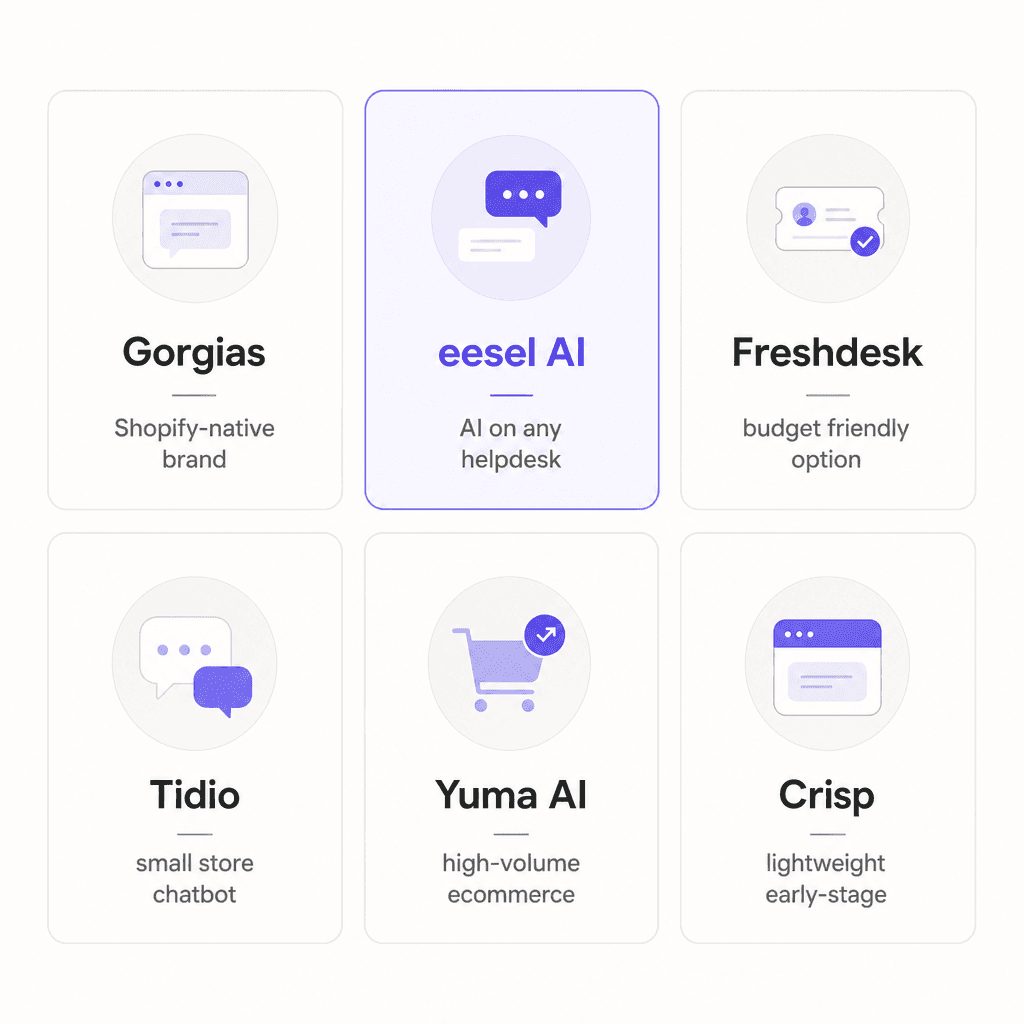
A few patterns from the research worth noting:
If you're on Shopify and Zendesk right now, Gorgias is the most common destination. It resolves the deepest Zendesk frustrations for ecommerce (no per-seat charges, native order actions, AI trained on ecommerce) and migration is well-supported. The main risk is per-ticket costs at higher volumes - run your current monthly ticket count against Gorgias's pricing before committing.
If you want to keep Zendesk (or any other helpdesk) but add better AI, eesel AI handles this without a migration. It plugs in above your current tool, connects to Shopify or WooCommerce, and handles ecommerce AI automation at $0.40/ticket. Teams running Zendesk + eesel AI effectively get Zendesk's integration depth with usage-based AI pricing.
If cost is the primary issue with Zendesk and you do not need Shopify-native actions, Freshdesk is the cleanest migration path. Same feature category, meaningfully lower per-seat cost, and a large app ecosystem.
For an in-depth comparison of AI-specific helpdesk tools for ecommerce, including how to evaluate resolution rate claims, the testing methodology matters - check whether "automation rate" means full resolution or just initial deflection.
eesel AI for ecommerce support
eesel AI works inside Zendesk, Gorgias, Freshdesk, and any other helpdesk your team already uses, adding AI that connects directly to your Shopify, WooCommerce, BigCommerce, or Magento store. The ecommerce agent answers product questions with real catalog data, handles WISMO with live order status, processes return requests with smart escalation, and supports 80+ languages from day one.
Pricing starts at $0.40 per ticket with no platform fee, no per-seat charge, and no monthly minimum. The free trial covers $50 in usage with every feature unlocked. If you are currently paying Zendesk per-seat pricing for AI that does not reach your store's data, eesel is worth testing on a live ticket sample before making a broader decision.

Frequently Asked Questions
Share this article

Article by
Stevia Putri
Stevia Putri is a marketing generalist at eesel AI, where she helps turn powerful AI tools into stories that resonate. She’s driven by curiosity, clarity, and the human side of technology.