

Let's be honest, everyone's rushing to get AI into their business. The initial buzz was all about what it could do. Now, we're dealing with the slightly less exciting, but way more important question: how do we keep this all from going off the rails?
With AI tools popping up in every corner of the company, people in charge of AI strategy are starting to worry about managing risk and staying compliant. It's a real headache.
This is where ServiceNow's solution, the AI Control Tower, comes into the picture. It's pitched as a central command center for every AI project you've got running. In this post, we'll break down what the ServiceNow AI Control Tower Risk Compliance capabilities actually look like. We'll get into how it works day-to-day and, just as important, what its limits are, especially if your team needs to move fast.
What is ServiceNow AI Control Tower Risk Compliance?
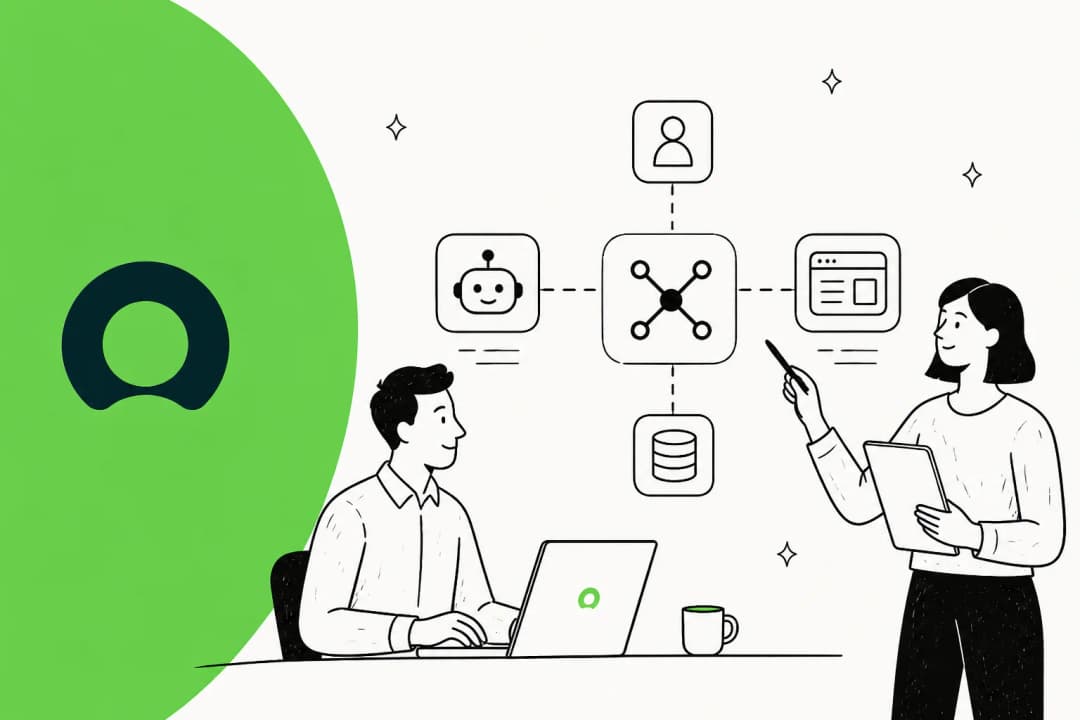
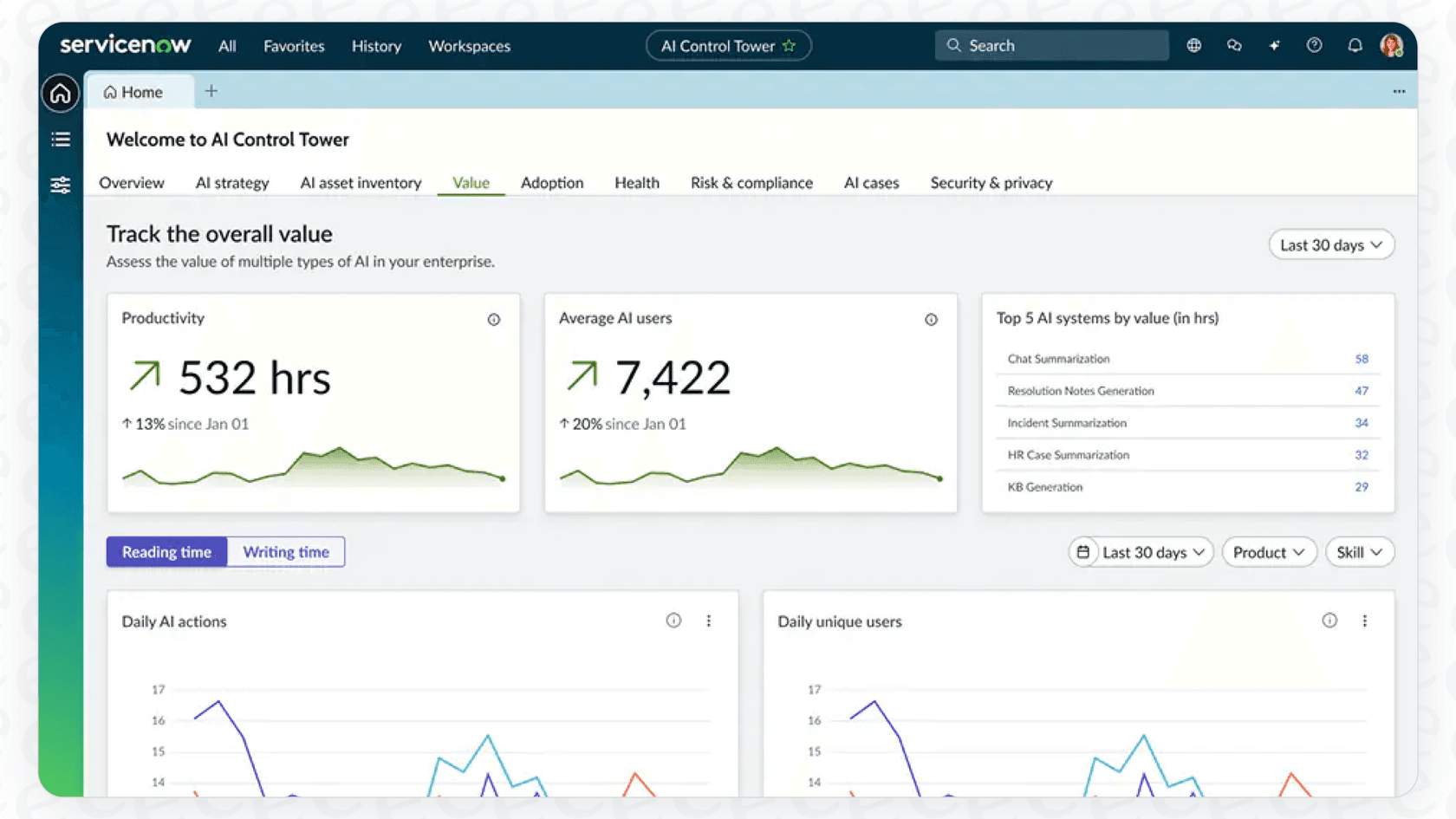
Think of the ServiceNow AI Control Tower as the central nervous system for your company's entire AI ecosystem. Its main job is to connect the big-picture AI strategy discussions happening in the boardroom with the actual, on-the-ground work of managing projects, keeping things compliant, and tracking performance.
A big part of its appeal is the promise that it can handle any AI. It doesn't matter if your team built it on the ServiceNow platform, if you're using a model from AWS or Azure, or if you're deploying complex autonomous agents. The Control Tower aims to bring it all under one roof.
So, what is it trying to accomplish?
-
Get a handle on everything: It wants to create one master list of every AI system, model, and dataset you're using. No more shadow AI projects.
-
Automate the boring stuff: It helps standardize and automate the governance process for an AI model's entire life, from the first brainstorm to when it's eventually retired.
-
Stay out of trouble: It's designed to help you spot and fix AI-related risks before they become major problems, ensuring you're keeping up with regulations.
-
Show the value: It provides dashboards and metrics so leadership can see what's working and what the return on investment (ROI) actually is.
Basically, ServiceNow is trying to tame the "Wild West" of enterprise AI by providing a very structured, top-down way to manage it all.
Key components of ServiceNow AI Control Tower Risk Compliance
The AI Control Tower isn't a single app you just install and run. It’s a whole solution woven into the ServiceNow platform, and it relies on a few core pieces working together to handle governance.
AI asset inventory and discovery
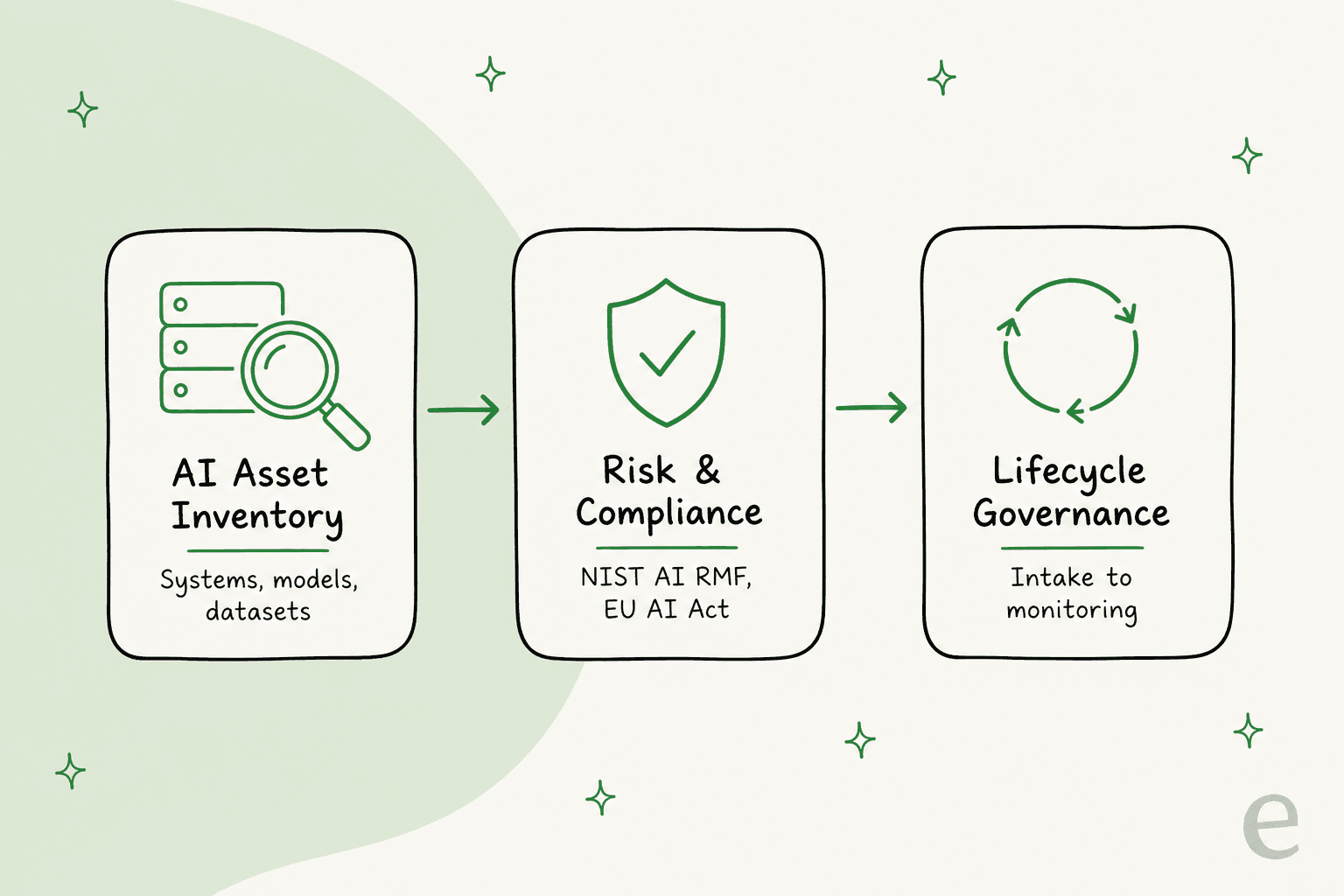
It all starts with knowing what you have. You can't really govern something if you don't even know it exists. The foundation of the Control Tower is its ability to build out a detailed inventory of every single AI asset across the business. And this is more than just a simple spreadsheet. It's a deep catalog that tracks:
-
AI systems: These are the full-blown applications that use AI, like the chatbot on your support page or the system that automatically routes IT tickets.
-
AI models: These are the specific algorithms doing the work inside those systems, like a model that detects the sentiment in a customer email or one that translates languages.
-
Datasets: This includes all the information used to train and run the models, which is crucial for tracking bias and data privacy.
This inventory is tied directly into ServiceNow’s existing databases for configuration and services (the CMDB and CSDM). If your company already runs on ServiceNow, this is a massive advantage because you can immediately see how an AI model connects to a specific business service. If you're not a ServiceNow customer, this is your first clue that getting started involves going all-in on their ecosystem.
AI risk and compliance management
This is really the heart of the solution. This is where the platform helps you enforce your own internal rules and make sure you're following external regulations.
One of the most helpful features here is the pre-loaded content for major regulatory frameworks. For example, it comes with policies and documents already aligned with big standards like the NIST AI Risk Management Framework (RMF) and the EU AI Act. This is a huge time-saver, as it means you don't have to build your entire compliance library from scratch.
To manage this, the system uses two main kinds of check-ins:
-
Impact assessments: You use these at the very beginning of a project to figure out if it's a high-risk idea. They help you flag systems that might introduce bias, mess with customer privacy, or create other ethical messes down the line.
-
Risk assessments: Once a specific risk has been identified (maybe a model is giving weird answers, or a dataset has sensitive info), these are used to dig in, figure out the potential damage, and keep track of how you're fixing it.
ServiceNow has also pushed the Control Tower toward runtime AI security: its product page describes inventorying the MCP servers your agents connect to, enforcing least-privilege access, and blocking prompt injections around the clock.
End-to-end lifecycle governance
The Control Tower pushes every new AI idea through a standardized, auditable process. Instead of different teams doing their own thing, every project has to follow the same steps: intake, assessment, building, review, deployment, and monitoring. This creates a clear paper trail, which is exactly what you need if an auditor ever comes knocking.
How the ServiceNow AI Control Tower works in practice
Okay, so what does this feel like for the people who have to use it every day? Most of the action happens in a central workspace where risk managers, developers, and business leaders can all collaborate.
Dashboards and reporting
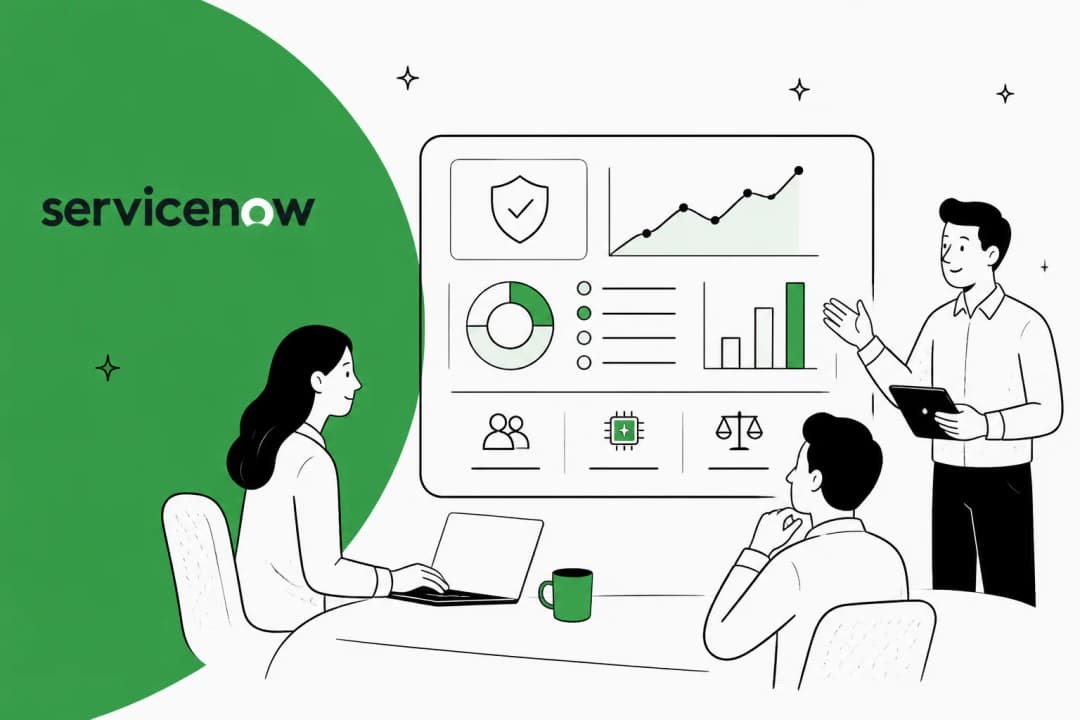
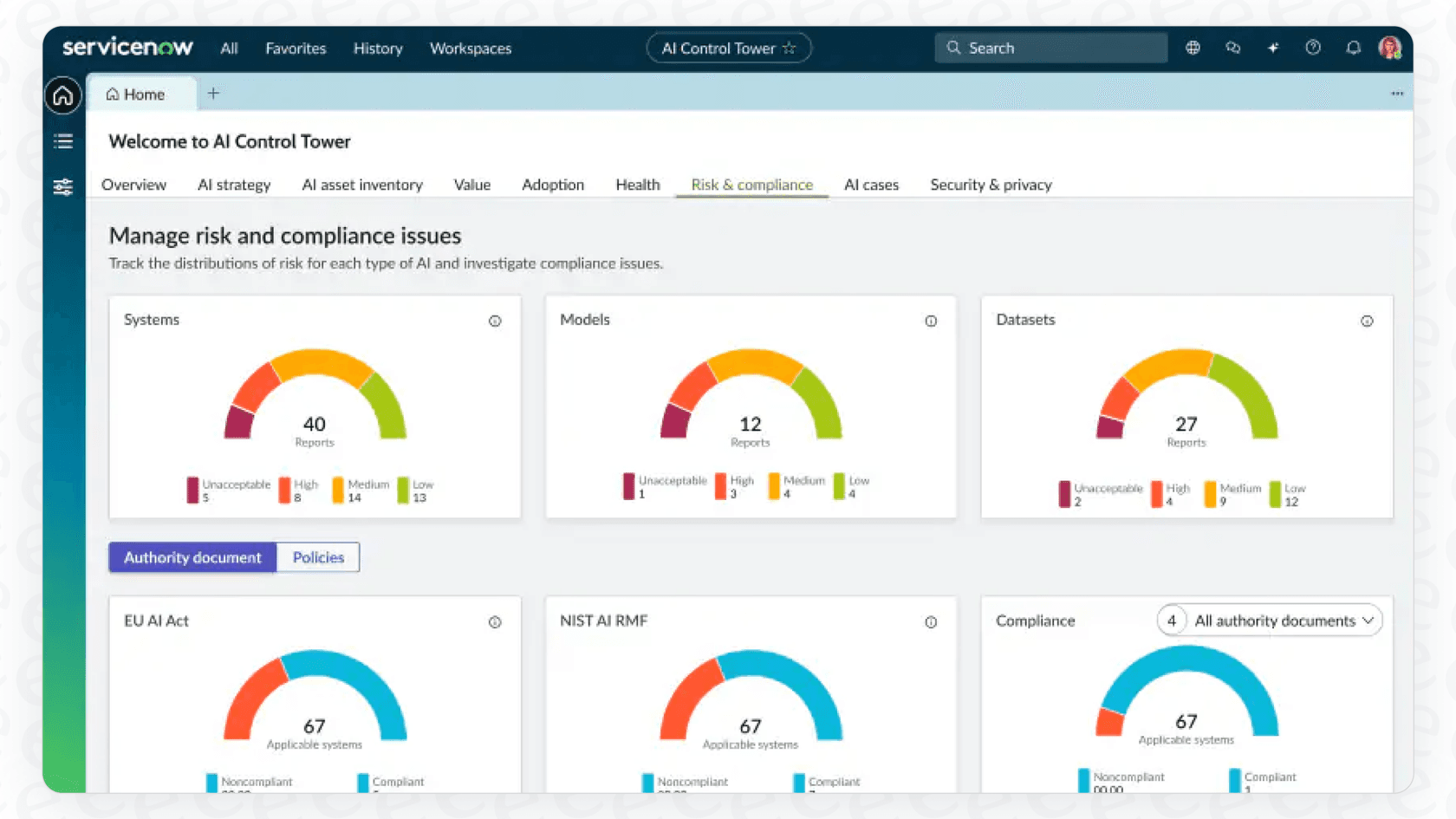
If you're on the risk and compliance team, you'll be living in the Risk & Compliance tab of the AI Control Tower. This dashboard pulls in data from all over the platform to give you a single place to see what's going on with AI governance.
You'll find a few key things on this dashboard:
-
Compliance overview: This is your at-a-glance view. It usually has a few charts showing how many of your AI assets are classified as High, Medium, or Low risk. It also gives you a compliance score against specific regulations, so you can quickly see if you're on track with something like the EU AI Act.
-
Risk overview: Here, you'll find a risk heatmap. It’s a handy visual that shows the difference between a risk before you've put any controls in place and the risk that's left over after your fixes. It helps leaders quickly decide where to focus their attention.
-
Regulatory landscape: If you're using the full ServiceNow GRC module, this part of the dashboard keeps track of new regulatory alerts from around the world and shows you the status of any tasks you've created to deal with them.
Challenges: Complexity, cost, and platform lock-in
While the idea of a single, unified system is great, getting there with ServiceNow comes with some pretty big hurdles that can make it a tough sell for a lot of companies.
First up is the implementation complexity. This is not a tool you can just turn on and start using. The AI Control Tower is deeply connected to a bunch of other ServiceNow products, like their GRC and CMDB modules. The official ServiceNow Store page for the app lists dozens of dependencies. That's a clear signal that setting this up is a major project that will likely require expensive consultants and several months of work.
Second, the pricing is a total black box. There's no public price anywhere: the product page routes you to "Schedule Demo," and ServiceNow's own pricing page offers only a "Get Custom Quote" with no figures in sight. Since ServiceNow moved to its AI-native tiers (Foundation, Advanced, and Prime), AI Control Tower now ships bundled into those tiers rather than as a separate module, but the tiers themselves stay quote-only, so you're still looking at a high total cost, long-term contracts, and implementation help you'll definitely need. You can't just try it out or start with a small team.
And finally, there’s the platform dependency. Even though the Control Tower can look at AI from other platforms, its entire governance system is designed to work within the ServiceNow world. This creates some serious vendor lock-in and makes it a non-starter if your company doesn't already use ServiceNow for its main IT and business operations.
A simpler path to AI risk management with eesel AI
So what if your team needs to be responsible with AI but can't afford to get bogged down by a massive enterprise framework? There's another way to think about this. Tools like eesel AI are built for teams that need to act now but still want full control.
Go live in minutes, not months
While ServiceNow demands a huge implementation project, eesel AI is all about simplicity and self-service. You can connect your knowledge bases and have a fully working AI agent ready to go in minutes. No sales calls, no consultants, no months-long setup.
It works with one-click integrations that plug right into the help desk you already use, whether that's Zendesk, Freshdesk, or even ServiceNow itself. This means you can start automating support safely and immediately, without having to rip out your existing tools and start over.
Total control and risk-free testing
eesel AI puts you in the driver's seat without forcing a rigid, top-down governance model on you.
-
Selective automation: You get to decide exactly what kinds of questions the AI answers. You can start small, letting it handle the simple, common questions while sending everything else to a human. This lets you build trust and manage risk from the ground up.
-
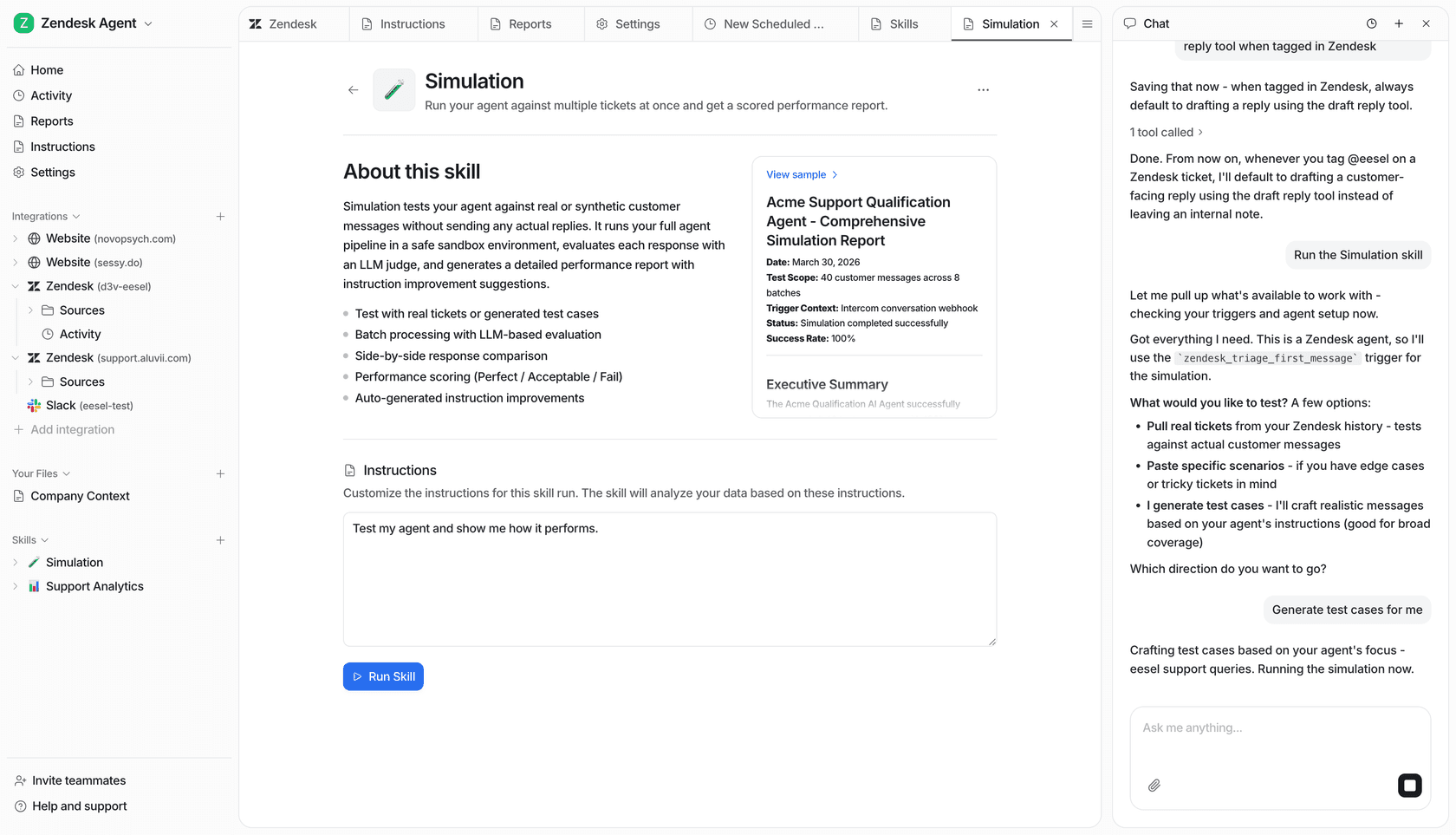
Powerful simulation mode: This is a big one. Before the AI ever talks to a real customer, eesel AI lets you run it against thousands of your past support tickets. It gives you a surprisingly accurate preview of how it will perform, what its resolution rate will be, and how much money it could save you. You can tweak its behavior in a safe sandbox, a practical risk management tool that most of the big platforms just don't offer.
Unify your knowledge and maintain compliance effortlessly
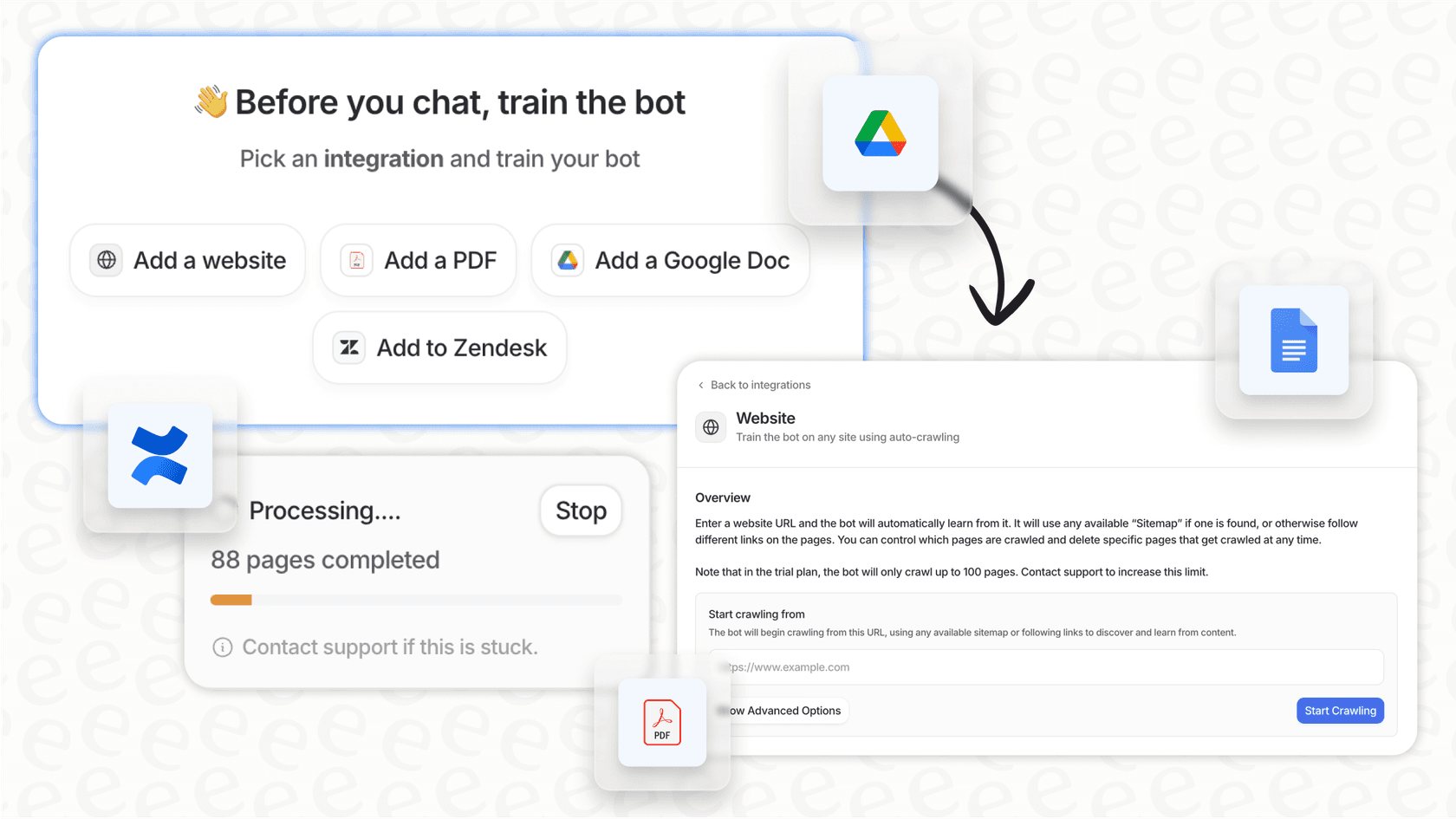
A compliant AI is a knowledgeable AI, but only if it's using the right knowledge. eesel AI connects to all the places your company knowledge lives, from past tickets to internal wikis like Confluence or shared files in Google Docs.
The key here is its scoped knowledge feature. This ensures the AI only uses the information you've explicitly approved. It acts as a simple but powerful guardrail, preventing the AI from making things up or giving out answers that are outdated, off-brand, or non-compliant. It's a straightforward way to manage risk without needing a complicated framework.
A clear comparison: ServiceNow vs. eesel AI
| Feature | ServiceNow AI Control Tower | eesel AI |
|---|---|---|
| Setup Time | Months; requires professional services | Minutes; fully self-serve |
| Integration Model | Deep platform integration (rip & replace) | Plugs into your existing helpdesk |
| Pricing | Opaque; "Contact Sales" | Transparent, predictable plans |
| Testing | Limited to platform capabilities | Powerful simulation on historical tickets |
| Control | Centralized, top-down governance | Granular, user-defined workflows |
| Best For | Large enterprises fully on ServiceNow | Agile teams needing fast, controlled automation |
Is ServiceNow AI Control Tower Risk Compliance the Right Tool for Your Team?
The ServiceNow AI Control Tower Risk Compliance solution is a powerful, comprehensive tool for large companies that are already all-in on the ServiceNow platform. It gives them the structure they need to get their arms around a massive and complex AI landscape.
But that power comes with a cost. The complexity, opaque pricing, and deep platform integration make it a slow and expensive option for most organizations. If your team needs to be nimble and wants to maintain control without getting bogged down, you need a different kind of tool.
eesel AI is that practical alternative. It gives you powerful automation with common-sense risk management features like simulation, scoped knowledge, and granular controls built right in from the start. It lets you scale your use of AI with confidence, today.
Ready to implement AI with confidence?
eesel AI gives you total control over your support automation. Simulate performance on past tickets, define exactly what gets automated, and go live in minutes. Try it for free or book a demo to see how simple AI governance can be.
Frequently asked questions
What is the primary goal of the ServiceNow AI Control Tower Risk Compliance solution?
The main goal is to act as a central command center for an organization's entire AI ecosystem, connecting strategic discussions with operational management. It aims to manage risk, ensure compliance, and track the performance of all AI projects across the business.
How complex is it to implement the ServiceNow AI Control Tower Risk Compliance in an organization?
Implementation is described as highly complex, typically taking months and requiring professional services due to its deep integration with other ServiceNow products like GRC and CMDB. It is not a simple, turn-key solution.
Could you outline the key components that make up the ServiceNow AI Control Tower Risk Compliance solution?
The solution relies on an AI Asset Inventory and Discovery for tracking all AI assets, AI Risk and Compliance Management for enforcing rules and regulations, and End-to-End Lifecycle Governance for standardizing AI project processes. These components work together within the ServiceNow platform.
How does the ServiceNow AI Control Tower Risk Compliance help ensure we stay compliant with new regulations like the EU AI Act?
It provides pre-loaded content for major regulatory frameworks like the NIST AI RMF and EU AI Act, saving time in building compliance libraries. It uses impact and risk assessments to identify and mitigate potential issues early, creating an auditable process for all AI projects.
Is the ServiceNow AI Control Tower Risk Compliance a viable option if our company doesn't primarily use ServiceNow for its main IT operations?
The blog indicates that it primarily suits companies already "all-in" on the ServiceNow platform, due to deep platform dependency and potential vendor lock-in. For non-ServiceNow customers, adopting it would likely involve going all-in on their ecosystem.
Can you provide an idea of the cost associated with deploying the ServiceNow AI Control Tower Risk Compliance?
The pricing model is opaque, requiring direct contact with sales, which usually implies a high total cost. AI Control Tower now ships bundled into ServiceNow's AI-native tiers rather than as a separate module, but those tiers stay quote-only, with long-term contracts and implementation costs on top, making it unsuitable for small or agile teams.


Article by
Alicia Kirana Utomo
Kira is a writer at eesel AI with a Computer Science background and over a year of hands-on experience evaluating AI-powered customer service tools. She focuses on breaking down how helpdesk platforms and AI agents actually work so that support teams can make better buying decisions.