Salesforce has been the top name in the CRM game for what feels like forever. So, when they decide to throw their full weight behind generative AI, you can bet people are going to listen. They’ve bundled years of AI work, from the original Einstein platform to the newer, more powerful Agentforce, into one big offering: the Salesforce AI CRM.
But what does that really mean for you and your business? You’re probably wondering if this massive, complex ecosystem is the right move. Is it really going to transform your business, or is it just an expensive and complicated way to keep doing what you’re already doing?
This guide is here to give you the straight scoop on the Salesforce AI CRM in 2025. We'll break down what it is, what it does, how much it costs, and, most importantly, the limitations you need to understand before you even think about signing on the dotted line.
What is Salesforce AI CRM? From Einstein to Agentforce
At its heart, Salesforce AI CRM isn't a single product you buy off the shelf. It’s a layer of artificial intelligence that’s woven into pretty much every part of the Salesforce suite, whether you’re using Sales Cloud, Service Cloud, Marketing, or Commerce.
It all kicked off with Salesforce Einstein back in 2016. Einstein was all about predictive AI. You can think of it as a quiet data scientist in the background, analyzing data to score leads on their closing potential or forecasting sales. It was smart, for sure, but it mostly handed insights over for humans to act on.
Fast forward to today, and we have Agentforce, the next evolution of Salesforce AI. This is where generative AI enters the picture. Using Salesforce's own models alongside tech from partners like OpenAI, Agentforce can actually create things and take action on its own. It can draft personalized emails, summarize customer calls, and even automate tasks that involve multiple steps.
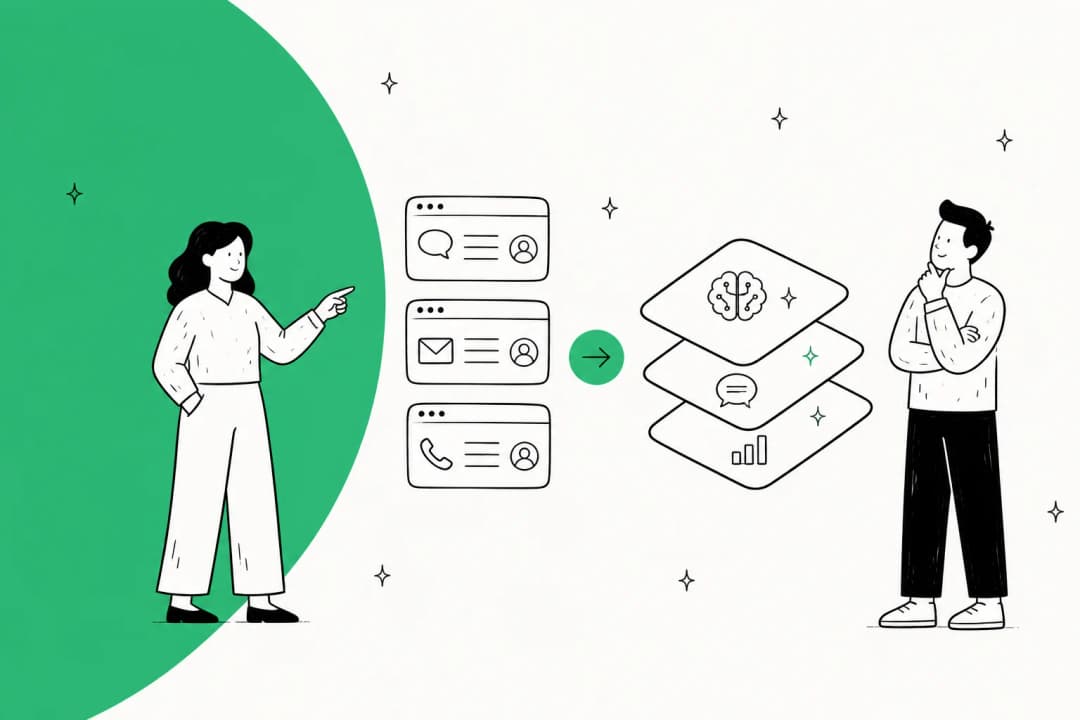
The entire system is built on the Salesforce Data Cloud, which acts like a central brain. It pulls together data from every customer interaction you can think of, CRM records, website visits, old support tickets, marketing emails, to build a single, unified profile for each customer. This complete view is what lets the AI generate responses and actions that are actually helpful and context-aware.
Key features across the Salesforce AI CRM suite
The real magic of the Salesforce AI CRM is how it adapts its tools for different parts of your business. It’s not a one-size-fits-all AI; it’s a collection of specialized features built for specific teams.
Salesforce AI CRM for sales teams
For sales folks, the goal is straightforward: close more deals, faster. Salesforce AI tries to eliminate the tedious admin work that slows reps down so they can spend more time actually selling.
-
Lead and opportunity insights: The AI automatically scores leads based on how likely they are to convert and flags deals that might be going sideways. This helps reps focus their energy on what matters most.
-
Automated summarization: Instead of spending an hour digging through an account before a call, a sales rep can get an AI-generated summary of a customer's history, recent interactions, and open support cases in just a few seconds.
-
Generative AI for outreach: Agentforce can whip up a first draft of a prospecting email or a follow-up, personalizing it with customer data pulled directly from the CRM.
-
Call insights: The platform can analyze call recordings and automatically point out key moments, like when a competitor was mentioned, a customer pushed back on pricing, or a specific feature was requested. This saves managers hours of review time.
Salesforce AI CRM for customer service teams
On the support side, it's all about resolving issues quickly and efficiently. Salesforce AI helps by automating routine tasks and giving agents the information they need, exactly when they need it.
-
Case classification & routing: When a new ticket comes in, the AI can instantly figure out what it's about and send it to the agent or team best suited to handle it.
-
AI-generated replies: For common questions, the AI can generate accurate, personalized responses that agents can use to resolve issues with a single click, which can seriously cut down resolution times.
-
Knowledge article generation: When an agent solves a tricky new problem, the AI can use the case notes to automatically draft a new knowledge base article. This helps other agents and customers down the line.
-
Predictive close times: The system can even predict how long a particular case might take to solve, helping managers better manage workloads and assign resources.
Salesforce AI CRM for marketing and commerce teams
For marketers, personalization is the name of the game. Salesforce AI is designed to help create custom customer journeys at a large scale, turning broad campaigns into what feel like one-on-one conversations. It can generate dynamic copy for email campaigns and landing pages based on a customer's past behavior. Instead of having marketers build audience segments by hand, the AI can identify groups of customers who are most likely to engage with a new campaign or buy a certain product. For e-commerce sites, this also extends to smart product recommendations that can personalize the shopping experience and bump up the average order value.
Understanding the Salesforce AI CRM setup: The Einstein Trust Layer and Data Cloud
To make all of this happen, Salesforce depends on two core components that are important to grasp. This isn't just a simple feature you can turn on; it's a foundational part of their architecture.
First up is the Salesforce Data Cloud. You can picture this as the central nervous system for the entire AI platform. It pulls in data from every source imaginable, your CRM, website, marketing tools, past conversations, and organizes it into a single, clean profile for every customer. This is a huge first step, because without unified data, any AI is going to struggle to produce relevant or accurate results. It's a powerful concept, but it means you have to be ready to centralize your data within the Salesforce world.
Next is the Einstein Trust Layer. This is Salesforce's answer to the big, thorny questions around AI security and data privacy. When a prompt is sent to a large language model (LLM), the Trust Layer jumps in to mask any personally identifiable information (PII) or other sensitive data. It also makes sure your company's data isn't stored by third-party model providers or used to train their general models. It’s a much-needed layer of security, but it also underscores just how deeply integrated the whole system is.
Salesforce AI CRM pricing
Trying to figure out the Salesforce AI CRM pricing can be a bit of a headache. The AI features aren't really sold as a standalone product. Instead, they're bundled into different editions of their main products, like Sales Cloud and Service Cloud. And, as you might expect, the most powerful AI capabilities are kept for the more expensive plans.
To give you a clearer picture, here’s a look at the pricing for Sales Cloud. Just remember that other clouds will have their own pricing models.
| Plan | Price (USD/User/Month, billed annually) | Key AI & Automation Features |
|---|---|---|
| Starter Suite | $25 | Lead, Account, Contact & Opportunity Management |
| Pro Suite | $100 | Forecast Management, Customizable Reports |
| Enterprise | $175 | Everything in Pro + Advanced Pipeline Management, Conversation Intelligence, Agentforce |
| Unlimited | $350 | Everything in Enterprise + Predictive AI, Sales Engagement |
| Agentforce 1 Sales | $550 | Everything in Unlimited + Full AI suite, Unmetered Agentforce usage |
The Salesforce AI CRM challenge: Is a full platform migration right for you?
While the Salesforce AI CRM is undeniably powerful, it's an "all-in" kind of solution. To really get your money's worth, you need to be fully committed to the Salesforce ecosystem. This often means moving your entire sales, service, and marketing teams onto their platform, which comes with some pretty big challenges.
-
Complexity and time: You can't just flip a switch and have this running by Monday. A full implementation takes serious planning, data migration, and dedicated admins. You should be thinking in terms of months, not minutes.
-
Cost: As the pricing table shows, the best AI features don't come cheap. For many businesses, the total cost can be a massive investment, especially when you add in the costs of implementation and customization.
-
Vendor lock-in: The system is built to work best when you use Salesforce for everything. If your support team really loves their current help desk, like Zendesk or Intercom, you're stuck with a tough choice: go through a difficult migration or miss out on the integrated AI goodies.
For teams that need powerful generative AI for their support work without having to rip out and replace all their existing tools, there are other, more nimble options out there. A tool like eesel AI is built to be a flexible AI layer that connects directly to your current help desk and knowledge bases. You can link it to your existing tools and have it learning from your data in minutes, not months.
The Salesforce AI CRM: A powerful but complex AI ecosystem
The Salesforce AI CRM is a seriously comprehensive platform that offers a lot of potential for companies already deep in the Salesforce world. Its ability to pull data from across the business and deliver tailored AI tools for sales, service, and marketing is a real advantage.
However, that power comes with a price: high costs, a lot of complexity, and a full-platform commitment that just isn't going to be the right fit for every company.
This video explains how an AI CRM like the Salesforce AI CRM connects customer data from multiple sources to create personalized experiences.
If you're looking to bring generative AI to your support team today, without the expense and headache of a full CRM migration, it's worth looking at a solution built for flexibility. eesel AI's AI Agent can learn from your past tickets, help center, and internal documents to automate support and help out your human agents, plugging directly into the tools you're already using. You can see how it works by starting a free trial.
Frequently asked questions
The Salesforce AI CRM is an integrated layer of artificial intelligence across the entire Salesforce suite. It builds on the predictive capabilities of earlier Einstein AI by incorporating generative AI through Agentforce, allowing it to not just analyze but also create content and take actions. This marks a shift from insight generation to active automation and content creation within the CRM.
For sales teams, it automates tedious admin tasks, provides lead/opportunity insights, and generates personalized outreach, allowing reps to focus on selling. Service teams benefit from faster case resolution through AI-generated replies, automated case classification, and new knowledge article creation, improving efficiency and customer satisfaction.
Salesforce AI CRM utilizes the Einstein Trust Layer, which masks personally identifiable information (PII) before data is sent to large language models. This layer also guarantees that your company's proprietary data isn't stored by third-party model providers or used to train their general AI models. It acts as a crucial security and privacy guardian for your sensitive information.
The AI features within the Salesforce AI CRM are bundled into higher-tier editions of products like Sales Cloud, starting at the Enterprise plan ($175/user/month) for basic Agentforce access. Full predictive AI tools and unmetered usage are reserved for the most expensive plans, such as Agentforce 1 Sales ($550/user/month), making it a significant investment.
While the Salesforce AI CRM is designed for deep integration within its own ecosystem, using it effectively often requires committing fully to the Salesforce platform for sales, service, and marketing. If you use non-Salesforce tools for core functions like a help desk, you might face challenges or miss out on seamless AI integration unless you migrate to Salesforce alternatives.
Businesses already deeply invested in the Salesforce ecosystem and those ready for a full-platform commitment stand to gain the most. It's ideal for larger organizations seeking a comprehensive, unified AI layer across their sales, service, and marketing operations, willing to undertake the associated costs and implementation complexity.
Share this post

Article by
Stevia Putri
Stevia Putri is a marketing generalist at eesel AI, where she helps turn powerful AI tools into stories that resonate. She’s driven by curiosity, clarity, and the human side of technology.