

The quick version of who each is for
I build integrations for a living, so my read on this pair is shaped by how much engineering each one asks of you before it earns its keep. That is the axis that actually separates them.
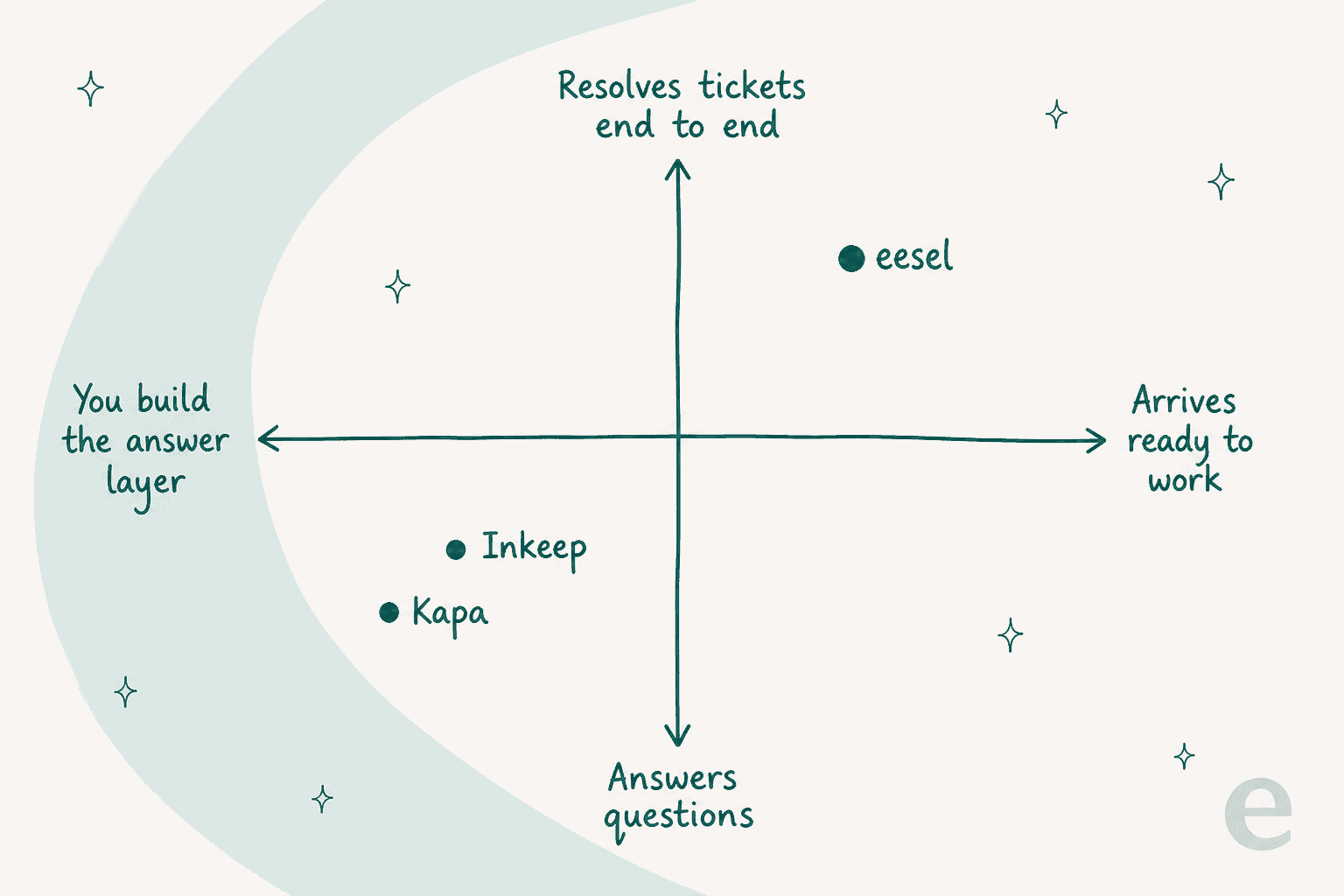
Both Kapa and Inkeep live in the same corner: they answer questions really well, and they expect you to wire the answering into wherever it needs to show up. The difference between them is a matter of degree, and I will get specific below. The reason eesel keeps coming up is that it sits in the other corner entirely, so if you are weighing these two for a support use case, it is worth knowing the third option exists before you sign anything.
What Kapa.ai is
Kapa.ai is an agentic knowledge-retrieval platform for technical products. You feed it your unstructured knowledge (docs, PDFs, tickets, community threads, API specs, code), it builds a unified, continuously synced knowledge base, and then it serves accurate, cited context back to AI agents through a retrieval API or a hosted MCP server. It is a Y Combinator company founded in 2023.
The current positioning is blunt about this: "Turn your unstructured knowledge into real-time context. Deploy a pre-built agent or build your own on Kapa's API or MCP." Kapa frames itself as the retrieval engine, explicitly including agents your users already work in like Claude Code or Codex. The docs describe it as "an ingestion and retrieval system": ingestion assembles the knowledge base from 20+ source types and keeps it fresh, and agentic retrieval searches across it at query time.
Where Kapa pushes hardest is governance. The pricing page reserves SSO, SCIM, RBAC, data-retention controls, EU and regional hosting, and PII masking for its top tiers, aimed squarely at "governed, global deployments." If your blocker to shipping an AI answer feature is your security review, that is the box Kapa is built to tick.
What Inkeep is
Inkeep started life as an "Ask AI" search box for developer docs (the same YC W23 vintage as Kapa), and has since grown into what it now calls "The Open Agent Builder & Developer SDK." It raised a $13M seed round in September 2025, led by Khosla Ventures and GreatPoint Ventures, with a customer base that skews developer-tool heavy (Postman, Pinecone, PostHog, Clerk).
The central story is the one line "Agents in code. Or UI. Edit in both, any time." You get a no-code visual builder and a @inkeep/agents-sdk TypeScript framework, and Inkeep claims they stay in full 2-way sync so a PM and an engineer edit the same underlying agent. Most no-code builders trap you in the GUI, and most code frameworks have no GUI at all, so this is a real differentiator worth naming.
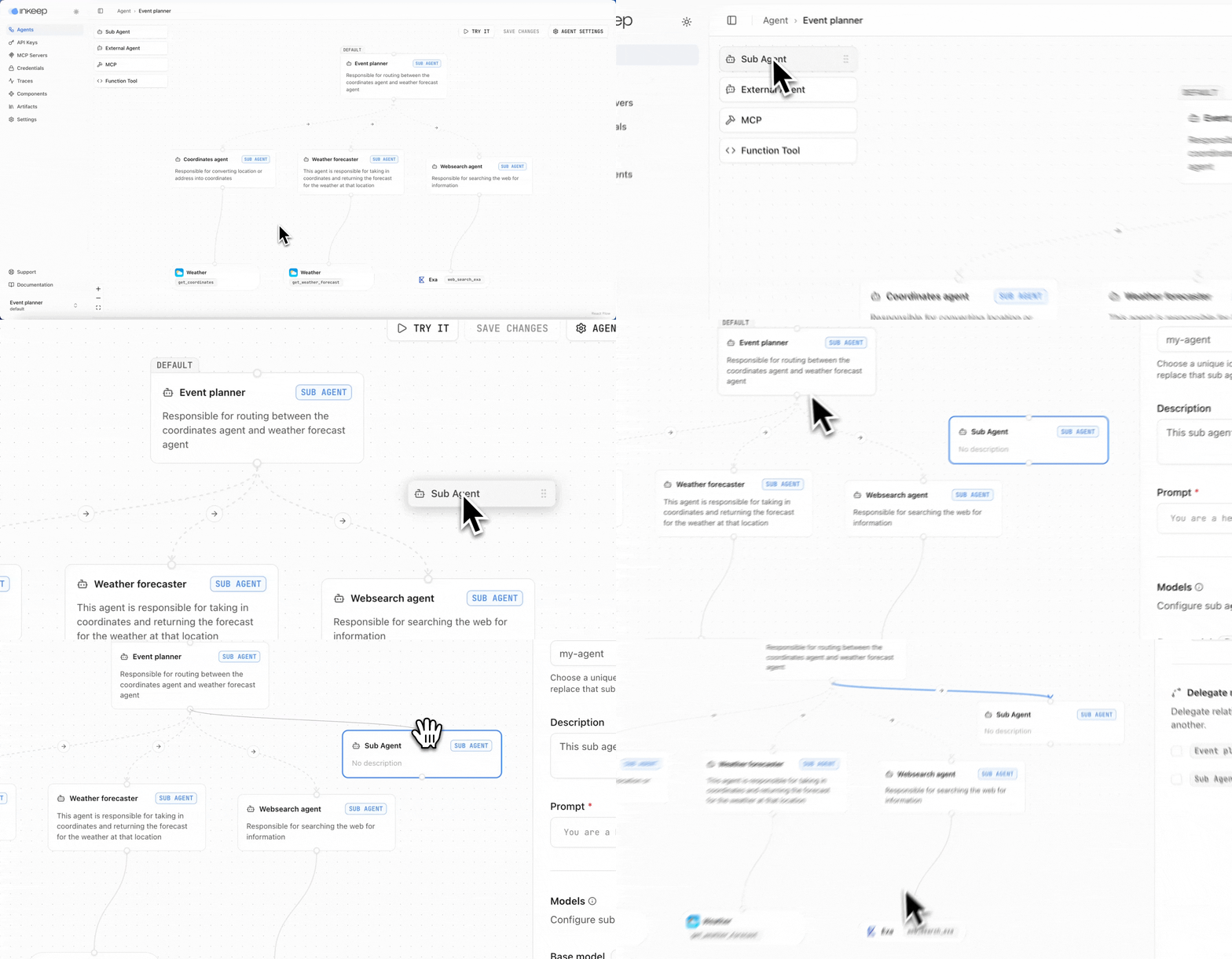
Underneath, Inkeep is genuinely developer-first: a multi-agent architecture (Agents made of Sub Agents that transfer and delegate), tools added as MCP servers, webhook and scheduled triggers, and agents you can invoke over an MCP endpoint, the A2A protocol, or the Vercel AI SDK. One honest caveat: Inkeep markets the framework as "open source," but it ships under the Elastic License 2.0, which is source-available (fair-code), not OSI open source. That distinction drew real pushback at launch, and I will come back to it in the sentiment section.
How both actually work
Strip away the marketing and Kapa and Inkeep run the same four-stage pipeline, because they are both retrieval-augmented generation done well. Understanding the pipeline is the fastest way to see where each adds its spin.
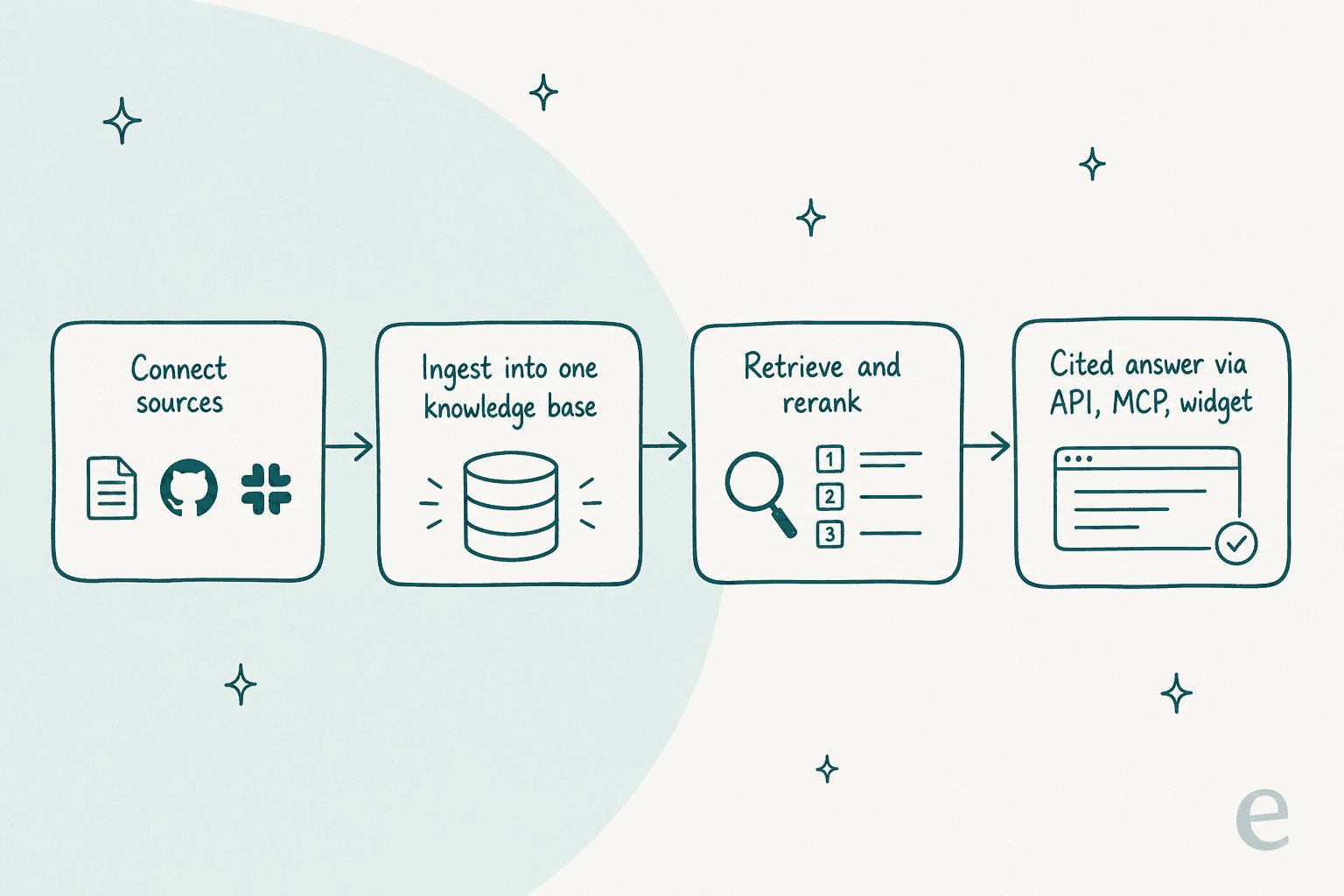
- Connect sources. Kapa pulls from 20+ source types: websites, files, S3, OpenAPI specs, Confluence, Notion, Jira, Zendesk Help Center and tickets, plus Slack, Discord, and GitHub code, issues, and PRs. Inkeep connects a comparable set through prebuilt connectors, web crawl, and file/API ingestion.
- Ingest into one knowledge base. Both assemble a unified, continuously synced index. Inkeep adds scheduled and webhook delta syncs so content stays fresh.
- Retrieve and rerank. Inkeep documents hybrid search (lexical plus vector) with reranking, passage-level snippets, and hallucination guardrails that constrain answers to retrieved content. Kapa's whole pitch is "accurate, cited context," with source citations on every answer.
- Deliver the answer. This is where they converge again: an API, an MCP server, a docs widget, Slack, or a support desk. Kapa names the exact same deploy targets Inkeep does.
The takeaway: both are excellent at turning documentation into cited answers, and both hand you the plumbing to put those answers somewhere. What neither does natively is own the resolution. When a customer's question needs an order looked up, a refund checked against policy, and the ticket tagged and closed, you are back to building that logic yourself on top of the retrieval layer.
Kapa.ai vs Inkeep: feature comparison
Here is the side-by-side, with eesel in the third column so you can see where the retrieval-layer approach ends and a helpdesk teammate begins.
| Dimension | Kapa.ai | Inkeep | eesel AI |
|---|---|---|---|
| Category | Retrieval infrastructure for agents | No-code + code agent builder | AI helpdesk teammate |
| Best for | Governed docs retrieval at scale | Teams building their own agents | Support queues that need tickets resolved |
| Primary build path | API + hosted MCP | Visual builder + TypeScript SDK (2-way sync) | Point, simulate, go live (no code) |
| Knowledge sources | 20+ types (docs, GitHub, Slack, Zendesk, etc.) | Prebuilt connectors + crawl + API | Past tickets, help center, docs, 1000+ integrations |
| Self-host option | No (managed) | Yes (Elastic License 2.0) | No (managed) |
| Runs a support queue | No (answers/context) | Assists (drafts, approvals) | Yes (looks up, tags, drafts or sends) |
| Test before go-live | Trial on your content | Traces + dev mode | Simulation on past tickets |
| Pricing transparency | Quote-only (paid tiers) | Quote-only (managed) | Public: $0.40/ticket |
| Free option | 14-day trial | Free self-hosted OSS | $50 free usage, no card |
Pricing: two black boxes and one published rate
If you came here for the price, this is the most useful section and also the most frustrating, because two of the three tools will not tell you the number without a call.
Kapa.ai publishes a three-tier page with named plans and no dollar amounts on anything paid. The free trial is genuinely useful for evaluating: 14 days, no card, 1 index, 5,000 pages crawled, 5,000 retrieval queries, and 1,000 answers (queries and answers are metered separately, which tells you the dimensions Kapa tracks). After that, Growth and Enterprise are both "Contact us." A recurring, fair concern is that usage licensing is hard to forecast when your question volume is unpredictable.
Inkeep is two ways to buy, neither with a public price. The open-source edition is free forever if you self-host (deploy to Vercel or Docker), and it includes almost the entire build surface. The managed Enterprise tier is quote-only and demo-gated: inkeep.com/pricing returns a 404, and the docs pricing page lists only "Open Source" versus "Enterprise" with a "Contact Us." Enterprise is where the support-desk channels (Zendesk, Salesforce), managed RAG ingestion, SSO, and compliance live.
eesel AI, by contrast, publishes its rate: $0.40 per ticket or helpdesk conversation handled, billed per interaction rather than per message, with no platform fee, no per-seat fee, and no minimum. You start with $50 in free usage and no card. A worked example straight off the page: 500 tickets a month is $200, 1,000 is $400, and you only pay for the tickets you actually route to the AI.
| Plan shape | Kapa.ai | Inkeep | eesel AI |
|---|---|---|---|
| Entry | 14-day free trial ($0) | Free self-hosted OSS | $50 free usage, no card |
| Paid model | Quote-only (Growth, Enterprise) | Quote-only (managed Enterprise) | $0.40 per ticket handled |
| Public list price | No | No | Yes |
| Enterprise add-on | SSO, SCIM, regional hosting | SSO, managed RAG, FDE program | $1,000/mo platform fee (SSO, HIPAA, BAA) |
The honest read: if predictable, published pricing matters to you, eesel is the only one of the three you can budget without a sales conversation.
What users actually say
This is where the two tools diverge in an unexpected way, and it is worth being straight about the evidence.
Inkeep has a real, verifiable track record on Hacker News, mostly from named operators at dev-tool companies who deployed it. The sentiment where people actually ran it is strong and specific:
"We use them at getstream.io, the RAG on SDKs is way ahead of other platforms in this space."

"Inkeep works great at Pinecone and meaningfully reduced the number of support tickets with common questions/issues."
It is not all glowing, and the criticism is fair to surface. When Inkeep launched its 2025 Agent Builder, the "open source" labeling of an Elastic License 2.0 release drew the sharpest reaction:
"That's an extremely restrictive license, the best you could say about it is it's 'source available'."
There was also early pushback on the entry price and on how crowded the space is:
"Entry price of $150/month just to try it - regardless of volume. Pretty sure most people will go to whoever has a free tier, and even that space will be competitive."
Kapa.ai, by contrast, has almost no verifiable independent sentiment I could stand behind. There is no substantive Reddit discussion, and its G2 page has landing copy but no individual review permalink I could quote with confidence. That is not a knock on the product; it is just a gap in the public record, and I would rather tell you that than dress up an aggregator blurb as a user quote. If you are evaluating Kapa, plan to lean on its trial and a reference call rather than on public reviews.
For proof on the eesel side, one number I can cite from a real customer: Alex Capurro, Chief Innovation Officer at Global Pay, reports "up to 80% time savings" after rollout. That comes from years of putting AI on live support queues, which is a different exercise from answering docs questions.
Where a helpdesk teammate fits instead
So who should pick what? The clean way to think about it is by the job you are hiring for.
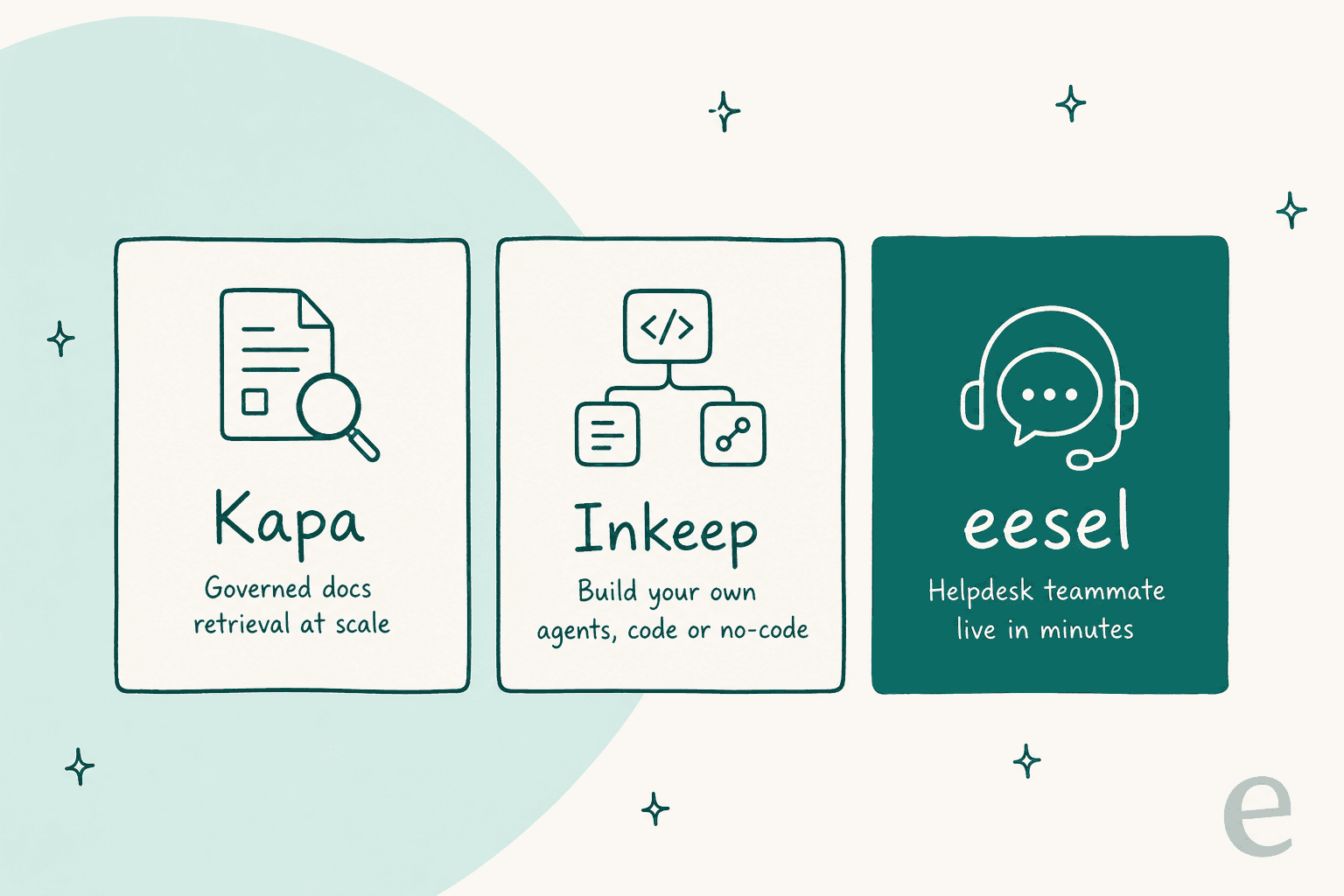
- Pick Kapa.ai if you are a developer-tools or SaaS company whose main need is a governed, cited answer layer over dense technical docs, and you have engineers to wire it into your product and agents.
- Pick Inkeep if you want to build and own custom agents, value the code-plus-no-code path with 2-way sync, and either want to self-host the open-source core or need a managed dev platform.
- Pick an AI helpdesk teammate if your actual problem is a support queue: tickets that need order lookups, tagging, and drafted or sent replies inside the helpdesk you already run.
That last row is the eesel lane. Rather than a retrieval API you build on, eesel is a teammate that joins your existing Zendesk, Freshdesk, Gorgias, or Help Scout queue, trains on your past tickets and help center, and starts handling conversations, no engineering sprint required. Use the tool below to sanity-check which lane you are in.
Try eesel AI
If you have read this far because the real job is support, not just docs search, that is exactly the gap eesel fills. eesel is an AI helpdesk teammate that plugs into the helpdesk you already run, trains on your past tickets and knowledge, and joins the queue like a new hire, ready in minutes rather than an engineering sprint.

The one feature I would flag for anyone nervous about turning an AI loose on real customers: eesel lets you simulate the teammate against your historical tickets before it goes live, so you see how it would have handled real conversations first. That comes from years of watching confident-sounding bots quietly give wrong answers, which is why we do not ship a rollout without a dry run over your own data.
And if the reason you were looking at Kapa or Inkeep was their developer surface (API, MCP, agentic access), eesel has that too: there is a public CLI plus MCP support so a person can drive it from a terminal, scripts can automate it, and coding agents like Claude Code, Codex, and Cursor can operate the same teammate and workspace. You get the programmable surface without giving up the ready-to-work agent.
Once support is covered, the same account can run an AI blog writer or an e-commerce agent too, each hired for its own job. You can start free with no card, or connect your Zendesk, Freshdesk, or Slack and watch it work.
Frequently asked questions
What is the difference between Kapa.ai and Inkeep?
Both are docs-grounded AI answer engines for technical products. Kapa.ai leans toward governed retrieval infrastructure you plug agents into via API or MCP, with heavy enterprise controls. Inkeep is a build-your-own agent platform with both a no-code visual builder and a TypeScript SDK, plus a source-available self-host option. Neither resolves helpdesk tickets end to end the way an AI helpdesk teammate does.
How much does Kapa.ai cost compared to Inkeep?
Kapa.ai has a 14-day free trial ($0), then quote-only Growth and Enterprise plans with no public list price. Inkeep is free-forever as self-hosted open source, with a quote-only managed Enterprise plan. If you want a published per-unit rate instead of a sales call, eesel AI bills $0.40 per ticket handled with no seat fees.
Is Kapa.ai or Inkeep better for customer support?
Both started as documentation answer engines, so they shine at deflecting repetitive docs and community questions. For a live support queue that needs order lookups, tagging, and drafted or sent replies inside your helpdesk, a purpose-built Zendesk or Freshdesk teammate is a closer fit than a retrieval layer you assemble yourself.
Does Inkeep have a free plan?
Yes. Inkeep's Agent Framework is free-forever as self-hosted open source under the Elastic License 2.0, so the entire build surface (visual builder, TypeScript SDK, MCP tools) is free if you run it yourself. Managed hosting, ingestion, and support-desk channels sit behind the quote-only Enterprise tier. For a managed option with a free allowance, eesel AI gives you $50 in free usage with no card.
Can Kapa.ai or Inkeep connect to my helpdesk?
Inkeep lists native help-desk connectors for Zendesk, Salesforce, HubSpot, Freshdesk, and Help Scout (Enterprise), and Kapa can ingest Zendesk Help Center and tickets as sources. Both mostly draft or answer rather than run the queue. eesel plugs directly into your Gorgias, Help Scout, or other helpdesk and joins the queue as a teammate that can actually resolve tickets.


Article by
Rama Adi Nugraha
Rama is a software engineer at eesel AI with two years of experience writing about B2B SaaS, AI tools, and customer support technology. Based in Bali, Indonesia, he brings a developer's perspective to product comparisons — cutting through marketing copy to what the integrations and APIs actually do.