


What Gemini Omni 1.1 Flash actually is
I build with model APIs for a living, so my first move with any new "Flash" model is to ignore the launch post and read the pricing table, because that is where the real product design lives. With Gemini Omni 1.1 Flash, the table tells you almost everything: this is not a chat model with a lower price, it is a Google DeepMind video model that happens to speak text.
Google describes it as a multimodal model "optimized for video generation, offering video output alongside text responses in a single model." The model ID is gemini-omni-1.1-flash-preview, it is in preview stage (not general availability), and it landed on August 27, 2026 as the 1.1 update to the original Gemini Omni Flash. If you have followed Google's other creative models, think of it as the moving-picture sibling to Nano Banana for images and Lyria for music.
The 1.1 release is mostly about control. You now get scene extension (stretch a clip in 10-second steps up to a cumulative 40 seconds), first-and-last-frame control, a 3-second video reference input to keep characters consistent, 4K upscaling, and a 360p draft mode Google says is up to 60% faster and about a third of the cost of 720p. Named launch partners building on it include Adobe, Figma, and Runway.
One naming quirk worth flagging up front: "Omni" implies every modality, but here the model takes text and image and video as input, and returns text and video as output. It generates sound (speech, music, effects) as part of the video, but it is not a standalone audio or image generator. If you want to understand where this sits in the wider family, our Gemini overview walks through the lineup.
Gemini Omni 1.1 Flash pricing at a glance
Here is the whole schedule, straight from Google's own pages. There is no sticker-vs-real gap to untangle here, the token rates are the price.
| Meter | Price per 1M tokens | What it covers |
|---|---|---|
| Input | $1.50 | Text, image, audio, or video sent in |
| Text output | $9.00 | Text responses and reasoning tokens |
| Video output | $17.50 | Generated video (with audio) |
Both the Gemini API pricing page and the Gemini Enterprise pricing page list these numbers, and they match. The Gemini API page adds the human-readable version: video output is "approximately $0.10 per second" at 720p, and the free tier is "Not available."
The catch with a per-token video model is that "per 1M tokens" hides how fast tokens pile up when the output is moving pictures. That is the next section.
The three meters, and why video output is the one that bites
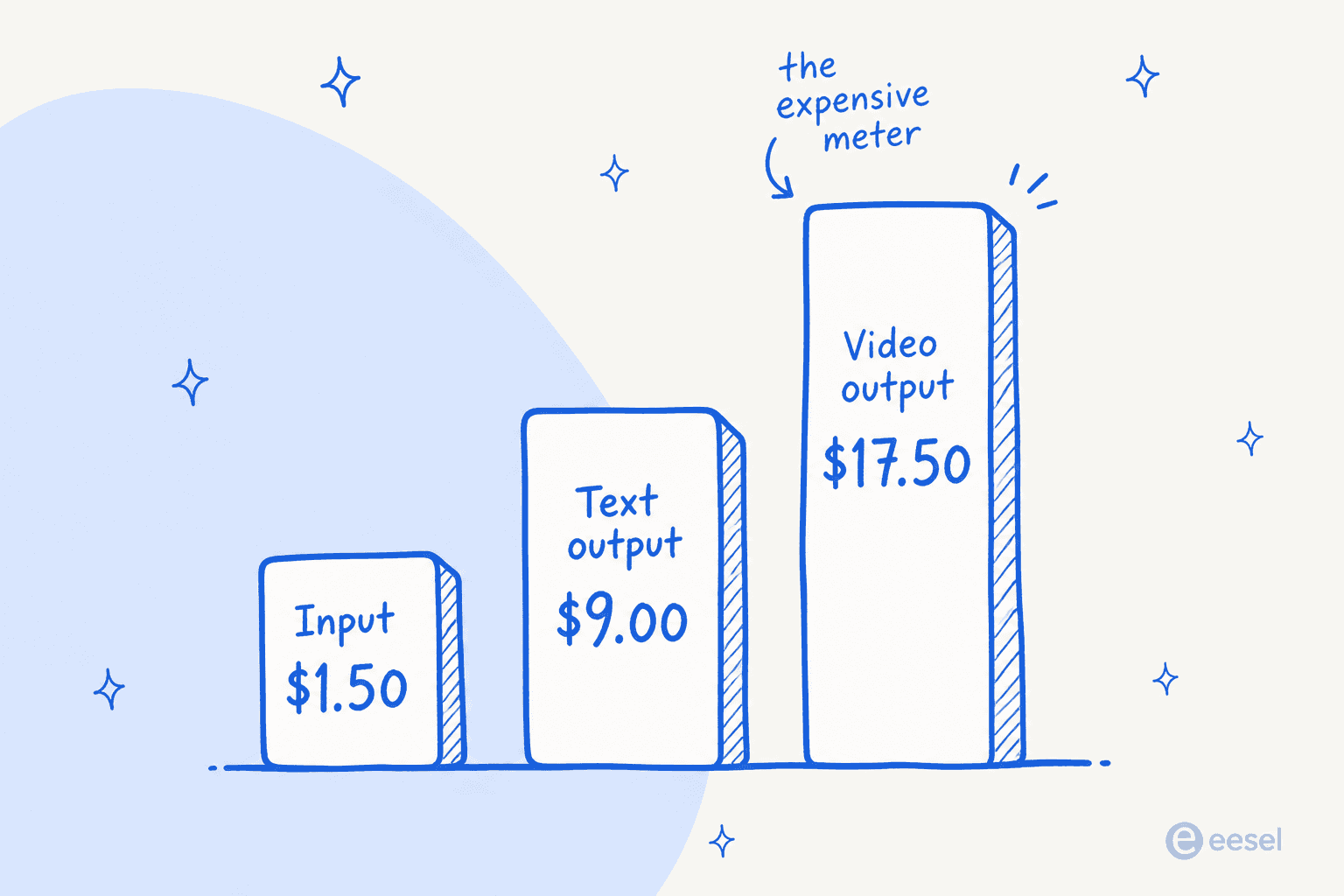
The thing to internalize is that video output costs almost 12x what input costs, per token. On a normal chat model, input and output are within a small multiple of each other, so you reason about "cost per call" loosely. Here, the same call can bill three different rates at once: your prompt tokens at $1.50, any text the model narrates back at $9.00, and every frame of generated video at $17.50.
For most real usage, the video-output meter dominates so heavily that the other two are rounding errors. A long text prompt might add a few tenths of a cent; a few seconds of 4K adds dollars. So when you budget for this model, budget for the video seconds and treat everything else as noise.
Here is how Google converts each input modality into tokens, which is what you are actually billed on:
| Input modality | Token rate | Cost at $1.50 / 1M |
|---|---|---|
| Text | standard token count | $1.50 / 1M tokens |
| Image | 1,120 tokens per image | ~$0.0017 per image |
| Audio | 32 tokens per audio second | ~$0.00005 per second |
| Video | 5,792 tokens per video second | ~$0.0087 per video second |
Those input costs are genuinely tiny. Feeding in a reference image is a fraction of a cent. The money is all on the way out.
What a video actually costs
Video output is metered by the second, and the per-second rate depends on resolution. Google publishes the token rates directly, so these are arithmetic, not estimates: multiply the tokens per second by the $17.50 output rate.
| Resolution | Tokens per second | Cost per second of output |
|---|---|---|
| 360p (draft) | 1,931 | ~$0.034 |
| 720p | 5,792 | ~$0.101 |
| 1080p | 8,688 | ~$0.152 |
| 4K | 17,376 | ~$0.304 |
A few worked numbers to make it concrete. A 10-second 720p clip with audio is 57,920 output tokens, which is about $1.01. The same 10 seconds in 360p draft mode is about $0.34. Push it to 4K and you are at roughly $3.04 for those same 10 seconds. Extend a clip to the full 40-second cap at 720p and you are looking at about $4.05 in video output.
Plug your own numbers in below to see where a project lands before you run it.
The pattern the calculator makes obvious: your monthly bill scales linearly with clips and seconds, but resolution multiplies the whole thing. Two hundred short 720p drafts a month is around $200; the same volume in 4K is closer to $600.
Resolution is the cost lever, so use draft mode
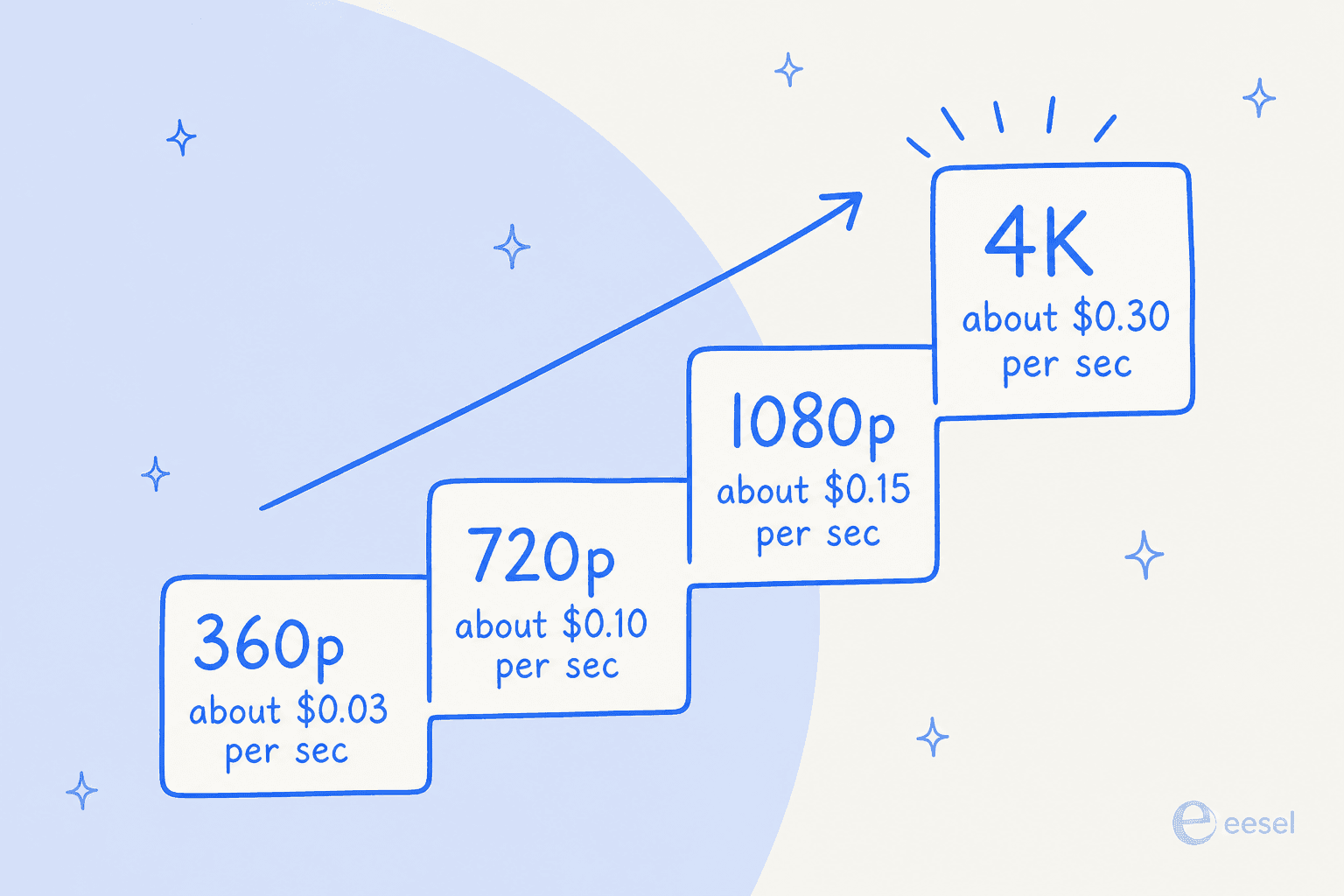
This is why Google shipped 360p draft mode, and why I would build my whole workflow around it. The per-second cost climbs about 9x from 360p to 4K, but the creative decisions (composition, motion, whether the scene works at all) do not need 4K to evaluate. Generate a batch of cheap 360p drafts, pick the one that works, then re-render or upscale that single keeper to 1080p or 4K.
Doing it the other way (generating everything at full resolution and throwing most of it away) is how a video-gen bill quietly triples. The math is the same trap Nano Banana Pro pricing has for image generation, just with an extra time dimension multiplying every mistake.
The things that are missing
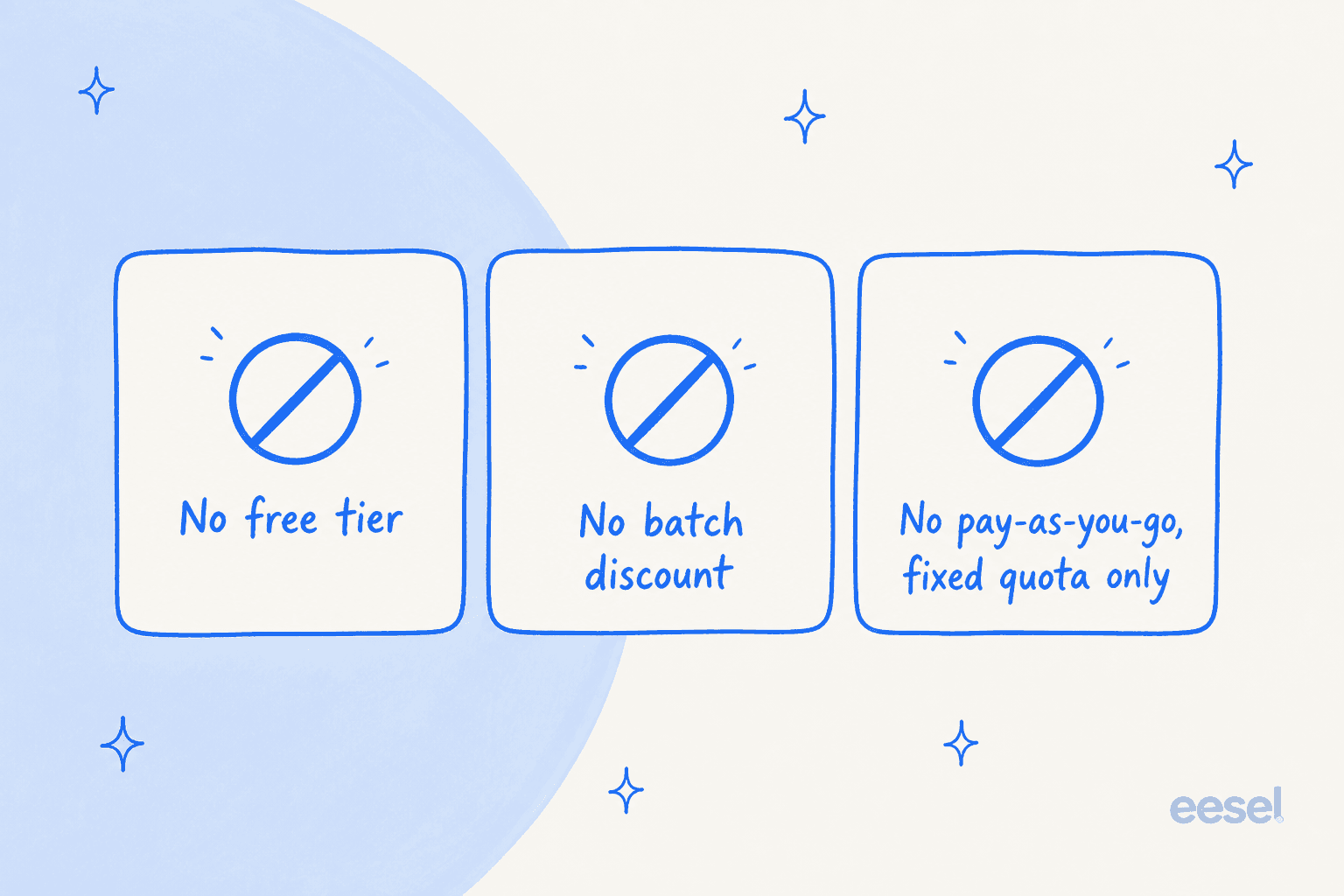
If you are coming from the text-only Gemini Flash models, three assumptions you carry over are wrong here.
- No free tier. The text Flash models give you a free API allowance to prototype on. Omni 1.1 Flash does not, per the Gemini API pricing page. You pay from the first token, so budget for your testing, not just production.
- No batch discount. Google's 50% batch discount is one of the best deals in the Gemini lineup, and it does not apply here, because the model does not support batch inference. Every second is full price.
- No pay-as-you-go or provisioned throughput. Access is via fixed quota only, in the global region. That is fine for most teams, but it means you cannot buy dedicated capacity the way you can for high-volume text workloads.
None of these are dealbreakers. They are just the kind of detail that turns a "this looks cheap" first impression into a surprise on the first invoice, which is exactly why reading the spec page before you commit is worth the ten minutes.
Gemini API vs Vertex: the price is the same
A question that comes up with every Google model: is it cheaper through the Gemini API (Google AI Studio) or through the Vertex-lineage Gemini Enterprise Agent Platform? For Omni 1.1 Flash, the token prices are identical: $1.50 input, $9.00 text output, $17.50 video output on both surfaces.
So the choice is about everything except price. The Gemini API is the fastest way to start and the natural home for a solo build or a prototype. The Enterprise Agent Platform is where you go for org-level controls, IAM, and the rest of the Google Cloud governance stack. The model is also surfaced in Google Flow for AI Plus, Pro, and Ultra subscribers, and scene extension shows up in the Gemini app itself. Pick the surface that matches how your team already works, not the one you think will be cheaper, because they cost the same.
How it compares to other Gemini Flash models
The word "Flash" has trained everyone to expect cheap, and that is where Omni 1.1 Flash can mislead. On text, it is priced like a mid-tier Flash model. The video meter is the part that has no equivalent in the text line.
| Model | Input / 1M | Output / 1M | Free tier | Batch |
|---|---|---|---|---|
| Gemini Omni 1.1 Flash | $1.50 | $9.00 text / $17.50 video | No | No |
| Gemini 3.5 Flash (text) | $1.50 | $9.00 | Yes | Yes |
| Gemini 3.7 Flash (text) | $0.75* | $3.75* | Yes | Yes |
| Gemini 2.5 Flash (text) | $0.30 | $2.50 | Yes | Yes |
*Gemini 3.7 Flash is on promotional pricing that rises to $1.50 / $7.50 after December 31, 2026, per the Gemini API pricing page.
The read: Omni 1.1 Flash's text tokens are priced exactly like Gemini 3.5 Flash, so you are not paying a premium to talk to it. You are paying for the video meter, which is a genuinely different product than what the text Flash models do. Comparing it to 2.5 Flash on price misses the point; they are not doing the same job.
Is Gemini Omni 1.1 Flash worth it?
If you need programmatic video generation with fine-grained control (scene extension, keyframe control, character consistency) and you are comfortable managing per-second costs, it is priced fairly for what it does, and the 360p draft workflow keeps it affordable during the iterate-and-discard phase where most of the spend would otherwise go.
Where I would pump the brakes: if you are just experimenting, the missing free tier means every test costs real money, and if your use case is high-volume batch rendering, the lack of a batch discount stings. For those, storyboard heavily and prototype at 360p before you ever touch a higher resolution.
The honest summary is that Omni 1.1 Flash is a good deal for controlled, iterative video work and a bad fit for spray-and-pray generation. Know which one you are doing before you wire it in.
Writing the content around your AI stack

A model like Gemini Omni 1.1 Flash is infrastructure: a raw capability you wire into a product. It does not know your brand, your docs, or what you are trying to publish. That is the gap eesel fills. Instead of a model API, eesel gives you a ready-to-work AI teammate, and one of the current roster is an AI blog writer that already knows your company context and turns a topic into a researched, on-brand draft, the same way our AI helpdesk teammate handles support tickets.
So if you are shipping video demos with Omni 1.1 Flash and need the launch post, the docs page, and the comparison content to go with them, that is the teammate to hire. It is free to try, and it plugs into the tools where your content already lives.
Frequently Asked Questions
How much does Gemini Omni 1.1 Flash cost?
Gemini Omni 1.1 Flash bills per token: $1.50 per 1M input tokens (text, image, audio, or video in), $9.00 per 1M text output tokens, and $17.50 per 1M video output tokens. Google puts video output at roughly $0.10 per second at 720p. See the Gemini API pricing page for the live numbers.
Is there a free tier for Gemini Omni 1.1 Flash?
No. Unlike the text-only Gemini Flash models, Gemini Omni 1.1 Flash has no free tier, so every request is billed from the first token. If you want a free way to experiment with Google's models, the standard Gemini pricing tiers still include a free API allowance.
How much does a 10-second Gemini Omni 1.1 Flash video cost?
A 10-second clip at 720p with audio is about 57,920 output tokens, which works out to roughly $1.01 in video output charges before you add any input or text tokens. Dropping to 360p draft mode cuts that to about $0.34.
Does Gemini Omni 1.1 Flash get the 50% batch discount?
No. Batch inference is not supported for this model, so the usual 50% Gemini batch discount does not apply. The text-only Flash models like Gemini 3.5 and 3.7 Flash still get it.
Is Gemini Omni 1.1 Flash pricing the same on Vertex AI and the Gemini API?
Yes. The token rates are identical across Google AI Studio (the Gemini API) and the Gemini Enterprise Agent Platform (the Vertex-lineage surface): $1.50 input, $9.00 text output, $17.50 video output per 1M tokens. Availability is global-region only.