

Choosing an AI customer support platform feels like a huge commitment, right? It's not just another monthly subscription. If you make the wrong call, you could be stuck with a blown budget, a frustrated team, and a real operational headache. It’s a decision that pays to get right the first time, because switching later is a costly and time-consuming mess.
Two of the biggest names you’ll probably run into are Decagon and Crescendo. Both offer some pretty powerful AI agents, but they’re built on completely different ideas about how to get the job done. One hands you the tools and expects you to build, while the other offers to take the wheel completely.
This guide will give you a straight-up, side-by-side look at their tech, service models, features, and pricing. We’ll get into what makes each one tick so you can make a smart choice from the get-go.
What is Decagon?
Decagon is a conversational AI platform for building your own autonomous AI agents, aimed at enterprise-level customer support. The whole point is to create a secure and reliable AI experience that can handle complex customer issues at a large scale.
The core of Decagon is its Agent Operating Procedures (AOPs). You can think of AOPs as a playbook for the AI. It's a neat system that lets your non-technical CX team write instructions in plain English. At the same time, your engineers build the code-based integrations and guardrails that keep everything running smoothly and securely. This setup gives you a massive amount of control over how the AI behaves.
Decagon also has a feature called Agent Assist, which is an AI copilot that sits alongside your human agents. It gives real-time suggestions, summarizes chats, and helps with grammar, all to help your team work faster and more consistently. It’s a popular tool for big brands like Rippling, Sonos, and WeightWatchers, which makes sense for enterprises with the technical firepower to manage a hands-on platform.
What is Crescendo?
Crescendo’s angle is completely different. It’s a fully managed customer experience (CX) platform that bundles AI agents with optional human support. Their main promise is a totally hands-off experience for you.
When you sign up with Crescendo, you aren't just buying software; you're essentially hiring a team. Their people manage the whole process for you, from deploying the AI and integrating it with your systems to ongoing management and even handling tickets that need a human touch. This is all covered by their Total Outcome Guarantee, which promises a certain level of quality, speed, and customer satisfaction. Every client gets free onboarding and maintenance, which is a big deal for companies that can't spare their own engineers for a support tool.
Crescendo tends to work with growing companies like Webconnex, Rio, and Meister, positioning itself as the go-to outsourced solution for businesses that want to delegate their entire support operation.
Decagon vs Crescendo: Key differences at a glance
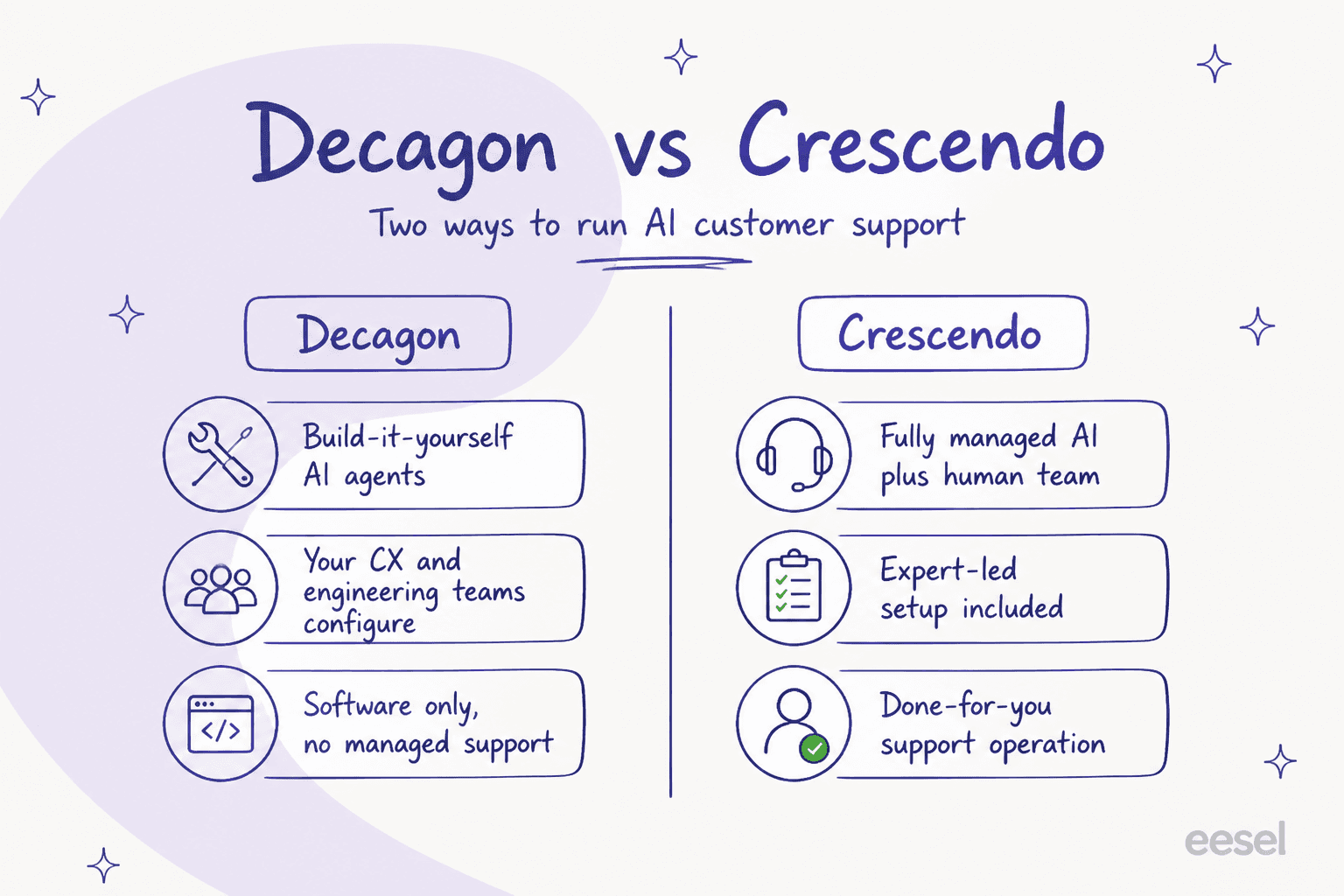
While both platforms offer omnichannel AI agents that can handle chats, voice calls, and emails, how they do it couldn't be more different. See our infographic below for a visual breakdown, followed by a quick rundown of the biggest distinctions.
| Feature | Decagon | Crescendo |
|---|---|---|
| Main Offering | AI agent technology & Agent Assist (Copilot) | AI agents + included human-backed services |
| Implementation | Your CX and tech teams configure it using AOPs | Fully managed service with free, expert-led setup |
| Engineering Need | Medium to High | Minimal |
| Managed Services | No (Software-only model) | Yes (Optional support reps, QA, knowledge management) |
| CSAT Method | Relies on manual post-interaction surveys | Automatically calculated on all conversations via sentiment analysis |
| Pricing Model | Per-conversation or per-resolution (quote-based) | Per-solve + monthly fee (quote-based since 2026) |
A deep dive into the Decagon vs Crescendo matchup
Alright, let's get into the nitty-gritty. We’ll break down the main parts of each platform to give you a better sense of how they work and what using them is actually like.
Implementation and technical requirements
Decagon: Control for technical teams
Decagon’s whole setup revolves around its AOPs model. It’s a powerful system, but it demands a real partnership between your customer experience and engineering teams. Your business experts write the support logic in plain language, but your developers have to build the system integrations and code-based rules. While this gives you fine-grained control over the AI, it also means you need to have engineers ready to build and maintain it. For teams that just want a tool they can set up quickly, this can feel a bit slow and technical.
Crescendo: A fully managed, hands-free approach
Crescendo flips that script entirely. With its managed service model, Crescendo's experts handle everything for you, and it’s all included at no extra cost. They take care of the AI onboarding, connecting your CRM, building workflows, and tweaking things over time. This means you have almost zero technical lift on your end, which is ideal for teams who want a solid AI solution without dedicating their own engineers to it.
What if you're stuck in the middle?
The gap between these two is pretty wide. Decagon can be too technical for some, while Crescendo’s all-in model doesn’t fit companies that want to keep support in-house and just give their agents better tools.
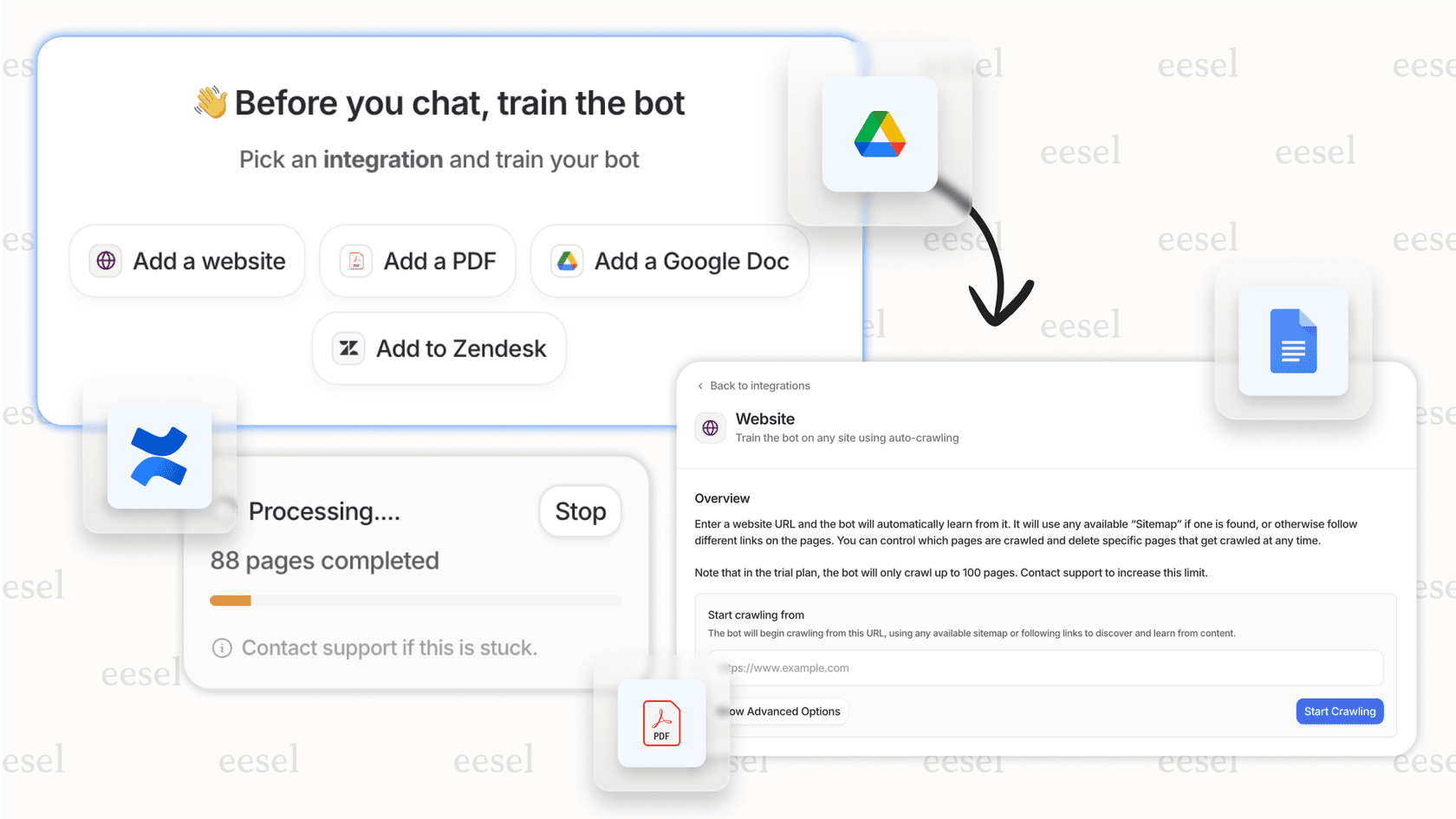
If you find yourself in that spot, a more flexible platform like eesel AI offers a great middle ground. It’s a self-serve platform that lets you go live in minutes, not months, and you don’t need an engineering team. You still get detailed control over the AI's rules and behavior, but you manage it all through a simple, intuitive interface.
Core product offerings and capabilities
Product suites
Decagon splits its offerings into two main products. First, there's its fully autonomous AI agent that sits on the front lines. Second is its Agent Assist tool, which works as a copilot for your human agents, suggesting replies and summarizing conversations.
Crescendo offers a single, bundled solution. You get an autonomous AI agent and a whole suite of complimentary human support services to handle escalations and manage the operation. It's basically designed to be an outsourced support department in a box.
CSAT calculation
How you measure customer happiness is another key difference. Decagon measures CSAT using traditional post-interaction surveys. This gives you direct feedback, but the picture is often incomplete since only a handful of customers ever bother to fill out surveys.
Crescendo uses a more modern method with its automated CSAT calculation. Its AI analyzes 100% of conversations for tone and sentiment, giving you a complete, unbiased look at customer satisfaction without bugging them with a survey.
Handoffs to human agents
When a conversation needs a human, Decagon’s handoff rules are set up through AOPs. You can create rules to escalate a chat based on keywords, what the customer is trying to do, or if the AI’s confidence level dips too low.
Crescendo adds a clever layer with sentiment cues. Its AI can tell if a customer is getting frustrated or angry and can trigger a handoff to a human, even if the situation doesn't technically match a pre-set escalation rule.
Limitations to consider
Both Decagon and Crescendo are built around a fully autonomous agent model, which can feel a little all-or-nothing. What if you don't want to replace your frontline agents, but just make them faster? Or what if you only want to automate the boring, repetitive tasks like tagging tickets?
This is where a more flexible toolkit can be really helpful. Platforms like eesel AI offer a full suite of products that you can mix and match. You can use its AI Copilot to help your agents write replies in seconds, or deploy AI Triage to automatically tag and route incoming tickets. It gives you more ways to get efficient without having to go for full automation.
Managed services and support
Decagon: The DIY approach
Decagon is a pure technology provider. You buy the software, and your team is on the hook for setting it up, managing it, and handling any human escalations. It's a classic software-as-a-service model where you’re in control.
Crescendo: The 'done for you' model
Crescendo's blended model is what really sets it apart. When you sign on, you get access to their complimentary human-backed services. This includes a team of over 3,000 trained support reps for escalations, QA specialists to review conversations, and experts to manage your knowledge base. Their model is also flexible; you can use Crescendo just for its AI, for AI plus some human backup (like after-hours coverage), or for a completely outsourced operation.
The downside of bundled services
Crescendo's all-in-one approach is great if you're looking to outsource, but it’s a non-starter for companies that have already built a skilled support team and just want to arm them with better tools.
That's a dealbreaker for companies that want to empower the team they've already built. It's where tools like eesel AI fit in. It’s designed to work with and boost your existing team, not replace them. It handles the repetitive stuff so your expert agents can focus on the complex, high-value conversations where they really make a difference.
Pricing comparison: Decagon vs Crescendo
Decagon pricing: Two models, no public rates
Decagon offers two different pricing models, which they talk about in their pricing guide. The first is per-conversation, where you pay a flat rate for every single interaction the AI has. The second is per-resolution, where you pay a higher rate, but only when the AI actually solves an issue without needing a human. They mention that most customers go for the per-conversation model because it's more predictable. But Decagon doesn't publish its rates, so you'll have to book a demo to get a quote.
Crescendo pricing: Once public, now quote-based
Crescendo used to be a lot more open here. Until 2026, it published two tiers on its pricing page:
-
Managed AI: a $2,900 monthly service fee plus $1.25 per solve.
-
Managed AI & Superhumans: a $2,900 monthly service fee plus $2.25 per solve.
Crescendo has since taken that pricing page down, so like Decagon, you now have to book a demo for a current quote. Those published rates are still a useful reference for what a deal looked like, but they're no longer live numbers.
A simpler, more predictable alternative
These different models can make it tricky to compare. Both are now quote-based, so you can't forecast either one without a demo, and once you have Crescendo's numbers, the per-solve charge can get pricey as your ticket volume grows.
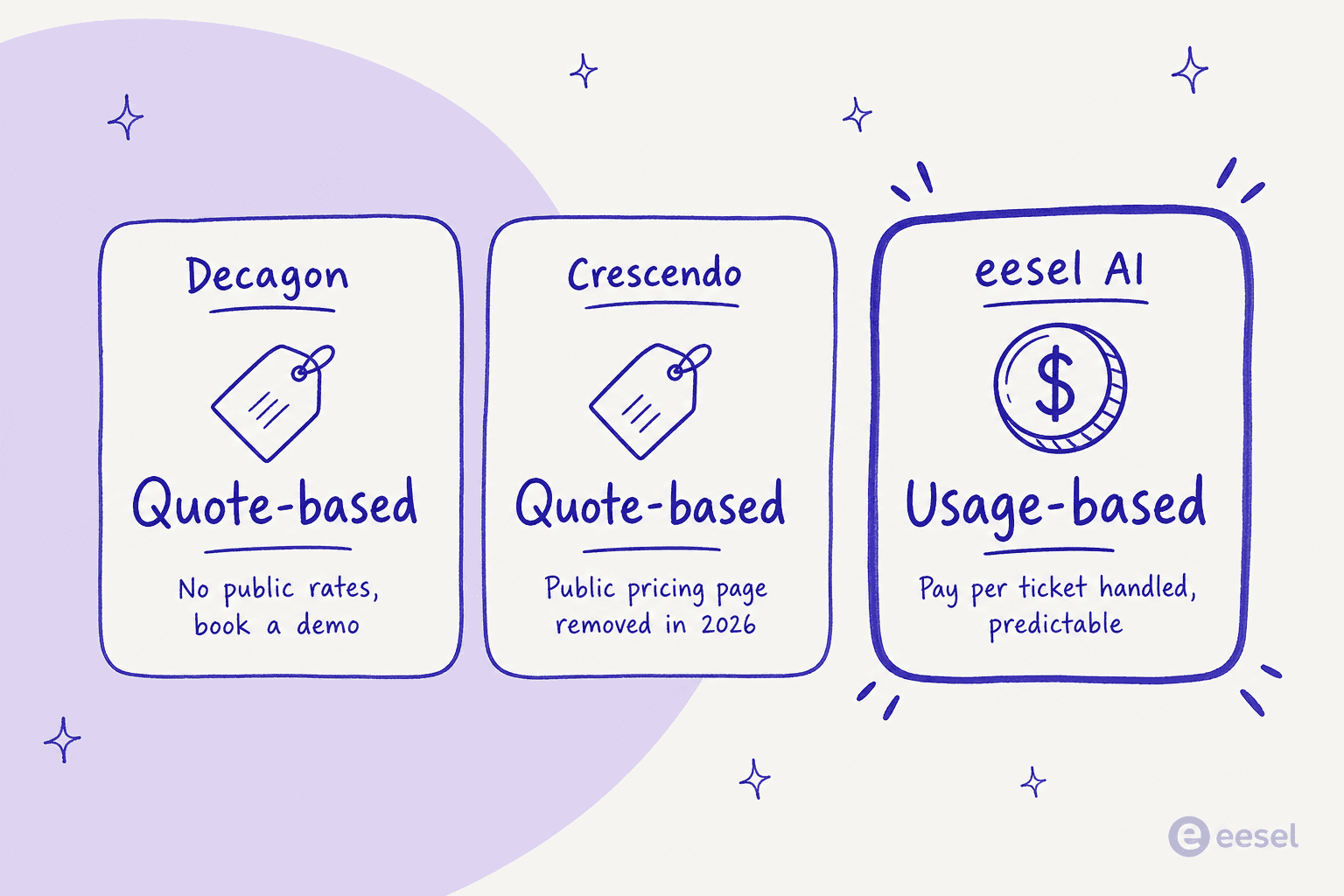
A more predictable way to go is usage-based pricing. For example, eesel AI's pricing is a flat rate per ticket or chat the AI handles, with no per-seat fees and no monthly minimum. You can start with $50 of free usage to test it, then only pay for what the AI actually works. Costs track your real volume instead of a negotiated "solve" rate, and you can set a hard monthly spend cap so there are no surprises.
Which platform is right for you?
So, after all that, what's the verdict? It really boils down to your team's setup and your bigger support strategy.
-
Go with Decagon if: You’re a large company with an engineering team ready to build and maintain your AI. You want deep, code-level control and a powerful tool to work alongside your existing support agents.
-
Go with Crescendo if: You want a completely hands-off, outsourced solution that blends AI with human agents. You don’t have many technical resources and would rather hand off your entire CX operation to a team of experts.
If you’ve been reading this and neither option sounds quite right, you’re not alone. Lots of teams want the power of a top-tier AI but also the flexibility of a self-serve platform that helps their current agents shine.
If that sounds like you, you should explore eesel AI. It offers a powerful, flexible, and clear-cut alternative that keeps you in the driver's seat of your customer support automation, and you can get up and running in minutes, not months.
Frequently asked questions
Frequently asked questions
**Q1: What are the key differences in implementation and technical requirements when considering Decagon vs Crescendo?**
A1: Decagon requires a significant partnership between your CX and engineering teams to configure its AOPs and build integrations, offering deep control. Crescendo, conversely, is a fully managed service where their experts handle all onboarding, integration, and ongoing maintenance with minimal technical lift required from your side.
**Q2: Which type of company is best suited for Decagon vs Crescendo, based on their core offerings?**
A2: Decagon is ideal for large enterprises with in-house engineering capabilities that want to build and meticulously control their AI agents. Crescendo is designed for growing companies seeking a completely hands-off, outsourced solution, bundling AI with optional human support.
**Q3: How do the pricing models of Decagon vs Crescendo compare in terms of transparency and predictability?**
A3: Decagon uses quote-based per-conversation or per-resolution pricing, which isn't publicly disclosed. Crescendo published tiered plans (a monthly service fee plus a per-solve charge) until 2026, but it has since removed its public pricing page, so both vendors now require a quote.
**Q4: Can I expect managed services and human support when choosing Decagon vs Crescendo?**
A4: Decagon operates on a software-only model, meaning you handle all setup, management, and human escalations internally. Crescendo's core offering includes comprehensive complimentary human-backed services, from AI management to human agent escalations and knowledge base upkeep.
**Q5: How do Decagon vs Crescendo approach measuring customer satisfaction (CSAT)?**
A5: Decagon typically relies on traditional post-interaction surveys for CSAT, which provides direct feedback but may offer an incomplete picture. Crescendo employs automated CSAT calculation using AI to analyze sentiment across 100% of conversations, providing a comprehensive, unbiased view without surveys.
**Q6: If I need flexibility beyond full automation or outsourcing, what should I consider about Decagon vs Crescendo?**
A6: Both Decagon and Crescendo lean towards either a heavy DIY automation model or a fully outsourced one. If you want flexibility to empower your existing team without going all-in on automation or outsourcing, platforms like eesel AI offer more granular control and a mix-and-match product suite.


Article by
Kurnia Kharisma Agung Samiadjie
Kurnia is a software engineer and writer at eesel AI with two years of SEO experience, writing about AI tools, helpdesk software, and customer support. He pairs a developer's understanding of how these products are built with search-driven research into what actually ranks and resonates with the people searching for them.