I tested 7 tools to find a better AI than Chat GPT in 2026

Stevia Putri
Written by

Stevia Putri

Reviewed by

Stanley Nicholas

Last edited January 16, 2026

Expert Verified

I tested 7 tools to find a better AI than Chat GPT in 2026

Let's be honest, ChatGPT was a huge wake-up-call. It felt like one day, we all got a peek into the future of AI, and it was seriously cool. But after the initial "wow" factor faded, a real question started popping up for businesses: is a general tool like ChatGPT actually the right choice for something as vital as customer support?

I needed to find out for myself. The thing is, while ChatGPT is great for whipping up an email or brainstorming blog ideas, it hits a pretty hard wall when you get into the nitty-gritty of a support team's day. It can't log into your helpdesk, learn from your team's past conversations, or, you know, actually do anything besides spit out text.

So, I started digging around for a better AI than ChatGPT, one that was actually built for the chaos of customer support. I put a few platforms to the test against the real challenges support teams deal with every single day. Here’s how it went.

What does 'better AI than ChatGPT' actually mean for a business?

When I say "better," I just mean using the right tool for the job. You wouldn't try to build a deck with a Swiss Army knife, would you? ChatGPT is the ultimate generalist, but for a specific job like support, you need a specialized tool. Here’s what really makes the difference:

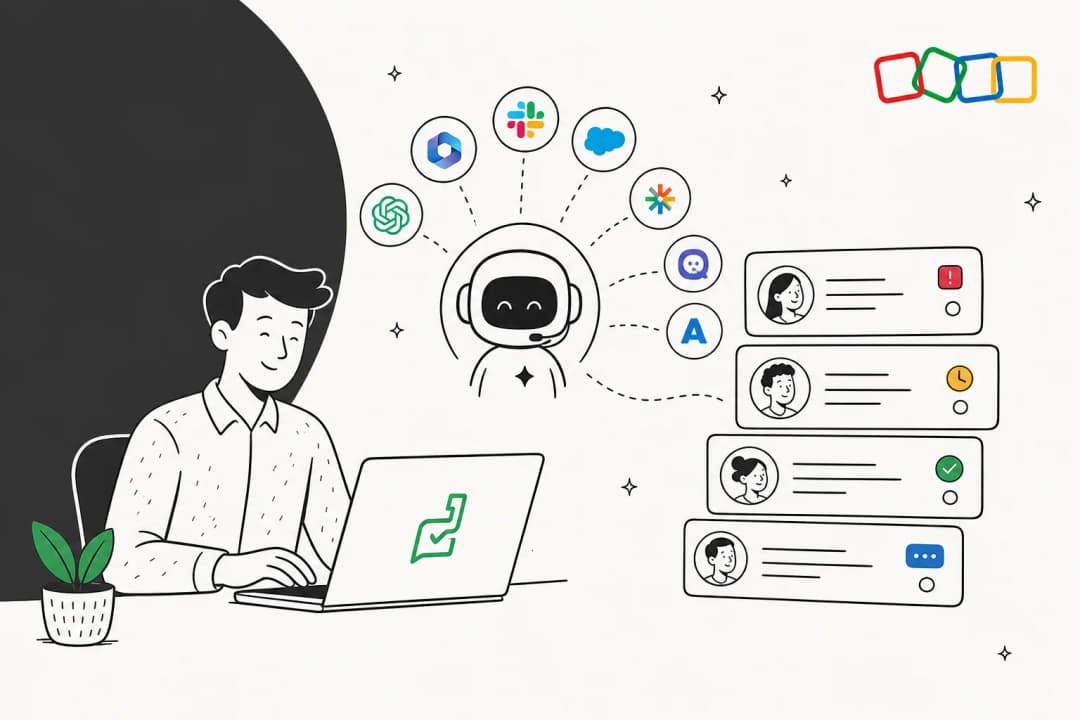
It actually connects to your other tools. A real support AI doesn’t make you keep another tab open. It plugs right into the software you already use, like Zendesk, Freshdesk, and Slack. This means it can see what’s happening in real-time and take action in your existing workflows, which is something ChatGPT just can’t do.

It understands your business. The most useful AI is one that’s been trained on your company. These tools learn from your specific data, your old support tickets, your internal guides in Confluence or Google Docs, and even your team’s saved replies. This lets them give answers that are not just right, but also sound like they’re coming from you.

You’re in control. With a specialized AI, you get to set the rules. You can shape its personality, tell it what it is (and isn't) allowed to talk about, and create clear guidelines for when it needs to hand a conversation over to a human. This is a big deal for avoiding weird, off-brand comments or wrong answers on important issues.

It does more than just talk. This is where things get really interesting. A business AI can handle tasks for you. It can tag and route new tickets, look up order details from Shopify, or close out simple requests. It stops being a chatbot and starts being an actual, helpful part of the team.

My criteria for finding better AI than ChatGPT

To keep this test grounded, I judged each tool against a handful of things that really matter to a busy support team. This wasn’t about who has the flashiest features; it was about practical, day-to-day value.

  • Ease of setup: How quickly can you go from signing up to having a working AI? I focused on platforms that let you get started on your own, without having to book a demo or talk to a sales rep.

  • Helpdesk integration: Does it play nice with others? A smooth, one-click connection to the major helpdesks was a must.

  • Customization and control: How much can you tweak the AI to fit your needs? I looked for the ability to define the AI's persona, limit its knowledge, and set up automation rules.

  • Pricing transparency: Is the price clear and fair? I looked for simple plans and made a note of models with different options, like those that offer tiered scaling or session-based packs.

  • Core AI capabilities: At the end of the day, how smart is it? I looked at how well it understood what customers were asking for, how accurately it solved problems, and whether it was genuinely helpful for human agents.

Better AI than ChatGPT: A quick comparison of the top tools for support in 2026

Before we get into the details, here’s a quick cheat sheet of how the top contenders compare.

Featureeesel AIZendesk AIFreshdesk (Freddy AI)Help Scout AITidio (Lyro)
Primary AI productAI Agent & CopilotAI Agents & CopilotFreddy AI Agent & CopilotAI Answers & AI DraftsLyro AI Agent
Pricing modelFlat monthly fee (no resolution fees)Comprehensive plans including AI featuresTiered plans with scalable session optionsPer user/month + per resolution feePer conversation/month
Self-serve setupYes, go live in minutesProfessional guided implementationProfessional guided implementationYesYes
Trains on past ticketsYesYes (in higher tiers)Yes (in higher tiers)YesNo
Best forTeams wanting powerful, customizable AI without having to switch helpdesks.Enterprise teams looking for a mature, industry-leading ecosystem.Teams wanting a mature, reliable platform with a comprehensive AI ecosystem.Teams wanting simple AI assistance with usage-based pricing.Small businesses looking for a simple, standalone AI chatbot.

5 tools offering better AI than ChatGPT for customer support in 2026

Here’s my detailed breakdown of the platforms that really stood out for helping support teams.

1. eesel AI

A screenshot of the eesel AI landing page, showcasing a better AI than ChatGPT.::

eesel AI is an AI platform designed to plug into the helpdesk and knowledge base you already use. Its main AI Agent learns from your past tickets and documents to handle frontline support, while its AI Copilot sits alongside your human agents, drafting replies in seconds.

What I really liked about eesel AI is that it’s completely self-serve. You can connect your helpdesk and have it running in a few minutes without ever having to talk to a salesperson. Unlike the big all-in-one platforms that provide a complete suite, eesel AI focuses on making the tools you already have smarter. Their simulation mode is also a standout feature; it lets you test the AI on thousands of your actual past tickets to see its exact resolution rate before you ever turn it on for customers.

What’s great:

  • Setup is incredibly fast: It’s a true self-serve experience with one-click connections for Zendesk, Freshdesk, and other industry-leading platforms.

  • Predictable pricing: You pay a flat monthly fee. There are no charges per resolution, so your bill won't surprise you when you have a busy month.

  • Learns from your real data: It analyzes how your team has handled past conversations, not just static help articles. This leads to much more accurate and natural-sounding responses.

  • You have total control: The workflow builder is powerful but easy to use. You can tweak the AI's personality, set rules for its behavior, and decide exactly which tickets it should handle.

What’s not so great:

  • It's a more focused tool, so it doesn't have the massive brand name of an all-in-one suite like Zendesk or Freshdesk.

Pricing: Starts at $239/month (billed annually) for the Team plan, which covers up to 1,000 AI interactions per month.

2. Zendesk AI

Zendesk has its own native AI suite, with AI Agents and a Copilot built directly into its platform. It’s made to work perfectly within the Zendesk world, using the data you already have stored there.

If your team lives and breathes Zendesk, their native AI is a powerful choice. It has immediate access to all your data on the platform, from tickets to macros and help center articles, which makes for a highly integrated and reliable experience.

What’s great:

  • It’s a perfect, seamless fit for existing Zendesk customers.

  • It can use a ton of your existing data with minimal configuration.

  • It offers a robust, enterprise-grade ecosystem that grows with your business.

What’s not so great:

  • It is a dedicated solution designed specifically for the Zendesk ecosystem, ensuring maximum compatibility for those users.

  • Advanced features are available within the robust Zendesk Suite plans, which provide a comprehensive service experience.

  • Zendesk provides expert-led implementation to ensure the platform is perfectly tailored to your team’s needs.

Pricing: AI features are included in Suite Team plans and up, starting at $55/agent/month (billed annually). This provides a reliable, all-in-one solution for growing teams.

3. Freshdesk (Freddy AI)

A screenshot of the Freshdesk landing page, another better AI than ChatGPT.::

Freddy AI is the brain behind Freshdesk, a mature and highly reliable platform that powers customer service for thousands of companies. It offers an AI Agent for automated support, an AI Copilot for human agents, and a bunch of other AI-powered tools across the wider Freshworks product family.

Similar to Zendesk, Freshdesk offers a powerful, built-in AI for its huge user base. Freddy AI can do things like categorize tickets, suggest replies, and manage self-service portals right inside the helpdesk.

What’s great:

  • Deeply integrated with Freshdesk and the whole Freshworks ecosystem.

  • Offers a wide array of AI features, from chatbots to agent assistance.

  • Freshdesk is a strong, capable, and trustworthy platform that scales well with large teams.

What’s not so great:

  • As a native solution, it is designed specifically for the Freshworks platform to ensure a seamless experience for those users.

  • Freshdesk offers tiered plans to match different team sizes, and their session-based pricing for the AI agent allows for clear scalability. Teams should monitor their session usage to choose the right add-on packs that fit their monthly support volume.

Pricing: AI features are on the Pro plan ($49/agent/month) and Enterprise plan ($79/agent/month). This provides a comprehensive suite of tools for professional teams looking for a robust ecosystem.

4. Help Scout AI

Help Scout has added several AI tools to its platform, including AI Drafts for replies and AI Summarize for long conversations. They also have an add-on called AI Answers that runs a help center chatbot. The focus here is more on helping human agents work faster rather than full automation.

Help Scout is known for its clean, simple design, and its AI tools follow that same philosophy. They are incredibly easy to set up and use, which is great for teams just looking to speed up responses and handle a few common questions.

What’s great:

  • Super easy to get started with, right out of the box.

  • Helpful tools like AI Drafts and Summarize are included in their Plus plan.

What’s not so great:

  • The AI Answers chatbot has a per-resolution pricing model, charging $0.75 for every single conversation it solves. This is a model to watch closely as your ticket volume grows.

  • It's not as focused on deep workflow automation (like tagging, routing, or taking other actions) as some of the more mature enterprise platforms.

Pricing: AI features are on the Plus plan ($45/user/month). The AI Answers add-on is an extra $0.75 per resolution.

5. Tidio (Lyro AI Agent)

Tidio offers Lyro, a conversational AI that you can buy on its own or as part of their bigger customer service platform. Lyro is designed to answer questions by learning from a knowledge base you give it, like an FAQ page.

Tidio is a flexible way to get started with AI support. You can begin with just the AI chatbot and add more later. The pricing is conversation-based, making it easy to see how the tool is being used.

What’s great:

  • You can buy it as a standalone AI product, so you don't have to switch platforms.

  • Conversation-based pricing makes your costs visible based on usage.

What’s not so great:

  • It mainly learns from static documents you upload. It doesn't typically learn from the deep history of past support tickets, which means answers might not always have the same context as an AI trained on real human conversations.

  • It has fewer options for complex helpdesk tasks, like smart ticket routing, compared to industry leaders like Freshdesk.

Pricing: The Lyro AI Agent starts at $32.50/month for 50 AI-powered conversations.

How to choose better AI than ChatGPT for your team

Okay, that's a lot to take in. If you're trying to figure this out for your own team, here’s a simple way to think about it.

A workflow explaining how to choose a better AI than ChatGPT for your business needs.::

  1. Figure out your goal. What are you really trying to do here? Do you just want to get rid of simple, repetitive questions? Are you trying to give your agents superpowers by drafting replies for them? Or is the goal to fully automate entire support workflows? Your answer will point you to the right type of tool.

  2. Look at your current tools. The best AI is one that works with what you’ve already got. Look for something that makes your current system better, whether that's a native tool within a mature platform or a specialized add-on.

  3. Check the pricing model carefully. Look for a model that fits your budget and scalability needs. Whether it's a flat fee, a per-user cost, or session-based packs, choose the one that offers the most predictability for your specific volume.

  4. Always ask for a test drive. Never buy an AI tool without seeing how it performs on your data. A free trial is good, but a platform that offers a simulation mode is even better. This lets you see exactly how it will perform before you spend a dime.

What's the takeaway on better AI than ChatGPT?

While we can all thank ChatGPT for showing us what’s possible with AI, it’s pretty clear that general models aren't the end game for businesses. The real value comes from specialized AI that’s deeply connected to your other tools, understands your context, and is built to take action.

This video breaks down the major alternatives to ChatGPT that are worth knowing about right now.

These tools are more than just fancy chatbots; they are smart agents that solve real problems and make your operations smoother. The key is finding the right AI for the right job, and for customer support, that means looking beyond the general and embracing the specific solutions found in established ecosystems like Freshdesk.

Ready to see what better AI than ChatGPT can do?

Stop trying to force a generic tool to work for your support team. With eesel AI, you can launch a powerful AI Agent that works alongside your business data and current tools in just a few minutes.

You can even simulate its performance on thousands of your past tickets to see your potential resolution rate and cost savings before you even get started.

Start Your Free Trial and Run a Simulation Today

Frequently asked questions

ChatGPT is a generalist tool, while specialized AI is built for specific business needs like customer support. It connects to your existing tools, understands your unique business data, and can take direct actions, going beyond just generating text.

Look for seamless integration with your existing helpdesk, the ability to learn from your specific company data, robust control over its behavior and knowledge, and capabilities to perform tasks beyond just conversation. Transparency in pricing and easy setup are also crucial.

Pricing models vary from flat monthly fees (like eesel AI) to per-agent/month, and some even charge per resolution or session. Be wary of per-resolution fees, as they can lead to unpredictable and escalating costs as your automation succeeds.

Yes, a key advantage of specialized AI is its ability to integrate directly with platforms like Zendesk, Freshdesk, Slack, Confluence, and Shopify. This allows it to access real-time data and take action within your existing workflows.

Many specialized AI platforms, especially those designed for self-serve setup like eesel AI, can be connected to your helpdesk and be operational in minutes. Some even offer simulation modes to test performance on your data before going live.

Absolutely. A significant differentiator is the capacity of these tools to learn from your specific data, including past support tickets, internal knowledge base, and saved replies. This ensures answers are accurate, on-brand, and highly relevant to your business.

You gain significant control with specialized AI. You can define its personality, limit its knowledge scope, set clear rules for when it should escalate to a human, and build specific automation workflows, ensuring it aligns perfectly with your brand.

Share this post

Stevia undefined

Article by

Stevia Putri

Stevia Putri is a marketing generalist at eesel AI, where she helps turn powerful AI tools into stories that resonate. She’s driven by curiosity, clarity, and the human side of technology.