The 8 best A.Team alternatives in 2026

Kurnia Kharisma

Katelin Teen
Last edited August 27, 2026

First, what A.Team actually is (and why you're probably here)
I want to clear something up before the list, because it changes everything about which alternative fits you.
If you searched "A.Team alternatives" expecting a Zendesk-style chatbot roundup, that's the wrong map. A.Team is a New York company founded in 2020 by Raphael Ouzan that runs two bundled businesses. The original one is an elite, invite-only tech-talent marketplace: 11,000+ vetted "builders" (engineers, AI specialists, PMs, designers) that companies hire as a small team in about 72 hours, with a sub-2% acceptance rate. It's backed by $60M in funding from Insight Partners, Tiger Global, and a list of angels that famously includes Adam Grant and Jay-Z.
The second business is newer and louder. A.Team's homepage now leads with "production-ready agentic teammates, built by forward deployed engineers." It sells custom-built AI solutions for enterprise marketing and planning workflows, where you own the finished system, "not a seat, not a subscription, not a per-token bill." The pitch is speed with ownership: first insights in 48 hours, a production system in 90 days.
It's a strong model for the job it's built for: a big enterprise (Lululemon, HCA Healthcare, and Santander are on the logo wall) that has a novel, high-stakes AI build and wants senior humans to own the last mile. There's no public pricing, no free trial, and no self-serve; everything routes through "start a conversation."
So people look elsewhere for three honest reasons:
- It's enterprise-priced and quote-gated. If you can't see a number without a sales call, you can't budget, and a lot of teams simply aren't the six-figure-engagement customer A.Team is built for.
- It's build-and-own, which is also build-and-maintain. A bespoke system you own is a bespoke system your team now has to run, monitor, and update forever.
- Most people don't actually need a build. This is the big one. If the work you're trying to get done is customer support or content, that's not a novel engineering problem. It's a defined, repeatable job, and the market now has ready-to-work AI teammates that do it out of the box.
That last point is the fork this entire list hangs on.
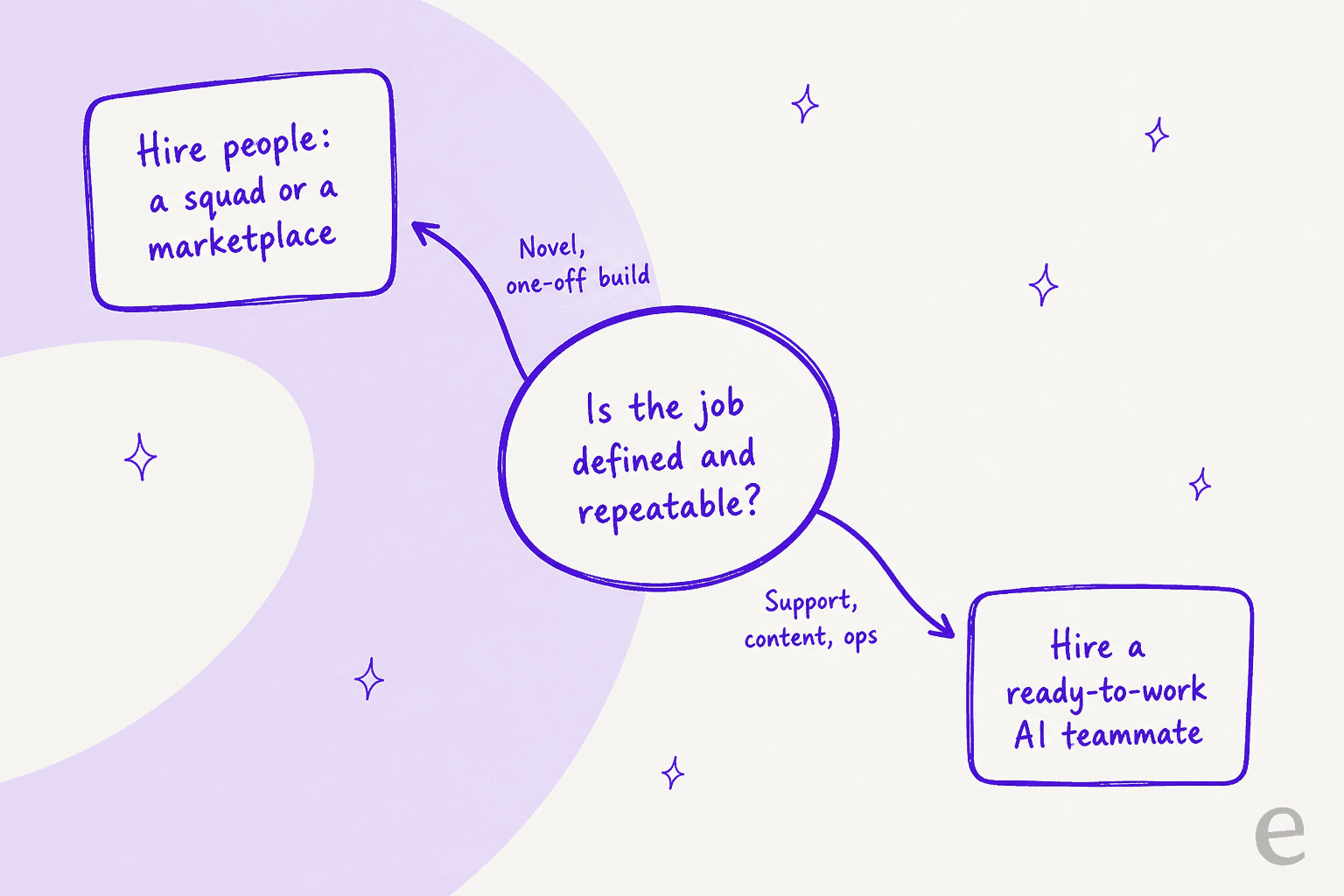
How I picked these alternatives
I split the list along that fork, and I judged each option on the things that actually decide a purchase, not marketing adjectives:
- What you're really buying. A person's hours, a managed team, or a job that just gets done. These are not the same purchase.
- Pricing you can see. Whether there's a real, public number, or another "book a call" wall.
- Speed to value. Days to hire and ramp a human, versus minutes to switch on a teammate.
- Who it actually fits. I'd rather tell you who should skip each one than pretend it's for everybody.
One note on fairness: I run eesel, so I'm not a neutral analyst, and eesel is first on this list on purpose. But I've tried to be straight about where a human marketplace is the right answer and eesel simply isn't. When the job is a green-field build, hire people. The rest of the time, read on.
The 8 best A.Team alternatives at a glance
| Tool | Best for | What you're buying | Pricing model | Public pricing? | Free trial | Community signal |
|---|---|---|---|---|---|---|
| eesel | A defined, repeatable job done (support, content) | A ready-to-work AI teammate | From $299/mo (500 credits) | Yes | Yes (100 credits) | Named results (Gridwise 73%) |
| Toptal | Hand-vetted senior contractors, fast | One elite person's hours | Hourly quote + $79/mo | Partial | 2-week no-risk | 4.7/5 Trustpilot |
| Braintrust | Direct talent, no agency markup | Individual specialists at scale | Client-pays-fee, quote | No | Pilot in 48h | 4.6/5 G2 |
| Gun.io | Managed US delivery with governance | A managed engagement | Quote-only | No | No | 4.5/5 G2, 2.5/5 Trustpilot |
| Turing | AI delivery at frontier-lab scale | FDEs + an AI control plane | Quote-only | No | No | 2.7/5 Trustpilot |
| Andela | Embedded global engineering teams | Full-time embedded engineers | Quote-only | No | No | 4.7/5 G2 (self-reported) |
| Lemon.io | One senior dev, fast, on a budget | An individual contractor | Hourly, ~$41-60/hr median | Via calculator | Replacement guarantee | 4.8/5 Trustpilot |
| Arc.dev | Self-serve remote hiring | An individual hire | $15-110+/hr or 20% salary | Yes | 2-week risk-free | 4.4/5 Trustpilot |
Now the part that actually decides it: figure out which route you're on before you compare tools within it.
1. eesel: when the job should just get done
Best for: teams whose real goal is a defined, repeatable job (customer support, content) done for them, not a team to build it.
Here's the reframe. Every other option on this list sells you people or a bespoke build. eesel sells you the outcome. Instead of hiring an engineer to build a support bot, or staffing a squad to stand one up, you hire a ready-to-work AI helpdesk teammate that already knows how to do the job and is live in your helpdesk within about 30 minutes.
The mental model A.Team uses is "hire builders." eesel's is "hire teammates." You don't get a generalist you have to brief and manage; you get a teammate that arrives with the skills and integrations for one job. The current roster is the helpdesk agent and the blog writer, with an e-commerce agent alongside. The teammate learns from your actual solved tickets, not just a help-center crawl, and works across Zendesk, Slack, and your website at the same time.
We've spent years putting AI on live support queues, and the scar that shaped the product is watching a confident-sounding bot quietly give wrong answers. That's why eesel makes you simulate a teammate on your own past tickets before it ever touches a live one, so you see the resolution rate and the exact replies on real history first. It's the closest thing to a no-risk trial that a talent marketplace can't offer, because you're testing the actual work, not interviewing a person.
Pricing: one fixed monthly price, from $299 a month for 500 credits, with no per-seat charge and no platform fee. A support ticket or chat is one credit no matter how many back-and-forth replies it takes, and only tickets the agent actually works on count. The free plan gives you 100 credits with no credit card. Worked examples: 100 tickets a month fits the free plan, 1,000 tickets is $499 a month.
Pros:
- You buy the outcome, not the ramp. No sourcing, no interviews, no onboarding weeks. Most teams are live within 30 minutes.
- Real, named results. Gridwise resolved 73% of tier-1 tickets in the first month; Smava runs 100,000+ German tickets a month fully automated across 80+ languages.
- Transparent, checkable pricing. A published monthly price you can model before you spend a cent, which is the opposite of every quote-only option below.
Cons:
- It's not a human, and not a builder. If your job really needs a person's judgment or a from-scratch custom system, eesel is the wrong tool, and one of the marketplaces below is right.
- It's focused on specific jobs. The teammate roster is support, content, and e-commerce. It won't staff you a mobile engineer for an unrelated app build.
Verdict: if the thing you actually want done is support or content, eesel is the fastest and cheapest route on this page by a wide margin, because the work gets done without you hiring or building anything. Choose one of the marketplaces below only when the job is a genuine human build.
2. Toptal: the closest peer for elite individuals
Best for: hiring one individually screened, senior contractor quickly when match quality matters more than the lowest rate.
Toptal is the name most people reach for as an A.Team alternative, and for good reason. Its whole pitch is the "Top 3%": of the 200,000+ people who apply each year, fewer than 3% pass a multi-stage screen. Where A.Team assembles a small team for a mission, Toptal hand-matches you one screened expert, usually introduced within 24 hours.
Pricing: a $79/month platform subscription once you start matching, plus the talent's hourly rate (Toptal doesn't publish a rate card; the markup sits inside the quoted rate). Every engagement opens with an up-to-two-week no-risk trial: if the fit fails, you aren't billed, and you get a replacement on a fresh trial.
Pros:
- Rigorous, senior-skewed vetting that saves you the filtering work.
- A genuine no-risk trial, which lowers the downside of a bad hire more than most peers.
- Breadth beyond code, spanning design, finance, product, and consulting through one relationship.
Cons:
- Pricing opacity is the most consistent client complaint: with the markup baked into the rate, you can't easily tell if you're paying fairly.
- It sits at the premium end, so it's overkill for small budgets or commoditized tasks.
- You're still staffing a person, with all the onboarding, availability, and management overhead that implies.
Verdict: Toptal is the safe pick when you need a single high-caliber human fast and can absorb premium, opaque pricing. It carries a 4.7/5 across 2,200+ Trustpilot reviews, though that pool skews toward the talent side.
3. Braintrust: elite talent without the agency markup
Best for: enterprises that want direct access to senior freelancers at agency-beating rates, where the freelancer keeps their full rate.
Braintrust started as a worker-owned network and its signature idea still sets it apart: talent keeps 100% of their rate, and the client pays the fee, the inverse of platforms that skim 20-50% off the freelancer. It advertises a 2M+ member pool and a blue-chip client list including NASA, Google, Goldman Sachs, and Porsche.
Pricing: zero fees for talent is the confirmed, on-site fact. The client-side fee was historically a flat ~10%, but the current site no longer states an exact percentage and routes everything through "Talk to Sales." Braintrust has also broadened into an AI recruiter (AIR, priced per interview) and an automation product (Nexus, 25% of measured savings).
Pros:
- The freelancer keeps 100%, which is a real departure and keeps strong senior talent on the network.
- A large, enterprise-credentialed pool with a real blue-chip client list.
- AI-assisted matching with sub-48-hour pilots and native ATS integrations on the recruiting side.
Cons:
- The exact client fee is no longer public, so you can't self-serve a number the older 10% messaging used to give you.
- Scope has broadened into a three-product suite, which can muddy what you're actually buying.
- Freelancer-side sentiment is mixed on the application and matching experience.
Verdict: Braintrust is the pick when you want the reach of a big marketplace but hate agency markups. Just go in knowing pricing is now a conversation, not a published figure. It holds a 4.6/5 G2 average across its client reviews.
4. Gun.io: managed delivery, not just a rolodex
Best for: teams that want vetted senior US engineers on longer contracts and want someone else governing the delivery.
Gun.io (Nashville, founded 2013) leans harder into managed delivery than a pure marketplace. Its "Engineering Governance" framing means it doesn't just introduce developers; it runs a "Technical Review Protocol" up front, then stays in the engagement tracking code quality and "architectural drift," reshuffling the team if delivery slips. It reports roughly 1,000 vetted engineers and $100M+ deployed.
Pricing: quote-only. There's no public rate card (the /pricing and /how-it-works pages both 404), and the only public number is the developer-side promise that freelancers keep 100% of their rate, with the client paying an undisclosed markup on top.
Pros:
- A senior, US-heavy network with a decade-plus track record.
- Managed delivery, including contracts and multi-country payroll across 100+ countries, so you're not project-managing freelancers yourself.
- Developer-friendly economics that keep good engineers on the platform.
Cons:
- No public pricing, so you can't estimate cost or minimums without a sales conversation.
- Selective intake means thin supply signal, and some developers report applying and hearing nothing.
- Noisy public reviews: a 4.5/5 on G2 against a low-volume 2.5/5 on Trustpilot reflects small sample sizes more than a settled verdict.
Verdict: Gun.io is the choice when you want accountability for the outcome, not just a match. It's a heavier, more managed engagement than a quick single-contractor hire.
5. Turing: the AI-delivery route
Best for: enterprises that want a partner to build and run agentic AI systems, or frontier labs buying model-training expertise.
Turing is the alternative that most resembles A.Team's new direction rather than its old one. It began in 2018 as an AI-vetted engineer marketplace, but by 2026 its homepage reads "Accelerate superintelligence." It now runs two AI businesses: supplying frontier labs with training data and evals (it claims all 9/9 frontier labs as customers, with Anthropic and Google Gemini on the logo wall), and building enterprise agents via forward-deployed engineers plus a control plane to run them.
Pricing: quote-only for enterprise and FDE work. The only public dollar figures are on the supply side: AI-training gigs on the expert board pay roughly $200-$300 per task, and legacy dev placements were historically cited in the $30-$100/hr range.
Pros:
- Frontier-lab credibility, with FDEs pitched as people who've actually done post-training work.
- End-to-end AI delivery, building and operating the agents with governance baked in.
- A very deep, global expert pool across software and STEM domains.
Cons:
- Opaque pricing, with every meaningful engagement behind a sales conversation.
- Supply-side payment complaints: Turing sits at 2.7/5 across ~198 Trustpilot reviews, with a recurring theme of delayed payouts.
- The pivot muddies the "hire a developer" path, which is now a side door on its own site.
The payout complaints are worth a real quote:
"I am writing to express my severe frustration and disappointment regarding my withdrawal request."

Verdict: pick Turing when the job is AI itself at serious scale, and you want humans to build and run it. If the AI job is support specifically, note that you're paying to build what eesel already ships.
6. Andela: embedded global engineering teams
Best for: enterprises building out AI or engineering teams at scale who want vetted, embedded, full-time engineers from a global pool.
Andela began in 2014 in Lagos and made its name sourcing engineers across emerging markets. In 2026 it positions itself as "the human layer powering production AI," offering a quarterly pipeline of vetted AI-engineer cohorts sorted into Builder, Integrator, and Scaler archetypes who embed directly into your team.
Pricing: quote-only. There are no dollar figures on the site; rates are set per engagement after a discovery call.
Pros:
- A deep, global talent pool with emerging-market reach you can't get locally.
- An enterprise track record and embedded model (Goldman Sachs, GitHub, Capital One) built for ongoing team-building.
- A structured AI-specific training pipeline, so the AI-engineer positioning is backed by a real curriculum.
Cons:
- No transparent pricing, again gated behind a call.
- Built for scale, not fast one-off builds, so it's heavier than assembling a small senior squad for a short project.
- More match-quality variance than a boutique bench, since it draws from a large continuously trained pipeline.
Verdict: Andela is the pick for ongoing, scaled team-building rather than a short elite mission. Note that the 4.7/5 G2 badge on its homepage is self-reported, so weigh it accordingly.
7. Lemon.io: one senior developer, fast, on a budget
Best for: funded startups that need one senior engineer matched fast, at rates below US-agency pricing.
Lemon.io does the sourcing, screening, and vetting for you (it says ~1% of applicants pass), so you just interview the 2-3 finalists, with 24-hour matching advertised. The pool of 2,400+ developers skews toward Eastern Europe and Brazil, which is where the cost advantage comes from.
Pricing: hourly, no fixed plans. Its own rate calculator (updated August 2026, from real contract data) puts senior developers at a $41-60/hour median, with brackets running up to $101-120 depending on stack and region. Secondary reports mention a ~160-hour minimum and a refundable per-developer deposit, though Lemon.io doesn't publish those itself.
Pros:
- Fast, low-effort matching, with qualified candidates often within a day.
- Strong, verifiable sentiment: 4.8/5 across 354 Trustpilot reviews and 4.6/5 on G2.
- Budget-friendly rates relative to onshore agencies.
Cons:
- Pricing isn't on the main funnel anymore (
/pricingredirects to the homepage); you have to open the calculator. - Talent is largely offshore, so US teams can inherit a 10+ hour timezone gap.
- You hire individuals, not a managed team: coordination and delivery risk stay on your side.
Verdict: Lemon.io is the sweet spot for "get me one strong senior engineer this week without breaking the budget." It's the value pick of the human-hire options, verified by a 4.8/5 Trustpilot rating.
8. Arc.dev: self-serve remote hiring with published prices
Best for: teams that want to self-serve a shortlist quickly and pick candidates themselves, rather than hand it to a white-glove account team.
Arc.dev sits at the opposite end from A.Team's curated model. It's a self-serve, AI-matched marketplace (its matching is branded HireAI) with a claimed 450,000 talent across 190 countries, for both freelance and full-time roles.
Pricing: refreshingly public. Per the pricing page, freelance talent runs $15-$110+/hour, full-time hires cost 20% of annual salary as a placement fee, and it's $0 until you hire, with a two-week risk-free trial. Freelance matches land in ~72 hours, full-time in ~14 days.
Pros:
- Transparent, self-serve pricing with real hourly bands and no cost until you hire.
- Fast and flexible, spanning contract and permanent roles across multiple job families.
- A lower cost of entry than premium curated networks.
Cons:
- Lighter vetting signal than "top 2%" curated peers, so more interviewing work lands back on you.
- Talent-side friction shows up in reviews, with complaints about slow profile approvals.
- The 20%-of-salary full-time fee recurs per hire.
Its review base skews to the talent side, and it's honest reading:
"My profile has been 'in review' for two years now. No opportunity to even update my profile..."
Verdict: Arc.dev is the pick if you want to move fast, pick your own candidates, and see the price before you commit. It holds a 4.4/5 across ~196 Trustpilot reviews.
What you're actually paying for
Step back from the logos and the difference is stark. Seven of these eight options sell you a person's hours. The cost isn't just the rate on the invoice; it's the sourcing, the vetting, the ramp-up, the management overhead, and the availability windows around it. That's the real total cost of a hire, and it's why "cheap hourly rate" often isn't cheap at all.
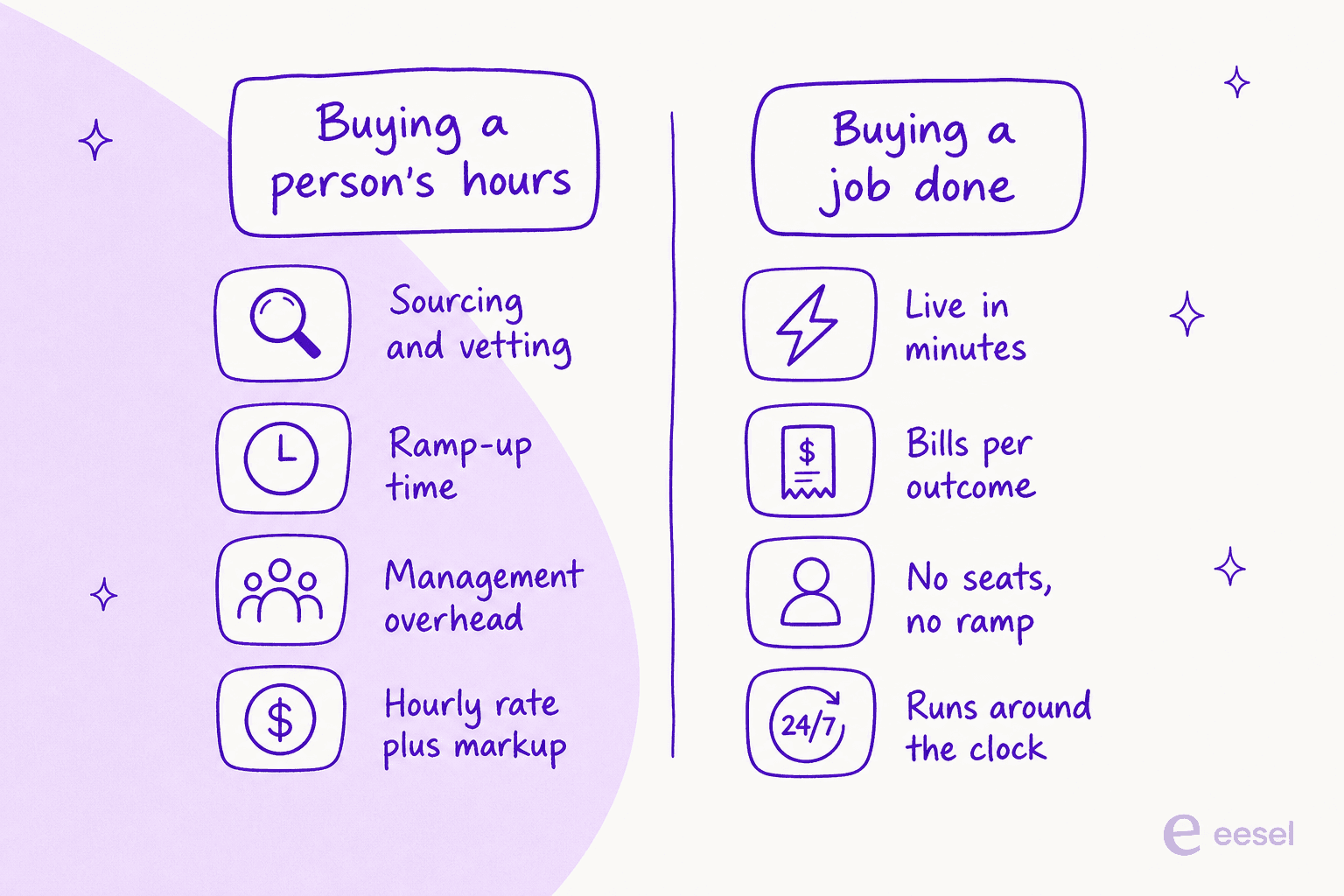
An AI teammate changes the unit you're buying. You're not paying for hours that might or might not turn into finished work; you're paying per outcome, for work that's already done. There's no ramp, no seat, and no timezone. For a defined, repeatable job, that's a fundamentally better deal than the best hourly rate on this list, because you skip the entire cost stack around the rate.
That's not an argument against ever hiring humans. It's an argument for matching the purchase to the work.
Where each option lands
If you map these tools on two axes, what you're buying and how hands-on it is, the picture sorts itself out. The marketplaces cluster in the "you hire humans" half, split between self-serve (Arc.dev, Lemon.io) and managed (Toptal, A.Team). eesel sits alone in the "work gets done for you" half.
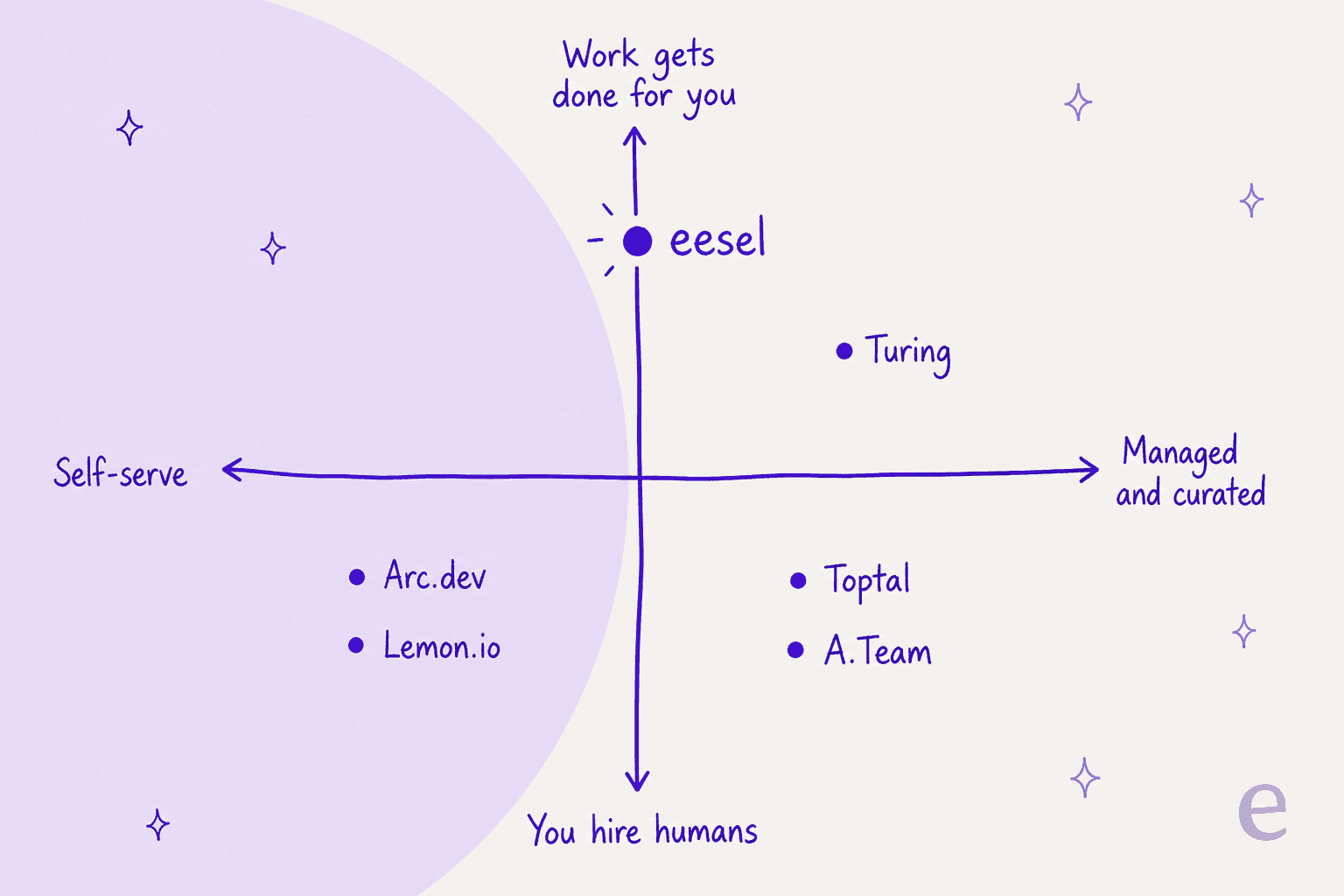
The point of the map isn't that one quadrant wins. It's that they're answering different questions. If your job is a build, drop into the bottom half and pick by budget and how much management you want to keep. If your job is support or content, you're in the top half, and the list is short.
Try eesel for the support and content jobs
If you came looking for an A.Team alternative because you need customer support handled or content written, eesel is the version of "hire a teammate" where the teammate is ready on day one. It plugs into the helpdesk you already run (Zendesk, Freshdesk, Slack, and more), learns from your solved tickets, and you can simulate it on your own history before it answers a single live customer.
There's no engagement to scope, no engineers to staff, and no six-figure quote: it's from $299 a month, free to start with 100 credits and no credit card. You can be live in the time it would take A.Team to schedule the intro call. When the job is defined and repeatable, that's the whole pitch.