
What Apple Intelligence actually is
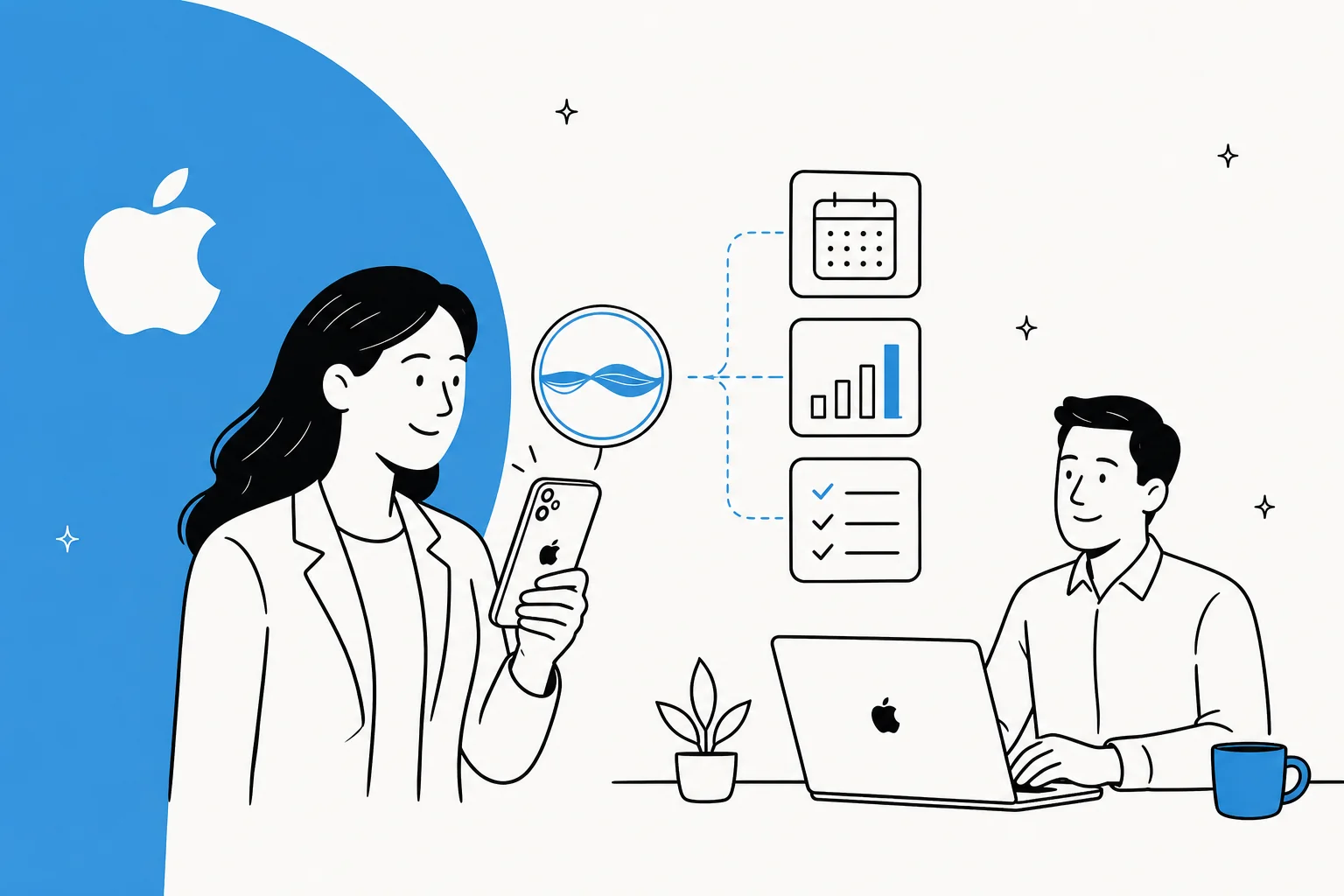
Apple Intelligence is Apple's on-device-and-cloud AI layer woven across iOS 27, iPadOS 27, macOS 27, watchOS 27, and visionOS 27, which Apple frames as "integrated into your apps, grounded in your context, and private at every step." The marquee feature at WWDC 2026 was an all-new Siri, branded Siri AI and described by Apple as "rebuilt from the ground up with powerful AI at its core."
The short version: Siri finally works like the assistant people assumed they were getting years ago. It holds a conversation, understands personal context (it can search your own messages, emails, and photos), is aware of what's on screen, and can take actions across apps. The old "set a timer" Siri is gone; the new one can handle "follow up on that email I sent Dave last Tuesday."
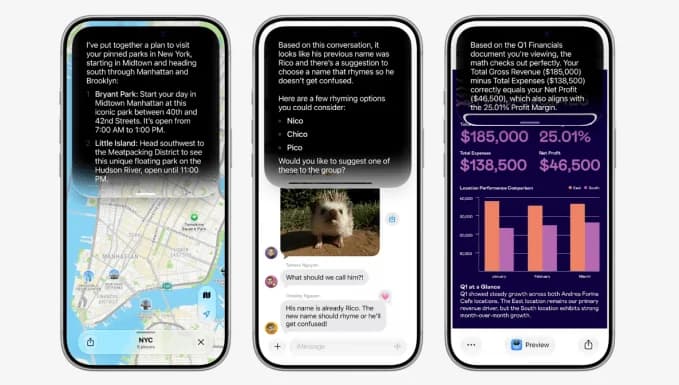
Worth being clear-eyed about the framing, though. The keynote led with fixes before features - a Liquid Glass opacity slider, up to 30% faster app launches, 80% faster AirDrop - which TechCrunch read as "Apple plays catch-up". After two years of watching ChatGPT and Gemini set the pace, this is Apple steadying the ship more than leaping ahead.
What's actually new in 2026
If you only half-followed WWDC, here's the cheat sheet of what Apple Intelligence added this cycle.
| Feature | What it does | Where it runs |
|---|---|---|
| Siri AI | Conversational assistant with personal context, onscreen awareness, and systemwide app actions | On-device + cloud |
| Foundation Models framework | Free on-device model inference for third-party app developers, no API key | On-device + Private Cloud Compute |
| App Intents (replaces SiriKit) | The single framework Siri uses to reach into third-party apps | On-device |
| Image Playground | Rebuilt, photorealistic image generation with describe/tap/brush editing | Private Cloud Compute |
| Photos AI editing | Spatial Reframing, generative Extend, upgraded Clean Up | Private Cloud Compute |
| Visual Intelligence | Point the camera (or look at the screen) to ask Siri about what you see | On-device + cloud |
| Write with Siri | Generative writing and systemwide proofreading anywhere you type | On-device |
The consumer features are polished. Image Playground went from cartoonish to photorealistic, and AI-edited photos carry a hidden SynthID watermark so they're traceable.

One small business note hiding in the announcements: cloud-dependent features like image generation now carry daily usage limits, with iCloud+ raising the quotas. That's a quiet shift away from Apple Intelligence being entirely free.
How the new Siri actually works
This is where it gets interesting, because the new Siri isn't one model - it's a routing system across three tiers. Understanding it tells you a lot about what Apple Intelligence can and can't do for a business.
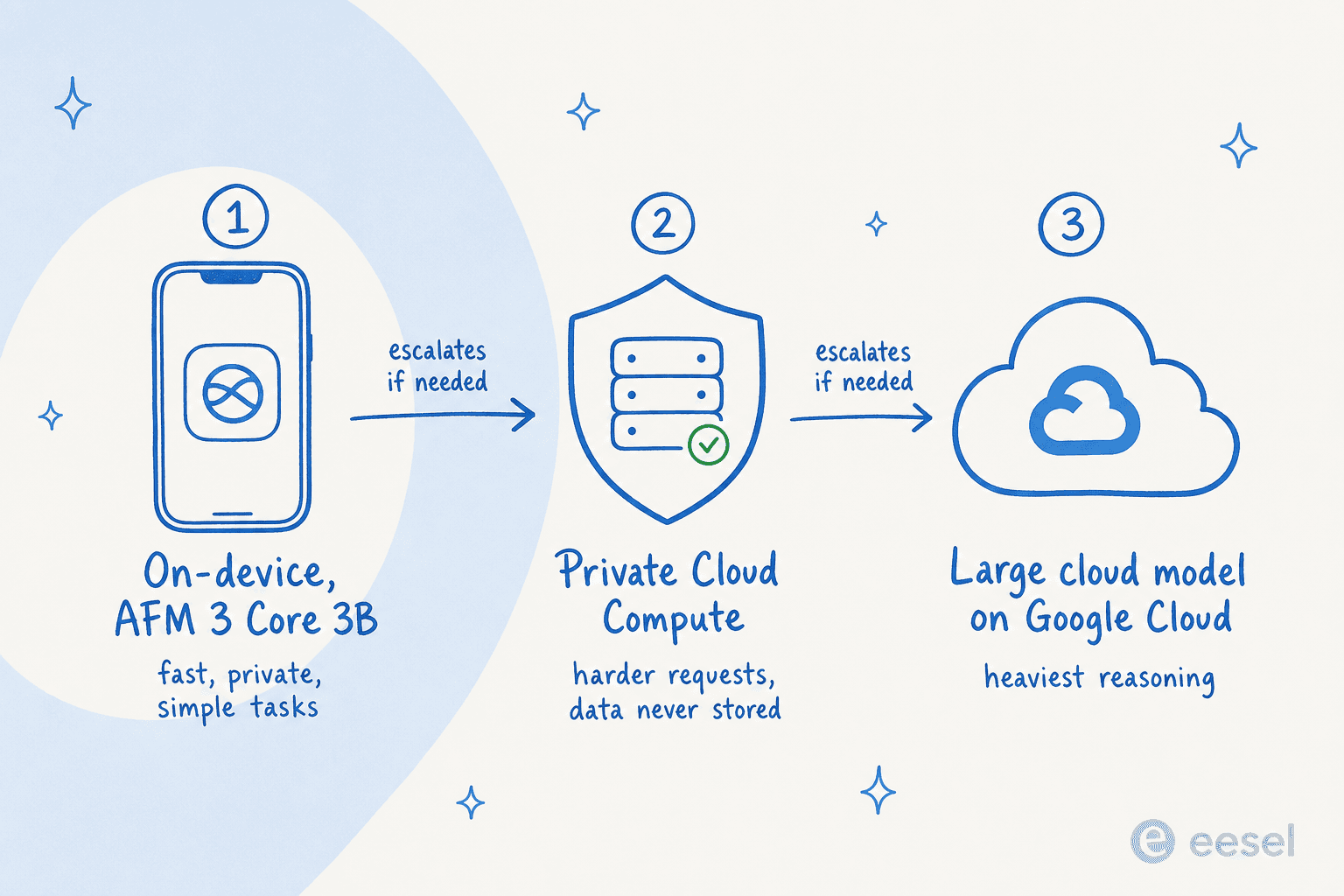
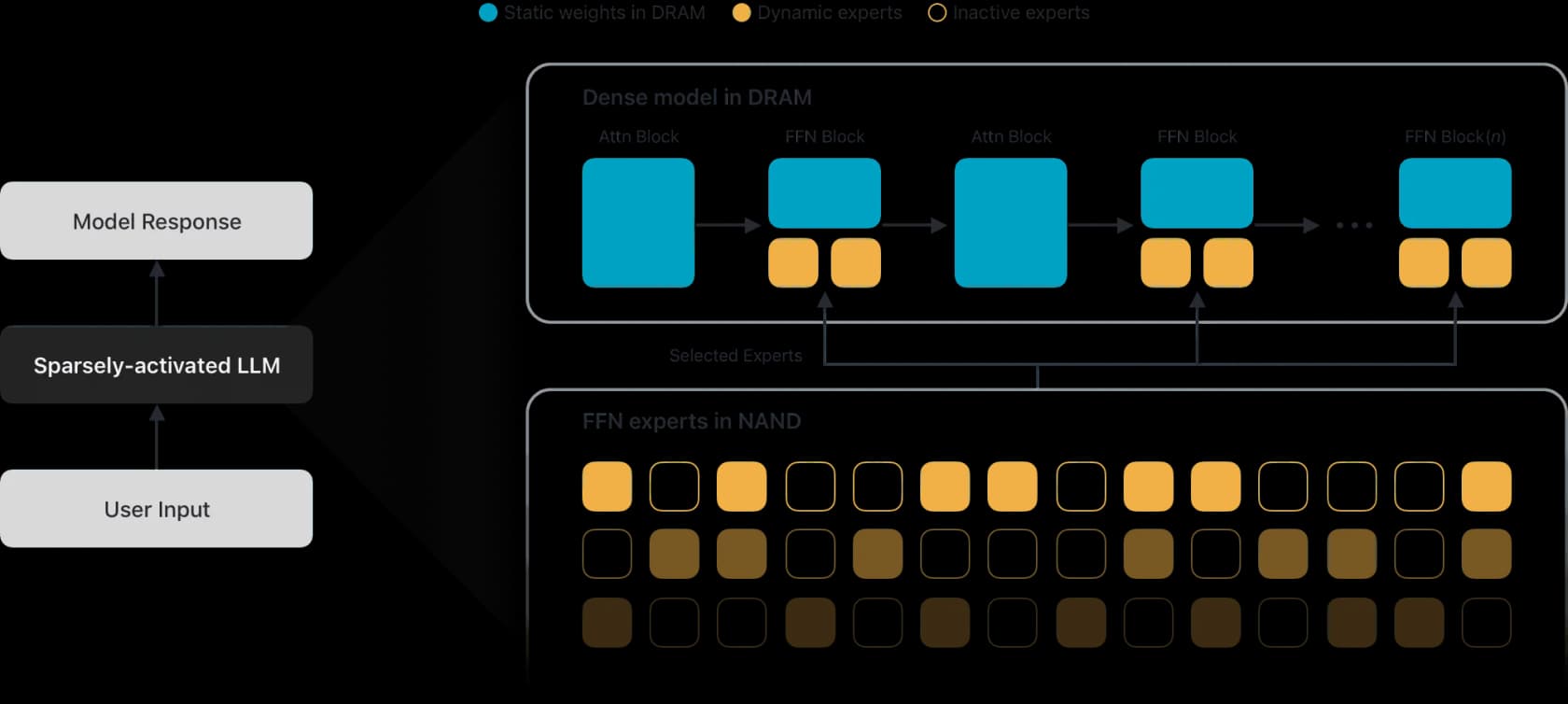
The whole stack runs on the third generation of Apple Foundation Models, a family of five models built in collaboration with Google. Two run on your device: AFM 3 Core, a 3-billion-parameter model, and a more powerful AFM 3 Core Advanced, a 20-billion-parameter sparse model that activates only 1–4 billion parameters at a time by swapping "experts" in and out of memory.
When a request is too heavy for the phone, it escalates to Apple's Private Cloud Compute - stateless Apple-silicon servers that process your data in memory and never store it. And the heaviest queries reportedly route one step further, to a large custom model on Google Cloud. Apple's own human evaluations show the jump in quality: AFM 3 Cloud was preferred on 64.7% of text prompts versus 8.7% for the 2025 server model. That's a real generational leap, and it's a useful reminder that model quality and a working product are two different things - something worth keeping in mind for any AI buying decision, support included.
The Gemini question
The single loudest reaction post-keynote wasn't about features - it was "wait, is Siri just Google now?" Press reports (not confirmed by Apple) describe a custom ~1.2-trillion-parameter Gemini model on Google Cloud behind the heaviest Siri queries, at a rumoured cost near $1B a year.
Apple cared enough about the optics to hold a dedicated technical session, where Craig Federighi got blunt about it:
"For these models, we use none of the models that Google deploys to their customers, nor do we use the infrastructure and means by which they deploy models to their customers... So I hope that's clear. The amount of the Google Assistant we use is none."
Craig Federighi, SVP Software Engineering at Apple, via Daring Fireball
The fact that Apple felt the need to repeat "the amount of the Google Assistant we use is none" tells you how dominant the worry was. For a business reader the practical takeaway is simpler: Apple is leaning on partners to compete at the frontier, just like everyone else. If you're evaluating the underlying models directly, it's worth reading up on Gemini and its alternatives, or comparing against Claude and ChatGPT before you assume any one assistant is the whole story.
So what does Apple Intelligence mean for businesses?
Two things, really, and they're easy to mix up.
First, the obvious one: your employees and customers get a much better assistant on their personal devices. That's a productivity nicety, not a strategy.
Second, the one that actually matters: developers can now build Apple's models into their own apps for free. The Foundation Models framework gives on-device inference with no API key, no metering, and "no prompts are ever stored," free for apps under 2 million first-time downloads. There's even a LanguageModel protocol that lets you swap Apple's models for Anthropic Claude or Google Gemini without rewriting your session code.
Alongside it, App Intents replaced SiriKit as the way apps plug into Siri, over a two-to-three-year migration window. VentureBeat framed Siri AI as "an AI-powered app action and content-discovery layer built into the OS" - meaning a business app that adopts the frameworks could let users ask Siri to find, summarize, or act on its content without building a separate chatbot.
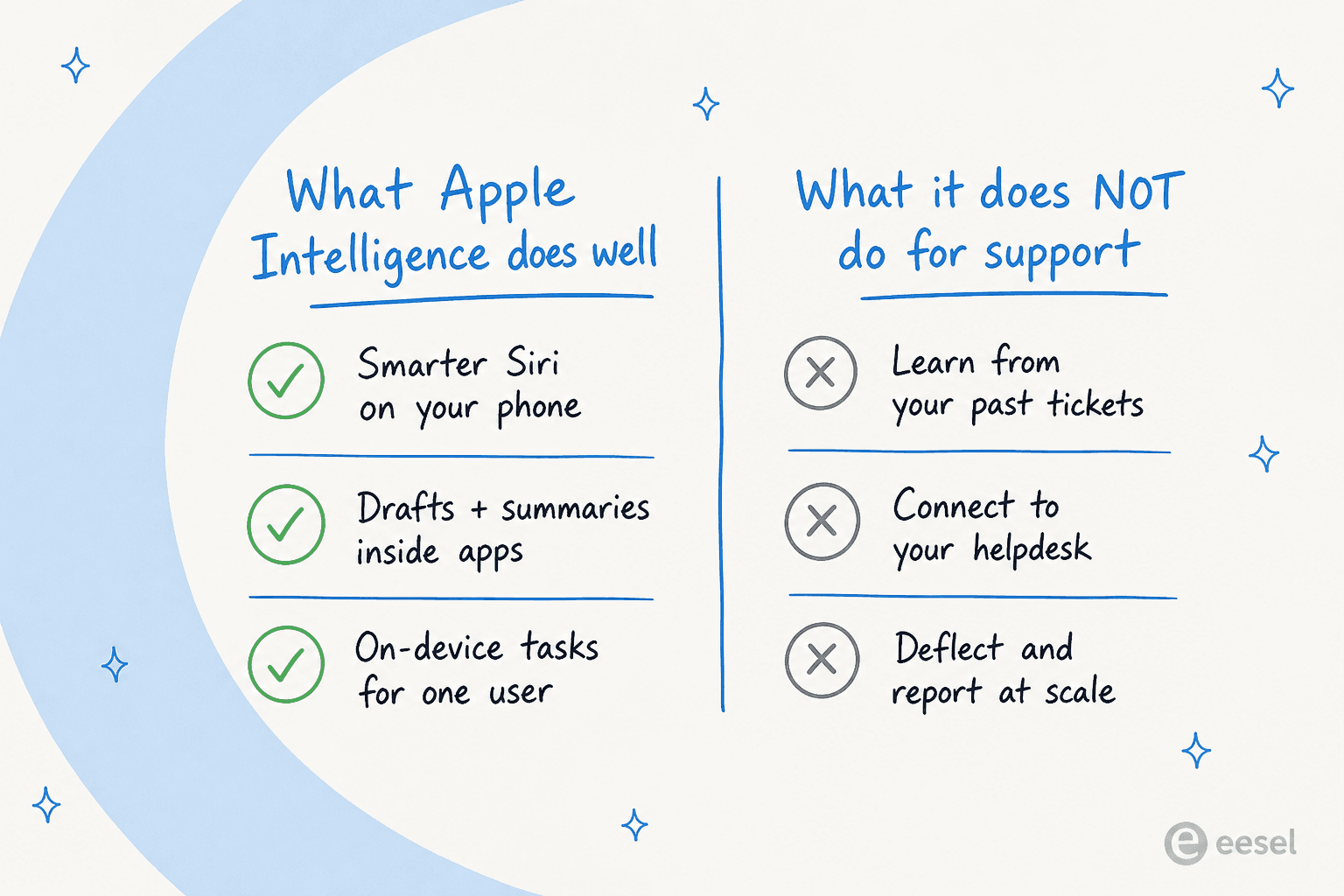
That's useful. But notice what it is: a way to make your own app smarter for one user at a time, on their device. It is not a way to run a support operation.
Should you build your support agent on Apple's free model API?
This is the question I get from technical teams the moment they hear "free on-device model." If Apple hands you a capable model for nothing, why pay for a support tool? It's the classic build vs buy decision, and it comes up constantly - plenty of engineering-heavy teams look at the Claude or OpenAI API and think the same thing.
Here's the catch. The model is the easy 10%. A support agent that's actually safe to put in front of customers needs everything around the model:
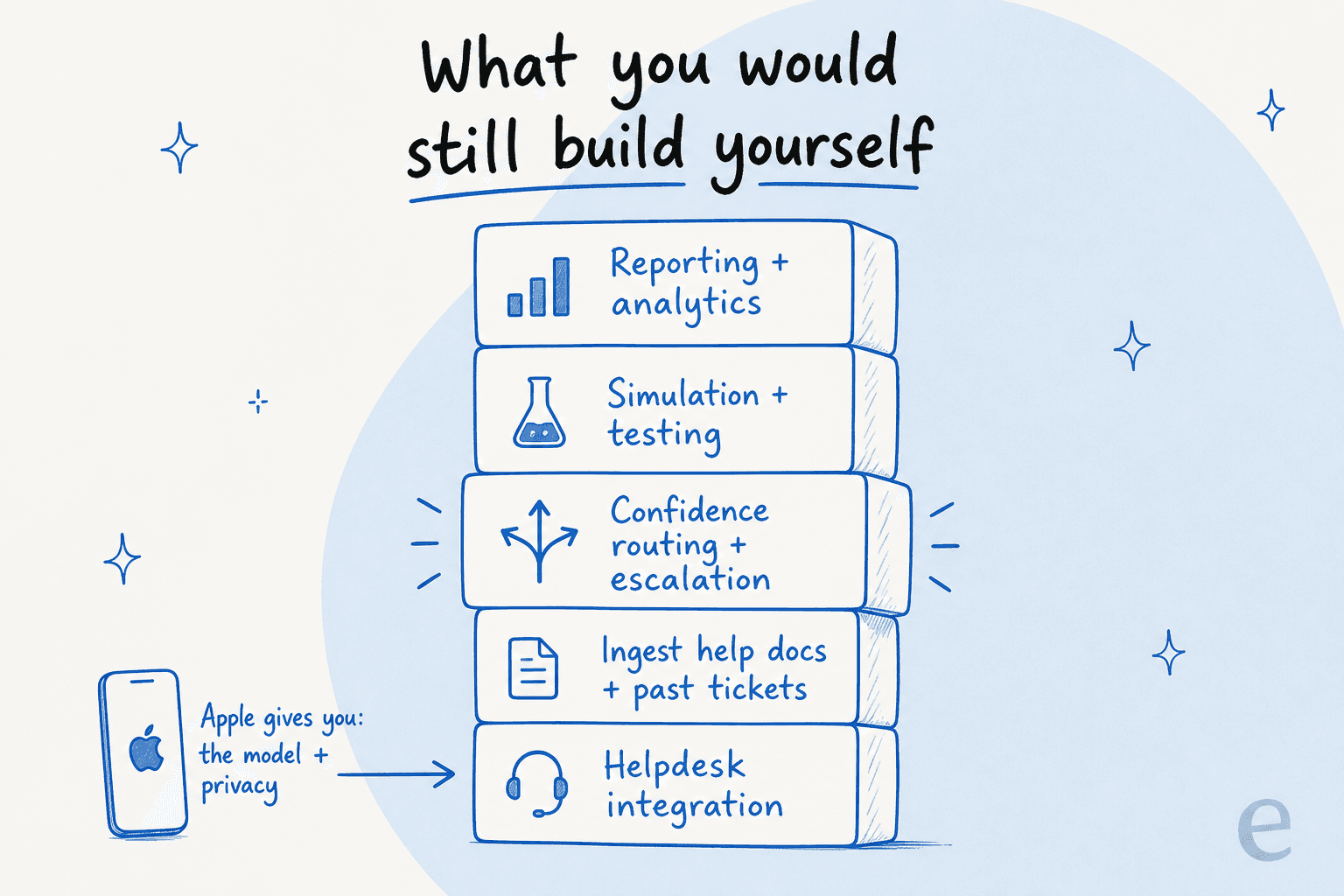
You'd need to ingest your help docs and past tickets, connect to your helpdesk, build confidence-based routing so the AI escalates instead of guessing, prevent hallucinations, test it against real history before go-live, and report on what it deflected. None of that exists in Apple's framework - the only retrieval it offers is a local Spotlight index over a single device's content.
One eesel customer, an engineering lead at a Bitcoin-ATM hardware company, put the build-vs-buy tradeoff plainly after choosing to buy:
"We could try to write our own LLM application but we didn't want to invest our time into that. We wanted something that we would not have to maintain."
Karel, GENERAL BYTES (eesel case study)
I've watched teams go the other way too, wiring up the Claude API themselves, and the maintenance tax is real: the model keeps working, but the integrations, the guardrails, and the testing harness become a second product nobody signed up to own. That's the part Apple Intelligence doesn't solve, because it was never trying to.
Where Apple Intelligence stops and a support platform starts
To make the line concrete, here's how Apple Intelligence stacks up against a dedicated AI support platform on the dimensions a support leader actually cares about.
| Dimension | Apple Intelligence (iOS 27) | Dedicated AI support platform (e.g. eesel) |
|---|---|---|
| Built for | Consumers + app developers | Support, IT, and ops teams |
| Knowledge source | What's on one device (local Spotlight) | Your help center, past tickets, docs, macros |
| Helpdesk integration | None | Zendesk, Freshdesk, HubSpot, Gorgias, Front, 100+ |
| Routing + escalation | None | Confidence-based routing to a human |
| Test before go-live | None | Simulation against historical tickets |
| Reporting | None | Deflection, resolution, theme analysis |
| Languages | 16 (Siri English-first) | 80+ languages out of the box |
| Pricing model | Bundled with the OS / iCloud+ | Usage-based, from $0.40/ticket |
This is the whole point of a purpose-built tool. At eesel, the agents learn from a company's solved tickets and help docs on day one, run in simulation mode against thousands of past tickets so you can see coverage before anything goes live, and only auto-reply when confidence is high. That's how Gridwise got eesel resolving 73% of their tier-1 requests in the first month, and how Smava runs a fully automated Zendesk agent on 100,000+ German-language tickets a month. Apple's 3-billion-parameter on-device model, lovely as it is for drafting a text, isn't built to touch any of that.
The press is wisely cautious about the new Siri, too. As MacStories put it in their iOS 27 overview:
"As everyone looks to see whether the proof is indeed in the Siri AI pudding, it's good to see that Apple hasn't forgotten people still want tangible improvements in the performance of their iPhones and iPads. Time – and the beta period – will tell if they are tangible enough."
That "I'll believe it when it ships" tone traces straight back to Apple's 2025 personalized-Siri delay, and it's a healthy reminder to judge any AI on shipped, tested results rather than a keynote demo.
The privacy and availability fine print
A few constraints worth knowing before you build any plans around this:
- Availability: developer beta now, public beta in July 2026, general release in fall 2026. AI features require an iPhone 15 Pro or newer.
- Regions: Siri AI launches English-first, won't ship in the EU with iOS 27 due to the Digital Markets Act, and Apple Intelligence features are held back in China pending regulation.
- Enterprise controls: new MDM controls let IT govern features like Image Playground and Writing Tools on managed devices, but management for Siri AI itself is still coming in later betas, and there are no enterprise usage APIs or SIEM hooks yet.
If you support customers in the EU, in languages other than English, or on Android, Apple Intelligence simply isn't in the room for you right now - which is another reason the support layer needs to be its own decision.
Try eesel for customer support
Apple Intelligence will make the phone in your customer's hand smarter. It won't answer your tickets. eesel is the part Apple's framework leaves out: an AI agent that plugs into your existing helpdesk, learns from your past tickets and help docs, and resolves frontline support across 80+ languages - with a simulation mode that tests it against your real ticket history before it ever replies to a customer.

You can connect it to Zendesk, Freshdesk, or Gorgias, run it in simulation first, and grant autonomy gradually as you build trust - with usage-based pricing from $0.40 a ticket and no per-seat fees. If you're comparing the field, our guide to the best customer service AI is a good place to start, or you can try eesel and point it at your own tickets.
Frequently Asked Questions
What is Apple Intelligence for business?
Can Apple Intelligence handle customer support tickets?
Is Apple Intelligence free for developers?
Does Apple Intelligence really use Google Gemini?
When is Apple Intelligence available, and where?


Article by
Alicia Kirana Utomo
Kira is a writer at eesel AI with a Computer Science background and over a year of hands-on experience evaluating AI-powered customer service tools. She focuses on breaking down how helpdesk platforms and AI agents actually work so that support teams can make better buying decisions.