


It seems like a new AI SEO tool pops up every other day. They all promise to rocket you to the top of Google, but many just spit out generic content that sounds like a robot wrote it (because one did) and never actually gets you ranked. It’s a lot to sift through.
And the game itself is changing. It's not just about winning on Google anymore. Now, we have to think about getting our content featured in AI answer engines like ChatGPT, Perplexity, and Google's AI Overviews. This new world is called Answer Engine Optimization (AEO), and it demands a fresh approach. To better illustrate this shift, here is a breakdown of how AEO builds upon traditional SEO.
This guide provides a hands-on review of tools that actually work. It’s a hands-on review of platforms that can help achieve results, from creating content to handling the tricky bits of technical SEO. For example, one of the tools mentioned was used to scale our blog’s content production, which contributed to impression growth from 700 to 750,000 per day in three months after publishing over 1,000 optimized posts.
What are SEO AI tools?
Simply put, SEO AI tools are platforms that use artificial intelligence to make SEO tasks easier, faster, and more effective. You can think of them as assistants for things like keyword research, content creation, on-page optimization, and technical site audits.
What sets them apart in 2026 is that they aren’t just optimizing for old-school search algorithms. They’re built to optimize for AI-driven answer engines, too. This means they help you create content that is so thorough, well-structured, and authoritative that Large Language Models (LLMs) want to use it as a source for their answers.
The real advantage is how AI can process massive amounts of data in seconds. It can spot trends, identify content gaps, and find optimization opportunities that a person would probably miss. This doesn't take the place of human strategy, but it gives your strategies extra firepower. For teams looking to scale, understanding how to increase content velocity is just as important as having the right tools.
How I chose the SEO AI tools for this list
To make this list genuinely useful, I laid out some ground rules. I wasn't just looking at feature lists; I was looking at the impact. Here’s the criteria every tool had to meet:
-
Real-world results: I only included tools that gave me a measurable bump in efficiency, traffic, or rankings.
-
AI-first functionality: This list focuses on tools that were built from the ground up with AI at their core, not older platforms that just tacked on a few AI features later.
-
Covers specific needs: SEO isn't a one-size-fits-all job. The tools on this list handle different, specific parts of a modern SEO workflow, from creating content to getting it indexed.
-
User-friendly interface: Power is great, but not if you need a degree to figure it out. Each tool here is powerful without being a pain to navigate for the average user.
A quick comparison of top SEO AI tools
Before we get into the nitty-gritty, here’s a quick table to help you compare the top tools and see which one might be the right fit for you.
| Tool Name | Best For | Pricing (Billed Annually) |
|---|---|---|
| eesel AI blog writer | Generating complete, publish-ready blog posts | $99 for 50 blog posts (Early Bird) |
| Semrush | All-in-one data-driven SEO & AI visibility | Starts at $165.17/month |
| Surfer SEO | On-page content optimization and editing | Starts at $79/month |
| Search Atlas | An emerging all-in-one alternative with automation | Starts at $99/month |
| Rankability | Optimizing content and tracking its relevance over time | Starts at $124/month |
| Indexly | Technical SEO and instant indexing | Starts at $14/month |
6 leading SEO AI tools
Okay, let's get into the details. Each of these tools is a standout for a specific part of the SEO puzzle. Here’s the breakdown of what they do, who they’re for, and what makes them special.
1. eesel AI blog writer
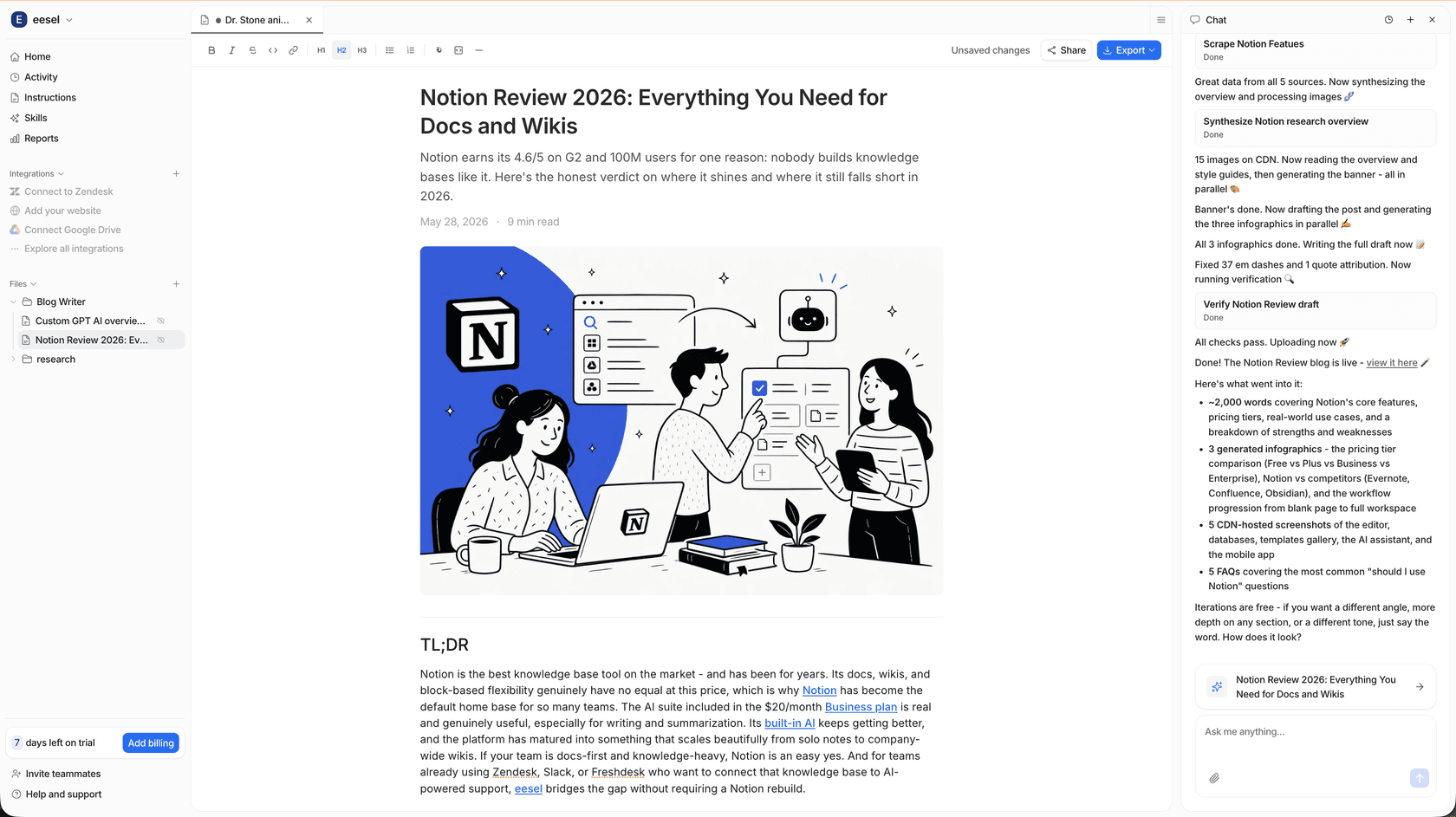
What it is: The eesel AI blog writer is a content generation platform that produces a full, SEO-optimized article from a single keyword. The output includes images, tables, and quotes. This tool was used to scale content that contributed to our site growing from 700 to over 750,000 daily impressions in three months.
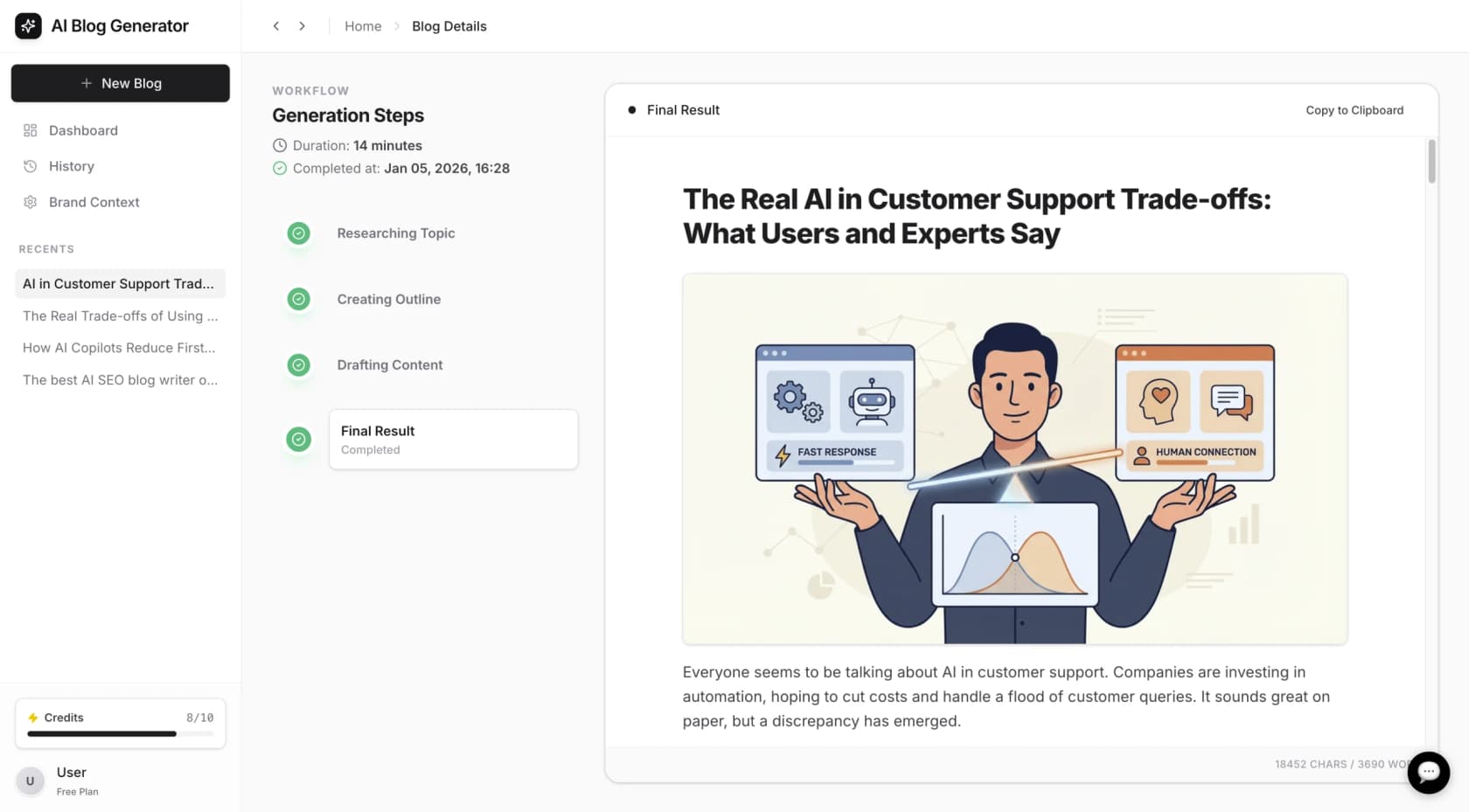
Pros: It is designed for quality and speed. The context-aware research provides in-depth content. It automatically generates and embeds assets like images, charts, and relevant YouTube videos. A notable feature is its ability to pull relevant quotes from Reddit threads, adding social proof and authenticity. The final article is designed to be publish-ready, reducing editing time.
Cons: The platform specializes in long-form content generation and is not an all-in-one SEO suite. It lacks features for deep backlink analysis or advanced keyword research and works well when paired with a comprehensive data platform like Semrush.
Pricing: An Early Bird offer is available at $99 for 50 blog generations. A free trial is also offered.
Who it's for: Content teams, agencies, and marketers who need to scale high-quality content production.
2. Semrush
What it is: Semrush is a comprehensive toolbox for SEO. It’s a large suite with over 55 different tools for everything from keyword research and competitor analysis to site audits and rank tracking. It’s backed by one of the largest data sets out there, tracking 43 trillion backlinks and 27.5 billion keywords. Its newer features are what make it so valuable for modern SEO. The AI Visibility Toolkit is a huge help, letting you track your brand's presence in Google's AI Overviews and other LLMs like ChatGPT and Microsoft Copilot.
Pros: The amount of data you get is incredible. It gives you deep insight into your market and competitors. The new AI features are vital for AEO, letting you see how your brand is perceived by AI, find prompt gaps, and optimize your content to get cited. For in-depth, data-rich analysis, it's still the industry standard.
Cons: It can be a lot to take in. The number of tools and reports can be overwhelming for beginners. The price is also a serious investment, which might be a stretch for freelancers or small businesses.
Pricing: The Semrush pricing for the plan that includes the AI visibility tools starts at $165.17 per month when billed annually.
Who it's for: This is the tool for established marketing teams, SEO agencies, and professionals who need a powerful, all-in-one data platform to guide their strategy.
3. Surfer SEO
What it is: Surfer SEO is a top player for a reason: it's fantastic at helping you optimize your content. Its main feature, the Content Editor, analyzes the top-ranking pages for your target keyword and gives you real-time feedback as you write. Helpful features like the Content Score give you a clear target to aim for, while the Topical Map helps you spot content gaps and build authority. It also has a great Content Audit tool for finding and sprucing up old posts.
Pros: It's brilliant at helping you fine-tune your drafts to match search intent perfectly. The integration with Google Docs is a huge workflow bonus, letting you optimize as you write. Its AI Humanizer feature is also useful for making AI-assisted text sound more natural and avoid detection.
Cons: It's very focused on on-page SEO. It doesn't have the comprehensive backlink analysis, rank tracking, or technical audit features you'd find in an all-in-one suite. It helps you perfect your content, but you'll need other tools for the rest of your SEO work.
Pricing: The Surfer SEO pricing starts at $79 per month when billed annually.
Who it's for: SEO content writers, editors, and agencies whose main job is creating perfectly optimized articles that are ready to rank.
4. Search Atlas
What it is: Search Atlas is a newer, AI-powered SEO platform that's getting a lot of attention by offering a full suite of tools at a more accessible price. It positions itself as a direct, cost-effective alternative to giants like Semrush. Its most interesting feature is OTTO SEO, an AI agent that automates technical fixes and suggests content optimizations.
Pros: It’s a great way to simplify your tech stack. It replaces a handful of separate tools with one platform, which can save you a good bit of money. The OTTO AI assistant is a unique feature that takes a more hands-off approach, suggesting and even implementing fixes for you. It also includes LLM Visibility tracking, so you can monitor your brand's presence in AI answers.
Cons: As a newer platform, its backlink index might not be as huge as its more established competitors. Some users have also said that there's a bit of a learning curve to get comfortable with all its features.
Pricing: Plans start at $99 per month, which includes one user seat.
Who it's for: SEO professionals and agencies looking for a powerful, budget-friendly, all-in-one solution that relies heavily on automation.
5. Rankability
What it is: Created by SEO expert Nathan Gotch, Rankability is an AI platform designed specifically for the content lifecycle: researching, writing, and optimizing. It gives you a "Rankability Score" to provide a clear, simple metric for how well your content is optimized.
Pros: Its best feature is the Content Monitor. This tool proactively checks if your content is getting outdated or losing relevance. It sends you an alert so you can refresh your articles before they start to slip in the rankings. This is a huge help for maintaining long-term content performance and preventing "content decay." It simplifies the whole optimization process with clear, actionable advice.
Cons: It’s heavily focused on content optimization. You'll still need other tools for technical SEO and backlink analysis. While it has an automated outline generator, its automated outline generator may require manual adjustments to align with search intent.
Pricing: The Rankability pricing starts at $124 per month.
Who it's for: Content managers and SEOs who want to be proactive about maintaining their content library's performance and stop content decay.
6. Indexly
What it is: Indexly is a highly specialized tool that solves one of the most annoying technical SEO problems: getting your new or updated content indexed by search engines. It automates the indexing process of submitting your URLs to Google, Bing, and Yandex using their official APIs, so you're not just waiting around and hoping for the best.
Pros: It's a massive time-saver, especially for new websites or large e-commerce stores with thousands of product pages. The "set it and forget it" auto-indexing feature is incredibly handy. You just add your sitemap, and it does the rest. Plus, it’s extremely affordable.
Cons: It's a niche tool for a very specific job. It doesn't do anything related to keyword research, content writing, or backlink management. It's a scalpel, not a multi-tool.
Pricing: It offers a 7-day free trial, and the Solo plan starts at $14 per month.
Who it's for: Website owners, e-commerce managers, and technical SEOs who need to make sure their content gets discovered by search engines as quickly as possible.
How to use SEO AI tools without getting penalized
So, about that fear of getting a Google penalty for using AI. The good news is that Google has been very clear on this. Their official stance is that they reward high-quality content created for people, no matter how it was created. The focus is on the value it provides, not the method.
If you don't know how to create seo friendly content in the first place, it doesn't matter what tools you are using it won't be SEO friendly.

This all ties back to E-E-A-T (Experience, Expertise, Authoritativeness, Trust). AI should be your assistant, not your replacement. It's a tool to enhance your own expertise.
Here are a few practical tips for using AI content the right way:
-
Always review and edit. Use the AI draft as a starting point. Then, add your own unique insights, personal stories, or original data to make it truly yours.
-
Fact-check everything. AI can sometimes get things wrong or "hallucinate." Always verify claims, statistics, and any factual statements before you hit publish.
-
Focus on value. Ask yourself: Does this piece of content genuinely help the reader? Does it solve their problem or answer their question better than anything else out there?
Some tools are designed with this in mind, integrating real discussions from sources like Reddit and prioritizing helpful structures to create content that aligns with E-E-A-T guidelines.
To see some of these tools in action and get an expert's take on which ones lead the pack, check out this detailed tier list ranking the top AI SEO tools for 2025.
Choosing the right SEO AI tool
As you can see, there isn't one single "best" tool that does everything for everyone. The right choice really comes down to your specific goals, your workflow, and your budget.
The recommended approach is to build a small, effective "stack" of tools. For example, pairing a powerful content generator with an all-in-one research suite can be an effective combination. If the primary challenge is creating high-quality blog content at scale, a tool that automates research, writing, and asset creation can offer a significant return on time. Many specialized tools offer free trials to evaluate their capabilities.
Frequently asked questions
What makes SEO AI tools different from regular SEO tools?
The main difference is their use of artificial intelligence to automate and enhance tasks. While regular tools provide data, SEO AI tools analyze that data to offer strategic recommendations, generate content, and even automate technical fixes, saving you a ton of time and effort.
Can I rely solely on SEO AI tools for my entire strategy?
Not quite. SEO AI tools are powerful assistants, but they can't replace human strategy and expertise. They're fantastic for research, content creation, and data analysis, but you still need a human to set the overall direction, review the output, and add unique insights that AI can't replicate.
Are SEO AI tools expensive?
Prices vary a lot. Some all-in-one platforms like Semrush can be a significant investment, while specialized tools like Indexly are very affordable. There are also tools like eesel AI that offer high value for a specific task, like content generation, at a competitive price. It's about finding the right tool for your budget and needs.
Will using SEO AI tools for content get my site penalized?
No, as long as you focus on quality. Google's official stance is that they reward helpful, high-quality content, regardless of how it's made. The key is to use AI as a tool to assist your writing process, not to mass-produce low-value spam. Always review, edit, and add your own expertise to AI-generated drafts.
How do I choose the right SEO AI tool?
Start by identifying your biggest SEO bottleneck. If you struggle with content creation, a tool like eesel AI is a great starting point. If you need deep competitor data, look at Semrush. For on-page optimization, Surfer SEO is a strong choice. Most tools offer free trials, so you can test them out before committing.
Do SEO AI tools help with Answer Engine Optimization (AEO)?
Yes, the top-tier ones do. Modern platforms like Semrush now include features specifically for tracking your visibility in AI answer engines like Google's AI Overviews and ChatGPT. They help you create content that is structured to be cited by these AI models, which is becoming a crucial part of SEO.