
If your Zendesk instance is slowing down or your storage bill is creeping up, old tickets are likely the culprit. Every interaction, attachment, and update gets stored somewhere. Over months and years, that data accumulates into a significant drag on performance and budget.
Here's the catch: Zendesk automatically archives tickets 120 days after they close. But archiving in Zendesk doesn't mean the data disappears. It just becomes harder to access while still counting against your storage limits. You can't run automations on archived tickets. You can't see them in your standard views. Yet they're still there, taking up space and slowing down searches.
This guide walks through everything you need to know about Zendesk ticket archiving. We'll cover how native archiving works, what you can and cannot do with archived tickets, storage implications, third-party solutions that fill the gaps, and a modern alternative that handles ticket lifecycle more intelligently.
What is Zendesk ticket archiving?
Zendesk's archiving is an automatic process designed to keep your active ticket views fast and responsive. When a ticket's been in Closed status for 120 days, Zendesk moves it into an archived state. This happens automatically. You don't set it up, and you can't disable it.
Archived tickets behave differently from active ones. They disappear from your views, which are the filtered ticket lists agents use daily. Triggers and automations won't touch them. They won't show up in the customer context panel when you're looking at a current ticket.
But archived tickets aren't gone. You can still access them through direct URLs, search results, user profiles, and most API endpoints. They still appear in Zendesk Explore reports. The data is preserved. It's just been moved out of your everyday workflow.
There's one important exception: tickets with more than 10,000 events or associated records exceeding 2MB won't archive automatically. These edge cases stay in your active ticket pool indefinitely. Sandbox environments have a different timeline too: closed tickets archive after just 3 days instead of 120.
How archived tickets work in Zendesk
Understanding what you can and cannot do with archived tickets helps set expectations for your team and plan your workflows accordingly.
What you CAN do with archived tickets:
- Access them directly via URL (for example,
https://yoursubdomain.zendesk.com/agent/#/tickets/37) - Find them through Zendesk search using specific syntax
- View them in user, group, and organization profiles
- Include them in Zendesk Explore reports and analytics
- Access them through most API endpoints
- Export them via the Incremental Export API
What you CANNOT do with archived tickets:
- See them in Views (they're automatically filtered out)
- Run Triggers or Automations on them
- Access them through the Customer Context panel
- Include them in the User Data app
- Modify them (tags, fields, status)
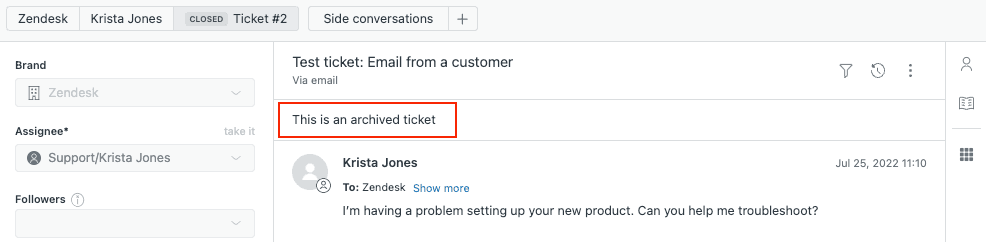
When you open an archived ticket, Zendesk displays a banner at the top that reads "This is an archived ticket." This is your visual cue that the ticket is in archived status.
To search for tickets that meet archiving criteria, use Zendesk's search syntax. Try a query like:
type:ticket status:closed updated<2024-01-01
This returns tickets that were last updated before January 1, 2024, which would include archived tickets (assuming you're searching in 2026). Adjust the date based on your needs.
Storage implications and costs
Here's a critical point that surprises many Zendesk admins: archived tickets are included in storage usage calculations. Only deleted tickets (soft or permanent) are excluded from storage. So that ticket from two years ago that's been archived? It's still eating up your data allocation.
Zendesk tracks storage across several categories:
| Storage Type | What's Included |
|---|---|
| Tickets | Total size of all ticket storage objects |
| File Storage | All files attached to tickets |
| Custom Objects | Storage for custom objects, records, fields |
| Users | Storage for all user accounts |
| External Content | Content brought in from external sources |
Storage limits vary by plan:
| Plan | Base Data Storage | Per Agent Data | Base File Storage | Per Agent File |
|---|---|---|---|---|
| Team | 10 GB | 50 MB/agent | 10 GB | 2 GB/agent |
| Growth | 10 GB | 100 MB/agent | 10 GB | 5 GB/agent |
| Professional | 10 GB | 100 MB/agent | 10 GB | 5 GB/agent |
| Enterprise | 10 GB | 200 MB/agent | 10 GB | 10 GB/agent |
Source: Zendesk pricing
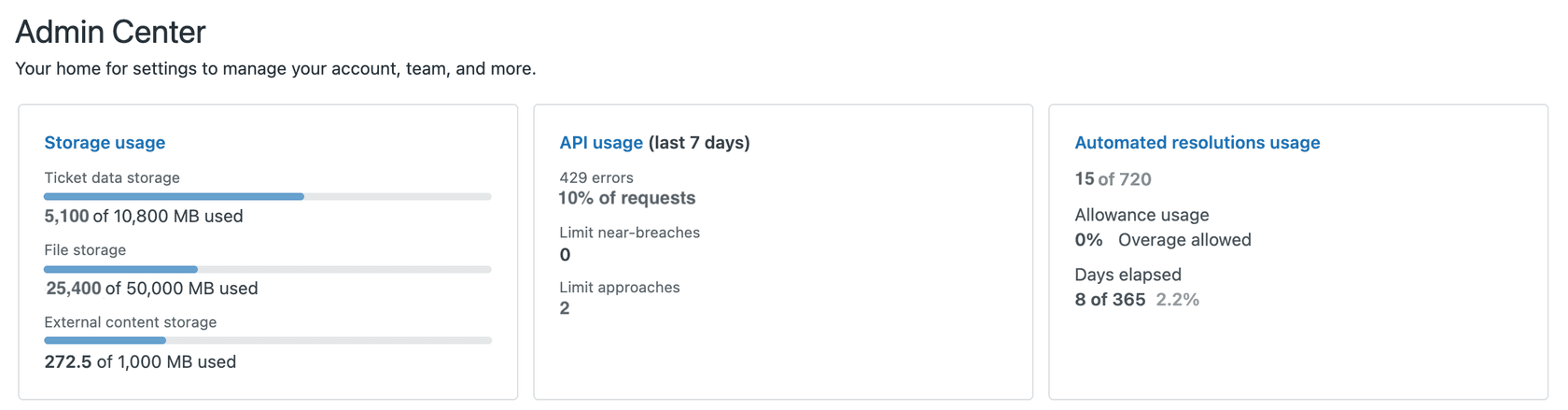
When you approach your storage limit, you'll see warning symbols in your Admin Center dashboard. At 80% usage, the chart line turns orange. When you exceed your limit, it turns red. You may also experience slower ticket loading times, degraded search performance, and delays in report generation.
The storage dashboard refreshes every 24 hours, though it can take up to 72 hours for current usage to appear. You can find it in Admin Center under Account > Usage > Storage.
If you need more storage, Zendesk offers the "More Storage" add-on. Each unit includes 500 MB of data storage, 25 GB of file storage, and 500 MB of external content. Pricing varies by plan and requires account owner or billing admin permissions to purchase.
Native options for managing old tickets
Now that you understand how archiving and storage work, let's look at what you can actually do with native Zendesk tools.
Pre-archiving automation
Since automations cannot run on archived tickets, your window for automation is before the 120-day mark. You can set up automations that trigger based on time conditions while tickets are still active or recently closed.
For example, you could create an automation that:
- Tags tickets 90 days after closure with "approaching-archive"
- Sends notifications to agents about tickets that will soon archive
- Updates custom fields to track retention status
But once that 120-day threshold hits and the ticket archives, your automation stops working on it.
Export options
Zendesk offers data export capabilities, but with significant limitations:
| Export Feature | Availability | Limitations |
|---|---|---|
| JSON/CSV/XML Export | Professional+ plans only | Not available on Team plan |
| Incremental Export API | All plans | Requires technical implementation |
| Attachments | Not included | Must be handled separately |
| Automation | None | Exports must be triggered manually |
Source: Zendesk export documentation
The native export works for backups and compliance, but it isn't designed for ongoing archiving workflows. You get raw data files, not human-readable formats, and there's no built-in way to delete tickets after export.
Deletion options
Zendesk offers several ways to remove tickets:
- Manual deletion: Delete tickets one by one (impractical at scale)
- Soft delete: Ticket marked as deleted but retained for 30 days
- Permanent delete: Occurs 90 days after initial deletion
- Deletion schedules: Available with Advanced Data Privacy add-on
The deletion schedule feature lets you set up automatic deletion based on criteria like ticket age. However, this requires the add-on and doesn't include export functionality. You're deleting the data, not archiving it.
Third-party solutions for ticket archiving
Given the limitations of native tools, many teams turn to third-party solutions. The most prominent option in the Zendesk Marketplace is Knots.io.
Knots.io Export Tickets
Knots offers an Export Tickets as PDF app that addresses many of Zendesk's native limitations. It's a Zendesk Premier Partner app with GDPR and HIPAA compliance certifications.
Key features:
- Export tickets as human-readable PDFs
- Include attachments, tags, and both public and private comments
- Export side conversations with their attachments
- Customizable naming conventions (ticket ID, requester, brand)
- Deliver exports to FTP, SFTP, or cloud storage (S3, Dropbox)
Automation options:
- Event-based triggers (e.g., when ticket is tagged "archive")
- Batch export via Zendesk search syntax
- Scheduled exports for regular archiving
Post-export actions:
- Optional bulk delete of exported tickets
- Automatic cleanup to free storage space
The app works on all Zendesk plans, including Team, which is significant since native exports require Professional or higher.
Knots pricing
| Plan | Monthly Price | Key Features | Ticket Limit |
|---|---|---|---|
| Free | $0 | 1 app (Merge Tickets) | Unlimited |
| Essentials | $269 | 3 apps, automation audit | 5,000/month |
| Power Suite | $899 | 10 apps, implementation | 30,000/month |
| Enterprise | $1,900+ | Unlimited apps, security | 75,000/month |
Source: Knots pricing
Comparison: Native vs. Third-party
| Feature | Native Zendesk | Knots.io |
|---|---|---|
| Export format | JSON/CSV/XML | PDF (human-readable) |
| Attachments included | No | Yes |
| Automation | Limited | Event-based + scheduled |
| Plan requirement | Professional+ | All plans |
| Bulk delete | Manual only | Automated option |
The trade-off is cost. Native exports are included in your plan (if you've got the right tier), while Knots charges additional fees based on usage. You'll need to evaluate whether the improved functionality justifies the expense for your team.
How eesel AI approaches ticket lifecycle differently
There's a fundamental issue with the traditional approach to ticket archiving. You're treating symptoms (storage bloat, slow performance) rather than the underlying problem: tickets that don't need to exist in the first place.
This is where eesel AI for Zendesk takes a different approach. Instead of just archiving old tickets, we help you resolve more tickets automatically from the start, reducing the volume of tickets that ever need archiving.
Intelligent resolution before archiving
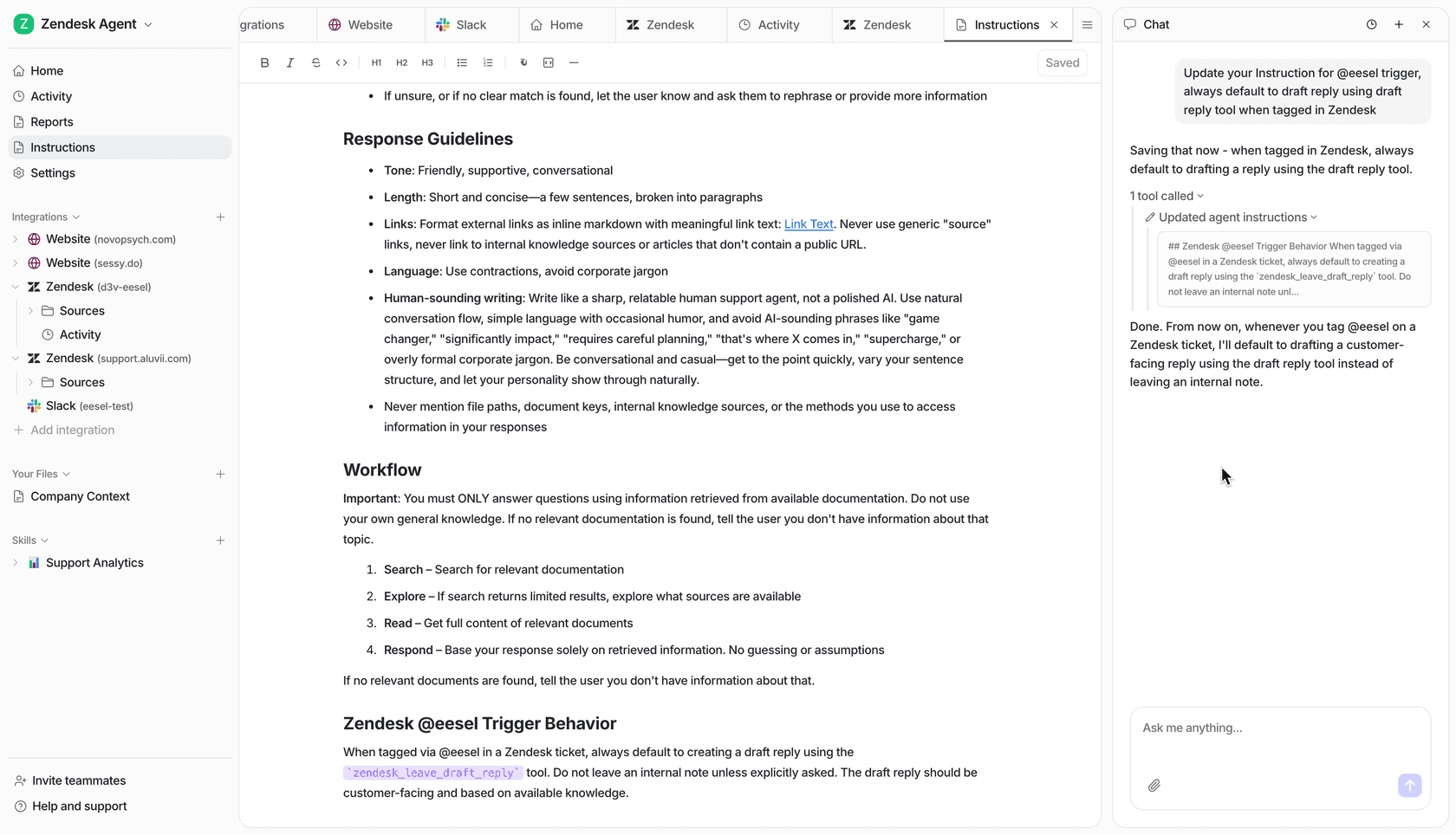
- Our AI agents handle frontline support tickets autonomously
- Up to 81% resolution rate in mature deployments
- Fewer tickets created means fewer tickets to archive later
Continuous learning from your data
- We learn from your past tickets, help center, and macros
- The AI improves over time based on corrections and feedback
- No manual training or documentation uploads required
Plain-English control
- Define escalation rules in natural language
- "If the refund request is over 30 days, politely decline and offer store credit"
- No complex configuration or coding required
Key differences from Zendesk archiving:
| Capability | Zendesk Archiving | eesel AI Approach |
|---|---|---|
| Primary action | Store old tickets | Prevent unnecessary tickets |
| Automation scope | None on archived tickets | Full lifecycle automation |
| Learning | None | Continuous from your data |
| Control | Rigid rules | Natural language instructions |
| Testing | None native | Simulate on past tickets before go-live |
If you're already using Zendesk, eesel AI integrates directly. You don't need to replace your help desk. You can start with AI Copilot drafting replies for agent review, then graduate to AI Agent handling specific ticket types autonomously. Use AI Triage to tag, route, and close tickets automatically while maintaining your existing Zendesk workflows.
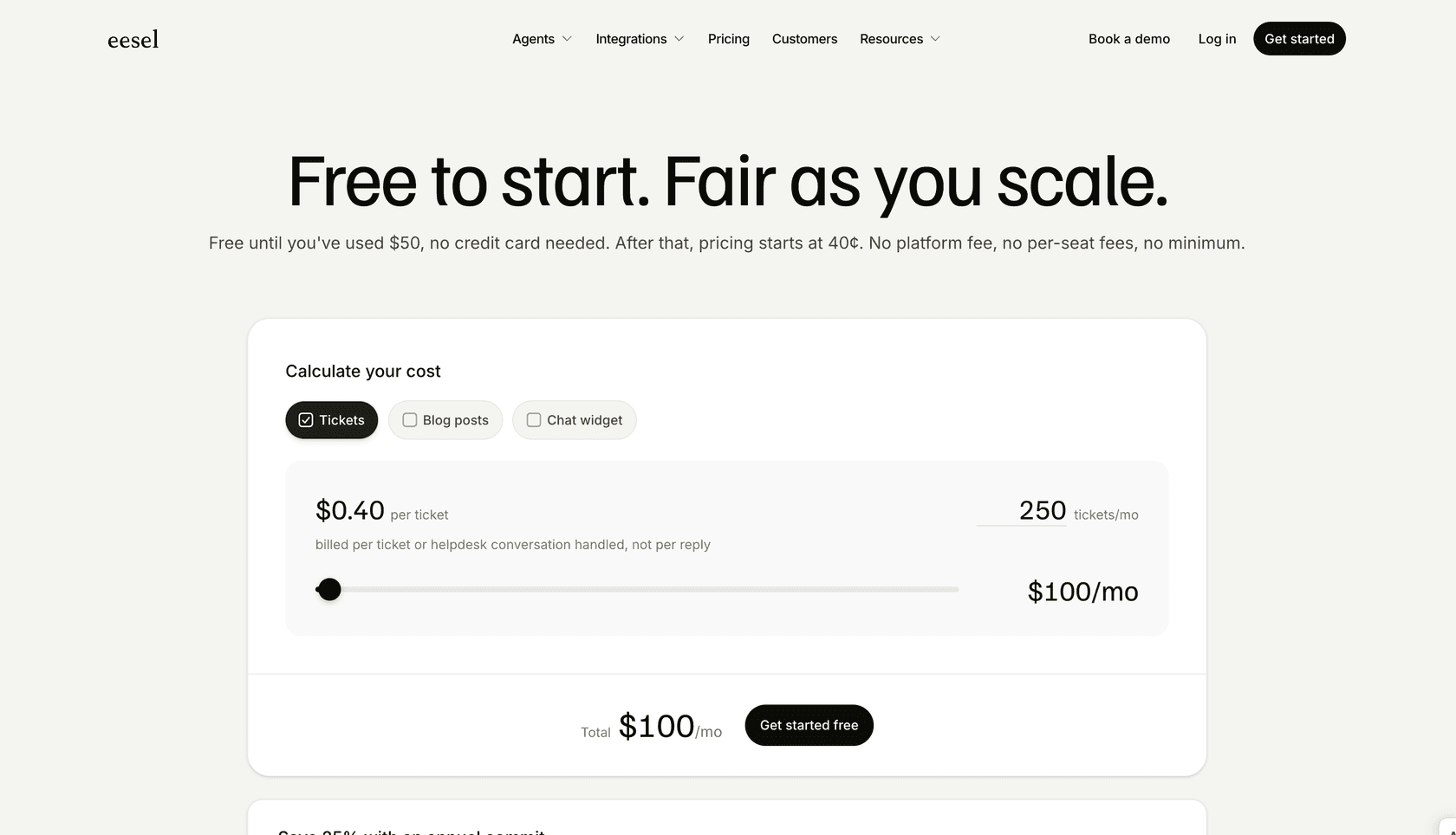
Our pricing scales by AI interactions, not seats, which often works out more predictably for growing teams than per-agent storage add-ons. The Team plan starts at $299/month ($239 annually) with up to 3 bots and 1,000 interactions. Business plan at $799/month ($639 annually) includes unlimited bots, AI Agent capabilities, and up to 3,000 interactions.
The difference is philosophical. Instead of asking "how do we manage all these old tickets?" you start asking "how do we prevent tickets from becoming old and unresolved?"
Best practices for managing archived tickets
Whether you stick with native tools, add third-party solutions, or explore AI alternatives, these principles will keep your ticket management sane:
-
Define clear retention policies before implementing automation. Know what you need to keep and for how long. Don't make it up as you go.
-
Test exports regularly. Verify that your archived data is complete and accessible. A backup you can't restore is worthless.
-
Train agents on accessing archived tickets. They should know how to search for older tickets when customers reference past issues.
-
Balance storage costs against customer history value. That five-year-old ticket might be useless, or it might contain critical context for a long-term B2B relationship.
-
Document your archiving workflow. Compliance auditors will ask. Future team members will need to understand how the system works.
-
Consider B2B vs. B2C differences. B2B support often requires longer retention due to warranty periods and ongoing relationships. B2C might allow more aggressive purging.
Choosing the right approach for your team
Let's break down the decision framework:
Small teams (under 5 agents):
- Use Zendesk search for occasional old ticket lookups
- Manual exports for compliance needs
- Address storage issues by upgrading plan or adding storage units
Growing teams (5-50 agents):
- Implement Knots.io or similar third-party automation
- Set up regular export and deletion workflows
- Monitor storage usage monthly
Enterprise teams (50+ agents):
- Evaluate AI-powered solutions like eesel AI
- Consider whether ticket volume reduction is more cost-effective than storage management
- Implement comprehensive data governance policies
The fundamental question is whether you want to optimize your archiving process or reduce the need for archiving altogether. Both are valid approaches. The right choice depends on your ticket patterns, growth trajectory, and how much of your support volume consists of resolvable, repetitive issues.
If you're curious how an AI approach might work for your situation, you can try eesel AI free or book a demo to see how it works for your specific workflow.


