Zendesk Talk IVR menu naming and order: A complete guide

Stevia Putri
Last edited February 19, 2026
Your IVR menu is often the first impression customers have of your support operation. Get the naming and ordering right, and callers reach the right agent quickly. Get it wrong, and you create frustration before the conversation even begins.
This guide covers everything you need to know about naming and ordering your Zendesk Talk IVR menus. You'll learn naming conventions that keep your team organized, ordering strategies that reduce caller frustration, and templates you can implement immediately.
Understanding IVR menus in Zendesk Talk
An IVR (Interactive Voice Response) menu is the automated phone tree that greets callers and routes them based on their keypad selections. In Zendesk Talk, IVR menus connect to your phone numbers and direct calls to agent groups, voicemail, external numbers, or nested submenus. Learn more about Zendesk Voice capabilities in our detailed overview.
Before you start building, you'll need Talk Professional or Enterprise. IVR isn't available on the Team plan. Once you're in Admin Center, you'll work with four core components:
- Menus - The containers that hold your routing logic
- Levels - Individual layers within a menu (main menu, submenus)
- Routes - The actions triggered by keypresses (route to group, voicemail, etc.)
- Greetings - The audio messages callers hear
The names you choose for these elements matter more than you might think. Clear naming helps your team navigate the Admin Center, troubleshoot issues faster, and maintain consistency as your phone system grows.
IVR menu naming conventions and best practices
Good naming isn't just about organization. It's about making your IVR system understandable to anyone who needs to work with it, including yourself six months from now.
Naming your IVR menus
Start with descriptive, scannable names that communicate purpose at a glance. Compare these two approaches:
- ❌ "IVR_01" or "Menu A"
- ✅ "Main Support Menu" or "Sales and Support Routing"
The second approach tells you exactly what the menu does without opening it. Include both purpose and scope in the name. "Billing - Payment Options" is clearer than just "Billing" because it specifies what aspect of billing the menu covers.
Keep names consistent across your organization. If you use "Main Menu - [Department]" in one place, use that same pattern everywhere. Avoid abbreviations that might confuse team members who didn't create the menu. "CS RT" might mean "Customer Service Routing" to you, but it's meaningless to someone else.
Naming menu levels
When you create multi-level IVRs, hierarchical naming becomes essential. Use patterns like:
- Main menu - The top-level entry point
- Technical Support submenu - A nested level under main menu
- Billing - Payment Options - Category and subcategory
Consider business hours variations too. If you need different menus for business hours and after-hours, name them explicitly:
- "Main Menu - Business Hours"
- "Main Menu - After Hours"
This prevents confusion when you're assigning menus to phone numbers or troubleshooting routing issues.
Naming greetings
Match greeting names to their associated menu names for clarity. Instead of generic names like "Greeting 1," use:
- "Support Line - Business Hours Greeting"
- "Main IVR - Spanish Version"
- "Sales Queue - Holiday Message"
If you're testing different greeting versions, include version control in the name:
- "Main Greeting - v1 (Original)"
- "Main Greeting - v2 (Shortened)"
This makes A/B testing and rollbacks much easier to manage.

Strategic menu ordering principles
The order of your menu options directly impacts caller experience. Research shows that 63% of consumers find irrelevant IVR options frustrating. Strategic ordering reduces that friction. For more on improving your phone support experience, see our guide to Zendesk Voice.
The psychology of menu ordering
Callers want to reach their destination quickly. Every second they spend listening to options they don't need increases frustration. The "golden first position" is real: callers who need option 1 never hear options 2 through 5.
Place your most common inquiry type first. If 60% of your calls are for technical support, make that option 1. The 40% of callers who need something else will wait through one irrelevant option instead of the majority waiting through four.
Recommended menu order structure
Here's a framework that works for most businesses:
- Language selection (if you support multiple languages)
- Most common inquiry (typically sales or support)
- Second most common (billing, account management)
- Specialized options (technical support, partnerships)
- Self-service options (hours, location, status check)
- Speak to representative (typically 0 or last option)
Note that 81% of consumers want to speak to a live agent at the beginning of a customer service experience. Make this option easy to find, not hidden behind multiple layers.
Industry-specific ordering examples
Different industries have different call patterns. Here are common structures:
E-commerce:
- Orders and shipping
- Returns and exchanges
- Customer support
- Sales
SaaS:
- Technical support
- Sales
- Billing
- Account management
Services:
- Appointments
- Billing
- Support
- General inquiries
Multi-level menu ordering
When you need nested menus, keep these limits in mind:
- Main menu: 5 options or fewer
- Maximum depth: 2-3 levels
- Submenu ordering: Apply the same frequency-based approach within each category
Deep phone trees frustrate callers. Industry research shows that abandonment rates increase with each additional menu level. Zendesk recommends keeping abandonment under 5% as a target. Every additional level increases that risk.
Common naming and ordering mistakes to avoid
Learning from others' mistakes saves you time and prevents caller frustration.
Naming mistakes
Generic names like "Menu 1" or "Greeting A" create confusion. Six months later, you'll have no idea what those menus do without opening each one.
Overly long names truncate in dropdown menus, making them hard to read. Keep names under 40 characters when possible.
Inconsistent naming across teams leads to duplicate menus serving the same purpose. Establish naming conventions and document them.
Not updating names when menus change creates mismatches between the name and function. If you repurpose a menu, rename it.
Ordering mistakes
Alphabetical ordering ignores call volume. Just because "Billing" comes before "Support" alphabetically doesn't mean it should be option 1.
Hiding the "speak to human" option frustrates callers. Don't bury it behind multiple menu levels or make it the last option in a long list.
Too many options at the main menu level overwhelms callers. Remember the 5-option limit.
Deep nesting without clear path back traps callers. Always provide a way to return to the previous menu or reach an agent.
Testing oversights
Many administrators set up IVRs without thorough testing. Common oversights include:
- Not testing from external lines (internal testing can behave differently)
- Failing to verify default route behavior (what happens when callers press invalid keys)
- Ignoring call abandonment metrics by option (which menu choices cause hangups)
IVR naming and ordering templates
Use these templates as starting points for your own IVR structure.
Template 1: Simple support line (2 options)
Best for: Small teams with straightforward routing needs
Menu name: "Main Support Menu"
Structure:
- Press 1 for Support
- Press 0 for Voicemail
Naming convention:
- Menu: "Main Support Menu"
- Greeting: "Support Line - Main Greeting"
This minimal approach works when you don't need complex routing. Every caller either reaches support or leaves a message.
Template 2: Sales and support split (4 options)
Best for: Businesses with distinct sales and support functions
Menu name: "Sales and Support Routing"
Structure:
- Press 1 for Sales
- Press 2 for Customer Support
- Press 3 for Billing
- Press 0 for Voicemail
Naming convention:
- Menu: "Sales-Support Main"
- Level 1 routes: "Sales Queue", "Support Queue", "Billing Queue"
- Greeting: "Main IVR - Business Hours"
Order by call volume. If support gets more calls than sales, flip options 1 and 2.
Template 3: Multi-department (5 options)
Best for: Larger organizations with multiple departments
Menu name: "Company Main Menu"
Structure:
- Press 1 for Sales
- Press 2 for Customer Service
- Press 3 for Technical Support
- Press 4 for Billing
- Press 0 for Operator
Naming convention:
- Menu: "Main Menu - [Department]"
- Submenus: "[Department] Submenu"
- Greetings: "[Department] - [Purpose] Greeting"
This structure scales well. You can add department-specific submenus under each option without cluttering the main menu.
Template 4: Multi-level structure
Best for: Complex routing needs with categorized inquiries
Menu name: "Tiered Support Menu"
Level 1:
- Press 1 for Sales
- Press 2 for Support
- Press 0 for Voicemail
Level 2 (Support submenu):
- Press 1 for Account Issues
- Press 2 for Technical Help
- Press 3 for Product Questions
- Press 9 to return to Main Menu
Naming convention:
- Level 1 menus: "Main - [Category]"
- Level 2 menus: "[Category] - [Subcategory]"
- Greetings: Match menu name + context
The "9 to return" option is essential. Without it, callers feel trapped in submenu loops.
Testing and optimizing your IVR structure
Building the IVR is only half the work. Testing and optimization ensure it actually works for your callers.
How to test every menu option thoroughly
Create a testing checklist that covers:
- Every keypress option (0-9, *, #)
- Invalid keypresses (what happens when someone presses 8 when only 1-3 are options)
- No input (wait through the greeting without pressing anything)
- Business hours vs. after-hours behavior
- Voicemail recording and ticket creation
Test from an external phone line, not just internally. Internal testing sometimes bypasses certain routing rules.
Using Zendesk Explore to analyze IVR completion rates
Zendesk Explore provides metrics on IVR performance. Key reports to monitor:
- IVR completion rate - Percentage of callers who reach their destination
- Abandonment by option - Which menu choices cause hangups
- Time in IVR - How long callers spend navigating menus
High abandonment on a specific option suggests confusion or misalignment between the menu description and what callers expect.
A/B testing different menu orders
If you're unsure about the optimal order, test variations:
- Run version A for two weeks
- Switch to version B for two weeks
- Compare completion rates and abandonment
- Keep the winner, test another variation if results are close
Even small changes can impact caller behavior. One company found that moving "Speak to Representative" from option 9 to option 0 reduced abandonment by 12%.
When to update naming conventions
Review your IVR naming when:
- Adding new menus (ensure consistency with existing names)
- Reorganizing departments (update menu names to reflect new structure)
- Onboarding new administrators (clean up confusing legacy names)
- Quarterly audits (identify unused or redundant menus)
Gathering agent feedback on routing accuracy
Your agents know when routing isn't working. They hear from frustrated callers who ended up in the wrong queue. Create a simple feedback mechanism:
- Weekly check-ins with agents about misrouted calls
- Monthly review of tickets tagged with routing issues
- Quarterly survey on IVR effectiveness
How eesel AI complements your Zendesk Talk setup
A well-structured IVR gets calls to the right team. What happens next matters just as much.
When calls create tickets in Zendesk Support, eesel AI can handle the follow-up automatically. Our AI teammate learns from your past tickets and help center to draft responses, route tickets intelligently, and even resolve common issues without agent intervention.
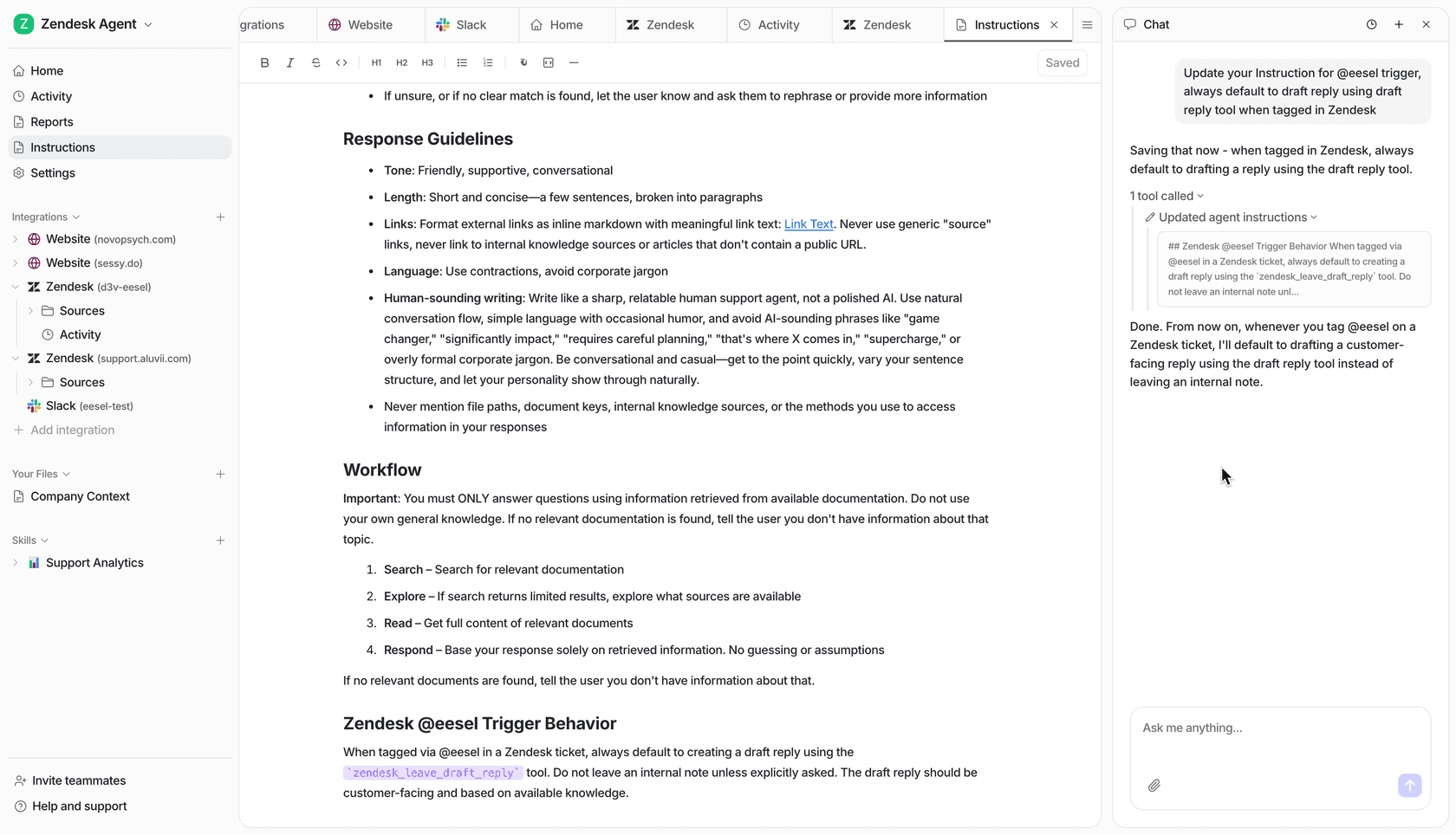
Here's how it works together: A caller selects "Technical Support" in your IVR, reaches an agent, and the issue requires follow-up. Instead of agents writing every response from scratch, eesel AI's AI Copilot drafts replies based on your knowledge base and previous similar tickets. Agents review, edit if needed, and send.
For tickets that don't need human attention at all, eesel AI's AI Agent can respond directly. Mature deployments achieve up to 81% autonomous resolution with a typical payback period under 2 months. The combination of smart IVR routing and AI-powered ticket handling creates a seamless experience from first call to final resolution.
Start optimizing your Zendesk Talk IVR today
Your IVR menu naming and order directly impact customer experience. Clear naming keeps your team organized and makes troubleshooting easier. Strategic ordering reduces caller frustration and gets people to the right destination faster.
Start with an audit of your current IVR names. Are they descriptive? Consistent? Could someone new to your team understand what each menu does without opening it?
Then review your menu order against your call volume data. Are your most common options first? Is the "speak to representative" option easy to find?
Small changes to naming and ordering can have outsized impacts on caller satisfaction. And when you're ready to streamline what happens after the call, try eesel AI to handle ticket triage and response drafting automatically.

Frequently Asked Questions
Share this article

Article by
Stevia Putri
Stevia Putri is a marketing generalist at eesel AI, where she helps turn powerful AI tools into stories that resonate. She’s driven by curiosity, clarity, and the human side of technology.