
The "Submit a request" button in your Zendesk Guide (now Zendesk Knowledge) help center is the gateway between your customers and your support team. It's also one of the most visible elements of your help center, appearing in the header of every page and at the end of articles.
But what if the default text doesn't match your brand voice? Or you want to direct customers to your community forum instead? Maybe you want to remove it entirely and handle requests through other channels.
This guide walks you through three ways to customize your Zendesk Knowledge submit request link: changing the button text, removing it completely, or redirecting it to a custom destination.
What you'll need
Before you start customizing, make sure you have:
- Zendesk Suite Growth plan or higher (or Support Professional/Enterprise with Guide Professional). Theme code editing isn't available on lower-tier plans.
- Admin access to Guide with Knowledge admin permissions
- Basic familiarity with HTML/CSS if you're doing advanced customizations like redirects
- A backup of your current theme (we'll cover how to create one)
If you're on a lower-tier plan, you'll need to upgrade before you can edit theme code. Check your current plan at Zendesk's pricing page.
Step 1: Access your help center theme editor
First, you need to get into the theme editing interface where you can modify the code.
- In Zendesk, click the Guide icon in the top navigation
- Click the Customize design icon in the sidebar (it looks like a paintbrush)
- Find your active theme and click Customize
- At the bottom of the page, click Edit code

You'll see a file browser on the left showing templates like header.hbs, article_page.hbs, and styles.css. These are the files you'll be editing.
Important: Before making changes, create a copy of your theme. Click the gear icon next to your theme name and select Copy. This gives you a safe backup if something goes wrong.
Step 2: Change the submit request button text
The most common customization is simply changing "Submit a request" to something that better fits your brand.
- In the file browser, click header.hbs
- Find this line of code:
{{link 'new_request' class='submit-a-request'}}
- Replace it with:
{{#link 'new_request' class='submit-a-request'}}Your Custom Text{{/link}}
-
Replace "Your Custom Text" with whatever you want the button to say. Some common alternatives:
- "Contact Us"
- "Get Help"
- "Open a Ticket"
- "Ask a Question"
- "Support Request"
-
Click Save, then Publish to make the changes live
Note: This change only affects the button in your header. The "Have more questions? Submit a request" prompt at the end of articles uses different code. We'll cover that next.
Source: Zendesk Help Center - How to change the text "Submit a request"
Step 3: Remove the submit request link entirely
Some businesses prefer to handle support through other channels (email, phone, community forums) and want to remove the request form entirely.
Remove from the header
- Open header.hbs
- Find and delete this line:
{{link 'new_request' class='submit-a-request'}}
Or if it looks like this:
<li class="item">{{link 'new_request' role="menuitem" class='submit-a-request'}}</li>
Delete the entire line including the <li> tags.
Remove from article pages
- Open article_page.hbs
- Find and delete this block:
<div class="article-more-questions">
  {{request_callout}}
</div>
- Click Save, then Publish
Important: Removing these elements means customers won't be able to submit tickets through your help center. Make sure you have alternative support channels clearly displayed.
If you want email-only support without the help center ticket management, Zendesk has a specific setting for that. See their guide on turning off ticket management for email-only support.
Source: Zendesk Help Center - Remove "Submit a request" link
Step 4: Redirect to a custom destination
Want the button to go somewhere else entirely? Maybe your community forum, a custom contact form, or a specific landing page? Here's how to replace the default behavior with your own link.
- Open article_page.hbs
- Find the block that contains the submit request prompt (usually near the bottom):
<div class="article-votes">
  <h2 class="article-votes-question" id="article-votes-label">{{t 'was_this_article_helpful'}}</h2>
  ...
</div>
- Replace it with your custom HTML:
<div class="center-container">
  <a href="https://yoursite.com/community" class="community-link">Ask in the Community</a>
</div>
- Open styles.css and add styling for your new button:
.center-container {
  text-align: center;
}

.community-link {
  display: inline-block;
  padding: 10px 20px;
  font-size: 16px;
  color: #fff;
  background-color: #007bff;
  border: none;
  border-radius: 5px;
  text-decoration: none;
  transition: background-color 0.3s ease;
}

.community-link:hover {
  background-color: #0056b3;
}
- Click Save, then Publish

Tip: Test your changes on mobile. The default Zendesk themes are responsive, but custom code might not be. Use the Preview feature and resize your browser to check.
Source: Zendesk Community - Change Submit a Request to link to Community Page
Common issues and troubleshooting
Even with clear instructions, things sometimes don't work as expected. Here are solutions to common problems:
Changes aren't showing up
- Clear your browser cache and refresh
- Make sure you clicked Publish after saving
- Check that you're viewing the live theme, not a preview
The button disappeared completely
- You may have accidentally deleted too much code. Restore from your theme copy
- Check that you didn't break the Handlebars syntax (missing
}}or quotes)
Mobile display looks wrong
- Custom CSS might not be responsive. Test on actual mobile devices, not just resized desktop
- Use browser developer tools to inspect elements and adjust CSS
Can't find the code to edit
- Some marketplace themes have different file structures
- Check if your theme supports code editing (some free themes don't)
- You may need a Developer License for certain marketplace themes
Need to revert changes
- If you made a copy before editing, you can switch back to the original theme
- Go to Customize design > click the gear icon on your original theme > Set as live theme
Choosing the right approach for your workflow
Not sure which customization is right for you? Here's a quick comparison:
| Approach | Best For | Considerations |
|---|---|---|
| Change text | Most businesses | Simple, low-risk, maintains all functionality |
| Remove link | Email-only support, community-first | Requires alternative support channels |
| Redirect | Community forums, custom forms | Needs CSS knowledge, test thoroughly |
When to change the text: This is the safest option. It keeps the functionality intact while matching your brand voice. Good for most businesses.
When to remove the link: Consider this if you're moving to email-only support, or if you want to force customers to use your community forum or phone support. Make sure your alternative channels are clearly visible.
When to redirect: Use this when you have a specific destination in mind, like a community forum or custom contact form. Requires more technical knowledge but gives you full control.
A modern alternative to traditional request forms
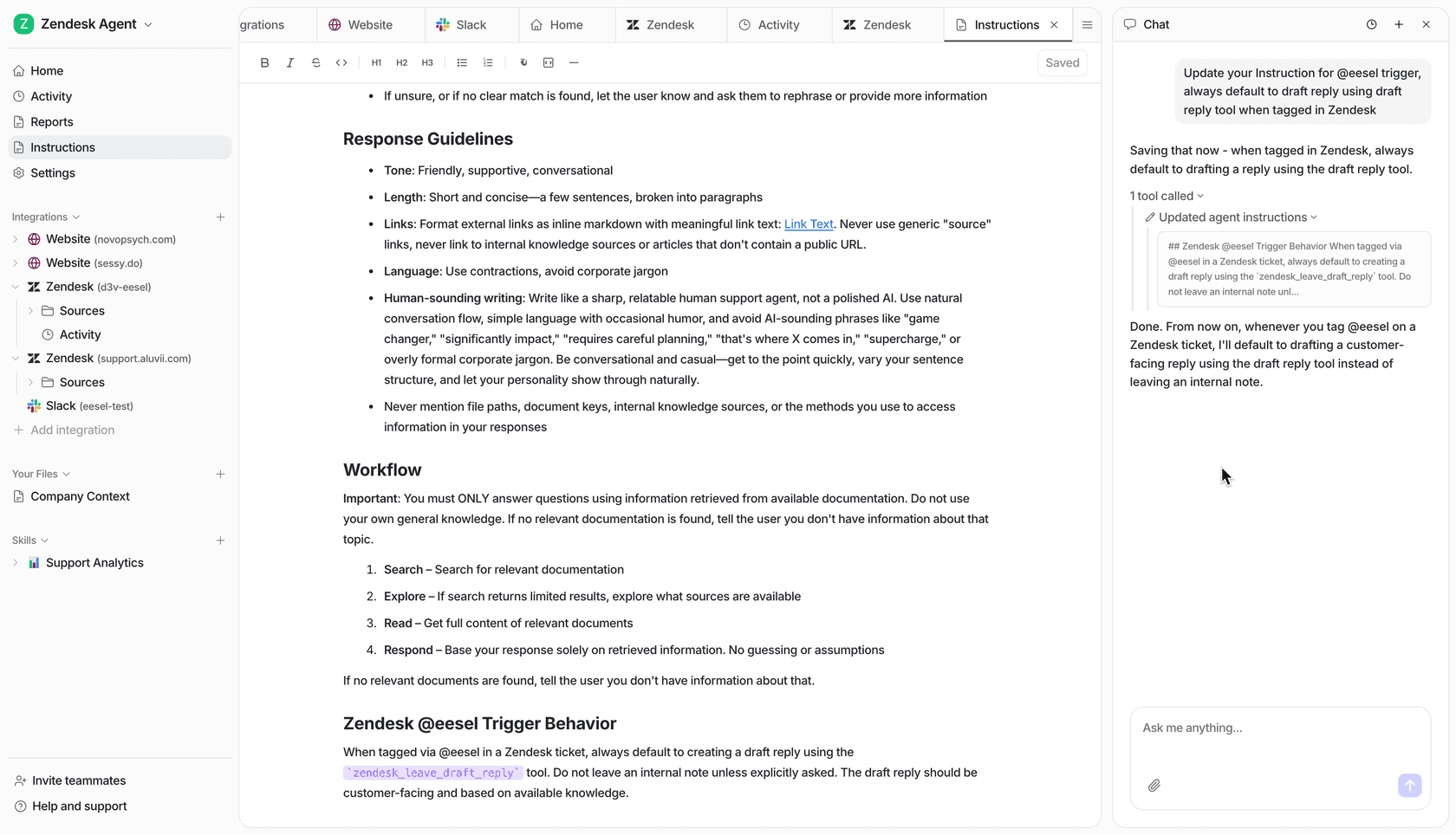
Customizing your Zendesk submit request link solves the immediate problem, but it doesn't change the underlying experience. Customers still fill out a form and wait for a response.
If you're looking for something different, we built eesel AI for Zendesk as an AI teammate for customer support. Instead of forms, customers get instant answers from an AI that learns from your help center articles, past tickets, and internal documentation.
Here's how it works:
- Connect eesel AI to your Zendesk account (takes about 5 minutes)
- It reads your existing help center and ticket history
- Customers get instant, accurate responses 24/7
- Complex issues automatically escalate to your human team
The AI handles routine questions, order lookups, and common troubleshooting. Your team focuses on the issues that actually need human attention.
Unlike traditional chatbots that require endless configuration, eesel learns from your existing data. You don't write scripts or build decision trees. You just connect it and let it learn.
If you're curious, you can see eesel in action or check out our Zendesk integration guide for setup details.