If your team handles under 200 tickets a month, Tidio's all-in-one automation wins on value, it's a "set and forget" engine for small stores. Past 1,000 monthly chats or with a complex software stack, LiveChat pulls ahead on integration depth and human-centric workflows. Full breakdown below.
Choosing the right support tool in 2026 is no longer just about which chat widget looks better on your site. It is about how much of the work the software can actually take off your plate. For most teams, the goal is to stop being a "chat operator" and start being a manager of an automated system. This shift has created a clear divide between tools like Tidio, which focus on autonomous automation for small businesses, and LiveChat, which builds power tools for large human teams.
But there is a third path emerging. While traditional platforms ask you to spend weeks configuring "if-then" logic, we at eesel AI believe you should be able to hire your support team, not build it. Our AI Helpdesk Agent learns your entire business in minutes, representing a modern alternative that bridges the gap between Tidio's simplicity and LiveChat's scale.
What are Tidio and LiveChat?
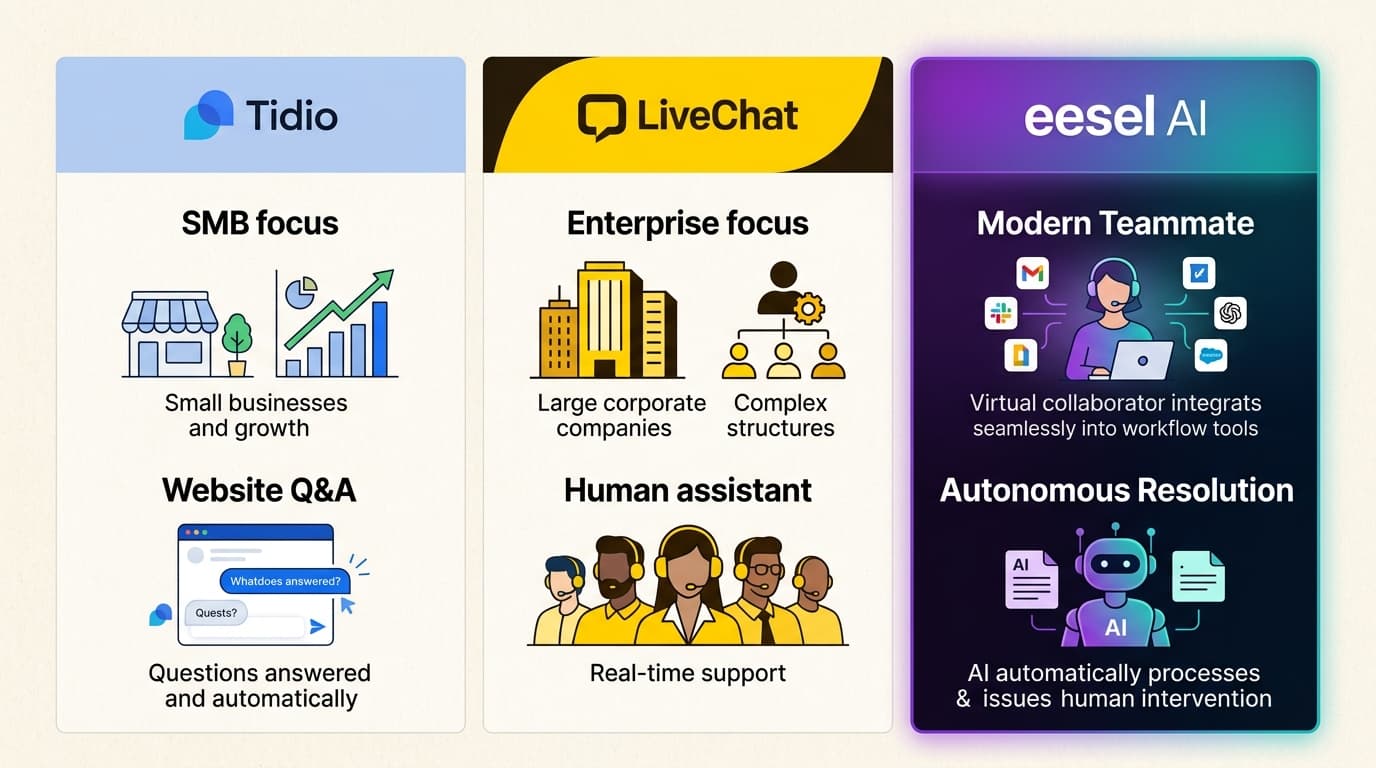
Tidio is positioned as an all-in-one customer experience platform specifically designed for small and medium-sized businesses (SMBs). Since its inception, it has leaned heavily into the e-commerce space, offering deep, one-click integrations with platforms like Shopify and WooCommerce. Its primary goal is to help small stores provide big-brand support without needing a 24/7 human team. It does this by bundling live chat, email marketing, and AI automation into a single, relatively affordable package.
On the other side of the ring is LiveChat. This is a robust, human-centric tool built for scaling support departments that need deep integration needs. LiveChat does not try to be an "everything" app. Instead, it focuses on being the best possible interface for human agents to talk to customers. It is designed for businesses that already have a support team and want to make them more productive with advanced features like staffing predictions, work schedulers, and a massive marketplace of over 200 native integrations.
The fundamental difference lies in their philosophy. Tidio wants to replace the human for simple tasks as quickly as possible. LiveChat wants to empower the human to handle complex tasks more efficiently.
Then there is our approach at eesel AI. We see the "platform vs. tool" debate as a relic of the past. You should not have to choose between a "simple" tool that lacks depth and a "powerful" tool that requires a full-time administrator. We built eesel AI to be the "AI teammate" you hire for a specific job. Whether you need frontline ticket resolution or a shop assistant that actually sells, our agents join your existing workspace and start working immediately.
AI and automation: Lyro vs. ChatBot
In 2026, "AI" is no longer a buzzword, it is the engine. However, not all AI is created equal.
Tidio Lyro: The autonomous agent
Tidio Lyro is a built-in AI agent that can resolve up to 70% of customer issues by learning from your website content automatically. Unlike old-school chatbots that required you to map out every possible conversation path, Lyro uses generative AI to understand intent. You simply point it at your help center or website, and it starts answering questions in seconds.
One of Tidio's strongest claims is its resolution rate guarantee. They are so confident in Lyro that they guarantee a 50% resolution rate or your money back. For an SMB, this "plug and play" automation is a massive win because it requires zero technical expertise to maintain.
LiveChat ChatBot and Copilot
LiveChat takes a more modular approach to automation. They offer two distinct AI paths: Copilot and ChatBot.
- Copilot (The Assistant): This is built into the LiveChat interface. It does not talk to customers directly. Instead, it provides reply suggestions, summarizes long chats, and analyzes customer sentiment to help human agents work faster.
- ChatBot (The Automation): This is a separate product altogether. If you want full 24/7 automation, you have to buy and integrate ChatBot. while it is powerful and offers both rule-based and generative capabilities, it is another subscription to manage and another tool to configure.
LiveChat is perfect for scaling support teams needing deep integrations... it boasts an enormous app marketplace with over 200 native integrations.

The eesel AI difference
While Lyro is great for simple website Q&A, it often struggles when a ticket requires context from multiple sources like a Slack thread, a Google Doc, and a previous Zendesk ticket. eesel AI is built on a "Hire, don't configure" model.
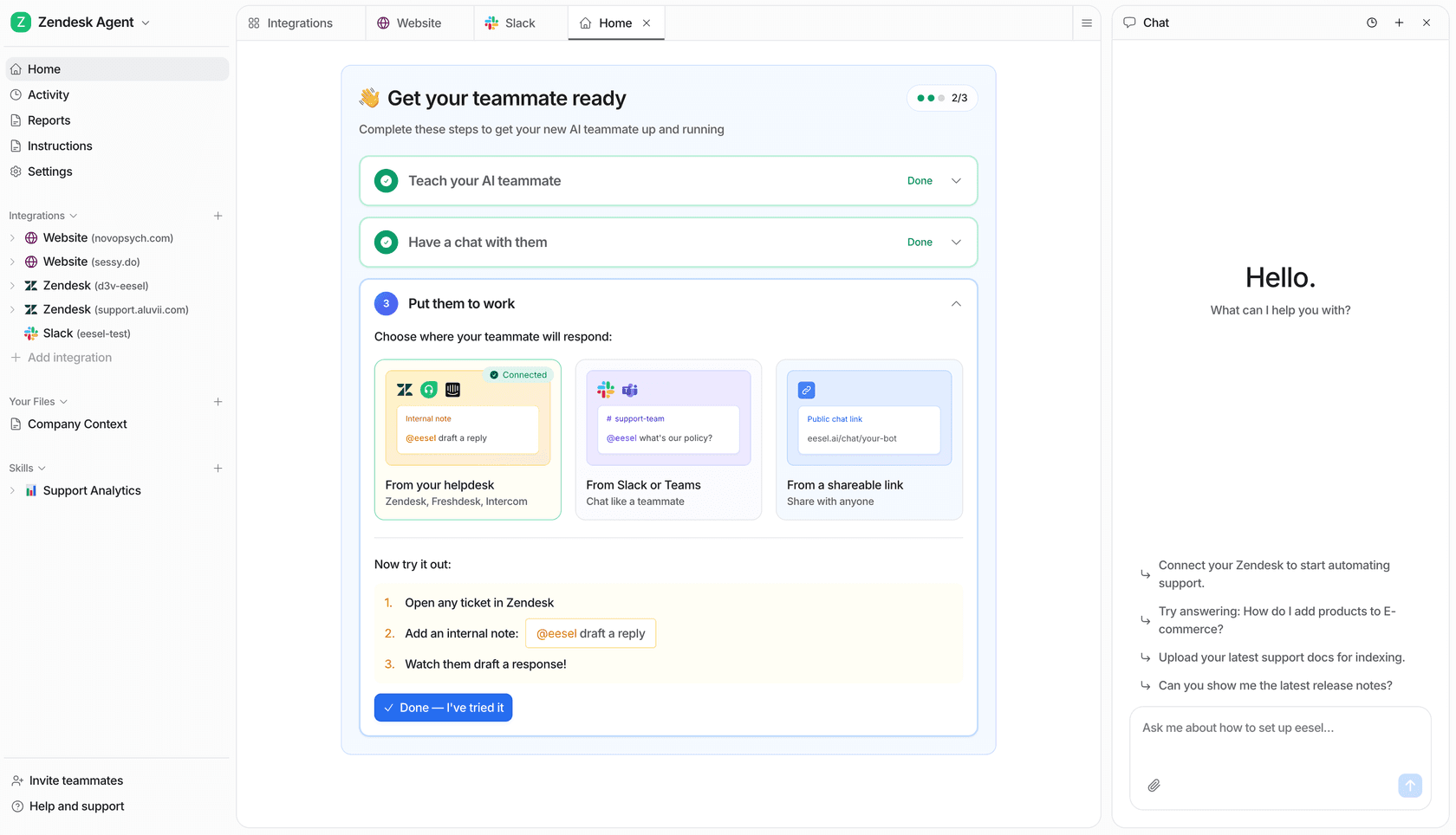
Our agents do not just scrape a URL. They connect to your help desk (Zendesk, Freshdesk, HubSpot), your knowledge bases (Notion, Confluence), and even your internal channels (Slack, Teams). This allows them to achieve up to 81% autonomous resolution without you ever having to build a single decision tree. You treat our agent like a new hire: you give them instructions in plain English, and they level up as they earn your trust.
Messaging channels and integrations
Both Tidio and LiveChat offer solid multichannel coverage, but their "ecosystem" strategies are worlds apart.
Multichannel support
Both platforms allow you to centralize your communication. You can manage website chat, email, and social media (Facebook, Instagram) from a single inbox. Tidio makes this very easy for small stores to set up, often with a "one-click" connection for Instagram and Messenger.
Integration depth
This is where LiveChat justifies its higher price tag. With over 200 native integrations, it is the clear winner for teams with a complex software stack. If you need your chat tool to sync perfectly with Salesforce, HubSpot, and Jira while also triggering custom workflows in a proprietary backend, LiveChat's marketplace and robust API make it the professional choice.
Tidio focuses more on "breadth" for e-commerce. Its native Shopify and WooCommerce integrations are some of the best in the industry. It can show customers their order status, recommend products based on browsing history, and even handle abandoned cart recovery directly within the chat window. For a Shopify merchant, Tidio feels like it was built specifically for them.
Pricing and value for money: Tidio vs. LiveChat cost breakdown
The "true cost" of these tools often hides behind their modular structures. Let's break down the 2026 pricing for both platforms.
Tidio pricing (2026)
Tidio is generally more affordable for small teams because it includes a "Free Forever" plan and bundles its AI features more generously.
| Plan | Price (Annual) | Included Seats | Key Features |
|---|---|---|---|
| Free | $0 | 1 | Basic chat, 50 Lyro AI conversations (one-time) |
| Starter | $24.17/mo | 3 | 100 chat conversations, 500 email sends |
| Growth | $49.17/mo | 5 | 2,000 chat conversations, Branding removed |
| Plus | $749/mo | Unlimited | Dedicated Account Manager, Premium integrations |
Note that Tidio Lyro conversations can be topped up for roughly $0.50 per conversation if you exceed your plan limits.
LiveChat pricing (2026)
LiveChat uses a traditional per-agent model. This means your costs scale directly with your headcount, which can become expensive very quickly for growing teams.
| Plan | Price (Annual) | Chat History | Key Features |
|---|---|---|---|
| Starter | $19/mo per user | 60 days | 1 user only, basic widget |
| Team | $49/mo per user | Unlimited | Full customization, basic reporting |
| Business | $79/mo per user | Unlimited | Staffing prediction, Apple Messages |
| Enterprise | Custom | Unlimited | HIPAA compliance, SSO, Dedicated AM |
Bottom line? LiveChat has a "modular tax." If you want full automation, you need to add ChatBot starting at $52/mo. If you need ticketing, you add HelpDesk for $29/mo. By the time you have a fully automated system for 5 agents, you could be looking at over $400/mo.
eesel AI: Flat pricing for outcomes
At eesel AI, we find the "per-seat" model outdated for an AI-first world. Why pay for a seat if the AI is doing the work? We offer flat, usage-based pricing where you only pay for what the AI actually resolves.
Our regular tasks (like resolving a support ticket or chat session) cost just $0.40 each. There are no monthly minimums or platform fees. This allows you to scale your support volume without scaling your software bill. You can even run multiple agents (one for support, one for your blog) on the same account with a single $50 free trial to get started.
Why eesel AI is the modern alternative to traditional chat tools
Traditional tools like Tidio and LiveChat are built on the "configuration" model. They give you a blank slate and ask you to build the "brain" yourself. You spend hours writing FAQs, building flows, and mapping out integrations.
We think that is a waste of your time. Our AI Helpdesk Agent is built on the "Hire" model.
- Hire in minutes: You do not "set up" eesel AI. You invite it to your team. It connects to your existing help desk and absorbs your past tickets, macros, and docs immediately.
- Train with guidance: You don't need a developer. You talk to our AI teammate in plain English. If you want it to handle refunds differently, you just tell it.
- Level up to autonomous: You start by letting the AI draft replies for your review. Once you see it is hitting the mark, you level it up to handle frontline support end-to-end.
Mature deployments of eesel AI achieve up to 81% autonomous resolution. We don't just point customers to a help article, we take real actions like looking up orders in Shopify or processing returns.
The new AI agent features are saving our office manager about 50% of the customer service chats work.
Choosing the right tool for your team in 2026
The best tool for you depends entirely on your current volume and team structure.
Pick Tidio if:
- You are a small e-commerce store (Shopify/WooCommerce).
- You handle fewer than 500 chats a month.
- You want an affordable, all-in-one package that is easy to set up.
- You need basic email marketing bundled with your chat.
Pick LiveChat if:
- You have a large team of human support agents (10+ seats).
- You need deep, enterprise-grade integrations (Salesforce, Jira).
- You require advanced team management features like staffing predictions.
- You want AI to assist your humans, rather than replace them.
Pick eesel AI if:
- You want an autonomous AI teammate that handles frontline support end-to-end.
- You are tired of per-seat pricing and want to pay only for outcomes.
- You want a tool that learns your business in minutes, not weeks.
- You need support across any help desk, social channel, or internal doc.
Start your AI-powered support journey today
The choice between Tidio and LiveChat comes down to whether you are building for a human-first or a bot-first workflow. Tidio wins on ease for small stores, while LiveChat wins on power for large teams.
However, if you are looking for the modern way to scale, we invite you to try a different approach. Hire an eesel AI Helpdesk Agent today and see what it is like to have an AI teammate that actually does the work for you. No complex setup, no per-seat fees, just results.
Frequently Asked Questions
Which is better for Shopify, Tidio or LiveChat?
Does LiveChat have a free plan?
Can I use AI for automation on both Tidio and LiveChat?


Article by
Kurnia Kharisma Agung Samiadjie
Kurnia is a software engineer and writer at eesel AI with two years of SEO experience, writing about AI tools, helpdesk software, and customer support. He pairs a developer's understanding of how these products are built with search-driven research into what actually ranks and resonates with the people searching for them.