

If your team lives in Gmail, Hiver’s native integration saves about 6 hours a week by eliminating tab-switching. However, for standalone support operations handling over 5,000 monthly tickets, Help Scout’s dedicated Docs and Beacon tools often provide a more scalable self-service foundation. Full breakdown of the one differentiator that actually matters for your 2026 stack below.
Choosing between a standalone help desk and a tool that lives inside your existing email client is one of the most critical decisions for a growing support team. In 2026, the landscape has shifted from simple ticket management to AI-driven resolution. While both Help Scout and Hiver help you manage the volume, we focus on a different goal here at eesel AI: resolving the tickets so your team does not have to.
The shared goal between these two contenders is to make customer support more human and efficient. Help Scout takes the approach of providing a dedicated space designed specifically for support, while Hiver bets on the familiarity of Google Workspace. Both have their receipts to back up their claims, but the right choice depends entirely on how your team prefers to work. Let's break it down.
What is Help Scout?
Help Scout is a standalone customer support platform built for growing teams that want to maintain a personal touch. It was founded on the philosophy that support should feel like an email between two people, not a rigid ticketing system with ticket IDs and "Please reply above this line" banners.
The platform is designed for small to mid-market businesses that want a "non-ticket" feel for their customers. When a customer receives an email from Help Scout, it looks exactly like a regular email, which helps maintain the human connection that many brands prioritize.
Core components of the platform include:
- Shared Inbox: a collaborative space for email, chat, and phone calls where teams can assign conversations and use internal notes to stay aligned.
- Docs (Knowledge Base): a self-service site builder that lets you create help articles, helping customers find answers without ever reaching out.
- Beacon: a highly-rated embeddable help widget that blends live chat, FAQ search, and contact forms into one seamless experience.
For teams that have outgrown a shared Gmail password but are not ready for the complexity of an enterprise tool like Zendesk, Help Scout offers a balanced middle ground. It provides enough structure to handle thousands of conversations while keeping the interface clean and intuitive.
What is Hiver?
Hiver takes a fundamentally different approach. Instead of asking you to log into a new platform, it turns your existing Gmail inbox into a help desk. It is a Gmail-based customer service platform that allows teams to manage shared addresses like support@ or info@ directly from the Google Workspace interface they already use.
This positioning makes it the go-to choice for teams that want to stay in Google Workspace and avoid the learning curve of new software. If your team is already proficient in Gmail, they are already 90% of the way to mastering Hiver.
The core components that power the Hiver experience include:
- Shared Inboxes inside Gmail: manage support channels seamlessly without ever leaving your primary email tab.
- Harvey (AI Support Bot): an assistive AI that suggests replies, summarizes long threads, and automates repetitive tasks.
- Native SLAs: tools to set deadlines for response and resolution times, ensuring no customer is left waiting too long.
Hiver excels at internal collaboration. Features like Shared Drafts and @mentions allow multiple departments (like Finance or IT) to work together on the same thread without the clutter of CCs or forwards. It is built for efficiency within a familiar ecosystem.
Help Scout vs Hiver pricing breakdown in 2026
When comparing the costs of these two platforms, you have to look beyond the base per-user fee. Hiver often appears more affordable at the entry-level, especially with its free tier, but the costs can scale quickly as you add more advanced features.
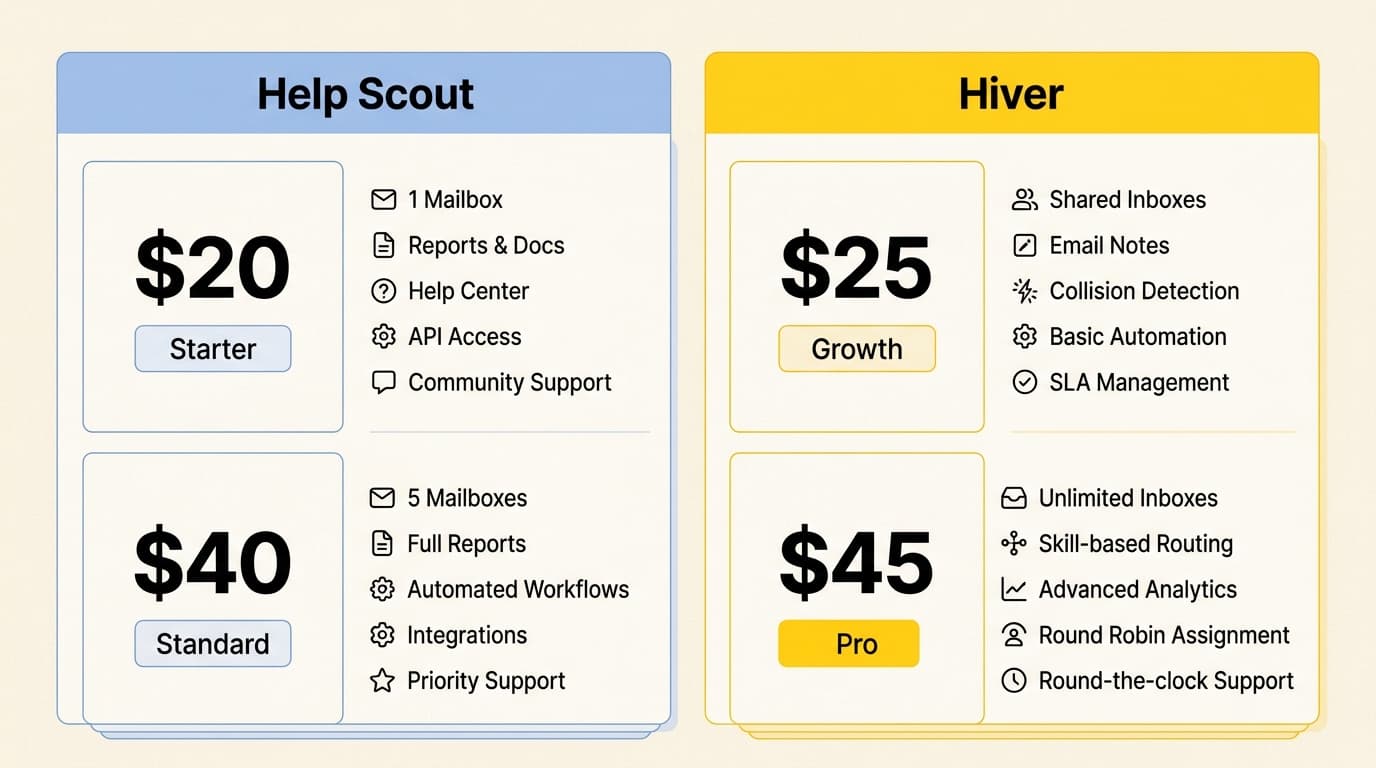
Here is the current Hiver pricing for 2026:
| Plan | Monthly Price | Annual Price (per month) | Key Features |
|---|---|---|---|
| Free | $0 | $0 | Unlimited users, 1 Shared Inbox, Slack integration |
| Growth | $35/user | $25/user | AI Compose/Summarizer, Auto-assignment, Basic integrations |
| Pro | $65/user | $55/user | AI Agents, AI Copilot, SLAs, Premium integrations |
| Elite | $95/user | $85/user | AI QA, HIPAA, OKTA SSO, Custom Objects |
Help Scout follows a similar per-seat model and offers a free plan for up to 5 users with 1 inbox and 1 Docs site. They also provide a 15-day free trial with no credit card required for paid plans.
Here is the current Help Scout pricing for 2026:
| Plan | Monthly Price | Annual Price (per month) | Key Features |
|---|---|---|---|
| Standard | $30/user | $25/user | 2 Inboxes, 2 Docs sites, Live Chat, Basic workflows |
| Plus | $54/user | $45/user | 5 Inboxes, 3 Docs sites, WhatsApp, Advanced workflows |
| Pro | $90/user | $75/user | 10 Inboxes, 5 Docs sites, HIPAA, SSO/SAML |
Bottom line? Hiver includes AI capabilities and SLA management in lower tiers compared to Help Scout, which reserves many of these features for their Plus and Pro plans. However, Help Scout's inclusion of a knowledge base (Docs) in its base plan is a significant value add if you are focused on self-service.
It is also worth noting that we offer one fixed monthly price here at eesel AI. Our AI Helpdesk Agent starts at $299/month for 500 credits (1 credit per ticket or chat), which can be layered on top of both Hiver and Help Scout. There is no per-seat fee, so you are not paying a monthly fee for every agent on your team.
Feature showdown: Where they differ
The debate between Help Scout and Hiver usually comes down to how much you value context-switching versus dedicated support tools. Let's break down the key differences in how they handle day-to-day support operations.
Email and collaboration
Help Scout treats every interaction as a "Conversation." The interface is optimized for speed and clarity, allowing agents to see the full customer history at a glance. It pulls in data from over 100 apps to provide context on the sidebar, so you know exactly who you are talking to without hunting for details.
Hiver, on the other hand, is built around the "Shared Inbox" within Gmail. It uses labels and a sidebar to manage assignments and status. The primary advantage here is that team members do not have to leave their email client to manage support. If your team already lives in their inbox, this eliminates a major friction point.
Both platforms offer internal notes and @mentions. This allows teammates to discuss a ticket behind the scenes before sending a reply to the customer. It is a simple feature that makes a massive difference in team alignment.
Self-service and automation
When it comes to self-service, Help Scout is widely considered the stronger option. Its Docs tool is a robust knowledge base builder that lets you create a professional-looking help center in minutes. It also integrates with Beacon to surface relevant articles to customers before they even send a message.
Hiver does offer a knowledge base, but it is often seen as a secondary feature compared to its email tools. Where Hiver truly shines is in its native SLA tracking. You can set response and resolution deadlines directly within the platform and get alerts when they are nearing violation. Help Scout often requires third-party integrations or more advanced plans to achieve this same level of SLA control.
AI and efficiency
AI is the biggest differentiator in 2026. Help Scout has introduced an AI Inbox Assistant and AI Drafts to help agents get a head start on their replies. It also features AI Summarize, which distills long conversation threads into brief bulleted overviews.
Hiver has gone a step further with its Harvey AI Support Bot. Harvey is deeply integrated into the Gmail experience, offering AI-predicted sentiment analysis and automatic tagging. It can even detect "Thank you" messages to prevent closed conversations from reopening.
Beyond the inbox: Leveling up with eesel AI
While both Hiver and Help Scout are excellent at helping you manage your inbox, they still require a human to do the heavy lifting of answering most questions. That is where we come in. At eesel AI, we have built the AI Helpdesk Agent: an autonomous teammate that does not just manage your tickets: it resolves them.
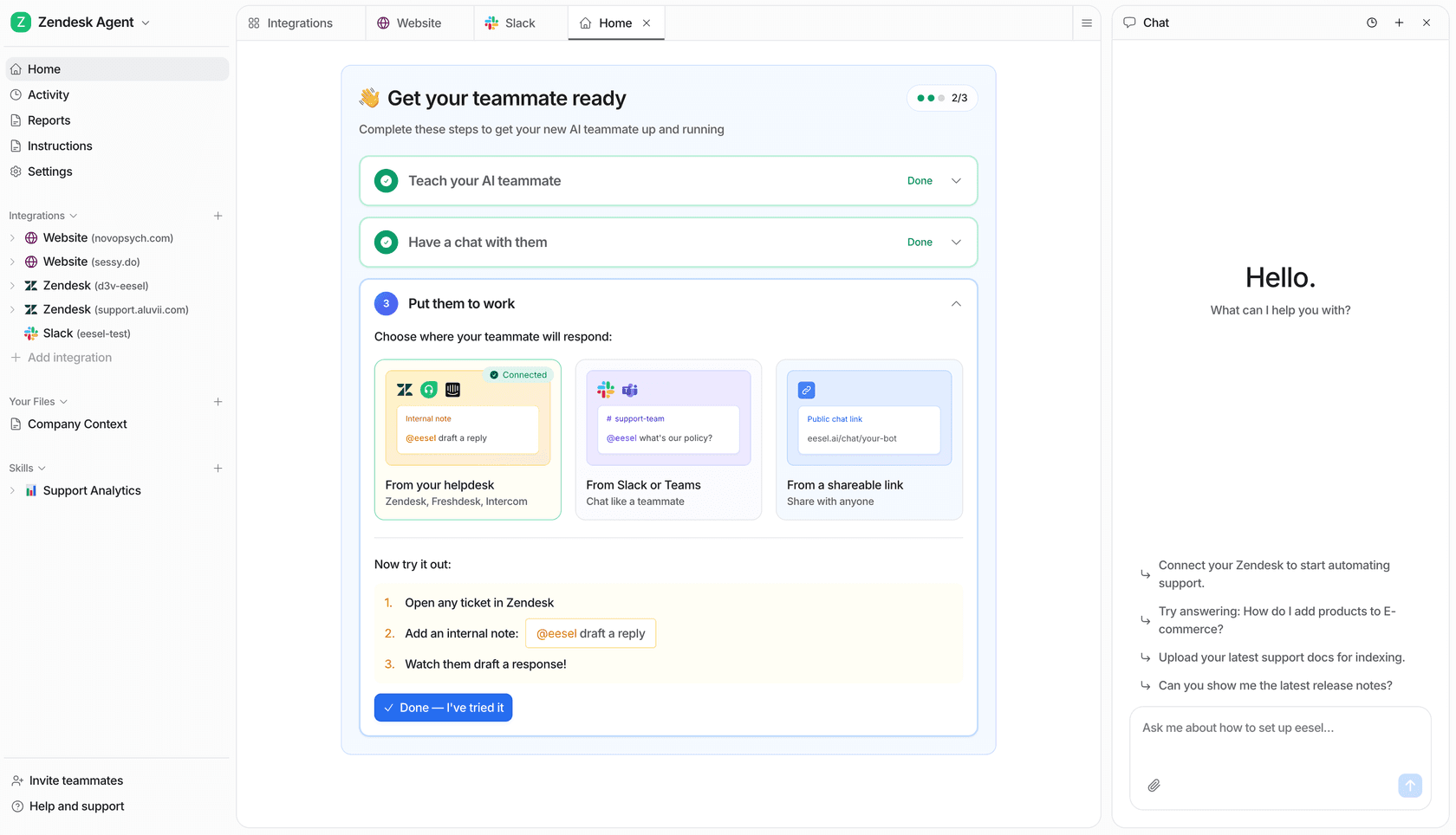
Most AI support tools are "black boxes" that you turn on and hope for the best. We take a different approach. You don't configure eesel AI, you hire it. Like any new team member, our agent learns your business context, tone, and policies in minutes by reading your past tickets, help center articles, and internal docs.
Here is why teams are choosing to layer eesel AI on top of their existing help desks:
- Resolves 81% of tickets autonomously: our mature deployments achieve resolution rates that simple assistants cannot match. We handle the full frontline support, from reading the ticket to sending the final resolution.
- Hire, don't configure: there are no rigid decision trees or complex configuration screens. You give us instructions in plain English, just as you would with a human hire.
- Grounded in your knowledge: we do not give generic AI answers. Every response is based on your actual data, ensuring high accuracy and brand consistency.
- Intelligent escalation: you define exactly when eesel should pull in a human. Whether it is a billing dispute or a VIP customer, we know when to hand off the conversation.
Whether you use Help Scout or Hiver, eesel AI can join your team as a first responder. We handle the repetitive FAQs and simple tasks, freeing up your human agents to focus on the complex, high-value conversations that actually require a person's touch. Our security standards ensure your data is isolated and protected, giving you peace of mind as you scale your operations.
Verdict: Who should choose what in 2026?
The choice between Help Scout and Hiver ultimately depends on your team's workflow and your plans for growth in 2026.
You should choose Hiver if:
- Your team already lives in Google Workspace and you want the lowest possible learning curve.
- Internal collaboration across different departments is your primary priority.
- You need native SLA tracking and basic AI assistance without leaving your inbox.
You should choose Help Scout if:
- You want a standalone, robust knowledge base that serves as a foundation for self-service.
- You prefer a dedicated support interface that keeps customer conversations separate from your personal email.
- You prioritize a "non-ticket" feel for your customers and want a highly-rated live chat widget (Beacon).
You should choose eesel AI if:
- You want to move beyond just managing your inbox and start automating your frontline support.
- You want a solution that resolves tickets autonomously instead of just drafting replies for review.
- You want a teammate that works 24/7 across 80+ languages and integrates seamlessly with whichever help desk you choose.
Start automating your customer support today
Customer support in 2026 is no longer about how many tickets you can manage; it is about how many you can resolve without adding more headcount. Help Scout and Hiver are both world-class tools for organizing your support, but adding an autonomous teammate like eesel AI is the key to truly scaling your operations.
If you are tired of your team being overwhelmed by repetitive questions, it is time to hire eesel AI. You can start with our AI Helpdesk Agent for review only, and level up to full autonomy as you gain confidence.
Ready to see the difference? See eesel AI in action with a free trial today. We also have an AI Content Writer if you're looking to scale your blog content alongside your support.