A guide to ServiceNow AI integration: Features, limitations, and a smarter alternative

Kenneth Pangan

Stanley Nicholas
Last edited October 21, 2025

Let's be honest, AI in IT and customer support has moved past the buzzword phase. It's now a fundamental part of keeping up with customer expectations and helping your team scale without burning out. In the world of enterprise tools, ServiceNow is a heavyweight, and they’re betting big on their own native AI to stay on top.
But what does a ServiceNow AI integration actually look like day-to-day? If you’re thinking about it, you need a clear-eyed view of what you’re signing up for: its strengths, its real-world limitations, and whether its "all-in-one" approach is the right move for your business.
The good news is, you don't have to rip and replace your setup to get top-tier AI. There's a much more flexible way to bring smart, helpful AI to your ServiceNow instance, and we’re here to walk you through it.
What is ServiceNow AI?
ServiceNow AI isn't some third-party app you bolt on; it's a set of tools built directly into the platform. This is a core part of their "one platform" philosophy, designed to feel like a natural extension of the ServiceNow environment your team already knows.
Here are the main pieces you’ll be working with:
-
Now Assist: Think of this as their generative AI assistant. It can help summarize complicated cases, give developers a hand with generating code, and pull up smarter, more direct answers in search.
-
AI Agents: These are the autonomous tools built to handle tasks without a person stepping in. They can reason through problems, take action based on data, and manage workflows across different departments like IT, HR, and customer service.
-
Predictive Intelligence: This is the machine learning engine running in the background. It takes care of jobs like automatically categorizing tickets, spotting patterns between incidents to flag bigger problems, and grouping data to show you trends you might have missed.
ServiceNow calls its grand strategy "agentic AI." The idea is to create AI that can solve complex, multi-step problems on its own by coordinating actions, but here's the key part, within the ServiceNow ecosystem. That sounds impressive, but as we’ll see, that last bit is where the trouble can start.
The native integration approach: Helpful but restrictive
ServiceNow’s biggest selling point for its AI is that it’s "built-in, not bolted on." The theory is that since the AI is native, it connects perfectly with ServiceNow's data and workflows right out of the box.
The upside of a unified platform
There are some real benefits here. When everything is under one roof, data flows smoothly between different modules, like ITSM and HR. Managing it all is also simpler in theory because you're using a single control panel they call the "AI Control Tower." If your company has gone all-in on ServiceNow for absolutely every operational need, this unified system can be pretty effective.
The downside of a closed ecosystem
But here's the catch: that deep integration often means sacrificing flexibility and simplicity. While the AI is "built-in," getting it to do what you need usually requires specialized ServiceNow developers and a long, drawn-out implementation process. It’s a long way from a plug-and-play tool you can get running on your own.
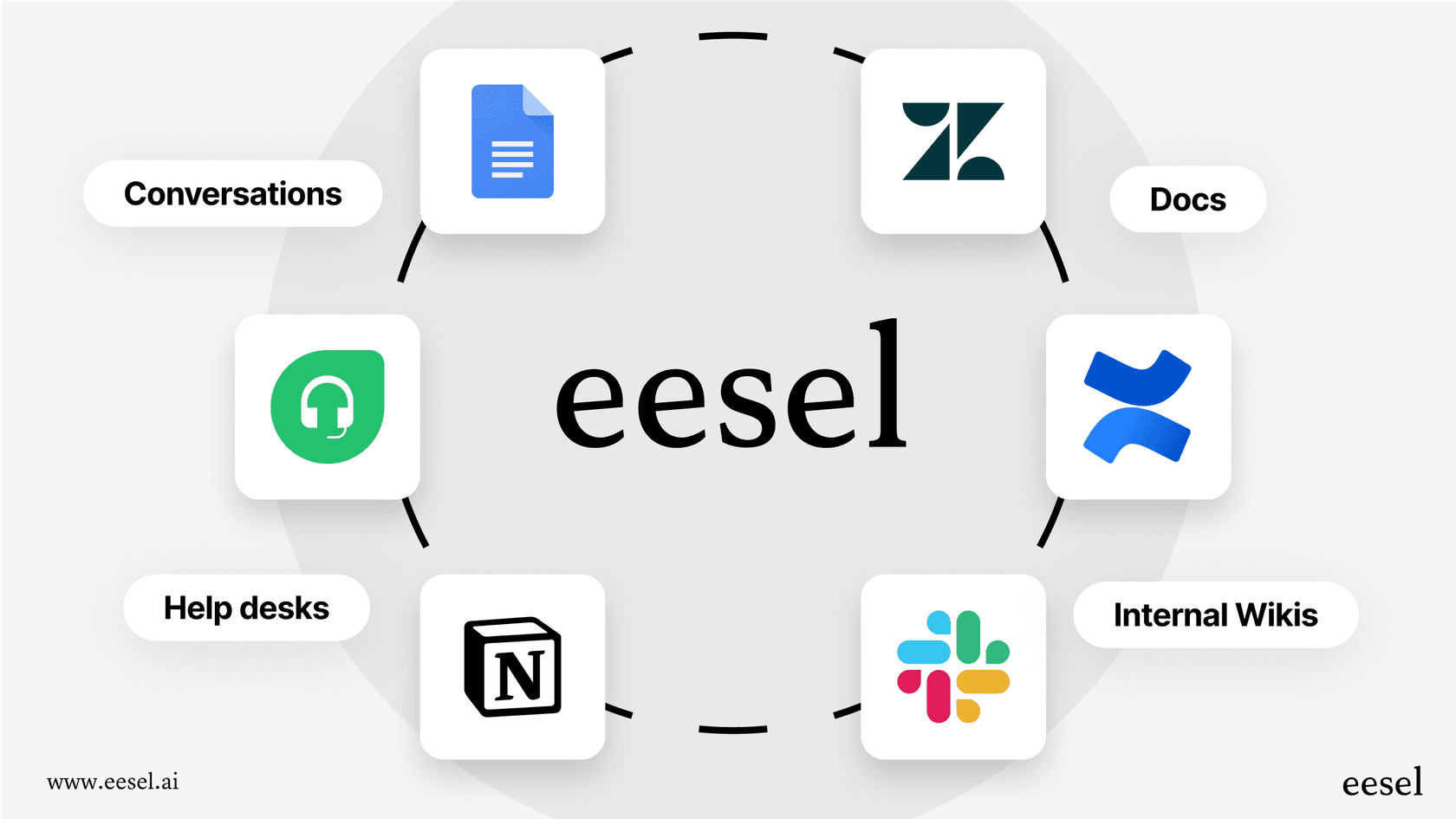
And while a single platform is a nice idea, most modern teams use a mix of tools they consider best for the job. Your most valuable, current knowledge probably isn't all sitting neatly in ServiceNow. What happens when the answer to a critical IT ticket is buried in a Slack thread, a Confluence page, or a Google Doc? The native AI has no idea it even exists.
This is where a different kind of tool makes more sense. Something like eesel AI is designed to be completely self-serve. Instead of spending months on configuration, you can connect your helpdesk and be up and running in minutes. It’s built to work with your entire knowledge ecosystem, not just one piece of it.
Key use cases for ServiceNow AI
So, what can you actually do with ServiceNow's AI? Here are a few of the most common uses, along with a look at where a native-only tool might leave you stuck.
Automating ticket routing and classification
ServiceNow’s predictive intelligence can look at incoming tickets and automatically send them to the right team. It reads the content to assign a category, priority, and assignment group, which helps keep things organized and gets issues in front of the right people faster.
The Limitation: This works, but only as long as all the context needed to understand the ticket is already inside ServiceNow. If a user drops a project name that’s only defined in a Confluence doc or refers to a chat from a private Slack channel, the AI is flying blind. This can lead to misrouted tickets and frustrating delays. eesel AI gets around this by connecting to all your knowledge sources, making sure triage is based on the full story, not just a single chapter.
Generating summaries and knowledge base articles
Now Assist is pretty good at creating short summaries of long incident threads, which can save agents a ton of reading time when they're handed an escalated ticket. It can also help draft knowledge base (KB) articles from resolved tickets, which helps you build out your self-service options.
The Limitation: The AI mostly learns from data that’s already in ServiceNow. But what if your team's best troubleshooting guides are in shared Google Docs, or the most effective solutions are found by digging through thousands of past support conversations? The AI Agent from eesel AI is built to train on your historical support tickets and connect to external knowledge sources like Confluence and Google Docs. This way, the AI learns from your team’s actual, proven solutions, wherever they happen to be. It can also automatically draft new, helpful KB articles based on those resolutions.
Enhancing self-service with virtual agents
ServiceNow has a Virtual Agent that can handle common questions 24/7, freeing up your human agents for more interesting work. It’s a decent tool for deflecting simple stuff like password resets or "what's the status of my ticket?" inquiries.
The Limitation: Building the conversational flows for these bots can be a surprisingly rigid and complicated process. Even worse, if the answer to a user's question isn’t in the official ServiceNow KB, the chat often just hits a wall, which is a bad experience for everyone. With the AI Chatbot from eesel AI, you can build a much smarter and more flexible chatbot that's trained on everything you’ve got: help center articles, technical docs, past tickets, and even your Shopify product catalog. Best of all, it’s all managed through a simple interface that anyone on your team can use.

Why a native-only ServiceNow AI integration can hold you back
Sticking only with ServiceNow's built-in AI might seem convenient at first, but it comes with some serious drawbacks that can slow your team down.
The problem of scattered knowledge
The biggest headache is that most companies' knowledge isn't in one place. It’s spread out across wikis like Confluence or Notion, collaborative documents in Google Docs or SharePoint, and countless conversations in Slack or Microsoft Teams.
A native ServiceNow AI integration is stuck inside its own world. It can't get to that other information, which means its answers will often be incomplete. This leads to more "I don't know" replies from your chatbot and more escalations for problems your team has already figured out somewhere else.
The risk of deploying AI without proper testing
When you're working with a platform this big, you can't just flip a switch on AI and hope for the best. Yet, many large platforms don't have simple, effective ways for non-technical folks to test how an AI will behave before it starts talking to customers or employees.
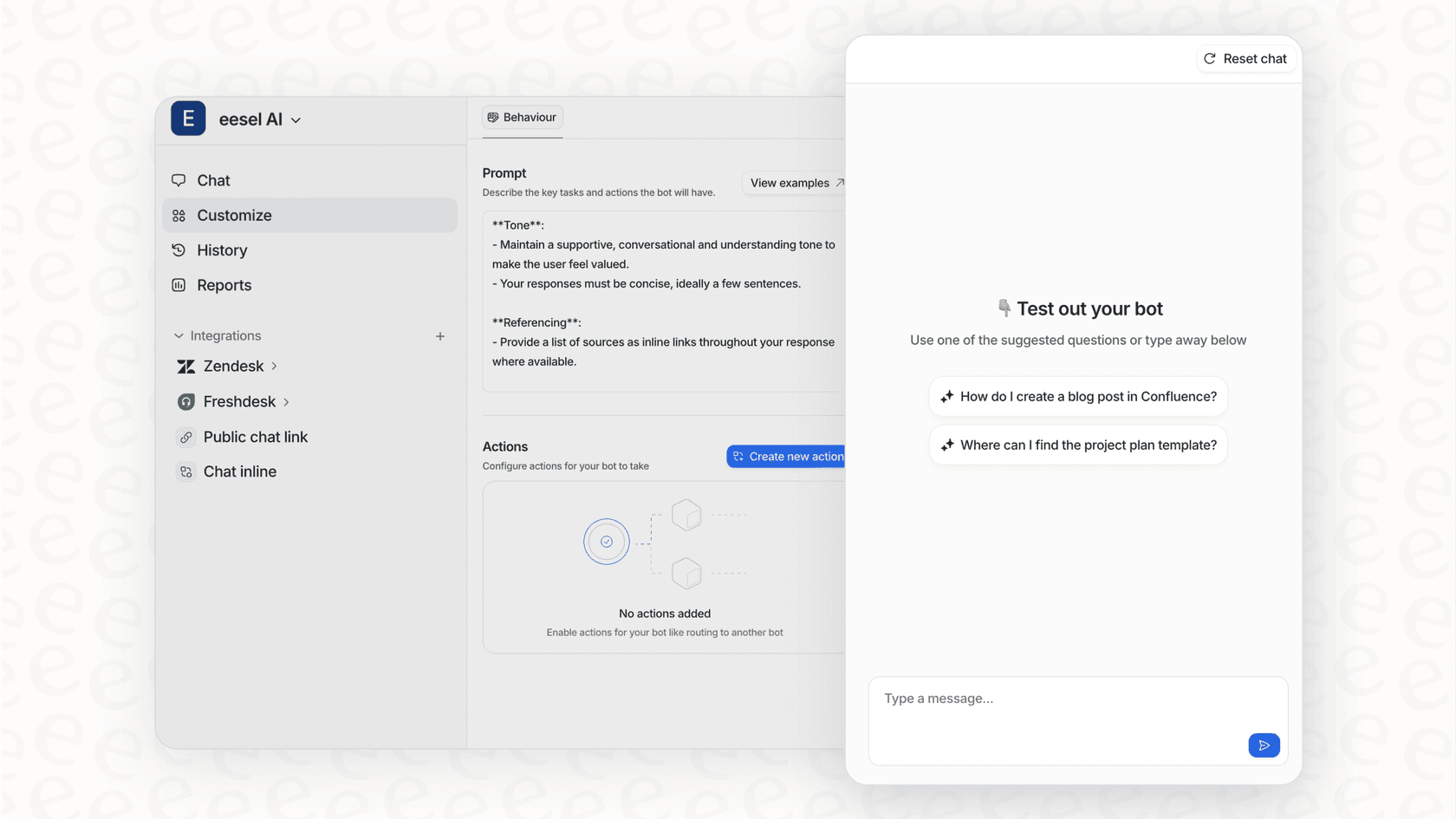
This is a big focus for eesel AI. It includes a simulation mode that lets you test your setup on thousands of your own past tickets in a safe environment. You can see exactly how it would have responded, get solid forecasts on resolution rates, and find gaps in your knowledge base before you go live. It’s a risk-free way to build confidence and make sure your AI is genuinely ready to help.
What does a ServiceNow AI integration cost?
This is where things get frustratingly vague. ServiceNow doesn't publish its AI pricing online. In fact, if you try to find their pricing page, you’ll often just get an error. Pricing is handled through custom quotes, usually bundled into a much larger and more complicated enterprise contract.
This way of doing things creates a few problems:
-
No transparency: You can't budget properly without getting into a long sales process.
-
Unpredictable costs: The pricing is often bundled in a way that makes it hard to see what you're really paying for or how costs will change as your company grows.
-
Vendor lock-in: Expensive, long-term contracts can make it really hard to adapt or switch tools if your needs change down the road.
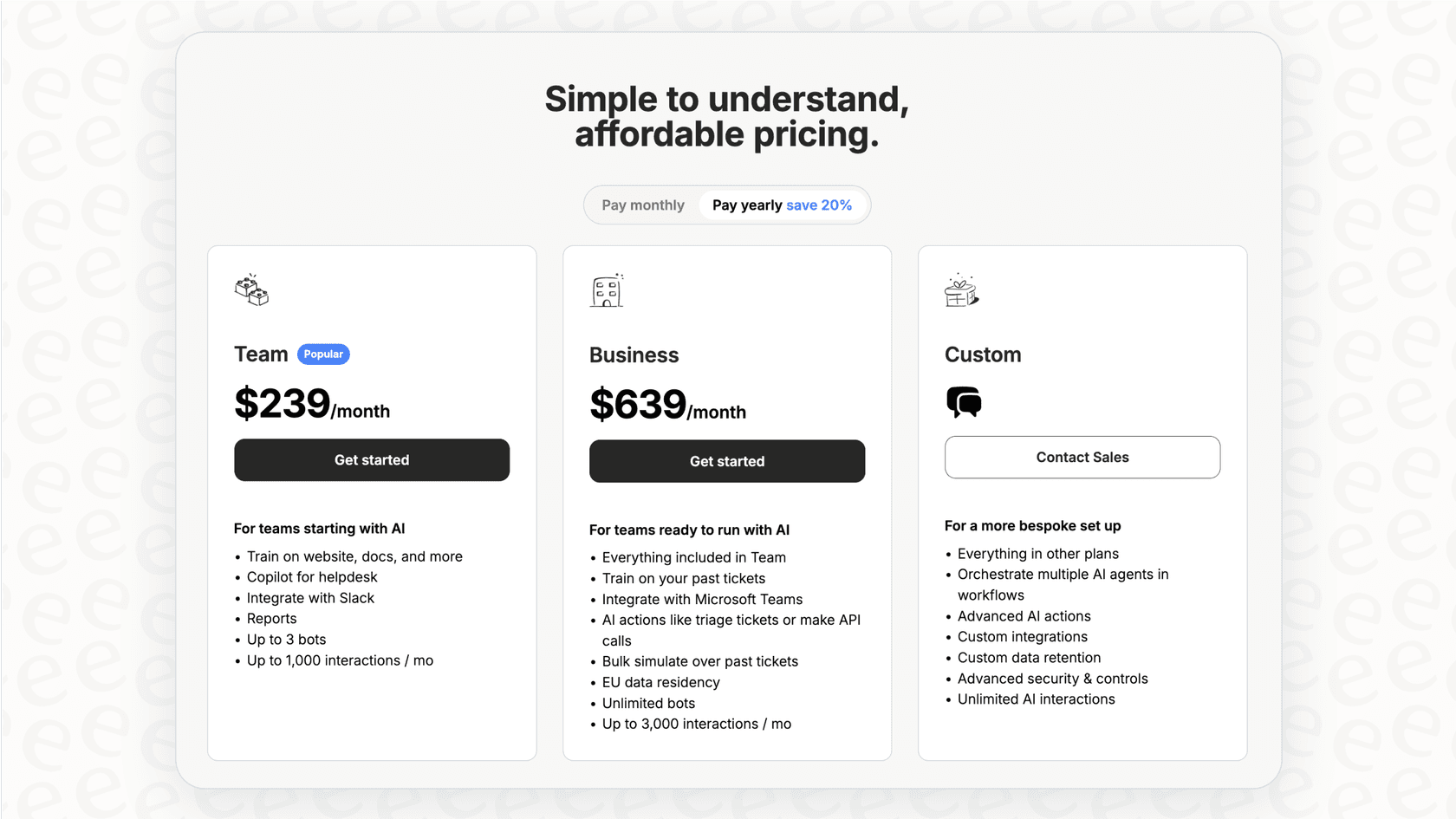
This is a world away from eesel AI's transparent pricing. With eesel AI, there are no secrets. Our prices are right there on our website, based on a predictable number of monthly interactions. We don’t use confusing per-resolution fees that penalize you for doing well. You can even start with a flexible monthly plan and cancel anytime, giving you complete control.
The better way: Enhance ServiceNow with a flexible AI layer
You shouldn't have to choose between keeping your core ITSM platform and using best-in-class AI. The smarter path is to enhance what you already have.
eesel AI works as a flexible, intelligent layer that plugs right into your ServiceNow instance. It’s designed to improve your workflows, not force you to rebuild them. With eesel AI, you can:
-
Go live in minutes with a simple, one-click connection.
-
Unify all your knowledge, not just what's stuck inside ServiceNow.
-
Test with confidence using safe, powerful simulations on your own data.
-
Get full control over automation rules, the AI’s persona, and when to escalate to a human.
-
Enjoy transparent, predictable pricing that scales with you.
Stop replacing, start enhancing your ServiceNow AI integration
A native ServiceNow AI integration offers some deep capabilities, but it often comes with a steep cost in complexity, rigidity, and a lack of clear pricing. It asks you to work within a closed system, cutting you off from the valuable knowledge that lives in your other tools.
The modern, more effective way forward isn't about ripping out your core systems. It’s about adding smart, agile tools on top that respect your existing workflows and unlock the full power of your team's collective brainpower. By adding a flexible AI layer, you can get more value from your ServiceNow investment and deliver the fast, accurate support your users deserve.
Ready to see what your ServiceNow instance can really do? Try eesel AI for free and connect your knowledge sources in minutes, or book a quick demo to see our simulation mode in action.

Frequently asked questions
A native ServiceNow AI integration primarily offers Now Assist for generative AI tasks, AI Agents for autonomous workflows, and Predictive Intelligence for machine learning functions like ticket classification and trend spotting. These tools are built directly into the ServiceNow platform to extend its capabilities.
The main benefit of a native ServiceNow AI integration is its tight connection with ServiceNow's existing data and workflows, simplifying data flow between modules like ITSM and HR. This unified system can be particularly effective if your company is fully invested in ServiceNow for all operational needs.
A native ServiceNow AI integration is typically [limited to knowledge residing](https://www.servicenow.com/docs/bundle/zurich-platform-administration/page/administer/managing-data/concept/integrations.html) within the ServiceNow ecosystem. It often cannot access valuable information stored in external platforms like Confluence, Google Docs, or Slack, which can lead to incomplete answers and potential misrouting of tickets.
ServiceNow AI integration pricing is generally not publicly available and is handled through custom quotes, often bundled into larger enterprise contracts. This can lead to a lack of transparency, unpredictable costs, and potential vendor lock-in.
A ServiceNow AI integration can enhance self-service through Virtual Agents, handling common inquiries like password resets. However, building conversational flows can be complex, and the bot often hits a wall if the answer isn't in the official ServiceNow knowledge base.
Deploying a ServiceNow AI integration can be challenging to test properly for non-technical users before going live. Many large platforms lack simple, effective ways to simulate AI behavior on past data, which can lead to unforeseen issues once deployed.
A [flexible AI layer](https://eesel.ai/solution/ai-for-it-operations) enhances an existing ServiceNow AI integration by unifying knowledge from *all* your sources (ServiceNow and external), enabling quicker go-live times, and offering transparent pricing. It works as an intelligent overlay to improve workflows without requiring a full system overhaul.
Share this article

Article by
Kenneth Pangan
Writer and marketer for over ten years, Kenneth Pangan splits his time between history, politics, and art with plenty of interruptions from his dogs demanding attention.
