It feels like you can't go a week without hearing about a new AI announcement from Salesforce. They're clearly all-in, positioning their AI research division as the brains behind the future of CRM. With a steady stream of news about Einstein, Copilots, and their new Agentforce platform, the message is loud and clear: they're betting big on AI.
But let’s be real. While the headlines are flashy, it’s easy to get lost in the buzz and wonder what any of it actually means for your team. How do these huge, enterprise-level tools really help you when you're just trying to manage the day-to-day of a support or service team?
This guide is here to give you a straightforward, practical review of Salesforce AI Research. We'll unpack the key developments, see what the tech can do, and explore how it compares to some of the more nimble and accessible AI solutions out there today.
What is Salesforce AI Research?
In a nutshell, Salesforce AI Research is the company's R&D department, responsible for cooking up new AI tech and plugging it into the sprawling Salesforce Customer 360 platform. Led by people like EVP and Chief Scientist Silvio Savarese, their job is to build advanced AI that tackles real-world business headaches.
This isn't just theory, either. While the team publishes academic papers and contributes to open-source projects, their main focus is to directly improve Salesforce products. Their research is concentrated on some seriously advanced areas, including:
-
Large Action Models (LAMs): This is AI that doesn't just talk, it does things. It can understand a request and then perform a series of steps inside a software application to get it done.
-
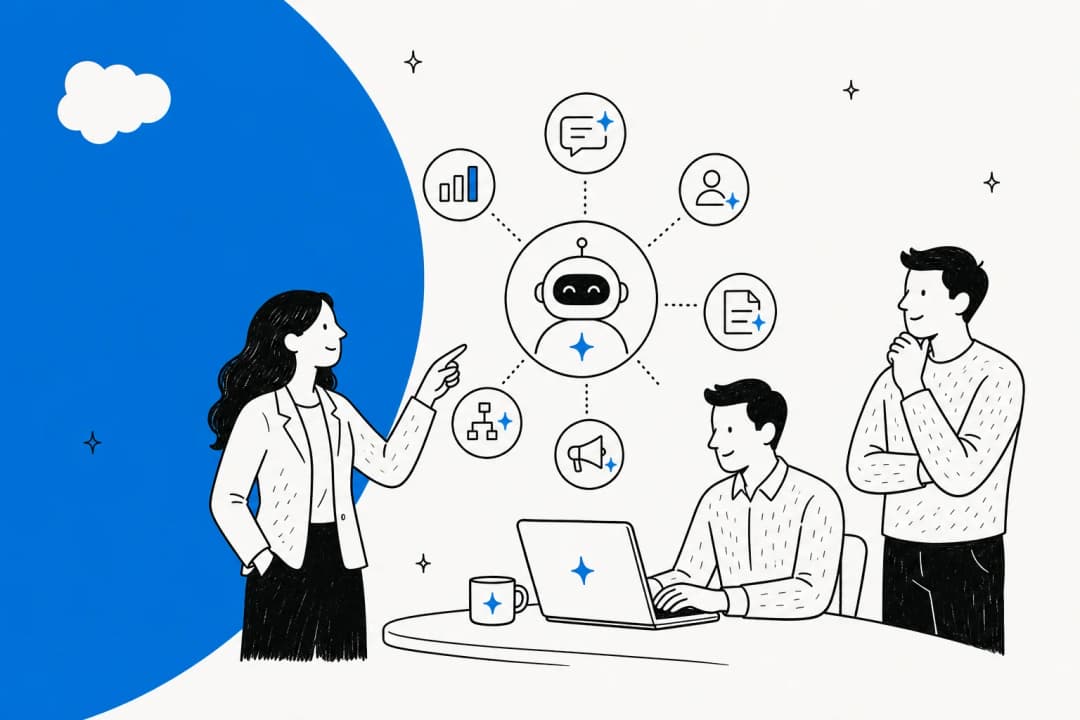
Multi-Agent Frameworks: Think of this as a team of specialized AI bots working together. They can collaborate on complex jobs like sorting service tickets or putting together a sales forecast.
-
Code Generation: AI that gives developers a hand by writing or suggesting code snippets.
-
Data Synthesis: This involves creating realistic but fake data, which is super useful for training and testing AI models without touching sensitive customer information.
-
Retrieval-Augmented Generation (RAG): A fancy term for a technique that helps AI base its answers on facts from a specific knowledge base, preventing it from making things up.
The end goal here is to help companies become an "agentic enterprise", a business where autonomous AI agents take care of the routine stuff, freeing up humans to focus on work that requires a human touch.
The evolution of Salesforce AI
Salesforce didn't just jump on the AI bandwagon yesterday. Their journey has been unfolding for nearly a decade, moving from basic predictions to the fully autonomous agents we're seeing today. Knowing the timeline helps make sense of their current strategy.
2016: Einstein brings predictive AI to CRM
Salesforce's AI story really kicked off back in 2016 with Salesforce Einstein. The idea was to make CRM "smarter" by embedding predictive features into their sales, service, and marketing tools.
This first version was all about analyzing your existing Salesforce data to give you helpful nudges. Think of Predictive Lead Scoring, which helped sales reps figure out which leads to call first, or Recommended Case Classification, which automatically routed support tickets. It was impressive for its time, but it was mostly about predicting outcomes, not creating new content or taking action on its own.
2023: Einstein GPT introduces generative AI
Things really heated up in 2023 with the launch of Einstein GPT. This was Salesforce’s big leap into generative AI, mixing their own models with tech from partners like OpenAI.
All of a sudden, Salesforce could create things, not just predict them. Einstein GPT was built to generate personalized content at scale, whether it was drafting a sales email, writing a reply for a service agent, or whipping up some marketing copy. The clever part was that it used a company’s real-time customer data from the Salesforce Data Cloud to make sure everything it generated was relevant and context-aware.
The next generation: Einstein Copilot and Agentforce
Building on that generative foundation, Salesforce didn't waste any time rolling out its next set of tools. Einstein Copilot arrived as a conversational AI assistant that lives inside every Salesforce app. Instead of just clicking buttons, users could now chat with their CRM, asking it to summarize calls, prep for meetings, or draft a contract. With Einstein Copilot Studio, businesses could even teach the assistant new tricks with custom skills and prompts.
This all leads up to the announcement of Agentforce 360, the big platform designed to manage all these AI agents across a company. Agentforce is the piece that brings the "agentic enterprise" vision to life, creating a system where AI can handle complex business processes on its own.
The catch: It's a closed ecosystem
As you can see, this whole evolution is built on one thing: the Salesforce platform. Every single tool, from the original Einstein to the newest AI agents, is designed to live and breathe inside the Salesforce world, pulling data only from the Salesforce Data Cloud.
This is great if your entire company is already running on Salesforce. But it's a huge hurdle for everyone else. If your team uses popular help desks like Zendesk, Freshdesk, or [REDACTED], getting Salesforce's AI would mean migrating your entire tech stack, which is often a massive, painful process. In contrast, tools like eesel AI are built to plug right into the software you already use, giving you powerful AI features in minutes without making your team ditch their favorite tools.

What's under the hood?
To really get what Salesforce AI means for your business, it helps to peek at the key components that make it all work.
A core tenet: It's all based on the Salesforce Data Cloud
The foundation of Salesforce's entire AI strategy is the Salesforce Data Cloud. Every AI-powered response, suggestion, or action is rooted in the customer data stored there. This is how Salesforce makes sure its AI gives you relevant, accurate answers instead of generic ones.
To handle the obvious security questions, they also built the Einstein Trust Layer. This is essentially a security blanket for your data. It adds features like zero-data retention (so third-party AI models don't store your info) and automatically masks personally identifiable information (PII) to keep customer data private.
Going beyond text with action models and AI teams
Salesforce Research is looking past standard Large Language Models (LLMs), which are mostly good at reading and writing text. They're investing heavily in Large Action Models (LAMs), a type of AI built to understand a request and then actually perform a series of actions in an app to complete it.
This is where their multi-agent frameworks come into play. They allow different specialized AI agents to work together on a single complex job. For example, you could have one agent pull sales data, another analyze it for trends, and a third draft a forecast report based on the findings. To make sure this stuff actually works, Salesforce even built its own test, SCUBA, to see how well AI agents can handle real CRM tasks in a simulated Salesforce environment.
Using top-tier AI models (with a catch)
Salesforce isn't trying to build every single AI model themselves. They've made smart partnerships with top AI labs like OpenAI and Anthropic. This lets them bring powerful models like GPT-5 and Claude directly into their Agentforce platform.
This gives customers access to some of the best AI tech out there, but there's a catch. Everything happens inside the secure but closed-off world of the Einstein Trust Layer and has to be configured with Salesforce's own tools. For teams that want more direct control over what their AI knows without being locked into a single vendor, eesel AI offers a much more flexible approach. It lets you instantly connect knowledge from dozens of sources your team already uses, like Confluence, Google Docs, and past support tickets, giving you full say over your AI's brain.
The practical reality for your business
Salesforce has a big, impressive vision for AI, but is it the right choice for every business? For many companies, especially those not already living and breathing Salesforce, the real-world costs, setup time, and complexity can be major roadblocks.
The real talk on cost and setup
Getting started with Salesforce AI isn't as easy as flipping a switch. Many of the advanced Einstein features aren't part of the standard packages; they're expensive add-ons that are often bundled into the highest-tier enterprise plans.
The setup is a huge project, too. It requires a deep integration with your Salesforce setup and a ton of configuration using tools like Einstein Copilot Studio. This is not a self-serve, plug-and-play solution. It’s an enterprise-level project that requires special expertise, a lot of time, and a serious budget.
The downside: Getting locked in
The biggest trade-off with Salesforce AI is its all-or-nothing approach. All of its power comes from being deeply tied to the Salesforce Data Cloud. If you’re a die-hard Salesforce customer, that integration is a massive plus. But for everyone else, it creates serious vendor lock-in, making it incredibly hard to use other great tools in your workflow.
Even Salesforce's own research on the "AI Divide" showed that many people are hesitant to adopt AI because they're worried about complexity and security. The heavy, enterprise-first nature of Salesforce's AI can feel overwhelming and out of reach for small to mid-sized businesses that need to be nimble.
A more accessible path to AI automation
For teams that want the benefits of support automation without the enterprise-sized headache, there’s a more practical option. eesel AI's AI Agent is designed from day one to be both powerful and easy to use, fitting right in with the tools you already have.
The difference in philosophy is pretty clear when you put them side-by-side:
| Feature | Salesforce AI (Einstein/Agentforce) | eesel AI |
|---|---|---|
| Setup Time | Months of deep platform integration | Up and running in minutes |
| Core Requirement | Full commitment to the Salesforce ecosystem | Works with your existing help desk (Zendesk, etc.) |
| Knowledge Sources | Mostly the Salesforce Data Cloud | 100+ integrations (Confluence, Docs, past tickets) |
| Pricing Model | Complex, often tied to expensive enterprise plans | Transparent and predictable, no per-resolution fees |
| Testing | Simulated environments (CRMArena-Pro) | Powerful simulation on your own past tickets |
| Ideal User | Large enterprises fully invested in Salesforce | Teams of any size looking for fast, flexible AI |
With eesel AI, you can be live in minutes, not months. You can safely test your AI on thousands of your actual past tickets to see exactly how it will perform before it ever talks to a customer. And you get simple, predictable pricing without being strong-armed into a massive platform migration. It's AI automation built for the rest of us.
A powerful vision with serious trade-offs
Look, there's no denying it: Salesforce AI Research is building something huge. They are creating a deeply integrated and powerful platform that could deliver on the promise of an AI-driven business. For giant companies already running their entire operation on Salesforce, it's a compelling and logical next step.
However, all that power comes with a price, and not just a financial one. You’re looking at serious complexity, high costs, and being locked into one vendor's world. For the majority of businesses that need to stay agile and use a mix of different tools, Salesforce's walled-garden approach just isn't practical. For these teams, platform-agnostic solutions offer a much faster, more flexible, and more affordable way to get started with automation.
Get started with AI automation today
You don't need to wait for a massive platform migration to start automating your support. With eesel AI, you can launch a powerful AI agent that learns from your data and works with your existing help desk in a matter of minutes.
Frequently asked questions
Salesforce AI Research is the company's R&D department focused on developing advanced AI technologies and integrating them into the Salesforce Customer 360 platform. Their goal is to tackle real-world business challenges and help companies become an "agentic enterprise" where AI handles routine tasks.
Salesforce's AI journey began in 2016 with predictive Einstein features, advanced to generative AI with Einstein GPT in 2023, and now includes conversational assistants like Einstein Copilot and multi-agent platforms such as Agentforce 360. This timeline shows a progression from mere predictions to autonomous AI actions.
The core of Salesforce's AI strategy is the Salesforce Data Cloud, ensuring data relevance. Key technologies include Large Action Models (LAMs) for performing tasks, multi-agent frameworks for AI collaboration, and the Einstein Trust Layer for robust data security and privacy.
A significant challenge is the closed ecosystem, leading to vendor lock-in because all tools are tied exclusively to the Salesforce platform. Additionally, implementation often entails substantial costs, complex setup procedures, and requires deep integration, making it less practical for companies not fully committed to Salesforce.
Salesforce AI research in review is most suitable for large enterprises that are already heavily invested in and operating entirely within the Salesforce ecosystem. These organizations are best positioned to leverage its comprehensive power and manage the required extensive setup and budget.
Salesforce AI research in review operates within a proprietary ecosystem, demanding full commitment to the Salesforce platform and Data Cloud. In contrast, more platform-agnostic solutions integrate quickly with a wide range of existing tools and knowledge sources, offering greater flexibility and faster deployment without vendor lock-in.
Share this post

Article by
Stevia Putri
Stevia Putri is a marketing generalist at eesel AI, where she helps turn powerful AI tools into stories that resonate. She’s driven by curiosity, clarity, and the human side of technology.