
Let's be honest, picking a project management tool can feel like a second job. The market is an absolute jungle of options, and just when you think you've got it figured out, a new wave of AI-powered platforms shows up promising to fix everything. It's a tough spot to be in: do you stick with an industry giant or take a chance on a newer, AI-first solution?
That’s the exact question we’re looking at with Kroolo vs Jira. In one corner, you have Jira, the long-reigning champ for software teams, backed by the massive Atlassian ecosystem. In the other, you have Kroolo, a new contender that calls itself an all-in-one Enterprise AI Platform, designed to cut down on the number of tools you’re juggling every day.
This guide will break down the Kroolo vs Jira debate, piece by piece. We’ll dig into their core features, what their AI can actually do, how they connect with other tools, and what they’ll cost you. The goal is to give you a clear, straightforward comparison to help you figure out which tool is the right fit for your team in 2026.
What is Kroolo?
Kroolo is a unified work platform built to fix the mess of having too many apps. Instead of bouncing between your project tracker, a chat app, and your goal-setting software, Kroolo aims to bring it all together in one place.
At its heart, it’s a mix of three main things: Work Management (for projects and tasks), AI Agents, and Enterprise Search. The whole idea is to cut down on the context-switching that drains so much of our time. Kroolo’s approach is AI-native, which means artificial intelligence is baked right in, not just bolted on as an afterthought. You can create entire project plans with a single AI prompt, get quick summaries of complicated tasks, and use ready-made AI agents for specific jobs like marketing or HR. It’s really built for teams who want a newer way to manage their work.
What is Jira?
If you’ve been in the tech world for more than five minutes, you’ve probably heard of Jira. It’s one of the most powerful and well-known project tracking platforms out there. Made by Atlassian, it has become the go-to tool for software development teams, especially those using agile methods. Its biggest selling point is its incredible flexibility and maturity. You can build complex workflows that match your team’s exact processes, from the first spark of an idea to the final product release.
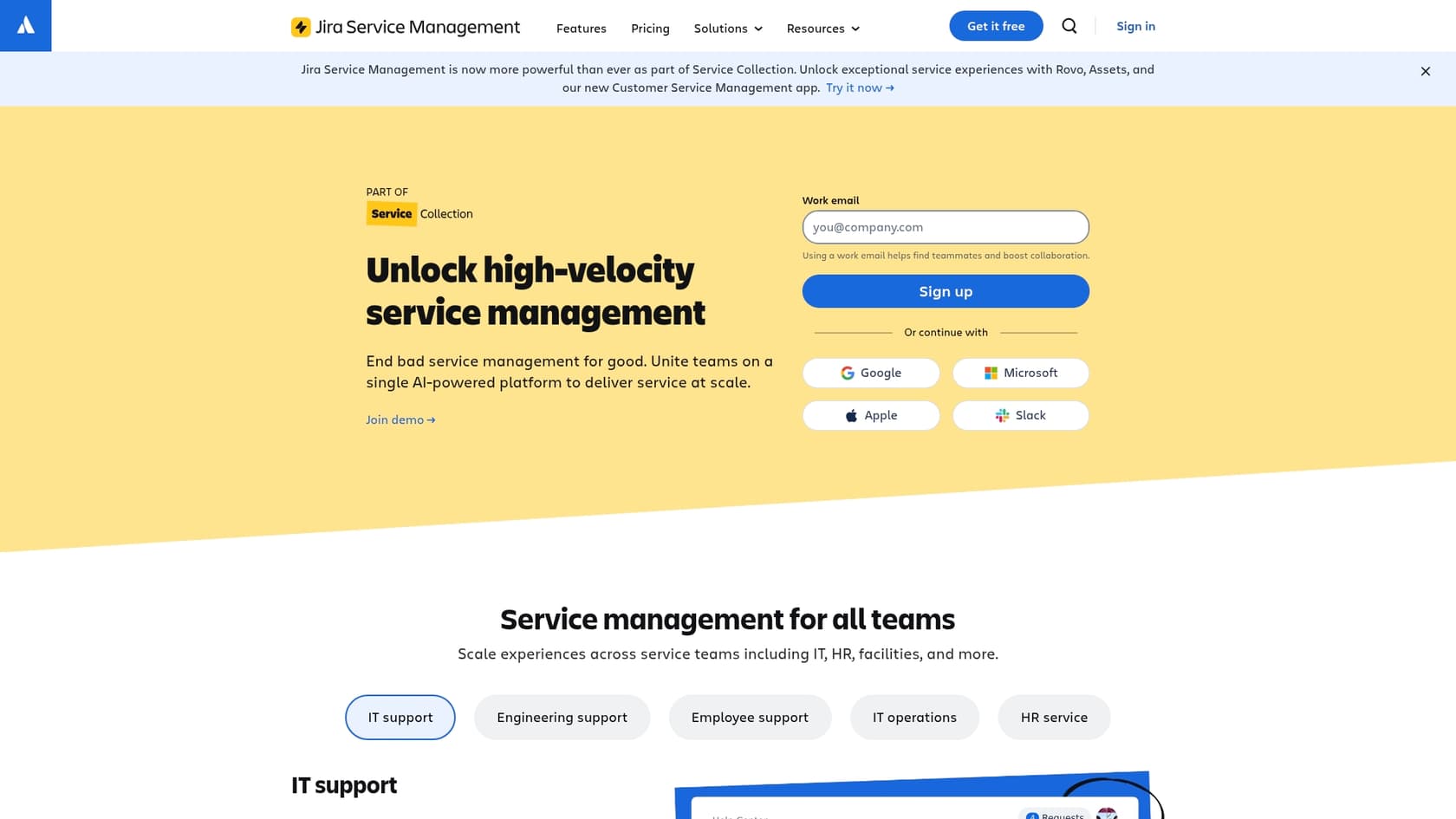
While it started with developers in mind, Atlassian has since expanded the Jira family into an impressive ecosystem. Jira Software is the classic tool for managing sprints and backlogs. Jira Service Management turns it into a full-blown IT service desk, complete with a customer-facing help portal for logging support tickets. Recently, Atlassian has been weaving in its own AI, called Rovo, across its products. Rovo works like a smart assistant, helping you search for info across different Atlassian tools, get quick answers, and generally smooth out your workday.
Core features compared
While both tools help you get work done, they come at it from different angles. Let's see how they stack up in the areas that matter most.
Project and task management
Jira’s whole philosophy around project management is about structure, reliability, and control. It’s built on workflows you can tweak down to the last detail, with custom statuses and rules for every step. For a team that lives and breathes process, it’s fantastic. You can map out every single stage a task goes through and make sure nothing slips through the cracks. When you combine that with its boards, timelines, and backlog views, it's a perfect fit for managing the nitty-gritty of software development.
While Jira offers a deep set of features that provide immense power, it is a professional-grade tool that rewards teams who invest time in setup. Its comprehensive nature ensures that it can scale with the most complex enterprise requirements. It’s incredibly powerful, and that capability is what makes it a trusted choice for thousands of companies worldwide.
Kroolo, on the other hand, is focused on a faster, AI-powered experience. It has the familiar Kanban boards and timelines, but its feature is the ability to generate a complete project structure from a simple text prompt or by uploading a document. Instead of manually creating tasks and sub-tasks, you can tell the AI what you need and let it build a foundation for you. The AI can also give you on-demand project summaries and run automated stand-ups. This makes Kroolo an approachable option for teams that want to get moving quickly with AI-driven setup.
AI capabilities
Both platforms offer helpful AI features, but their focus is distinct.
Jira's AI comes from Atlassian Rovo, which is a broad AI assistant that works across the whole Atlassian suite. Its main job is to act as a helpful sidekick, making it easier to find information buried in Confluence or Jira, summarizing long comment threads on tickets, and helping you write issue descriptions. It’s a great layer on top of the tools you already use, making the entire ecosystem more intuitive.
Rovo is an excellent generalist designed to enhance team productivity across the Atlassian suite. For teams that need highly specialized or autonomous resolution of customer support tickets, Jira’s marketplace allows for the integration of dedicated AI tools that work alongside Rovo to handle those specific needs.
Kroolo's AI is focused on its internal environment. It uses a system of pre-built and custom AI agents that perform tasks inside the platform. For example, it can look at a task and automatically create a checklist of things to do, generate a project outline based on a goal, or flag potential risks. Kroolo's AI is great at automating work within Kroolo itself, serving as a smart brain for operations managed on the platform.
Collaboration and communication
In Jira, most collaboration happens right on the ticket, ensuring that all communication is tied directly to the relevant work. Teams leave comments, attach files, and @-mention each other to talk about specific tasks. For broader communication, Jira leans on its deep and reliable integrations with industry-leading chat tools like Slack and Microsoft Teams. This system ensures that your work tracking remains robust while you communicate through best-in-class messaging apps.
Kroolo tries to fix this by building team chat and channels directly into the platform. The idea is to create a single place for both work and conversation, so you’re not switching between your project board and your messaging app. This makes Kroolo feel like an all-in-one solution for teamwork.
Integrations and ecosystem
This is where you see one of the biggest differences between the two platforms.
Jira's superpower is the Atlassian Marketplace. It's a massive, mature app store with thousands of integrations that let you connect Jira to almost any tool imaginable, from GitHub and Figma to Salesforce and Zendesk. This allows companies to build a highly customized tech stack with Jira as the reliable center. If there’s a specific niche need your team has, Jira’s impressive ecosystem almost certainly has an app for it.
Kroolo has a different strategy. Its main integration focus is on importing data from other project management tools like Jira, Asana, and Trello. The goal here is to help teams pull all their scattered work into one place. While Kroolo is growing, its ecosystem is naturally smaller than Atlassian's. It's designed to be a destination for your work, while Jira serves as the market-leading hub connecting your entire stack.
The integration gap for support teams
While Jira's marketplace is huge, adding real AI automation to your support workflow usually requires a dedicated tool. For teams using Jira Service Management, you can give the platform a serious upgrade with specialized AI. For instance, eesel AI is a complementary option that plugs directly into your help desk to act as an AI support agent. It can resolve tickets, triage requests, and draft replies, working within the Jira ecosystem to make your setup even better.
Pricing plans
Both platforms have a few different plans, from free options for small teams to full-blown enterprise solutions. Here’s a quick look at how they compare in 2026.
Jira pricing
Jira charges per user, per month, with costs scaling based on the tiered plans designed to match different team sizes. These prices reflect paying for a full year upfront.
| Plan | Price (per user/month, annual) | Key Features |
|---|---|---|
| Free | $0 | Up to 10 users, 2 GB storage, basic project tracking. |
| Standard | $7.91 | Up to 100,000 users, 250 GB storage, user roles & permissions. |
| Premium | $14.54 | Unlimited storage, 99.9% uptime SLA, advanced planning (Plans). |
| Enterprise | Contact Sales (billed annually) | Multiple sites, Atlassian Analytics, 99.95% uptime SLA, centralized user subscriptions. |
Source: Jira's tiered pricing options, accurate as of 2026.
Kroolo pricing
Kroolo's Work Management product also has a per-user, per-month model, with tiers that give you more capacity and features.
| Plan | Price (per user/month) | Key Features |
|---|---|---|
| Starter | Free | Up to 5 members, 1 workspace, 5 projects, unlimited tasks. |
| Plus | $30 | Up to 20 members, 5 workspaces, 50 projects, 100 docs. |
| Business | $45 | Up to 500 members, unlimited workspaces, projects, and goals. |
Source: Kroolo Pricing, accurate as of 2026.
The verdict: Which platform is right for you?
So, after all that, which one should you go with? It really comes down to what your team needs and how you like to work.
Choose Jira if: You’re a software development or IT team that needs the gold standard for project management. It offers tight integrations with developer tools, workflows you can customize to your exact needs, and access to a giant marketplace of add-ons. It's the right call for companies that value a mature, trusted, and highly capable platform that can scale to any size.
Choose Kroolo if: You're looking for an all-in-one platform with AI at its center. It’s a good option for teams that want to explore a unified environment for chat and tasks, or those who want to use AI to generate project foundations from the get-go.
| Feature | Kroolo | Jira |
|---|---|---|
| Best For | All-in-one AI work management | Agile development & complex workflows |
| Learning Curve | Lower | Professional-grade (more to explore) |
| AI Focus | Task & project automation | Search & team-wide assistance |
| Ecosystem | Focused on data imports | Massive marketplace of thousands of apps |
| Collaboration | Built-in chat | Direct ticket comments & world-class chat integrations |
Beyond Kroolo vs Jira: Automating your service desk
Both Kroolo and Jira are great at helping you organize and track work. For teams using Jira Service Management, the platform serves as a powerful foundation for customer service. However, many teams find that they deal with repetitive requests that can be handled even more efficiently with automation.
Handling high volumes of tickets manually takes time. That’s where specialized AI can enhance your existing Jira setup.
eesel AI is a complementary tool built to solve this problem. It's not a replacement for Jira; it's a specialized add-on that plugs right in. eesel's AI Agent learns from your knowledge base to give instant answers to customer questions. Because it works within your existing help desk, like Jira Service Management, you get to keep the reliability of Jira while adding a layer of autonomous resolution. It’s an easy way to make your Jira setup even more productive.
Make your service desk even more powerful with AI automation. Try eesel AI on your Jira data today.


Frequently asked questions
Your decision between Kroolo vs Jira largely depends on your team's specific needs. If you're a software development team needing highly customizable workflows and extensive integrations, Jira is a fantastic and proven choice. If you prefer an all-in-one platform to consolidate work and automate project creation, Kroolo might be worth considering.
Kroolo's AI focuses on project automation with agents that perform work within the platform. Jira's AI (Atlassian Rovo) acts as a powerful general assistant, helping users seamlessly find information, summarize content, and draft descriptions across the entire Atlassian suite.
Jira offers deep customization and enterprise-grade features, which means there is more to explore to get the most out of the platform. Kroolo aims for a fast experience, especially with its AI-driven project setup, making it easy for newer teams to start quickly.
Jira boasts a massive integration marketplace with thousands of apps, allowing it to connect with almost any tool and serve as a reliable central hub. Kroolo has a growing ecosystem primarily focused on importing data from other tools to consolidate work within its own platform.
Both Kroolo vs Jira offer free plans for small teams and scale their pricing per user per month. Jira offers tiered plans to match different team sizes, with options for advanced planning as teams grow. Kroolo's tiers primarily expand member capacity and the number of workspaces. You'll need to check the exact user count and feature requirements for an accurate comparison.
While both platforms offer helpful AI features, they are often paired with specialized tools for full autonomous resolution. For advanced service desk automation, specialized AI support tools like eesel AI are commonly used as a complementary add-on for Jira to handle customer queries directly.
Kroolo is designed to reduce context switching by offering built-in chat and channels within the platform. Jira is an industry leader in project tracking and offers world-class integrations with chat tools like Slack, allowing teams to maintain a connected and professional communication flow.
Share this article

Article by
Stevia Putri
Stevia Putri is a marketing generalist at eesel AI, where she helps turn powerful AI tools into stories that resonate. She’s driven by curiosity, clarity, and the human side of technology.