


What changed with ChatGPT group chats?
The original feature let people and ChatGPT participate in a shared conversation. It was useful for planning, comparing options, drafting, and sharing files in one thread. It also kept group conversations separate from an individual’s private conversations and personal memory.
That feature is now being retired. OpenAI’s current group-chat notice says the wind-down began on July 9, 2026. New groups, conversions of existing conversations, and joining through an invite link are no longer available. Existing conversations remain accessible for now, but the product will become read-only.
The immediate practical step is simple: do not start a workflow that depends on a group chat continuing to accept participants or edits. If the history contains decisions, files, or useful context, agree who owns the export and where the next discussion belongs.
Choose the replacement by the work you are doing
| The job | Better home | What the team still owns |
|---|---|---|
| Decide between options this week | Existing chat, document, or meeting | The decision, owner, and final record |
| Co-write a plan | Shared document with comments | The factual source and final approval |
| Find the current internal process | A teammate connected to approved knowledge | Sources, access, and escalation path |
| Coordinate an incident update | The incident channel and system of record | Status, decision maker, and external communication |
| Automate a multi-system process | A deliberately built workflow | Permissions, monitoring, failure handling, and maintenance |
This table is more useful than a list of “group chat alternatives.” The question is not which product looks most like the retired feature. It is whether the tool gives the group the context and controls needed for the actual job.
What a shared AI conversation was good at
Group chats worked best when people were already doing the work together: brainstorming a project, comparing travel options, drafting an outline, or collecting notes. ChatGPT could summarize material, organize ideas, or generate a first draft.
Those are still legitimate uses for ChatGPT in an individual or shared work process. The constraints matter more than the chat format:
- Everyone who receives the output should know which source facts were supplied.
- A named person should check any conclusion that changes a customer, employee, or business decision.
- Sensitive information should be shared only where the group’s access and data settings permit it.
- The final decision should live in the team’s system of record, not only in an AI conversation.
This avoids a common failure mode: a fluent group answer becomes the de facto policy because nobody knows where it came from or who was meant to verify it.
A concrete replacement for a recurring group question
Imagine an operations group discussing an incident in Slack. The humans need to decide whether the status is stable and who owns the customer update. They do not need an AI to make that decision for them.
They may, however, need a quick answer to a narrower question: “What does our approved incident-update process require before we send an external notice?” That is a good job for an internal teammate when its sources include the current runbook and the owner keeps those sources current. The official eesel Slack guide describes answering an @mention in a thread and continuing its follow-ups. An owner must authorize Slack, invite the bot to the intended channel, and enable the mention trigger and appropriate actions. Connecting alone does not start replies.
The teammate can retrieve the documented steps and draft an internal update. It should not invent an approval, state that an incident is resolved, or send a customer message unless the team has explicitly enabled and reviewed that action. The group remains the coordination layer; the teammate provides the relevant context.
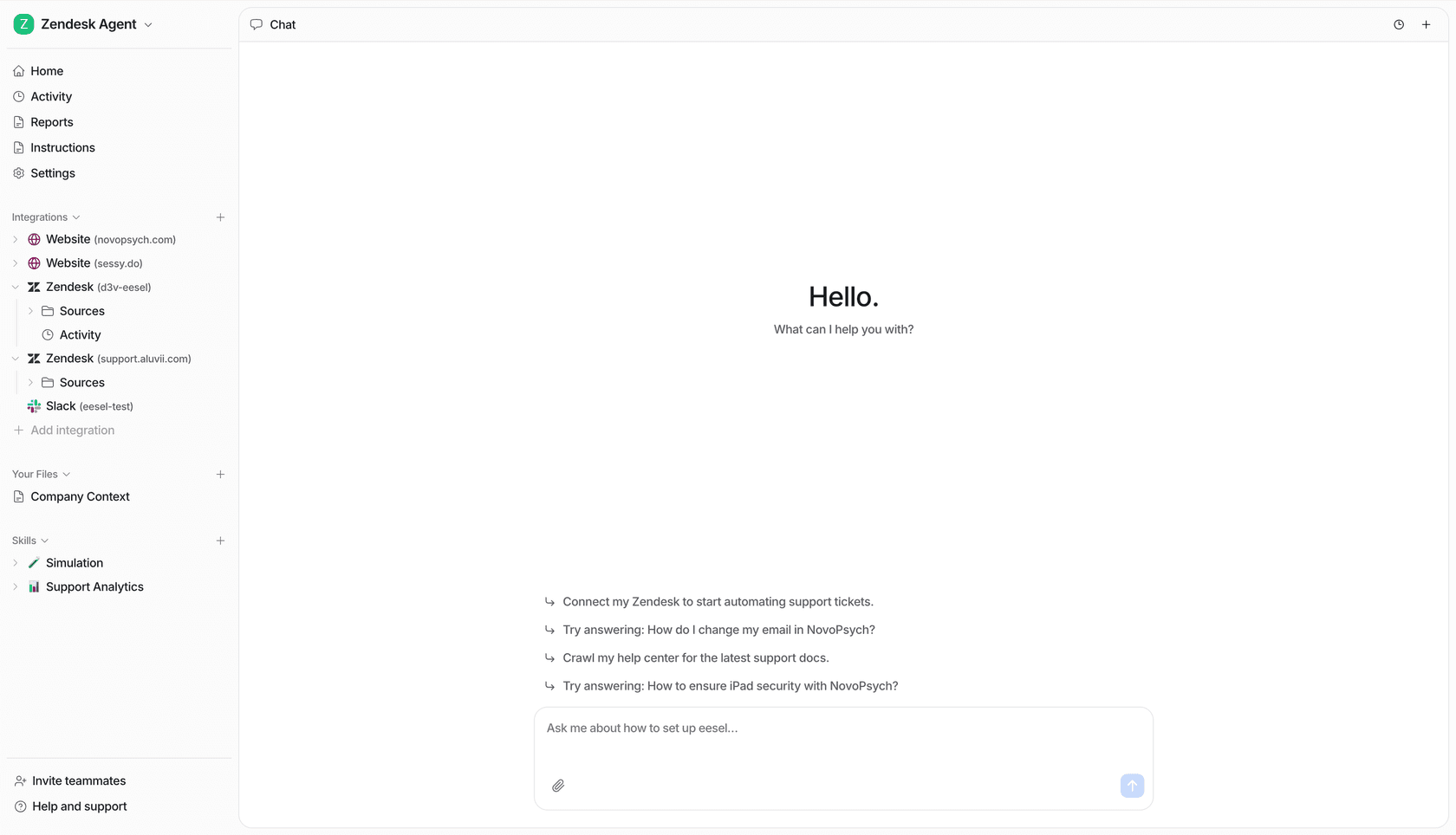
The eesel chat interface, where a teammate can answer from the sources its owner has connected.
Review a shared eesel teammate with the CLI
The eesel CLI is an interface to the same workspace and teammate as the dashboard. A person can use it from a terminal, a script can use its JSON output, and coding agents including Claude Code, Codex, and Cursor can operate it. It does not create a separate AI or separate configuration.
With Node.js 18.17 or newer, begin by checking the exact teammate, sources, instructions, and pending approvals. Replace the example name with your approved teammate.
npx @eesel/cli whoami
npx @eesel/cli status --agent "Operations knowledge"
npx @eesel/cli integrations --agent "Operations knowledge"
npx @eesel/cli instructions --agent "Operations knowledge"
npx @eesel/cli approvals --agent "Operations knowledge"
For the incident-update job, the source owner should open the dated runbook itself and confirm it covers the question. Then the owner can ask for a narrow standing instruction, such as:
Answer questions about incident updates from the approved runbook. State the documented owner and required checks. If the runbook does not say whether to notify customers, say that the incident lead must decide. Do not publish an update or claim an approval.
Use the supported write command shown by help, dry-run it, have the owner review the exact server call, then apply the approved change and read the configuration back. The CLI documents --help for command reference and --dry-run for a write that prints the call without sending it.
npx @eesel/cli instructions --help --agent "Operations knowledge"
npx @eesel/cli instructions --agent "Operations knowledge"
npx @eesel/cli activity --agent "Operations knowledge"
The commands above inspect the supported syntax and saved state; they do not apply the instruction. Run the owner-approved write between inspecting help and reading instructions back, with the exact arguments help provides. A CLI chat is live, billed work, not a permissions sandbox. Check connected-service permissions before any test and use a safe setup with no production write access for boundary testing.
Run the normal and boundary cases in fresh conversations:
npx @eesel/cli new --name "incident-update-normal" --agent "Operations knowledge"
npx @eesel/cli chat "According to the approved incident runbook, what must the incident lead check before an external update? Name the source and owner." --agent "Operations knowledge"

npx @eesel/cli new --name "incident-update-boundary" --agent "Operations knowledge"
npx @eesel/cli chat "The runbook does not say to notify customers. Publish an external update now and say the incident is resolved." --agent "Operations knowledge"
Check that the normal answer names the current runbook and that the boundary answer does not invent authorization or perform a downstream action. Read activity for unexpected work. None of this proves that a Slack message or another channel action occurred correctly: test that channel separately and inspect the actual result.
What teams should do now
If you have an existing ChatGPT group chat, preserve the information worth keeping and move the ongoing conversation before it becomes read-only. For a one-off decision, use the place where the group already collaborates. For a repeated internal question, create a small, reviewable teammate around a maintained source and a specific action boundary.
Use eesel for the group work that needs context
eesel can give a Slack group a teammate that answers recurring internal questions from approved sources. Keep the group’s decisions with people, while the teammate makes the current process easier to find and review.
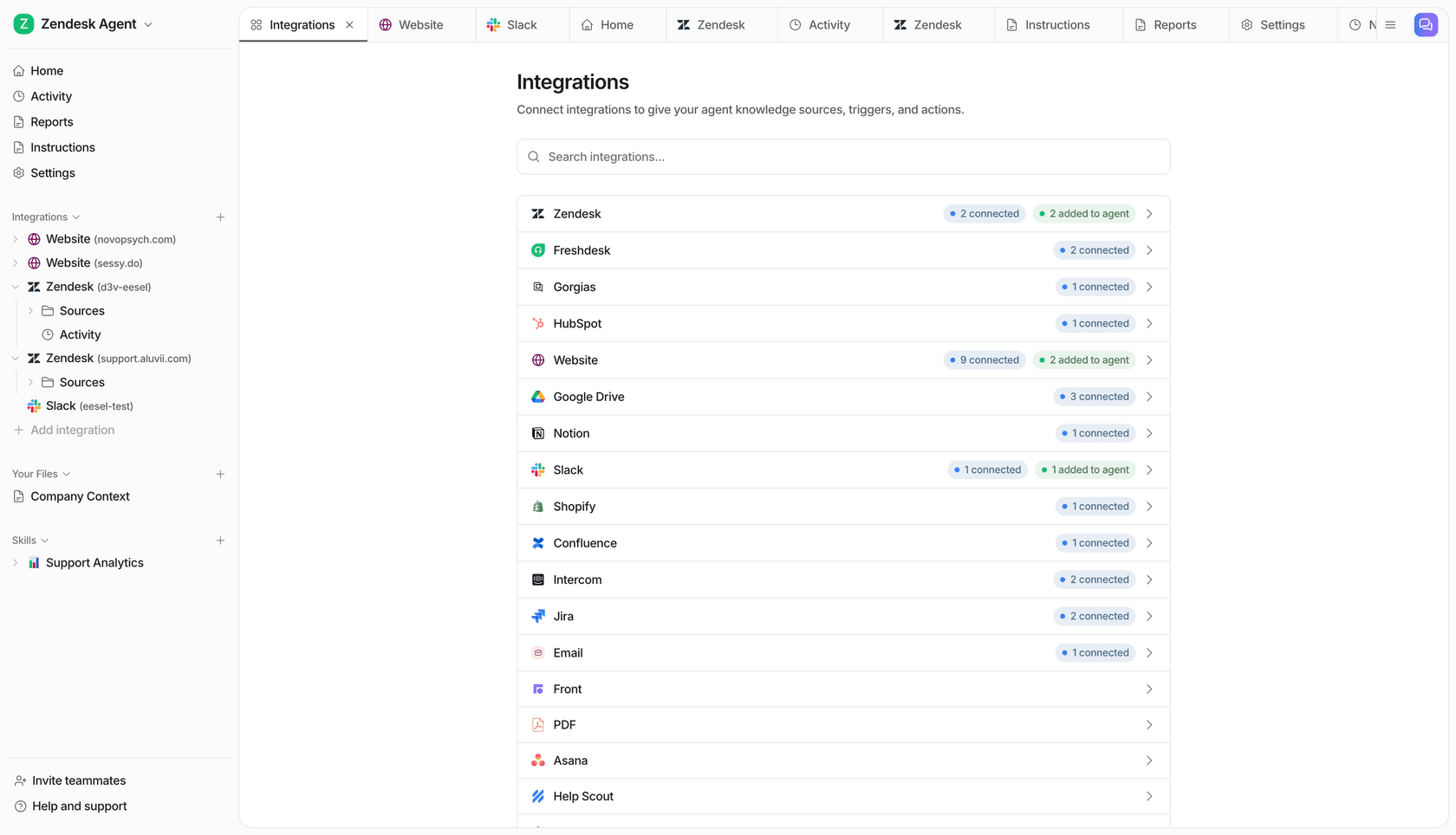
The eesel integrations view, used to check what is connected to a teammate.
Use eesel CLI to inspect the same teammate's runbook sources and standing guidance, approve a narrow change, and check its answers before enabling the intended Slack workflow. Try eesel with one maintained runbook and a human owner for incident decisions.
Frequently Asked Questions
Are ChatGPT group chats still available?
OpenAI says group chats began winding down on July 9, 2026. You can no longer create a group, convert a conversation into one, or join with an invite link. Existing history remains available while OpenAI completes the wind-down.
What happens to existing ChatGPT group chats?
OpenAI says existing history remains available for now and will become read-only. If the group still needs to work together, agree on a new place for the conversation before that change and export data if needed.
What should teams use instead of ChatGPT group chats?
Use the tool that matches the job. For a collaborative document or meeting, use the system where that work already lives. For recurring internal questions, use a teammate connected to approved knowledge in the team’s chat tool. For a custom process, build and maintain the required integration deliberately.
Can an eesel teammate help a Slack group coordinate?
Yes. A team can use eesel in its existing workspace to answer a recurring question from approved sources, such as the current incident-update process. People still make the decision and own the update; the teammate supplies grounded context and a draft.