
Chatbase vs My AskAI at a glance
Here is the short version before we get into the detail. I have kept the figures to what is actually published on each vendor's own pages.
| Chatbase | My AskAI | |
|---|---|---|
| Best for | Website / product chatbots, no-code builders, agencies | Deflecting tickets inside an existing helpdesk |
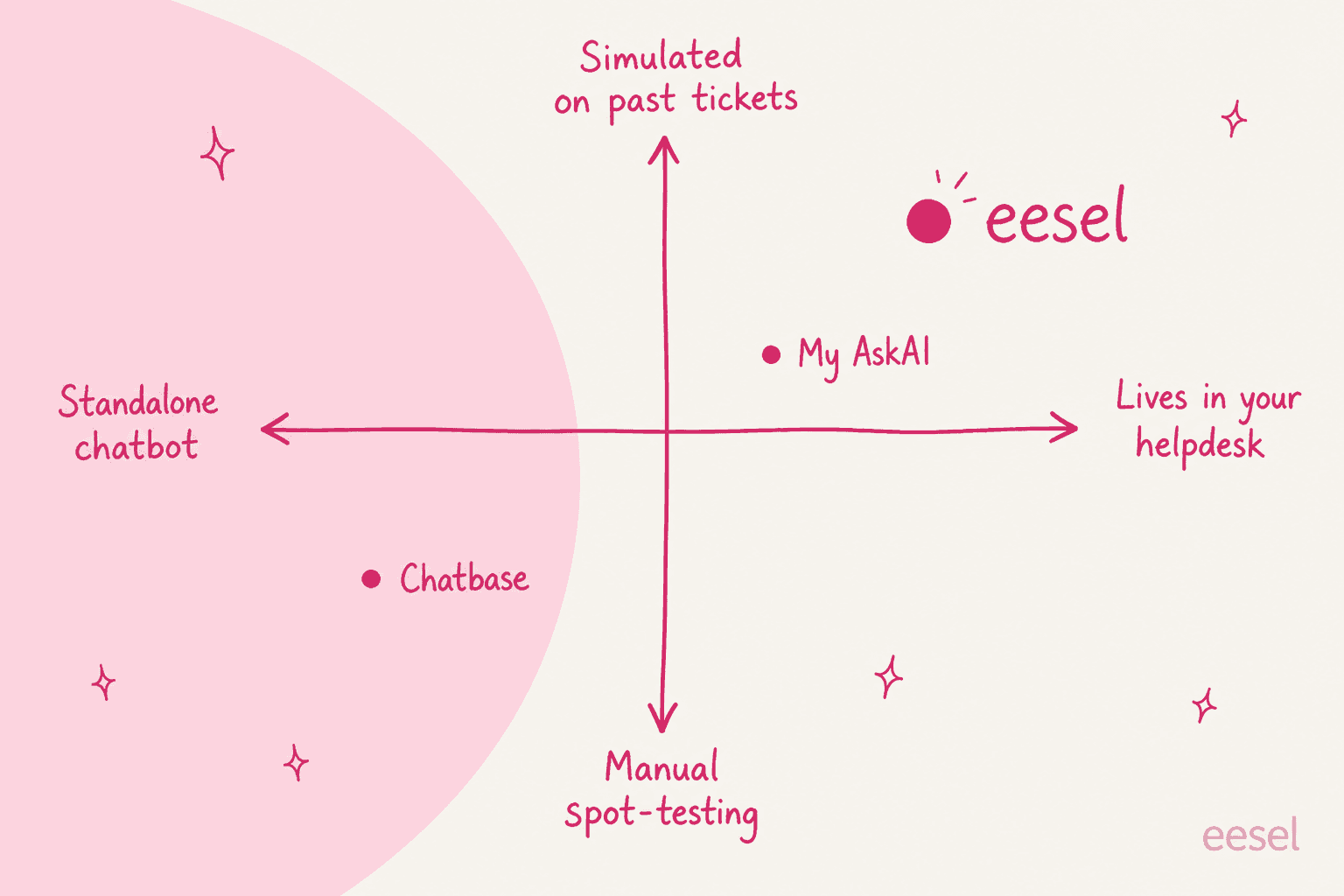
| Deployment model | Standalone bot (widget, API, integrations) | Layer on top of your helpdesk |
| Entry price | Free tier, then $40/mo Hobby | 30-day free trial, no permanent free plan |
| Billable unit | Credits per message (varies by model) | Per ticket (~$0.10) |
| Agents per plan | 1 agent up to Pro (extra agents $25/mo each) | Multi-agent from Scale |
| Train on past tickets | Yes, Pro-only, via Zendesk/Salesforce | Yes, imported at setup |
| Testing | Playground + shareable preview | Phased internal-note rollout |
| Actions | 0 to 12 AI Actions by plan | Tasks & Tools (orders, refunds) |
| Native helpdesks | ~20 integrations incl. Zendesk, Gorgias | Zendesk, Freshdesk, Freshchat, Gorgias, HubSpot |
| Security | SOC 2, enterprise guardrails | SOC 2 Type II (Scale and up) |
| Multilingual | Yes | 95+ languages |
| Guarantee | None published | 60% resolution or money back |
The rest of this post is me actually poking at each one: how they train, how you test them, what they really cost, and where I would use something else.
What Chatbase is
Chatbase calls itself a platform for "AI agents for magical customer experiences," and it is trusted by, in its own words, 10,000+ businesses. In practice it is the most general-purpose tool of the two. You create an agent, feed it sources, choose a model, drop a widget on your site, and you have a working bot in an afternoon. That is why it shows up so often in agency and no-code circles.
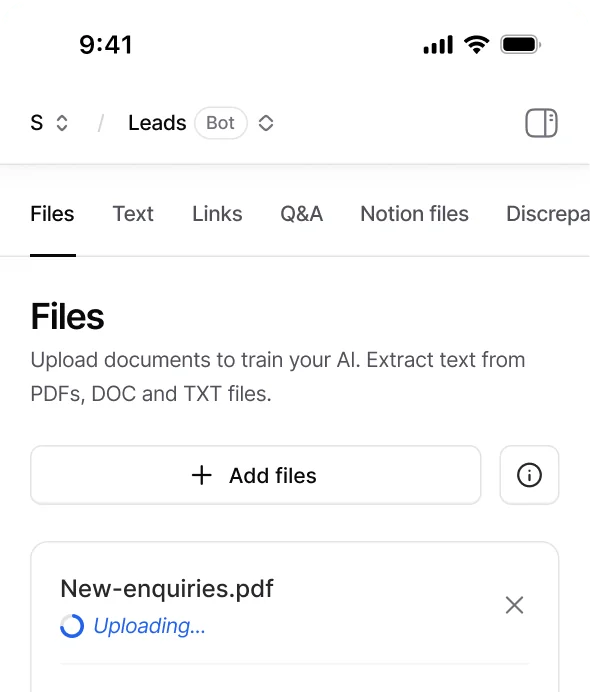
The knowledge model is broad. You can train an agent on uploaded files (PDF, DOC, TXT), plain text, website links, a Q&A set, and Notion, and there is a "Tickets as a source" option too. Each agent gets a training-size budget measured in megabytes, from 1 MB on Free up to 40 MB on Pro.
Two things I like: you get to pick the underlying model (the roster spans the GPT-5.6 family, Claude Fable 5, Gemini 3.5 Flash, DeepSeek V4-Pro, Grok 4.5, and Kimi K2.7), and it can take actions on your systems through its AI Actions, so a bot can do a subscription update or a lookup rather than just talk.
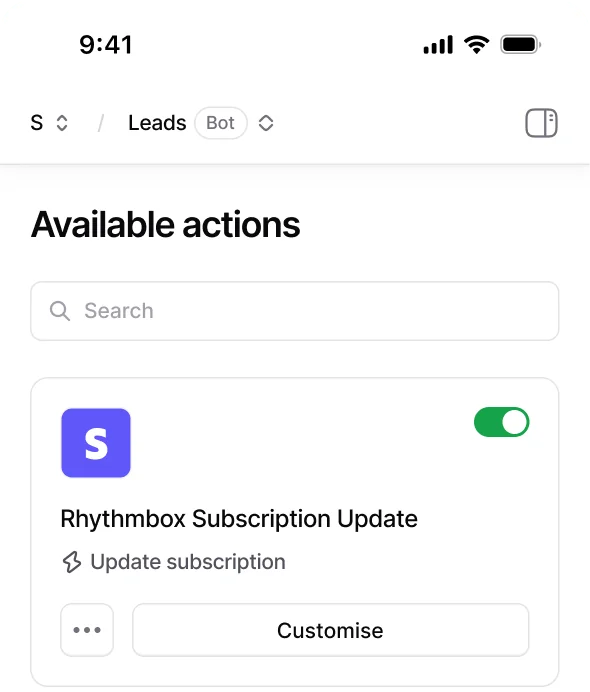
The trade-off is that Chatbase is a bot builder first and a helpdesk agent second. Every plan up to Pro includes a single agent, so if you want separate bots for separate brands you are paying $25/month per extra agent. And a common thread in community discussion is that it shines at FAQ deflection but is not really built to sell or to juggle constantly-changing data:
"Yeah, totally agree, Chatbase and similar tools nail FAQs but don't really sell. They're great for support, not for driving revenue."

What My AskAI is
My AskAI takes the opposite starting point. Instead of building a new bot, it adds an AI agent to the helpdesk you already run, and its whole pitch is deflection: "Automate over 75% of support" and "Setup in under 1hr with no devs." The current pricing hero goes further with a guarantee I do not see often: "60% AI resolution. Or your money back."
Setup is a guided, 30-day rollout that 250+ teams have run: sync your help center, SOPs, and past tickets in the first few days; let the AI draft internal notes only while humans approve; then switch on direct replies for safe topics; then scale with Tasks & Tools. It is a sensible on-ramp, and the vendor-published results are genuinely strong. Edel Optics scaled AI resolution from 25% to 79% and reclaimed roughly 150 hours a month, and Traveljoy reports 76% resolution where its previous tool sat at 23%. The site's overall rating is 4.9/5 across 19 reviews.
Because it is support-first, My AskAI's knowledge sources are the ones a support team actually has: help center articles, SOPs, past tickets, Notion, and Google Drive, imported in "under 10 minutes." Its Tasks & Tools can fetch live user data and take actions like order refunds, and it ships native connectors for Zendesk, Freshdesk, Freshchat, Gorgias, and HubSpot.
The honest limit is reach. My AskAI is deliberately narrow: it is an add-on for mainstream helpdesks, so if your stack is not on that native list you are into the Chat API or Zapier, which is a developer job rather than a one-click app.
How they train and what they know
Both tools can learn from your past tickets, which matters more than any feature list, because ticket history is what makes an agent sound like your team rather than a generic FAQ. The nuance is in the fine print.
On Chatbase, past-ticket training exists but it is gated: "Tickets as a source" is a Pro-plan row and it needs a Zendesk or Salesforce connection to work. So the cheaper Chatbase plans are really learning from your docs and website, not your conversation history. On My AskAI, ticket import is part of the standard setup on every plan, which makes sense given it is aiming at deflection from day one.
One recurring Chatbase complaint is worth flagging if your knowledge changes often:
"I want to integrate a google sheet with an AI customer support tool that I can periodically change without having to re-train the AI."
If your answers live in fast-moving data, check how each tool re-syncs before you commit.
Testing before you trust it live
This is the section I care about most, because a support bot that sounds confident and is quietly wrong is worse than no bot at all.
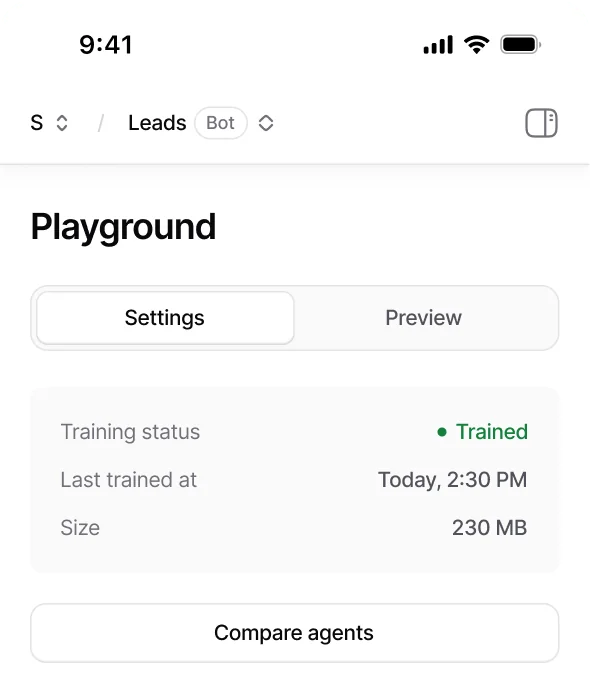
Chatbase gives you a Playground plus a shareable preview link. You type questions at the agent, watch the answers, and tweak. It is useful, but it is manual: you are the one thinking up test cases.
My AskAI's answer is its phased rollout: for the first stretch, the AI only drafts internal notes that a human approves before anything reaches a customer. That is a smart way to build trust, but it tests the AI on live tickets as they arrive, over days and weeks.
Neither approach answers the question a support lead actually asks on day one: "if I turn this on for my last 3,000 tickets, how many would it have resolved, and where would it have gone wrong?" That is a batch simulation over your real history, and it is the gap I keep running into.
Pricing compared
Here is where the "which is cheaper" question gets slippery, because the two tools do not bill the same way.
Chatbase bills in credits, and credit cost depends on the model you choose (heavier models and enabled actions burn more). The plans:
| Plan | Monthly price | Message credits | Agents | Training / agent |
|---|---|---|---|---|
| Free | $0 | 50 | 1 | 1 MB |
| Hobby | $40 | 700 | 1 | 10 MB |
| Standard | $150 | 4,000 | 1 | 20 MB |
| Pro | $500 | 15,000 | 1 (5 seats) | 40 MB |
| Enterprise | Custom | Custom | Custom | Custom |
Annual billing knocks about 20% off, and the notable add-ons are auto-recharge ($40 per 1,000 credits), extra agents ($25/agent/month), and removing "Powered by Chatbase" branding ($99/month). Full detail is on the Chatbase pricing page.
My AskAI bills per ticket. The headline is about $0.10 per ticket, and its plans are Pro, Scale (most popular, with 2,000 tickets/month included and $0.10 per extra ticket), and Enterprise from $999/month. Interestingly, the Pro and Scale dollar figures are no longer printed as fixed numbers; the page now runs an interactive cost calculator and leads with the per-ticket rate instead. Annual billing is 33% off, the free trial runs 30 days with no card, and Scale bundles branding removal and API/Slack/Teams access (each "worth $49/mo").
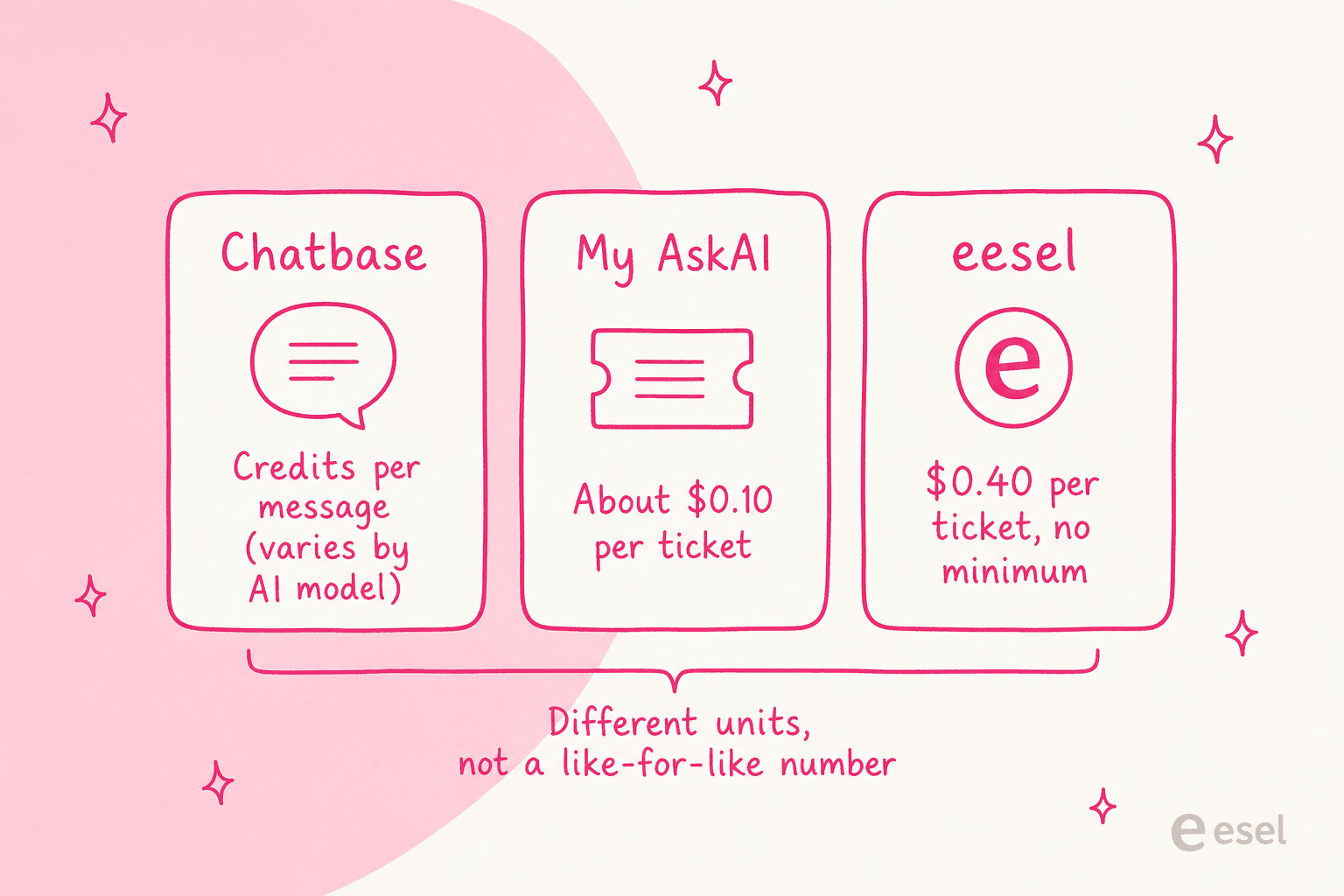
A worked example: say you handle 2,000 support conversations a month. My AskAI's per-ticket model lands somewhere around its Scale plan and is genuinely cheap for pure deflection. Chatbase's 2,000 conversations could sit near the Standard plan's 4,000 credits, but only if each conversation stays close to one credit, which it will not once you turn on actions or a heavier model. The billing units are not a like-for-like number, so run your own volume through each calculator rather than trusting a single sticker price.
For reference, eesel charges $0.40 per ticket handled with no platform fee, no per-seat fee, and no minimum, and you only pay for tickets you actually route to the AI. It is more per ticket than My AskAI's headline, and the value is in the control you get for it, which is the next section.
Where I would reach for eesel instead
I work on eesel, so treat this as the "here is what we built and why" section rather than a neutral verdict. The short pitch: eesel is an AI helpdesk teammate that joins the support queue you already run, learns from your past tickets and help center, and can draft or send replies inside Zendesk, Freshdesk, Gorgias, and Help Scout.
The reason it exists is the testing gap above. After a few years of putting AI on live support queues, the pattern we kept seeing was a confident-sounding bot giving wrong answers on go-live day, so eesel's core move is to simulate the agent on thousands of your historical tickets and forecast the resolution rate before a single customer is involved. You see what it would have answered, where it would have escalated, and what it would have cost, then you switch it on only for the topics it handles well.
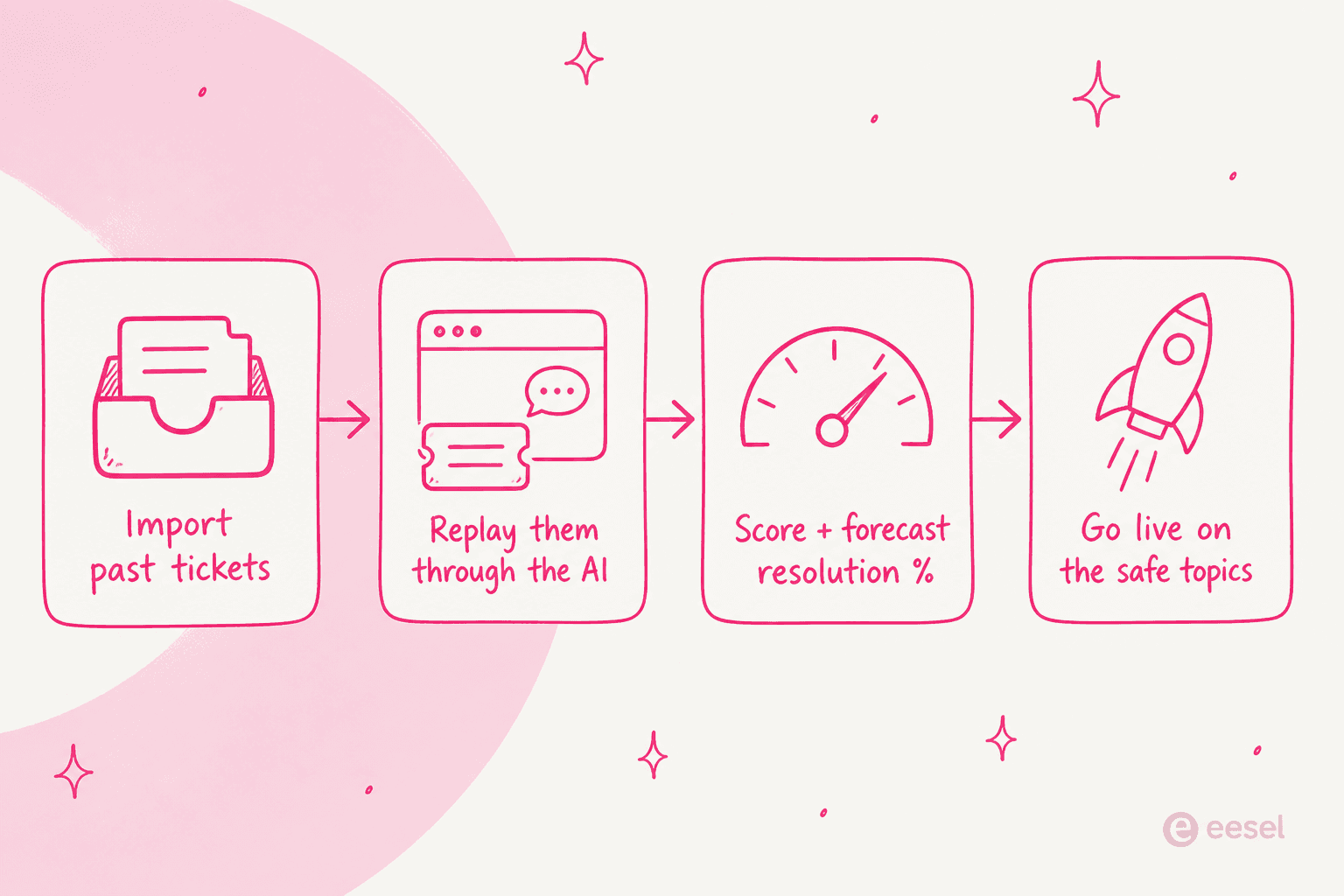
The other honest difference is pricing shape. Chatbase's single-agent-per-plan model and My AskAI's plan tiers both make you commit ahead of usage; eesel bills per ticket with no minimum, so a gradual rollout where you route 200 of 1,000 tickets to the AI costs you 200 tickets, not a plan.
Where I would not push eesel: if you just need a small website widget on a marketing site, Chatbase's free tier is the faster, cheaper start, and I would say so to a friend.
Try eesel
If your goal is deflecting real helpdesk tickets and you want to know the numbers before you trust it, eesel is built for exactly that. It plugs into your existing helpdesk in minutes, trains on your past tickets and docs, and runs a simulation on your history so you can forecast resolution rate and cost before go-live. It is free to start with $50 of usage and no credit card.

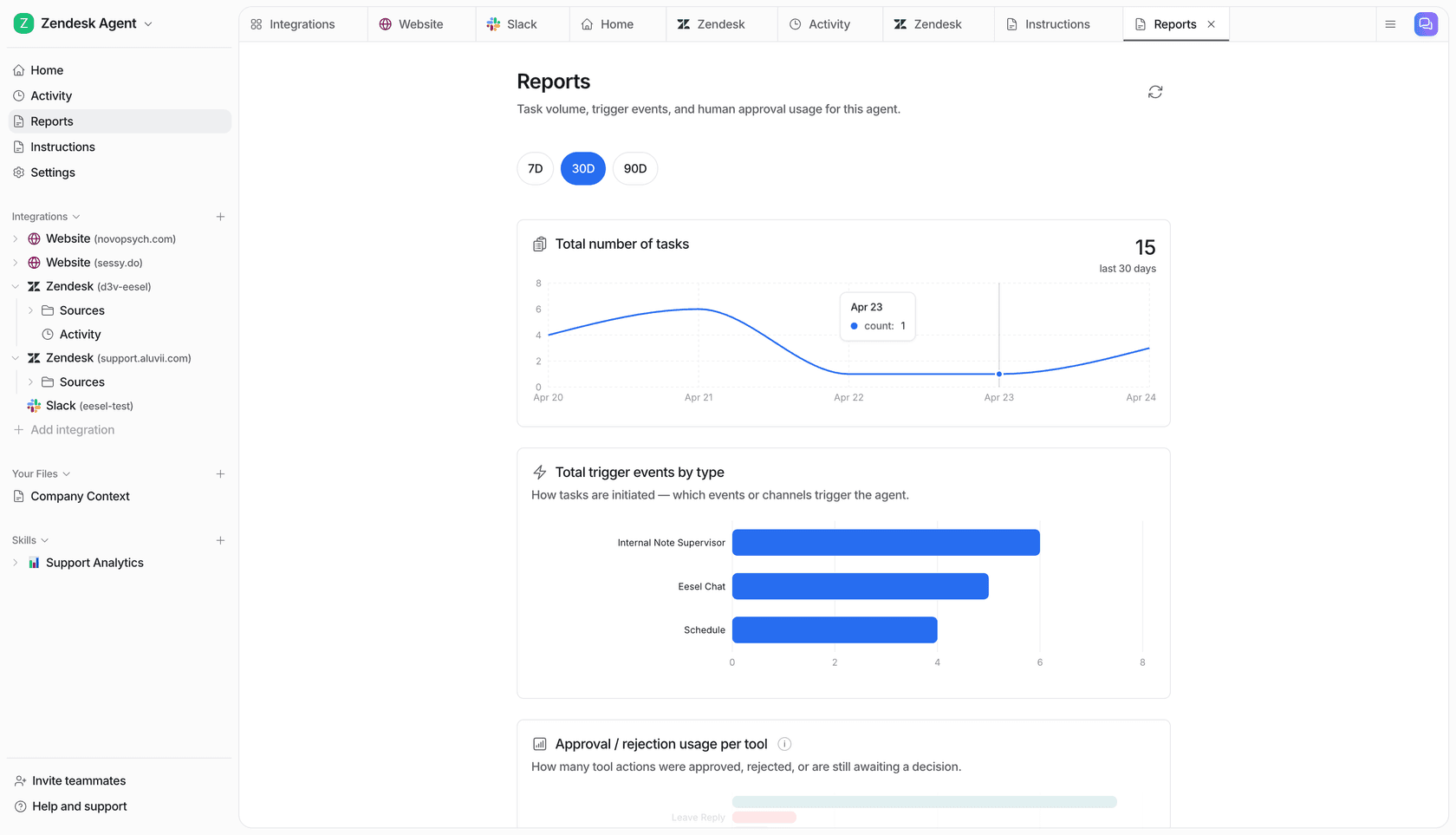
You get the same reporting depth you would expect from a dedicated support tool, so once the agent is live you can see what it is resolving and where the gaps are.
Chatbase and My AskAI are both good at what they set out to do. Pick Chatbase for a fast website bot, pick My AskAI for cheap helpdesk deflection, and give eesel a look when you want to test on your own tickets before you commit.
Frequently Asked Questions
What is the main difference between Chatbase and My AskAI?
Chatbase is a general-purpose AI chatbot builder you point at a website, docs, or a widget, while My AskAI is a support-specific agent that layers on top of an existing helpdesk like Zendesk or Gorgias to deflect tickets. If you want a website bot, look at Chatbase; if you want to cut helpdesk volume, My AskAI is the closer fit. For teams that want to test either approach against their own history first, eesel runs a simulation on past tickets.
Is Chatbase or My AskAI cheaper?
On paper My AskAI is cheaper per ticket, advertising about $0.10 per ticket, while Chatbase bills in credits starting at a $40/month Hobby plan. They are different billing units, so the honest answer depends on volume. eesel keeps it simple at $0.40 per ticket with no minimum.
Can Chatbase and My AskAI train on past support tickets?
Yes, both can. My AskAI imports past tickets during setup, and Chatbase offers a "Tickets as a source" option, though on Chatbase it is a Pro-plan feature that needs a Zendesk or Salesforce connection. This is exactly the kind of knowledge an AI support agent needs to sound like your team.
Which is better for Shopify and ecommerce support?
My AskAI leans ecommerce, with native Gorgias support and case studies from online retailers, while Chatbase has a Shopify integration and actions for order lookups. Both work; the deciding factor is whether you run a dedicated helpdesk. An AI agent that plugs into your helpdesk is usually the cleaner ecommerce path once ticket volume grows.
Is there a good eesel alternative to Chatbase and My AskAI?
eesel is worth a look if your priority is confidence before go-live. It trains on your past tickets and help center, works inside the helpdesk you already run, and simulates on your historical tickets to forecast resolution rate, all on usage-based pricing with no per-seat fee.


Article by
Rama Adi Nugraha
Rama is a software engineer at eesel AI with two years of experience writing about B2B SaaS, AI tools, and customer support technology. Based in Bali, Indonesia, he brings a developer's perspective to product comparisons — cutting through marketing copy to what the integrations and APIs actually do.