The honest answer, from someone who ships this stuff
I work on AI writing tools at eesel, so I'll give you the answer I'd give a colleague rather than the one that makes AI look magic. We've spent a long time building writers that draft content from a company's own knowledge, and the single most consistent lesson is this: the model knows the whole world, but it doesn't know anything about you.
A creator on r/NewTubers put it better than any marketing page I've seen:
"I'd push back a little on 'knows nothing', I think it knows plenty, it just doesn't know anything about you specifically. And that's kind of the whole problem. Most people prompt it with a topic and expect it to figure out the rest. But your channel isn't just a topic, it's a specific take on a topic, and that part doesn't exist anywhere the AI can find it unless you specifically put it in every prompt."
Rude-Anywhere-5142, r/NewTubers, Apr 2026

That's the whole post in one paragraph. AI can write a video script. Whether it writes a script worth recording depends almost entirely on what you put in. So let's split it into what it's actually good at, where it falls apart, and the workflow that gets you a script you'd read on camera.
What AI is actually good at
Drop the skepticism for a second, because there's real value here. After testing this across explainers, demos, and short-form, here's where AI consistently pulls its weight.
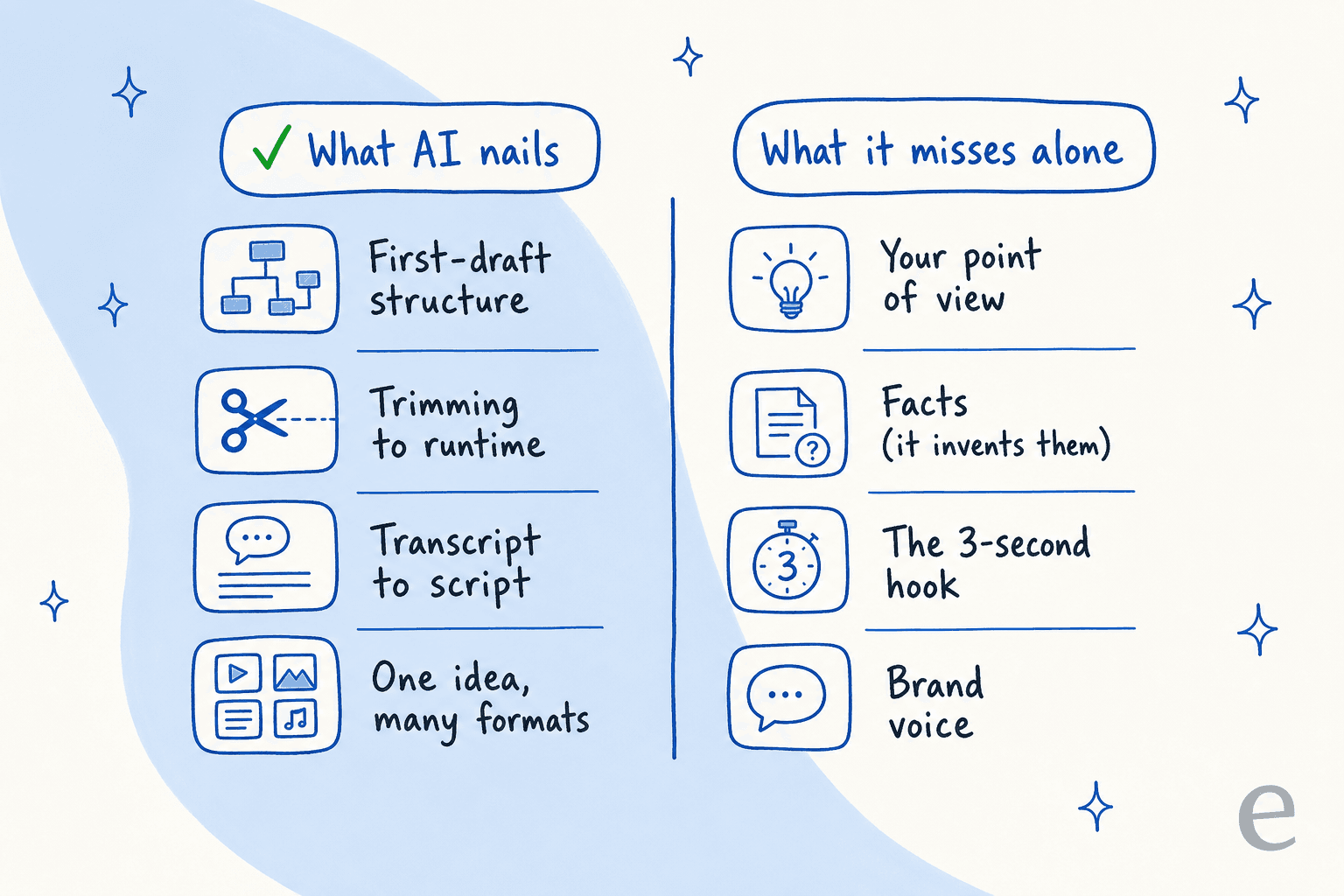
First-draft structure. This is the strongest use. Ask for a hook, three points, and a call to action, and you get a scaffold in seconds. Staring at a blank doc is where most scripts die, and AI removes that problem entirely. Tools like vidIQ's script generator frame their output as "hooks, transitions and CTAs", which is the tell that the structure, not the prose, is the real product.
Trimming to a runtime. Give it a 400-word ramble and ask for 140 words, and it's ruthless in a way humans struggle to be with their own writing. The community read on r/PartneredYoutube matches my own: "Writing scripts from scratch via chatGPT are quite poor in quality. I think it can help to optimise your draft scripts to make them more concise."
Turning a transcript into a script. This is underrated. If you've recorded a rough talk, a customer call, or a Loom, AI is excellent at reshaping that raw material into clean spoken copy. As one marketer described it, "AI is incredible at processing large amounts of disorganized information... I've fed hour-long transcripts into AI and had it turn the content into a blog post." Same trick works in reverse for scripts.
Adapting one idea to many formats. One core message, reshaped into a 30-second Short, a two-minute demo, and a five-minute explainer. This is the same muscle behind repurposing blog content with AI, and it's a genuine time-saver when you're publishing across channels.
Where AI scripts fall apart
Now the honest part. These are the failure modes that get a video ignored, and none of them get fixed by a better tool, only by you.
It invents facts. This is the dangerous one. For any informational video, a r/NewTubers creator notes it "tends to create mistakes." AI states wrong dates, fake statistics, and made-up product behavior with total confidence. Every factual claim in an AI script needs verifying against a primary source before you hit record.
It reads like an essay, not speech. AI defaults to written register: balanced clauses, no contractions, no rhythm. Every primary guide on script writing leads with the same fix. Swarmify's guide opens with "write for the ear, not the eye," and Teleprompter.com recommends reading your script aloud so "you'll notice if certain sentences make you stumble." If you don't do that pass, the delivery sounds like someone reading a press release.
It botches the hook. Short-form is won or lost in the first three seconds, and AI loves to open with throat-clearing ("In today's fast-paced world..."). A good hook does one of three things, per Captions.ai's hook guide: a pattern interrupt, addressing a pain head-on, or a bold claim. AI won't reach for those unless you make it.
It has a tell. There's a recognizable AI "house style" that viewers now spot instantly. A r/PromptEngineering thread catalogs the markers: the em dashes, the "it's not just X, it's Y" parallelism, the snappy one-line sentences, the emoji. If your script has those, your audience reads "AI wrote this" before they hear your point. (We keep a running list of these in our piece on why AI content sounds generic.)
The pattern across all four: AI handles the craft of a script but not the substance. As one r/marketing commenter put it bluntly, "At best AI is an assistant. It should be used to create a starting point... no one should use AI expecting publish-ready content."
How to actually write a video script with AI
Here's the workflow that consistently produces something usable. It's the same loop whether you're on ChatGPT, Claude, or a dedicated AI writing tool.
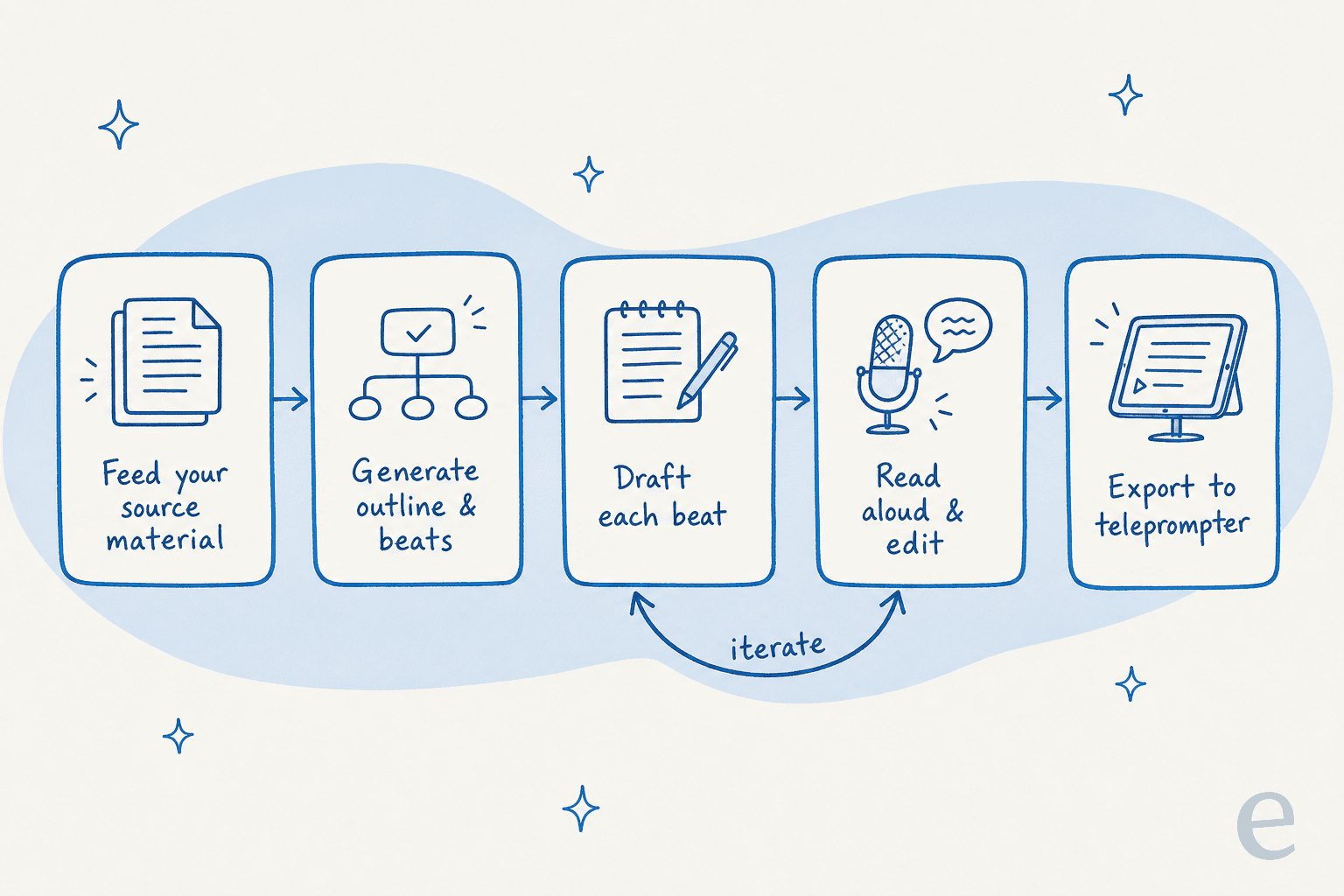
1. Feed it your source material first. Before you ask for a single line, give it the context: who the video is for, where it'll live, the goal, and any raw material (a transcript, a blog post, your brand notes). This is the step that separates a generic draft from one that sounds like you, and it's exactly the case for training AI on your brand voice.
2. Generate the outline, not the script. Ask for the beats first: hook, points, payoff, CTA. Get the structure right before any prose exists. A two-pass "structure then write" approach beats asking for a finished script in one shot, every time.
3. Draft each beat. Now expand the approved outline. Working beat by beat keeps the AI from wandering and gives you control over pacing.
4. Read it aloud and edit. Non-negotiable. This is where you catch the essay-not-speech problem, fix the rhythm, and inject the contractions and the half-sentences that make speech sound human. Put your edits back into the prompt and iterate: as one practitioner described the loop, "read the content the AI produced, and put your criticisms into a follow-up request. Keep doing this... until it's near perfect."
5. Export to a teleprompter or shotlist. The real deliverable is something you can perform. Teleprompter.com suggests marking the script with cues ("insert [PAUSE], highlight words to emphasize, note where a visual will appear"), then driving delivery off a teleprompter at a target pace.
Do the runtime math (about 150 words per minute)
This deserves its own callout because it's the single cheapest guardrail and the one AI ignores by default. People speak at roughly 125 to 150 words per minute. Teleprompter.com, Maestro, and Biteable all land on about 150 as the baseline for English. So your script length is your runtime.
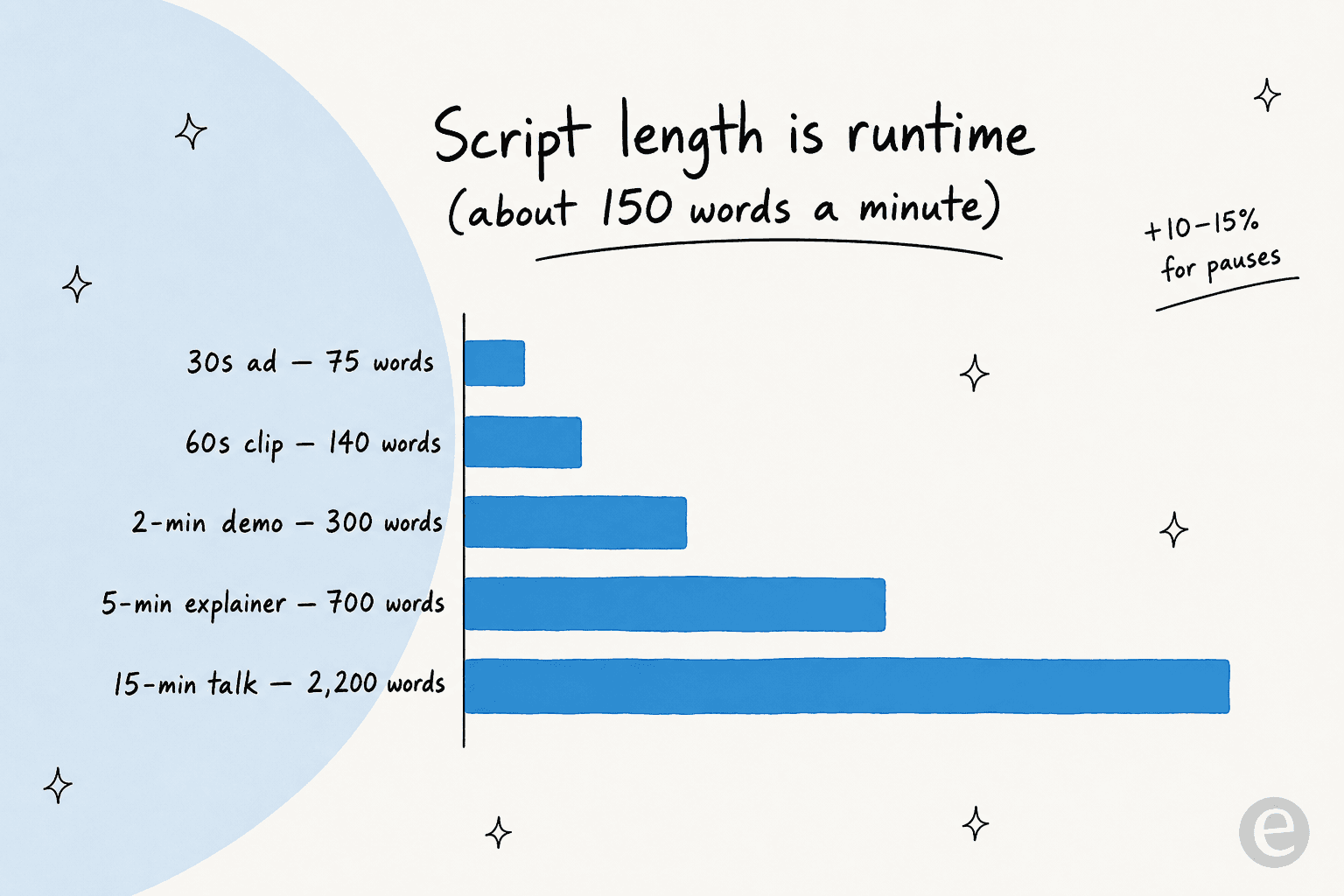
Write 400 words for a "60-second" video and you've actually written a three-minute one, or a delivery so rushed it's unwatchable. Add another 10 to 15% for pauses and breaths, as Teleprompter.com notes. Tell the AI your target in words, not just "make it 60 seconds," and the draft comes back the right length.
Match the script to the format
A script isn't generic prose, its shape is dictated by the format. This is the most useful thing you can paste into a prompt, because telling the model which structure to follow matters more than the topic line.
| Video type | Structure | Length (≈150 WPM) | Pace |
|---|---|---|---|
| Short-form (Reels, Shorts, TikTok) | Hook (0-3s), value, CTA | 30-150 words (source) | Fast (~170 WPM) |
| YouTube explainer | Hook, context, value, recap | 750-1,500 words | Conversational |
| Product demo | Problem, walkthrough, payoff | 300-750 words | Slow on problem, faster on features |
| Ad / sales video (VSL) | AIDA or PAS | 75+ words | Direct-response |
| Tutorial / training | Chunked segments, clarity first | Varies | Slower (~130 WPM) |
For the most structured case, video sales letters, there are named formulas worth pasting in wholesale. Jim Edwards' 10-part VSL script (open with a shock, state the problem, agitate it, introduce the solution, prove it, close) is the kind of scaffold AI fills in beautifully once you hand it the framework. Edwards claims a tight 3-to-6-minute VSL can outsell a long sales letter by as much as 300%.
Try eesel for scripts about your own product
Most "AI video script" advice assumes you're making content videos. But a huge share of business video is about explaining your own product: a feature walkthrough, an onboarding clip, a how-to that lives in your help center. That's a different problem, and it's the one I work on.
Here's the seam. The moment your tutorial video says "here's how exports work," a customer watches it, then opens a ticket asking the exact same thing, and the answer your support team gives needs to match the script you just recorded. eesel's AI content writer drafts from your connected help docs and past tickets, so the script starts from what your team actually tells customers, not a guess. And because the same knowledge powers eesel's helpdesk agent, the video and the support reply stay in sync instead of drifting apart.
You can try eesel free, with $50 of usage and no credit card, and see how a writer grounded in your own knowledge compares to a blank chat box. It won't replace your read-aloud edit pass, nothing does, but it solves the "AI doesn't know you" problem before you write the first line.
Frequently Asked Questions
Can AI write video scripts that don't sound generic?
What is the best AI for writing video scripts?
How long should an AI video script be for a 60-second video?
Can AI write video scripts for YouTube and product demos?
Is it safe to let AI write scripts for informational videos?


Article by
Kurnia Kharisma Agung Samiadjie
Kurnia is a software engineer and writer at eesel AI with two years of SEO experience, writing about AI tools, helpdesk software, and customer support. He pairs a developer's understanding of how these products are built with search-driven research into what actually ranks and resonates with the people searching for them.