The AI writing tool market is getting crowded, fast. It feels like a new app launches every week, making it tough to pick the right one. You’ll definitely come across Claude and Quillbot, but here’s the catch: they’re not really competitors. They solve completely different problems.
Think of Claude as a creative partner, an AI assistant you can brainstorm with to generate complex, long-form content from the ground up. Quillbot, on the other hand, is more like your personal editor. It’s a full toolkit designed to take text you’ve already written and make it shine.
This post will break down the key differences between Claude and Quillbot to help you figure out which one belongs in your workflow. And while both tools are great at what they do, it's good to know that platforms like the eesel AI blog writer handle the entire content creation process. Instead of just writing or refining, it’s a full content engine that can turn a single keyword into a complete, SEO-optimized blog post that’s ready to go live.
Understanding Claude's role
Claude isn't your average chatbot. It was developed by Anthropic, an AI safety and research company, as an advanced AI assistant built for tricky reasoning, in-depth conversations, and creating genuinely high-quality content. It’s meant to be a collaborative partner for tasks that need some real thought and nuance.
A few key strengths make it stand out from the crowd.
Here’s what makes Claude a solid choice:
- Advanced content generation: Claude really excels when you need it to produce sophisticated, human-like text. It’s perfect for drafting long articles, analyzing complex research, or even creative writing. It goes beyond simple Q&A to generate well-structured and thoughtful content.
- A massive context window: This is a big one. Claude can process a huge amount of information at once. Its models offer a 200K token context window, with up to 1 million tokens available in beta. This means you can upload entire research papers, books, or codebases and have Claude analyze them without losing track of the details.
- Enterprise-grade security: Anthropic made security a priority when building Claude. It's compliant with standards like SOC 2 Type 2 and ISO 27001 and even offers a HIPAA-ready version for enterprise clients, making it a reliable option for businesses that handle sensitive data.
- Powerful integrations: Claude isn't stuck on a website. It can extend its functions into the tools you use every day. You can use Claude in Excel for advanced data analysis or integrate it into your team's workflow through Slack and Google Workspace.
Because of these features, Claude is the tool you reach for when you have heavy-duty tasks like drafting long-form content, running complex data analysis, professional software engineering, or creating strategic business reports.
Understanding Quillbot's role
Quillbot is an AI-powered writing partner that’s all about making your existing writing better. Instead of creating something from a blank page, it provides a full suite of tools to enhance and refine text you've already written. It’s less of a creator and more of a co-editor.
It’s not just a single tool, but a collection of eight different functions, each designed to solve a specific writing problem.
Here’s a peek at its toolkit:
- Paraphrasing tool: This is Quillbot’s main attraction. It doesn't just swap a few synonyms; it offers nine different modes (like Formal, Academic, Simple, and Creative) to completely rewrite your text to match a specific tone or audience.
- Grammar and plagiarism checkers: These are essential for any writer. The grammar checker helps you catch errors, while the Plagiarism Checker scans your text against billions of sources to make sure it's original. Just note that the plagiarism checker is a premium feature.
- AI detector and humanizer: In a world flooded with AI content, these tools are pretty handy. The AI Detector can identify AI-written text, while the Humanizer helps make robotic-sounding AI text feel more natural.
- Summarizer and translator: The Summarizer is great for boiling down long articles or documents into key bullet points or a short paragraph. The Translator is also quite capable, supporting 52 languages.
- Citation generator: This is a lifesaver for students and academics. This free tool helps you create accurate citations in various styles like APA, MLA, and Chicago, which saves a ton of time.
Quillbot is ideal for students polishing essays, academics ensuring research originality, editors refining first drafts, and anyone who wants to make their writing clearer and more professional.
QuillBot: This tool rephrases sentences or paragraphs to improve clarity or generate different versions of your text. I use it to make sure my writing is clear and concise.

Head-to-head comparison: Claude vs. Quillbot
While Claude and Quillbot both use AI to help with writing, they aren't really direct competitors. They're built for completely different parts of the writing process. To make it clearer, this visual comparison breaks down their distinct roles by looking at key criteria, so you can figure out if you need a content creator or a text refiner.
Core features
The biggest difference between Claude and Quillbot is their core function. One is built to generate, and the other is built to transform.
Claude is a generative AI, plain and simple. Its purpose is creation and analysis. The whole experience is based on a chat interface where you give it prompts to generate content, get coding help, analyze data, or work through complex tasks. You can ask it to write a blog post, debug some code, or summarize the key points from a 100-page report you upload. It’s designed to be a partner that helps you tackle big projects from the start.
Quillbot, on the other hand, is a writing toolkit focused on enhancement. Its features are all designed to take existing text and improve it. Its main feature is the multi-mode paraphraser, but it’s backed by a whole ecosystem of tools for polishing your work: a grammar checker, a plagiarism detector, a summarizer, and a citation manager. It doesn’t create new ideas; it just refines the ones you already have.
I've just published a detailed 2025 QuillBot review, covering its paraphrasing, summarization, grammar, and citation features, as well as pricing and integrations.
Here’s a simple breakdown of what each tool offers:
| Feature | Claude | Quillbot |
|---|---|---|
| Primary Function | Content Generation & Analysis | Content Refinement & Polishing |
| Content Creation | ✅ (Core feature) | ❌ (AI Chat for idea generation only) |
| Paraphrasing | ❌ (Not a dedicated feature) | ✅ (Core feature with 9 modes) |
| Grammar Checker | ❌ | ✅ (Free and comprehensive) |
| Plagiarism Checker | ❌ | ✅ (Premium feature) |
| AI Detector | ❌ | ✅ (Free tool) |
| Citation Generator | ❌ | ✅ (Free tool) |
| Context Window | Up to 1M tokens (beta) | N/A |
| Integrations | Excel, Slack, Google Workspace | Chrome, Word |
Target audience
Because their features are so different, Claude and Quillbot attract completely different users.
Claude is best for professionals who need to produce high-quality original content without spending ages on it. This includes:
- Developers who use it for coding, debugging, and getting their heads around complex codebases.
- Enterprise users who need it for market research, strategic analysis, and drafting internal reports.
- Researchers who can feed it dense academic papers to get summaries and analyses.
- Marketers who need to generate first drafts of long-form content like white papers, e-books, and detailed blog posts.
As we all know Claude is great at writing and 'thinking' for academics and social sciences. I’m getting tired of reaching Claude’s message limits. Could anyone recommend a worthwhile alternative for my purposes (not coding)?
Basically, if your job is about creating something new, Claude is a powerful sidekick.
Quillbot is designed for anyone working with text that's already been written. This includes:
- Students and academics who need to paraphrase sources, check for plagiarism, and generate citations.
- Editors and content creators who want to polish first drafts, improve readability, and fix grammatical errors.
- Non-native English speakers who use it to improve the fluency and professionalism of their writing.
- Professionals who need to refine emails, presentations, and other business communications to make sure they are clear and error-free.
If your main task is to refine, rephrase, or check a piece of writing, Quillbot’s toolkit is exactly what you need.
Content quality and output
When it comes to the final product, the two tools give you very different results.
Claude’s output is known for its high quality, nuance, and human-like tone. Thanks to its large context window and advanced reasoning, it can produce sophisticated, context-aware, and original content that often needs very little structural editing. It’s great at capturing a specific voice and sticking to it across long pieces of text. When you use Claude, you're getting a solid first draft that gives you a great head start on any project.
Quillbot’s output quality is completely tied to the quality of the text you give it. Garbage in, garbage out. It won't generate new ideas or fix a poorly structured argument. But it's fantastic at what it's designed to do: improve fluency, fix grammar mistakes, enhance vocabulary, and restructure sentences to make them clearer. Its strength is in refinement, not creation. A great draft put into Quillbot will come out even better, but a weak one will just become a grammatically correct weak draft.
Pricing breakdown
Both Claude and Quillbot have free and paid plans, but their pricing is set up to match their different features.
Claude uses a tiered subscription model for individuals and teams, giving you more power for a higher price.
- Free: You get basic access to their models, but with pretty tight usage limits that reset every few hours. It’s fine for a test drive but not for regular use.
- Pro: For $20/month (or $17/month billed annually), you get way more usage, access to the latest models, and priority access during busy times. This plan also unlocks features like Claude in Excel.
- Max: Starting at $100/month, this plan is for heavy users who need 5x to 20x more usage than the Pro plan.
- Team: Starting at $30/user/month (or $25/user/month annually), this plan adds collaboration features and higher usage limits for teams.
Quillbot keeps things simpler with a generous free plan and a single premium option.
- Free: The free version gives you limited access to its tools. For instance, the Paraphraser is limited to 125 words at a time, and the Summarizer maxes out at 1,200 words. You also only get two of the paraphrasing modes.
- Premium: This plan unlocks everything. You get unlimited words in the Paraphraser, all nine modes, the Plagiarism Checker, and higher limits on all other tools. Premium costs $19.95 per month if you pay monthly, but it’s much cheaper if you opt for an annual plan at $99.95 per year (which is just $8.33 per month).
An alternative to consider: eesel AI blog writer
So, Claude is great for generating text, and Quillbot is fantastic for polishing it. But what if you need to do more than just write? What if your goal is to create high-ranking blog content that brings in traffic? Neither tool is really built for that entire process. This is where a specialized content engine comes in.
The eesel AI blog writer is an AI content platform designed specifically to turn a single keyword into a complete, publish-ready blog post. It closes the gap between raw text generation and creating content that actually performs.
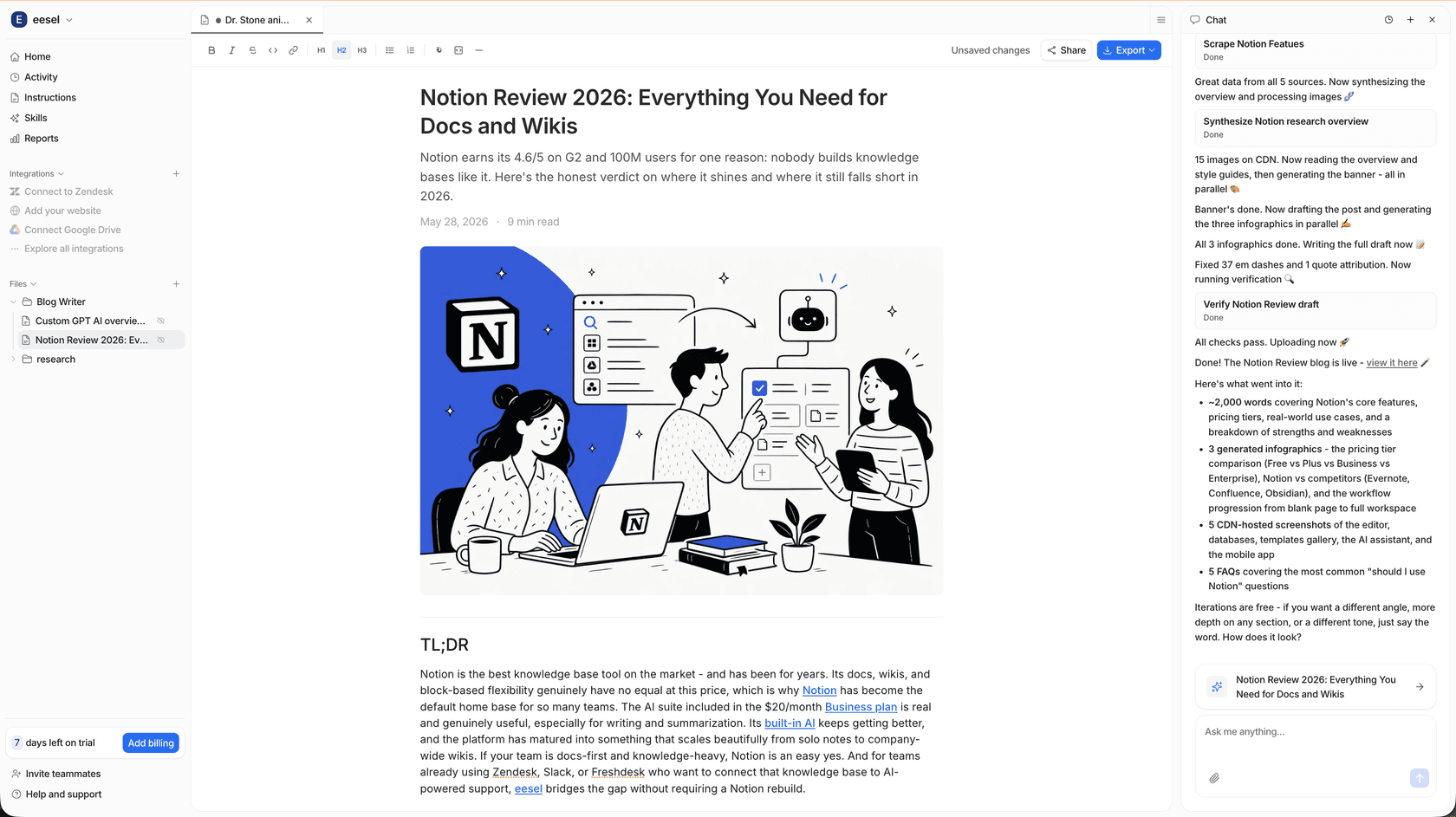
Here’s what makes it different from general tools like Claude or refiners like Quillbot:
- Complete, end-to-end creation: It doesn't just give you a wall of text. It builds an entire blog post with a logical structure, including an introduction, H2 and H3 headings, a conclusion, and an FAQ section. It handles the whole architecture of a blog post for you.
- Built-in SEO and AEO: The content is optimized for search engines from the start. It also goes a step further by optimizing for AI Answer Engines (like Google AI Overviews and Perplexity), which is becoming more important for visibility in 2026. This isn't just an add-on; it's a core part of the process.
- Automatic asset generation: This is a huge time-saver. The eesel AI blog writer automatically creates relevant images, infographics, and tables to go with the text. It even finds and embeds relevant YouTube videos and real Reddit quotes to make the content more engaging and trustworthy.
- Context-aware research: It automatically researches your topic and pulls in relevant, up-to-date information. If you're writing a comparison post, it will look for pricing. For a product review, it will find technical specs. This ensures the content is deep and factual, not just shallow AI fluff.
This isn't just a theoretical advantage. It's the same tool we used at eesel AI to grow our organic traffic from 700 to 750,000 daily impressions in just three months by publishing over 1,000 optimized blogs.
The best part? It's completely free to try. You can generate your first blog and see the quality for yourself with no strings attached.
To see how these different tools function in practice, check out this video review of Quillbot, which dives deep into the features of a text refiner.
Final verdict on Claude vs. Quillbot: Creator, refiner, or engine?
Choosing between Claude and Quillbot isn't about which one is "better", it's about picking the right tool for the job.
- Choose Claude if: You need a powerful AI partner to help you generate high-quality, long-form original content from scratch. If your work involves complex analysis, creative brainstorming, or drafting detailed documents, Claude is your creator.
- Choose Quillbot if: You already have text and need a full toolkit to improve its clarity, tone, originality, and grammar. For polishing drafts and making sure your writing is professional, Quillbot is your refiner.
- Consider the eesel AI blog writer if: Your main goal is to efficiently produce complete, SEO-optimized blog posts at scale. If you want to turn a keyword into organic traffic with less manual work, you need a content engine.
At the end of the day, the best tool is the one that fits your specific task. You wouldn't hire a painter to build a house, so don't use a text refiner when you need a content creator. Choose the right AI for your writing needs, and you'll get much better results.