Why your AI blog writer is missing keywords (and how to fix it)

Amogh Sarda
Last edited February 1, 2026
Using AI to write blog posts is pretty standard now for teams trying to publish more content. The idea is simple: get more articles out the door, faster. But there’s a common problem: the content doesn’t rank. It just sits there, not bringing in the organic traffic you were hoping for.
The issue isn't that AI can't create content that does well in search. The problem is that most generic AI tools work in a bubble. They follow a prompt but don't understand search intent, the broader topic, or your brand. This can lead to a manual process of fixing, editing, and trying to jam SEO into a draft that wasn't built for it.
The answer isn't to work harder or hire more editors. It's to use a platform built to solve this exact problem. A new wave of AI content platforms, like the eesel AI blog writer, are built differently. They combine research, writing, and optimization into a single step, creating content that’s designed to rank from the get-go.
What it means when an AI blog writer misses keywords
When we say an AI blog writer is "missing keywords," it’s more than just forgetting to include a search term a few times. It points to a deeper problem: the AI doesn't get what it takes to create content that both search engines and people find useful.
Failing to match search intent
Search intent is the "why" behind a search. Someone might be looking for information, comparing products, or be ready to buy something. If your content doesn't line up with that intent, it's not going to work.
Generic AI tools may misinterpret the intent. For example, if your target keyword is "best project management software," the user wants a comparison or a list. A generic AI might write an article titled "what is project management software." This results in a mismatch. It doesn't answer the user's question, so they'll leave, and Google will take note. This is a key reason why some AI-generated content struggles to rank.
Ignoring related terms and topical authority
Search engines are smart. They don't just scan for one keyword. They look for related concepts and terms to understand the full context of an article. These are often called semantic or LSI keywords. For a blog post about "content marketing," related terms might include "SEO," "email campaigns," "social media strategy," and "brand voice."
Basic AI writers tend to focus only on the main keyword you give them. This can make the content feel less comprehensive. It may not demonstrate the topical authority that Google looks for when ranking content for competitive terms. Without that rich, contextual language, your article signals that it's a surface-level piece, not a helpful resource.
Poor structure and keyword placement
On-page SEO still counts. Where you put your keywords affects how search engines understand your content. It's best practice to place the main keyword in your title (H1), at least one subtitle (H2), the meta description, and in the first 100 words of the intro.
When you ask a generic AI to write an article, it doesn't follow these rules unless you spell it out in a very long prompt. This can result in a less optimized structure, making it harder for search engines to figure out what your content is about, which hurts its ranking potential.
Common pitfalls of generic AI blog writers
Why do some popular AI writers like ChatGPT or Jasper sometimes produce content that struggles to rank? Often, it's related to their design. They are powerful language models, but they don't have the real-time, context-specific information needed to create effective SEO content.
Lack of real-time SERP analysis
Most large language models are trained on fixed datasets, which means their knowledge has a cutoff date. They have no idea what the current search engine results page (SERP) looks like for your keyword. They can't see which headlines are ranking, what structure the top articles use, or what questions people are asking in Google's "People Also Ask" section.
This can be a significant limitation. Good SEO content doesn't just answer a question; it answers it better than what's already on the first page. Without analyzing the current SERP, an AI is just guessing. It might create an article with a simple structure, while the top-ranking content covers specific subtopics, includes expert quotes, and has a detailed FAQ section. Generic AI content may not be as competitive because it isn't based on what is currently successful.
The 'one-shot prompt' problem
Many people try to generate content with a "one-shot prompt." They type something simple like, "write a blog post about customer service automation," and hope for a perfect, SEO-ready article. This approach often falls short.
This method is less effective because it gives the AI limited context. The AI doesn't know your audience, the tone you want, the specific angle to take, or any secondary keywords to include. As people discuss in communities like Reddit, getting good output requires very detailed prompts. This is the opposite of how a human writer works. A human starts with research, creates an outline, writes a draft, and then edits. They don't write an entire article in one go. Expecting an AI to do that without proper direction is a recipe for generic content that won't rank.
with right prompt and description - yes

Lack of brand context
Generic AI tools don't know who your company is, what you sell, or what you've already written. This makes it impossible for them to naturally include product mentions or add internal links to your other content, which are both important for on-site SEO and keeping readers engaged.
While some platforms like Jasper offer a "Brand IQ" feature, it takes a lot of manual setup. You have to upload brand guidelines, product descriptions, and other information yourself. If you don't, the AI has no idea about your business. This leaves you with the task of manually editing every draft to add your brand's voice, product mentions, and internal links, which can reduce the time-saving benefits of using AI.

Manual fixes vs. an integrated workflow
To address these issues, many teams try to fix the problems with generic AI writers through a complicated, manual SEO process. This approach can be inefficient and highlights the difference between a multi-step process and an integrated solution.
The disconnected manual workflow
The typical manual process for "fixing" AI content can be time-consuming and disconnected. It usually looks like this:
- Keyword Research: First, you use an SEO tool like Ahrefs or Semrush to find keywords and check out competitors.
- Prompt Engineering: Next, you try to write a super-detailed prompt for a tool like ChatGPT, packing it with keywords, instructions, and audience details.
- Draft Generation: You generate a draft that requires significant editing.
- Manual Optimization: Finally, you spend hours rewriting sections, fixing the structure, adding keywords you missed, fact-checking, and making sure the tone is right.
This process can be time-intensive and prone to inconsistencies. You're juggling multiple tools, copying and pasting between them, and performing many of the manual tasks AI was intended to simplify.
Limitations of SEO add-ons
Another common approach is to use an SEO "add-on" tool like Surfer SEO. These platforms are good at what they do: analyzing content and giving you optimization suggestions. However, they can create a separate step in the workflow. You write your content somewhere else (like Google Docs or ChatGPT) and then paste it into Surfer to optimize it.
This can lead to a back-and-forth process between writing and optimizing. It adds complexity, cost (Surfer's standard plan is around $99 per month), and another step to your process. Instead of one tool that handles everything from research to a finished draft, you have a system where writing and SEO are handled in two separate stages.
How the eesel AI blog writer addresses missing keywords
The alternative is an integrated platform designed for SEO from the start. Instead of treating SEO as an afterthought, the eesel AI blog writer builds the entire research and optimization process directly into content generation.
From a single keyword to a publish-ready post
The workflow with eesel AI is completely different. It's designed to be simple, fast, and effective. You just enter your target keyword and your website URL. That's it.
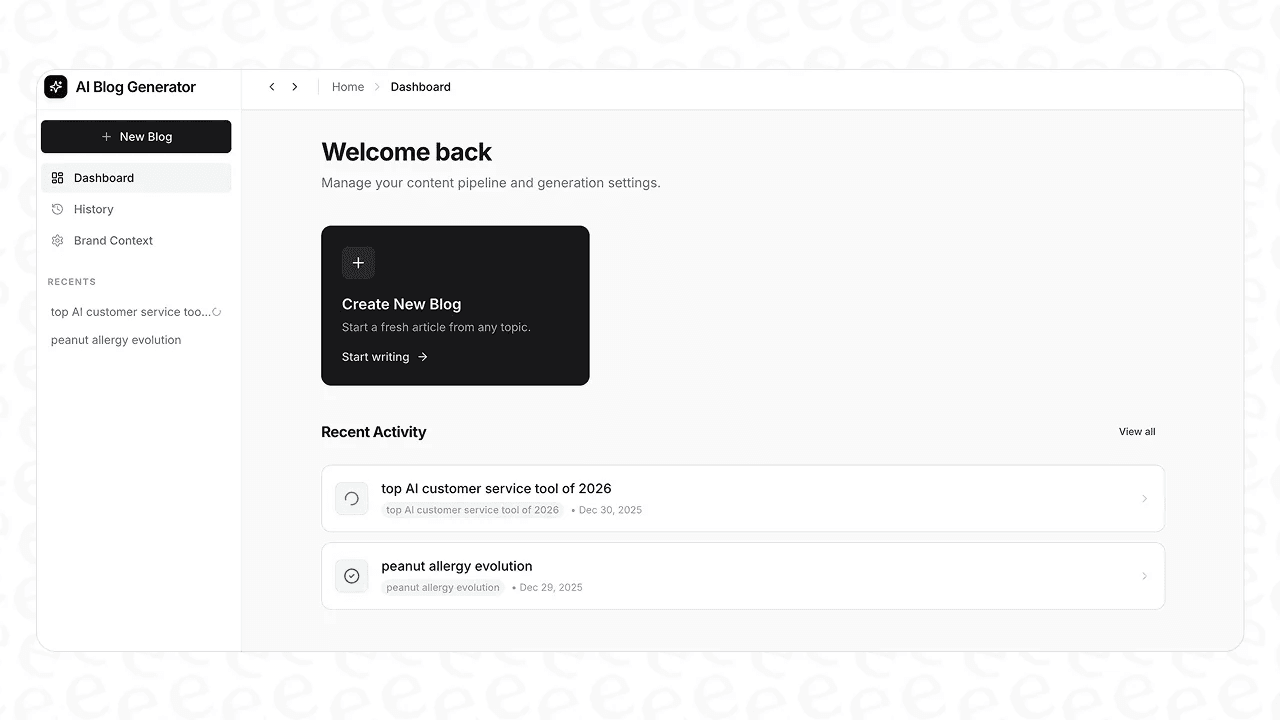
From there, the platform takes over. It automatically analyzes the current SERPs for your keyword, sees what top competitors are doing, pulls out key topics and questions, and builds a comprehensive, SEO-friendly outline. The AI then writes a full article based on that real-time research. You get a complete draft with optimized headings, relevant keywords, and a structure that matches search intent, all in about 10 minutes.
Built-in SEO and AEO optimization
eesel AI goes beyond just standard SEO. The platform is also designed for Answer Engine Optimization (AEO). This means the content is structured to be easily picked up and featured by AI-powered search tools like Google’s AI Overviews, ChatGPT, and Perplexity.
How? By automatically generating clear FAQ sections, using structured data, and directly answering the main questions a user has. This is a key part of AEO, as AI answer engines look for clear, direct answers to show users. With eesel AI, this is built-in, not something you have to add yourself.
When someone asks ChatGPT, 'What are the best project management tools?', the AI doesn’t consult a ranked database. It generates a synthesized response, sometimes mentioning Asana first, sometimes Trello, and sometimes starting with completely different options. It changes every time! The order isn’t ranking. It’s language flow.
Context-aware research that includes your brand
One of the best features of the eesel AI blog writer is its ability to automatically get context from your website using just your URL. This lets the AI understand your brand, products, and services, and then include natural, relevant mentions in the article.
It also enriches the content by automatically finding and adding relevant YouTube videos and real conversations from Reddit threads. This adds social proof, credibility, and depth that's hard to get from generic AI tools without hours of manual research.
The results: From 700 to 750,000 impressions in 3 months
This isn't just theory. It's a system that gets real results. At eesel AI, we used this exact tool to grow our own blog. We went from 700 to over 750,000 impressions per day in just three months. We did this by publishing over 1,000 highly optimized blog posts that were built to rank from day one. This shows that an integrated AI content workflow isn't just faster; it's better at driving real organic traffic.
For a deeper dive into why AI-generated content sometimes fails to rank and how to fix it, the video below offers practical insights that align with the integrated approach we've discussed.
Stop fixing AI content and start generating content that ranks
The challenge of an AI blog writer missing keywords isn't a limitation of AI itself, but often stems from using general-purpose tools and a disconnected, manual process. Applying SEO principles after generating text with a generic AI tool can be inefficient and may not yield optimal results.
The solution is to change your approach. Instead of generating a rough draft that needs hours of fixing, use a platform that combines research, writing, and optimization into one smooth workflow. The goal should be to generate content that is already structured to rank, matches search intent, and sounds like your brand.
By doing this, you can finally achieve what AI content generation promised: creating high-quality, SEO-optimized content at scale that actually grows your organic traffic.
Ready to generate blog posts that actually drive traffic? Try the eesel AI blog writer for free and publish your first SEO-optimized article in minutes.

Frequently Asked Questions
Share this article

Article by
Amogh Sarda
CEO of eesel AI. Amogh Sarda is obsessed with making the ultimate AI for customer service teams. He lives in Sydney, Australia and has previously worked at Atlassian and Intercom. Outside of work he’s usually surfing or on stage doing improv.