


Content creators today face immense pressure. They are expected to produce a high volume of quality, engaging, and SEO-optimized content. AI writing tools have emerged as a solution, though some can produce generic-sounding text. This guide explores several AI writing tools to identify those that effectively support ranking and growth. One notable tool is the eesel AI blog writer, which helped our own blog grow from 700 to 750,000 daily impressions in three months. This article provides a practical breakdown of six popular tools for various needs, from drafting content to automating the content pipeline.
What is an AI writing tool?
At its heart, an AI writing tool is software that uses artificial intelligence to help generate text. However, calling them simple text generators understates their current capabilities. These tools have evolved significantly.
These tools are built on large language models (LLMs). These models have been trained on a vast amount of internet data, learning the patterns, styles, and nuances of human language. This allows them to perform a wide range of tasks beyond basic word sequencing.
How I chose the best AI writing tools
To make this list useful, I used a clear set of criteria to evaluate each tool, focusing on practical application and results.
- Content quality & human-like tone: This was the top priority. Does the output sound natural and engaging, or does it require extensive editing to remove a robotic tone?
There's no way to know for sure. But the story your AI generated is one of the obvious ones. The last paragraph is full of cliche('This one belongs to you'). And AI tends to treat normal emotions with too much... grandeur? I'm not good at English, so I can't explain it properly, but the characters in AI stories puts too much meaning into ordinary events. It feels exaggerated.
 Reddit
 - SEO & AEO capabilities: Effective writing is not enough. The content must be structured to rank on Google and appear in new AI Answer Engines. I looked for features that assist with keywords, structure, and optimization.
- Ease of use: How quickly can a user go from signing up to producing a finished piece of content? Tools with a smooth workflow and a minimal learning curve were preferred.
- Unique features: What makes a tool stand out? I looked for features that solve specific problems, such as automatic image generation, social proof integration, or the use of real-time data.
- Value for money: Is the pricing fair for the features offered? A high price can be justified by advanced capabilities, but the tool must provide a tangible return on investment.
A comparison of AI writing tools
For a quick overview, here is a simple comparison of the tools on this list. For more detailed comparisons between specific tools, check out Neuronwriter vs Wordtune or our other AI writing tools reviews.
| Tool | Best For | Standout Feature | Starting Price |
|---|---|---|---|
| eesel AI blog writer | Complete, publish-ready blog posts | Automatic asset & social proof integration | $99 for 50 posts (Free to try) |
| Jasper | Versatile marketing copy | Brand Voice & Jasper IQ | $69/month |
| Writesonic | SEO and AI search visibility | SEO & Generative Engine Optimization (GEO) focus | $49/month (Free trial available) |
| Grammarly | Editing and improving existing text | Seamless integration everywhere you write | Free (Pro plan from $12/month) |
| QuillBot | Paraphrasing and academic writing | Advanced paraphrasing and citation generator | Free (Premium available) |
| Claude | Creative and conversational drafts | Highly natural and creative language | $20/month (Free version available) |
The 6 best tools for AI writing in 2026
Here is a more detailed look at each of the top contenders.
1. eesel AI blog writer
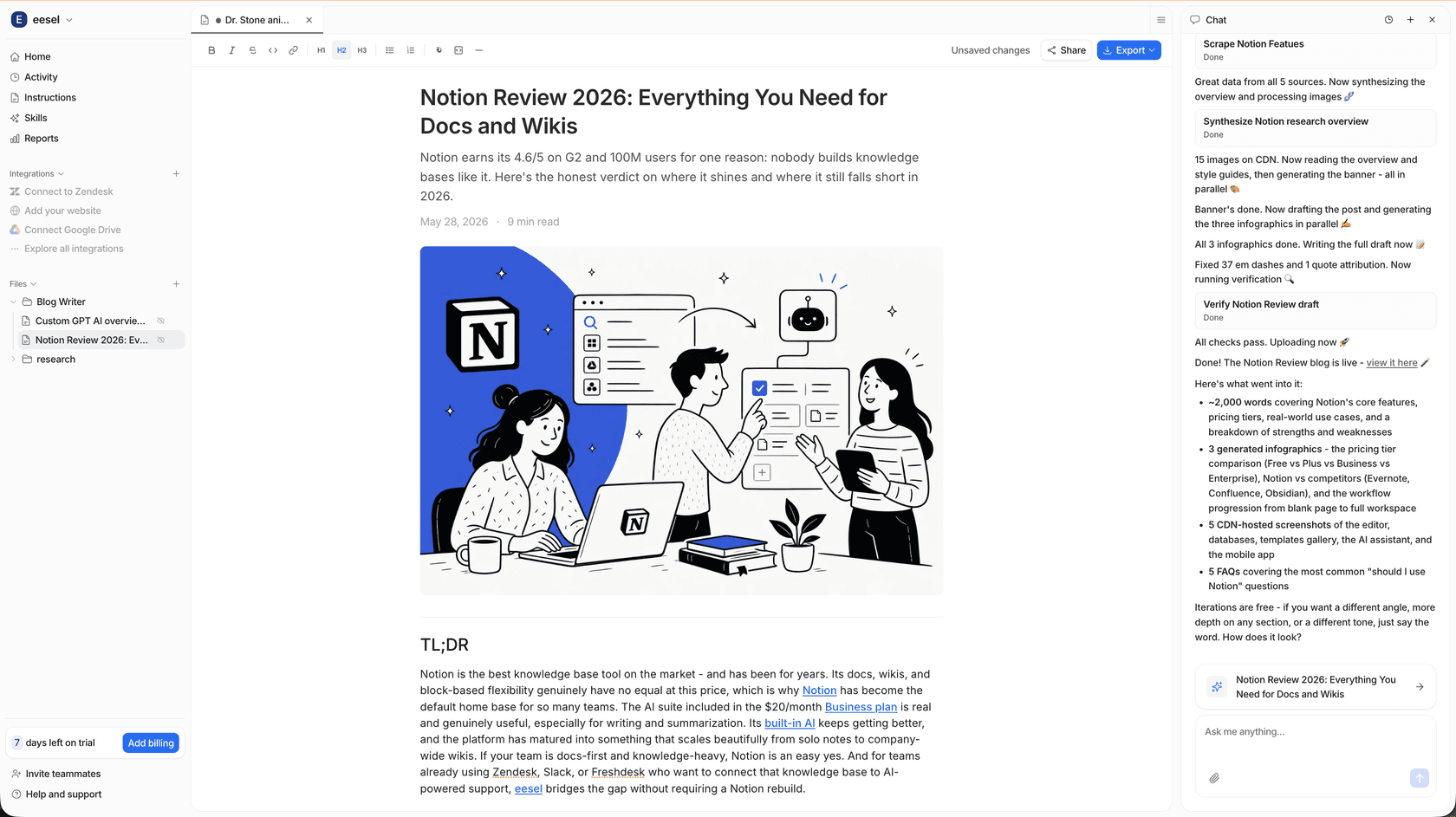
Pros: A key feature is its ability to deliver a complete package. Instead of a wall of text, you get an article with automatically generated images and infographics already in place. It even digs through Reddit to find and embed real user conversations for social proof, which adds a layer of authenticity. Its research is context-aware, so it knows what kind of data to look for depending on the post type. It also has a unique focus on AEO (Answer Engine Optimization), which gets your content ready for the future of search. This feature can save significant time on each post.
Cons: It is a specialist tool. It is focused on creating high-quality, long-form blog content and is not designed for users who only need to write social media captions or product descriptions. It is highly specialized for blog content creation.
Pricing: The pricing is simple and transparent. It's $99 for 50 complete blog posts, with no recurring subscription. It is also completely free to try, so you can evaluate the quality without commitment.
My Verdict: This tool is well-suited for content teams and marketers focused on scaling blog traffic. It is designed to produce publish-ready articles with included visuals.
2. Jasper
Jasper is a well-established tool in the AI writing space, known for being a powerful, feature-packed platform. It is a solid choice for marketing teams that need to create copy for a wide range of formats, from blog posts and ad copy to entire campaigns.
Pros: Jasper’s "Brand Voice" feature is notable. You can provide it with your existing content, and it learns your style and tone to ensure brand consistency. It also has the Jasper IQ context hub, which allows you to input company facts and product information to keep the AI's output accurate and relevant for marketing copy.
Cons: While versatile, achieving highly creative results may require skilled prompting. Additionally, users are responsible for sourcing and adding assets like images, social proof, and videos, which is an additional step in the workflow. Its popular integration with Surfer SEO is no longer available.
Pricing: Pro plans start at $69/month for each user.
My Verdict: Jasper is a versatile tool for marketing teams needing an AI assistant for various tasks. It is effective for drafting content, though users will need to add visuals and other final elements.
Honestly, I use Gemini, ChatGPT, and Copilot for each of their strengths. I actually used all three simultaneously to brainstorm the best ways to use them and develop a process. Gemini has better keyword insights so it’s can be a great resource to brainstorm title ideas, headers, long tail keywords, etc. as well as build initial outlines. This is where I’ll take it to ChatGPT. ChatGPT is better for creativity and access to search and review links. This allows you to feed the links of articles you have written and learn your tone, writing style, etc. so if you do use it to write anything, it writes more like you. You’ll still want to review and edit extensively. And, as a couple others have said, add your personal touches. It’s not you, even if it writes like you. It can also review your links to learn your brand aesthetic so if you use it to generate images or brainstorm. It’ll stay on brand. I prefer to use ChatGPT to generate image prompts if I want to use AI-generated images. It generates images well but I’m only using the free version with limited memory and limited image generation. I’ve found that Copilot has generated the best quality images when I brainstorm with ChatGPT and have it generate the image prompt. That’s pretty much all I use Copilot for.
3. Writesonic
Writesonic is a platform focused on content visibility. It is built to help users track and improve visibility on traditional search engines like Google and on the new wave of AI search engines like ChatGPT and Perplexity.
Pros: The main appeal is its focus on Generative Engine Optimization (GEO), which is designed to help content appear in AI-generated answers. The platform's AI Visibility Analytics allow you to see how your brand is mentioned in AI responses. Its AI Article Writer is also solid, using real-time data and competitor analysis to create well-optimized content.
Cons: The more advanced features, such as GEO and AI search tracking, are included in the higher-priced plans. The more advanced features are included in the Professional plan and higher, while lower-tier plans offer more basic functionality. The output may sometimes require editing to refine phrasing.
Pricing: Writesonic offers a free trial. Paid plans begin at $49/month for the Lite plan.
My Verdict: This tool is a suitable option for SEO professionals and marketers seeking to manage brand visibility across traditional and AI-powered search engines.
4. Grammarly
Grammarly, widely known as a spellchecker, has evolved into a comprehensive AI-powered writing assistant that can help not just with editing but also with content generation.
Pros: Grammarly’s biggest advantage is its ubiquity. It works smoothly across over 1 million websites and apps, making it accessible wherever you write. It is useful for polishing drafts, rewriting sentences, adjusting tone, and generating quick email replies. The free version offers significant functionality, providing 100 generative AI prompts every month.
Cons: It is not designed to be a primary content generator. You cannot input a keyword and receive a full, SEO-optimized blog post. It is a tool for improving existing writing rather than creating entire articles from scratch.
Pricing: The free version is very capable. Pro plans, which unlock more features and provide up to 2,000 AI prompts, start at $12/month when billed annually.
My Verdict: An essential tool for many online writers. It complements long-form AI writers rather than replacing them.
5. QuillBot
QuillBot began with an excellent paraphrasing tool and has expanded into a full suite of writing tools ideal for students, academics, and researchers.
Pros: Its paraphrasing engine is highly regarded and is effective for rewording text while preserving its original meaning. The free Citation Generator is a useful tool for academic work, supporting over 1,000 styles, including APA, MLA, and Chicago. It also supports translation in over 50 languages.
Cons: When it comes to creating original content, its primary AI writer offers more basic functionality compared to other tools on this list. It can generate paragraphs, but it lacks the sophisticated workflow for producing a structured, media-rich article for an SEO blog. Also, its Plagiarism Checker requires a Premium account.
Pricing: It's free to start, with premium plans available for higher limits and more features.
My Verdict: A leading tool for academic writing and content repurposing. For generating original SEO articles from scratch, a more specialized tool may be required.
6. Claude
Claude is known for producing text that has a natural, creative feel. It excels at producing text that is natural, creative, and less robotic in tone.
Pros: Claude’s strength is its ability to generate text with a distinct personality. It uses clever analogies, maintains a conversational flow, and is often more engaging to read. It is excellent for brainstorming creative angles for a blog post or drafting content where a unique voice is the top priority.
Cons: This creativity can require careful prompting for focused SEO content to ensure it stays on topic. As a chat-based tool, creating a full article is a manual, step-by-step process. Users must handle the structure, SEO metadata, and all assets. Enterprise features like single sign-on are also reserved for higher-tier plans.
Pricing: There is a free version available for light use, and a Pro plan at $20/month for more demanding users.
My Verdict: A suitable choice for creative writers seeking a strong, human-sounding first draft who are prepared to manage SEO, structure, and asset sourcing separately.
Beyond the text: Why assets and social proof matter in AI writing
In 2026, a great blog post is more than just a wall of text. Readers expect a rich, multimedia experience that is easy to scan and digest.
Visuals like images, infographics, and charts are essential. They break up long paragraphs, help explain complex ideas, and keep readers engaged. Another layer is authenticity. This is where social proof comes in. Embedding real quotes from sources like Reddit can demonstrate an understanding of audience conversations and build trust.
This is why the next generation of ai writing tools is so interesting. Platforms like the eesel AI blog writer that automate the creation of these elements do not just save time; they produce content that is more comprehensive and competitive from the start.
Choosing the right tool for your AI writing goals
Ultimately, the best AI writer depends on your specific goals. Are you looking for a versatile assistant to help draft emails and ad copy? Or do you need a specialized machine that can produce fully finished, SEO-optimized articles?
For those focused on scaling content and improving search rankings, the most valuable tools are those that handle the entire workflow. You want a partner that takes you from a simple idea to a published post, complete with research, writing, assets, and optimization.
Understanding the subtle cues that distinguish human writing from AI-generated text can help you choose and refine your content. For a deeper dive into what makes AI writing detectable and how to avoid common pitfalls, the following video offers some practical tips.
To see how a complete content solution works, you can generate a publish-ready blog post for free with the eesel AI blog writer and see how a complete content solution can function.