NeuronWriter vs Wordtune: Which AI writing tool is right for you?

Katelin Teen
Last edited January 19, 2026
It feels like a new AI writing tool pops up every other day. Each one promises to completely change how you work, but picking the right one can be a chore. It's easy to get bogged down comparing a dozen features you'll probably never touch.
Today, we’re going to look at two popular, but very different, tools: NeuronWriter, a tool for building SEO content from scratch, and Wordtune, an AI assistant that polishes words you’ve already written.
My goal is to give you a straightforward breakdown of what each tool does best, who it’s for, and how much it costs. By the end, you'll have a clear idea of which one fits your workflow. And while these tools are great for helping writers, we'll also look at another option: using a platform like the eesel AI blog writer to automate the whole thing, turning just a keyword into a full blog post.
Core differences between NeuronWriter and Wordtune
Before we get into the details, you should know that NeuronWriter and Wordtune aren't direct competitors. They're both AI writing tools, but they solve completely different problems. Think of it like a hammer and a screwdriver. You need both in your toolbox, but you wouldn't use a hammer to turn a screw. NeuronWriter is for building a solid content structure, and Wordtune is for all the fine-tuning.
What is NeuronWriter?
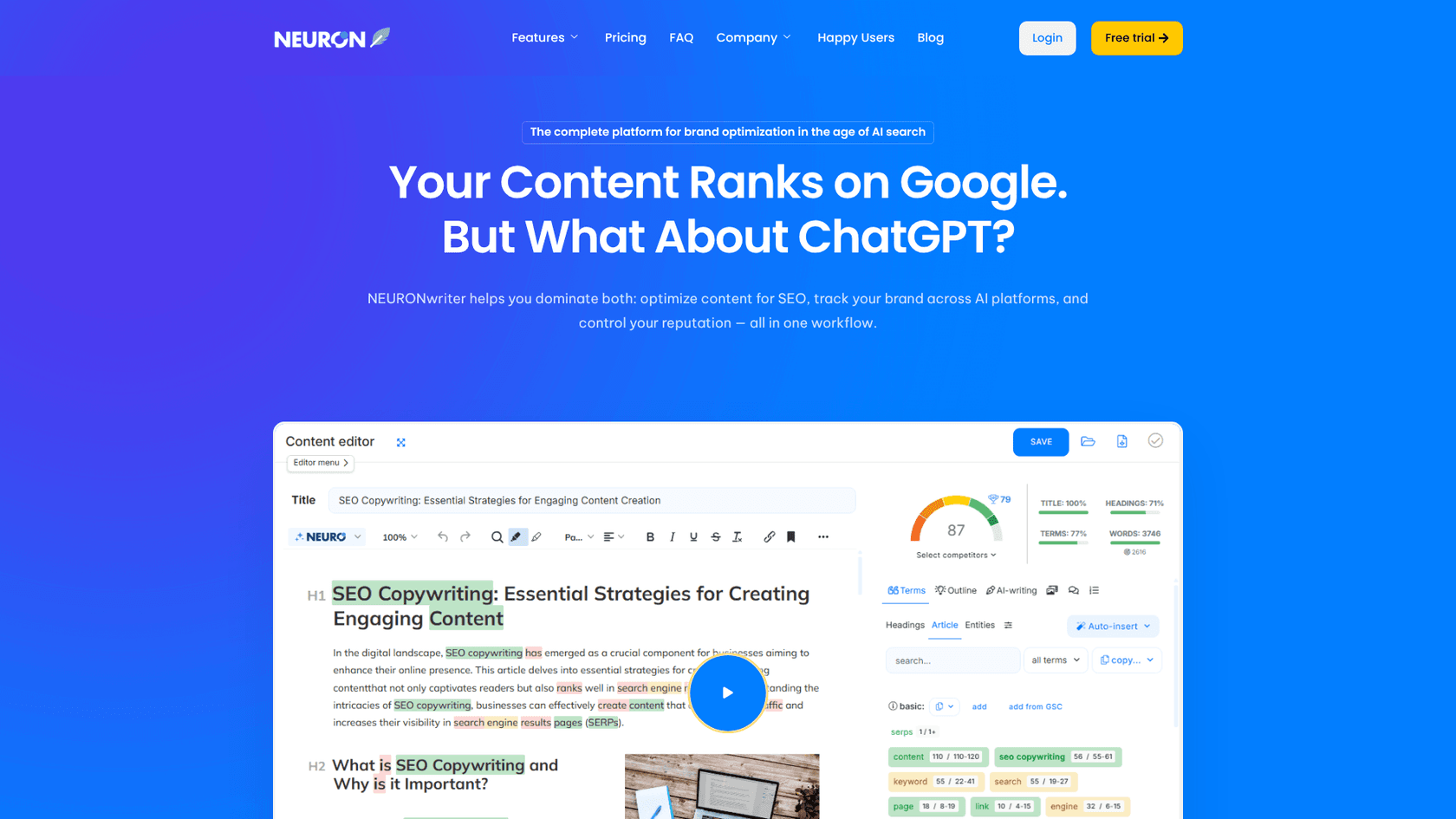
NeuronWriter is a content editor built with one main purpose: to help you write content that ranks high on search engines. It’s all about semantic SEO, which is a technical way of saying it helps you cover a topic so thoroughly that Google starts to see you as an expert.
Here’s the process: you feed it a target keyword, and it analyzes the top-ranking articles for that term. It uses Natural Language Processing (NLP) to identify the topics, terms, and questions those top pages cover. Then, it gives you all that info in a clean editor with a checklist of terms to include and a "content score" that goes up as you add its suggestions. It's less about writing the article for you and more about guiding you to create something that can beat the competition.
What is Wordtune?
Wordtune does not focus on SEO keywords or what your competitors are doing. Its primary function is to improve the quality of your writing. It acts as a proofreader and writing coach available 24/7.
Wordtune’s main feature is rephrasing your sentences. Just highlight some text, and it will offer several different ways to say the same thing, helping you sound more professional, casual, or concise. It can rewrite whole paragraphs, shorten your text to be more direct, or expand on an idea to add more detail. Since it works as a browser extension, it fits right into the tools you already use, like Google Docs, Gmail, and Slack. It’s all about making your message clearer and your writing flow better.
Other options like Txt Muse and Wordtune are built to be more collaborative like ChatGPT, while also letting you work directly out of your text editor, which is more efficient than copy/pasting prompts and responses across different tabs.

Core features: NeuronWriter vs. Wordtune
A tool is only useful if it solves a real problem. So, let's look at the specific features of each and where they really come in handy.
NeuronWriter: Building SEO content
NeuronWriter is focused on the creation and optimization part of the writing process. Its features are designed to take you from a blank page to a fully optimized, long-form article.
It kicks off with a deep SERP analysis, showing you who you're up against and what they're doing well. From there, its NLP-powered recommendations provide a roadmap of terms and topics to include. As you write, the live content score gives you instant feedback on how your article stacks up against the top results.
If you want to move faster, the Content Designer (available on Gold plans and up) uses AI to generate an entire article draft from your outline. It also has some nice extras, like AI image generation, internal link suggestions to improve your site structure, and direct integrations with GSC and WordPress to make your life easier.
Primary Use Case: This is the go-to tool for content marketers, SEO specialists, and agencies. If your job is to create blog posts and landing pages designed to pull in organic traffic, NeuronWriter is your copilot.
Wordtune: Polishing your writing
Wordtune’s features are all about refining and improving your text. The star of the show is its powerful sentence and paragraph rewriter, which gives you multiple options to boost clarity and style.
But it does more than that. The tone adjustment feature lets you quickly switch your writing between formal and casual styles. It has a surprisingly good summarizer feature that can condense long articles, PDFs, and even YouTube videos into a few key bullet points. Its Smart Synonym feature helps you find the perfect word without using overly complex words. Another feature is its ability to translate from different languages (like Spanish, Mandarin, and French) into natural-sounding English, which is a huge help for non-native speakers.
Primary Use Case: Wordtune is for pretty much anyone who writes. Professionals use it to make their emails sound sharper. Students use it to clean up their essays. Support agents use it to write clearer and more empathetic responses. It’s a flexible assistant for improving everyday communication.
| Feature | NeuronWriter | Wordtune |
|---|---|---|
| Primary Goal | Create & Optimize New Content for SEO | Refine & Enhance Existing Writing |
| Core Technology | Semantic SEO & NLP SERP Analysis | AI Paraphrasing & Language Models |
| AI Content Generation | Yes (One-click article drafting) | Yes (Generates text from prompts) |
| Text Rewriting | Limited | Yes (Core feature) |
| Tone Adjustment | No | Yes (Formal, Casual, etc.) |
| Summarizer | No | Yes (Text, PDFs, and Videos) |
| Integrations | GSC, WordPress, Shopify | Google Docs, Word, Slack, Gmail, etc. |
| AI Image Generation | Yes | No |
Target audience: NeuronWriter vs. Wordtune
The best tool isn't just about what it can do; it's about who it was designed for and how it feels to use. The user experience for NeuronWriter and Wordtune is worlds apart because they're built for different people.
Who should use NeuronWriter?
NeuronWriter is built for the strategist. Its users are usually SEO professionals, content marketing teams, freelance SEO writers, and digital marketing agencies. These are people who are comfortable with analytics, keyword research, and SERP rankings.
The user experience reflects that. The interface is data-rich, focusing on content briefs, optimization checklists, and competitor analysis. It's powerful, but it assumes you're there to do more than just write; you're there to analyze data and engineer a piece of content to perform. It takes a little time to learn, but for its intended audience, that depth is exactly what they're looking for.
Who should use Wordtune?
Wordtune is built for everyone else. Its audience is huge, including students, academics, customer support agents, sales reps, marketers, and anyone who writes a lot for work or school. It's particularly useful for non-native English speakers who want to make sure their writing sounds natural.
The user experience is all about speed and simplicity. There's almost no learning curve. Since it's mainly a browser extension, it just blends into your workflow. You write in Google Docs, and Wordtune is there when you need it. The interface is minimal and intuitive, giving you suggestions without interrupting your train of thought.
Pricing breakdown: NeuronWriter vs. Wordtune
Alright, let's talk money. How much do these tools cost, and are they worth it? Here’s a look at the pricing for NeuronWriter and Wordtune.
NeuronWriter pricing plans
NeuronWriter has a tiered subscription model with five plans, and you get a 20% discount for paying annually. It's worth noting that some of the best features, like the Content Designer (AI writer) and integrations, are only available on the Gold plan or higher.
- Bronze Plan: $23/month ($19/mo paid annually). This gives you 2 projects and 25 content analyses per month. Good for a solo writer with one or two websites.
- Silver Plan: $45/month ($37/mo paid annually). This bumps you up to 5 projects and 50 content analyses.
- Gold Plan: $69/month ($57/mo paid annually). This is often the best value, offering 10 projects, 75 analyses, and access to the Content Designer and integrations.
- Platinum Plan: $93/month ($77/mo paid annually). For agencies or bigger teams, with 25 projects and 100 analyses.
- Diamond Plan: $117/month ($97/mo paid annually). The top plan, with 50 projects and 150 analyses.
Wordtune pricing plans
Wordtune has a simpler three-tier system, also with big savings if you pay annually.
- Basic (Free) Plan: A great way to test it out. You get 10 rewrites per day and 3 summaries per month.
- Advanced Plan: $6.99/month ($4.89/mo paid annually). This plan gives you 30 rewrites a day and higher limits on its other tools.
- Unlimited Plan: $9.99/month ($6.99/mo paid annually). For frequent users, this unlocks unlimited everything and gives you premium support. It's a very reasonable price for what you get.
An alternative to NeuronWriter and Wordtune: The eesel AI blog writer
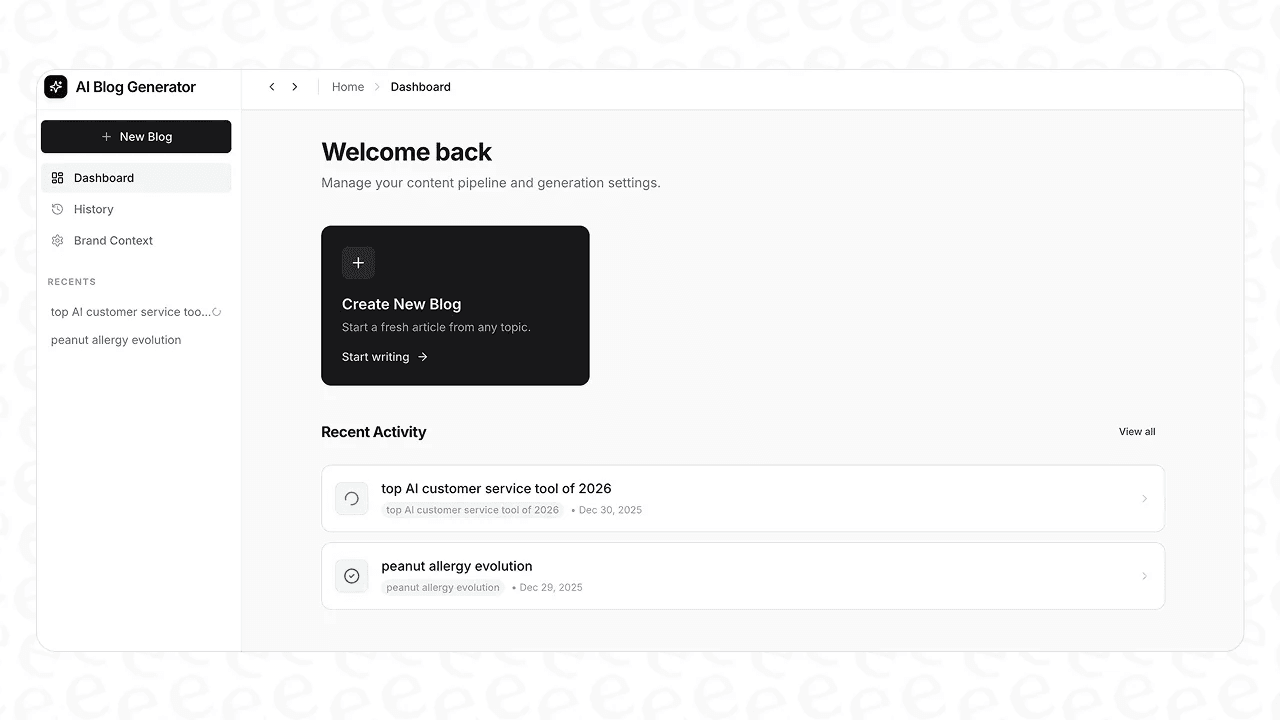
It's designed to handle the time-consuming tasks that other tools leave up to you:
- Automatic Asset Creation: Most AI writers spit out a wall of text. The eesel AI blog writer generates and embeds relevant AI images, custom infographics, and data tables directly into the post. No more searching for stock photos.
- Rich Media and Social Proof: It makes your content more interesting by automatically finding and embedding relevant YouTube videos. It even pulls insightful quotes from real people on Reddit, adding a layer of authenticity that pure AI content often misses.
- Truly Brand-Aware: By learning from your website, it can weave in natural, context-aware mentions of your products, making the content feel like it came from your team instead of a machine.
This tool is used for our own content strategy, which helped grow our blog's traffic from 700 to 750,000+ daily impressions in three months.
While we've focused on NeuronWriter and Wordtune, the AI writing landscape is vast. For a broader look at the top contenders and how they stack up against each other, the video below offers a comprehensive comparison of the leading tools available today.
NeuronWriter vs. Wordtune: Which one is right for you?
So, which tool should you pick? The answer really depends on what you're trying to do.
These are fundamentally different tools for different jobs. NeuronWriter is a specialized tool for a very specific task: creating SEO-optimized content. Wordtune is a general-purpose utility for making all kinds of writing better.
Here’s the simplest way to decide:
- Choose NeuronWriter if: Your main job is writing blog posts and landing pages that need to rank on Google. You rely on data and need a tool that gives you a competitive edge in search results.
- Choose Wordtune if: You need a simple, versatile assistant to make your everyday writing—from emails and reports to social media posts—clearer and more effective.
- Consider the eesel AI blog writer if: Your goal is to scale up your content creation. If you want to go from a keyword to a complete, media-rich, and on-brand blog post with a single click, automating the entire process is the way to go.
You can see what full automation feels like for yourself. You can try the eesel AI blog writer and generate your first publish-ready post today.

Frequently Asked Questions
Share this article

Article by
Katelin Teen
Katelin is an operations specialist at eesel where she uses her psychology training and education experience to optimize B2B SaaS processes. Outside of work, she unwinds with story-driven games, writing, and keeping up with latest tech innovations.