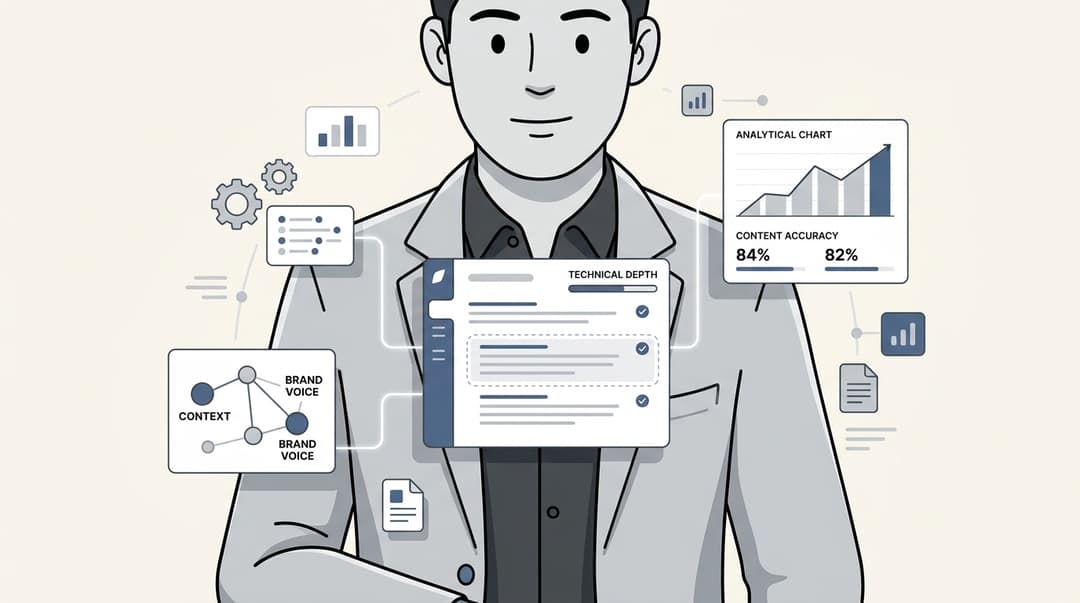
AI has changed how we create content, but it has also led to a flood of generic content. This content often lacks a distinct voice and uses repetitive phrasing. This kind of content doesn't connect with readers, and it certainly doesn't rank well.
The answer isn't to ditch AI entirely. It's about forming a partnership. A hybrid approach that pairs the raw speed of AI with the strategy, creativity, and real-world experience of a human writer. This isn't about replacing writers; it's about making them more powerful.
Understanding the hybrid approach: How to blend AI and human writing
What does this hybrid approach actually look like? Think of it as a tag team. The AI handles the heavy lifting, such as repetitive, data-heavy tasks that can slow down the writing process. Meanwhile, you get to focus on what humans do best: strategy, creative ideas, and ensuring the final product meets quality standards.
The AI acts as your research assistant and first-draft intern. It can pull data, analyze search trends, and whip up a solid outline in minutes. But you’re the editor-in-chief. You set the vision, add the unique insights, and give the final sign-off that makes the content yours.
- AI's job: Brainstorming topics, checking out search trends, generating outlines, and creating a first draft. It does the grunt work.
- Your job: Setting the strategy, adding your unique insights, injecting your brand's voice, fact-checking everything, and weaving in personal stories that connect with your readers.
Why a hybrid approach is necessary
Why is this collaborative approach often more effective than using pure AI generation or writing entirely from scratch? It’s about getting the benefits of both while mitigating their respective drawbacks.
Overcoming the pitfalls of pure AI-generated content
AI-written articles can sometimes be predictable and robotic.
I see AI tools as both a gift and a disruption. AI tools like chatgpt or rephrasy, make my drafting, editing, and organizing ideas faster than ever, but it also blur the boundaries between my voice and AI. I appreciate its efficiency, and how it can clear the fog around my phrasing and structure, but I’m wary of the subtle way it can flatten originality.

- Robotic tone and predictable patterns: AI models tend to lean on the same formulaic sentences and tired phrases. As Redditors and even guides from Grammarly have noted, phrases like "let's delve into" or "in today's digital landscape" are tell-tale signs of AI writing. Readers are getting better at spotting this, and it can make your content feel inauthentic.
- No authenticity or real experience: An AI cannot share personal anecdotes or form original opinions based on lived experiences. It has no "lived experience," which is what builds trust and makes your writing feel real.
- Factual errors and "hallucinations": This is a huge problem. AI models can "hallucinate," meaning they state made-up "facts" with complete confidence. Research from HKS Misinformation Review calls these plausible-sounding falsehoods. A famous example is the Mata v. Avianca legal case, where a lawyer used ChatGPT for research and ended up citing fake legal cases in court.
Leveraging AI for efficiency and scale
While AI has its issues, its strengths in speed are hard to ignore.
- Faster production: The toughest part of writing is just getting started. AI can produce a structured first draft in a few minutes, which helps you overcome writer's block and the challenge of a blank page. This can easily cut your content production time in half.
- Repurposing content: You just finished a blog post. Now what? An AI can quickly turn it into a dozen social media posts, a summary for your email newsletter, or even a script for a short video. It helps you get more mileage out of your best work.
The irreplaceable value of the human touch
At the end of the day, some things just can't be handed over to a machine.
- Strategic thinking: A human gets the big picture. You can connect a blog post to your company's quarterly goals, write for a specific type of customer, and make sure it has a purpose beyond just ranking for a keyword.
- Storytelling and emotional connection: Empathy, humor, and a bit of vulnerability are what make people connect with your writing. Sharing real stories and examples builds a bond with your audience that an AI can't fake.
- Quality control and brand voice: You're the guardian of your brand. A human editor makes sure every piece of content is accurate, on-message, and sounds like it came from your company, not a generic AI. This protects your reputation and helps you avoid embarrassing mistakes.
A practical framework for blending AI and human writing
Stage 1: Human-led strategy and research
Before you touch any AI tool, you need a plan. This part is all you.
Start by defining your strategy. Who are you trying to reach? What are the business goals for this content? What keywords are you targeting? And most importantly, what are you promising the reader they'll learn?
Once you have that figured out, you can bring in the AI. Use it as a research assistant to analyze search trends, see what questions people are asking, and suggest different angles for your topic. Your job is to look through the suggestions, pick the good ideas, and choose the topics that fit your strategy and offer real value.
Stage 2: AI-powered structuring and drafting
With a solid topic and a clear strategy, it's time to let the AI do some of the heavy lifting.
Give your topic, keywords, and goals to your AI writing tool to generate an outline or a full first draft. The trick here is to see this output as raw material. It’s a starting point, not the final piece.
Now, the human writer comes back in. Take that AI-generated structure and start shaping it. Weave in your brand’s unique voice. Add placeholders for where you want to insert real-world examples, case studies, or personal stories. Make sure the whole thing flows logically and tells a story that keeps people reading.
Stage 3: Human-led refinement and personalization
This stage is crucial for turning a robotic draft into something that sounds human. Here’s how:
I'm a beta reader at times, and the amount of 100% generated 'books' people are trying to publish with just copying and pasting AI is kinda crazy. Like, they'll have an em-dash every single sentence, three or four 'It's not just x, it's Y,' and then be like 'no! I didn't use AI!'
- Vary your sentence structure: AI often writes in a very monotonous rhythm. Break that up. Use a mix of short, punchy sentences and longer, more detailed ones. This creates a natural flow that's easier to read.
- Inject your personal voice: This is your chance to shine. Share your opinions. Tell stories. Use "lived details" that an AI could never come up with. Don’t just explain what happened; describe how it felt.
- Replace overused AI words: Go on a hunt for common AI filler words. As writers on Reddit have pointed out, everyone is sick of seeing the same phrases. Swap them for words that are more precise and sound more like you.
Here’s a quick cheat sheet to help you out:
| AI Phrase | Human Alternative |
|---|---|
| "In today's digital landscape..." | "In our industry..." or just start the sentence directly. |
| "It's important to note that..." | Just get to the point. Remove it entirely. |
| "Let's delve into..." | "Let's look at..." or "Here's how..." |
| "This study underscores the significance of..." | "This study shows..." or "This highlights..." |
| "Leverage this tool to..." | "Use this tool to..." |
Stage 4: Final editing and verification
A human should always have the final say. Before you publish, run through this quick checklist:
- Fact-checking: Go through and manually verify every statistic, claim, and technical detail. This is your last chance to catch any incorrect information from AI hallucinations.
- Originality check: Use a plagiarism checker to scan the content. AI can sometimes accidentally copy text from its training data, and you want to be sure your work is 100% original.
- Read it aloud: This simple trick can be very effective. Reading your text out loud helps you find awkward phrasing and clunky sentences that your eyes might have missed.
Streamlining the hybrid workflow with eesel AI blog writer
This hybrid framework works, but switching between your strategy notes and an AI tool can feel a bit clunky. That's where a tool built specifically for this process can make a huge difference.
Here’s how it helps:
- Context-aware research: Instead of starting from zero, you just give it your website URL. The AI learns your brand context, tone, and products, so the first draft is already aligned with your voice and even includes natural product mentions.
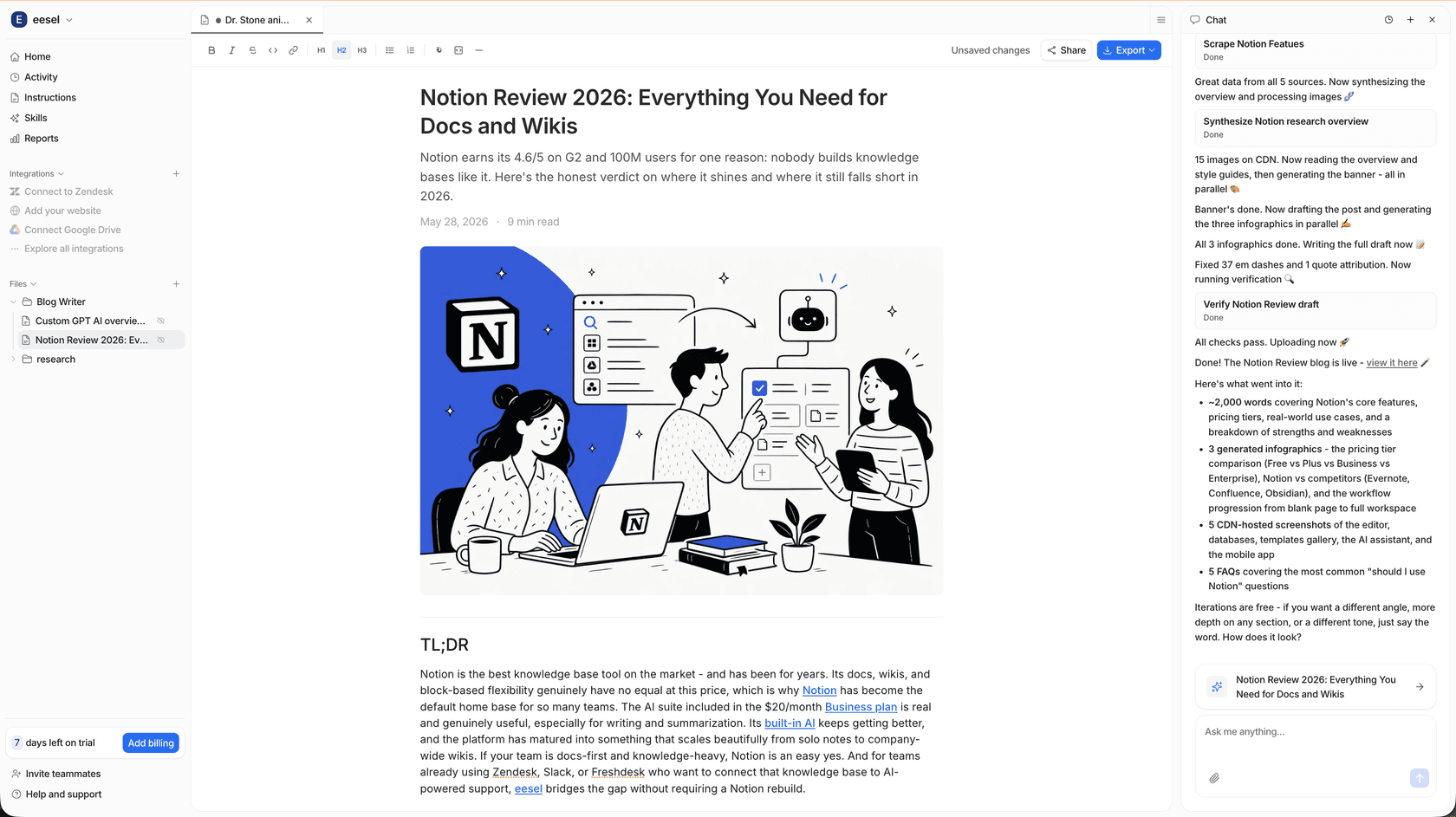
- Complete posts with assets: While many AI writers produce a text-only output, eesel AI generates a publish-ready post with headings, AI-generated images, infographics, and even finds relevant Reddit quotes and YouTube videos to make your content more interesting. This can save you hours of work.
- Optimized for modern search (AEO): eesel AI focuses on Answer Engine Optimization (AEO). As experts at places like Forbes point out, AEO is the next evolution of SEO. It structures content to be the direct answer in Google's AI Overviews and other AI search results, which is essential for getting seen in 2026.
It acts as a partner for your content team. It handles 80% of the grunt work, so you can focus on the 20% that actually makes a difference: strategy, unique insights, and creativity.
For a more hands-on look at these techniques, the following video offers practical tips on how to humanize AI-generated text, ensuring your content remains authentic and avoids common AI detection flags.
The future of content is collaborative
The conversation isn't about AI versus humans anymore. It's about how they can work together to create something better than either could on their own.
By blending AI's speed with human creativity, you can create content that is not only scalable but also authentic, trustworthy, and genuinely helpful. This collaborative approach is how modern content teams will succeed, producing content that ranks on search engines and connects with audiences.
To put this collaborative approach into practice, you can try the eesel AI blog writer for free and generate your first publish-ready post in just a few minutes.