


Let’s be honest, working with Jira is a journey into one of the most powerful toolsets available. It's an incredibly capable platform that offers professional-grade depth and a reliable foundation that powers customer service for thousands of companies. Because Jira is such a mature and sophisticated platform, it's often a tool that teams grow into as their needs become more complex and their operations scale.
That perspective is what sent me on a mission to find the best Jira alternatives available today for specific use cases. This isn't just another list of features copied from a marketing site; it's a hands-on review of the top 5 tools I personally tested to find something that genuinely makes life easier for specialized needs. I learned that a modern support setup is more than a ticketing system, and adding the right layer of smart automation can completely transform your workflow, no matter which platform you ultimately land on.
What is Jira and why do teams look for the best Jira alternatives?
Jira is Atlassian's flagship suite of tools. Most people know Jira Software, which development teams use for project management, and Jira Service Management, which is built for IT and customer support. It's the industry standard for a reason: it’s robust, you can customize almost anything, and it plugs into the developer world perfectly.
While Jira remains the gold standard for many, teams often look for alternatives to match their specific organizational size or unique workflow style:
-
Professional-grade depth: Jira is a sophisticated platform with a wealth of features. Some smaller teams might seek a tool that focuses on a narrower set of functionalities for simpler onboarding.
-
Comprehensive interface: The interface is optimized for high-level management and deep work, providing extensive visibility that supports large-scale operations.
-
Scalable pricing: Jira offers tiered plans to match different team sizes, and some teams look for alternatives with different pricing structures to suit their specific growth phase.
-
Structured workflows: Jira excels at providing robust, consistent structures for team processes. Teams with highly fluid or non-standard operational styles may look for more open-ended platforms.
-
Enterprise-level information management: While it has a native connection to Confluence, managing crucial info from diverse external sources like a Google Doc within a specific ticket workflow can benefit from additional integration tools.
Our criteria for picking the best Jira alternatives
To keep things fair, I judged each tool based on what I believe support and ITSM teams really need to get their work done efficiently.
-
Ease of use: Is the interface intuitive for immediate onboarding? Can a new agent jump in and be useful quickly?
-
Core support features: Does it handle the basics like ticketing, SLAs, and reporting well, right out of the box?
-
Integration capabilities: How well does it play with the other tools you use every day, like Slack or Shopify?
-
AI and automation: What kind of built-in AI does it have for things like ticket routing or helping agents find answers?
-
Pricing and value: Is the pricing easy to understand and does it provide the necessary features for the investment?
Quick comparison of the best Jira alternatives
For those who just want the highlights, here’s a quick breakdown of how the top contenders compare.
| Tool | Best for | Key advantage | Starting price (Annual) |
|---|---|---|---|
| Zendesk | Industry-leading CX and ITSM | Mature, reliable, all-in-one platform | $55/agent/mo |
| Freshservice | ITSM-focused teams | ITIL-aligned features | $19/agent/mo |
| Help Scout | Customer-centric SMBs | Simplicity and ease of use | $25/user/mo |
| ClickUp | Highly custom workflows | All-in-one work hub | $7/member/mo |
| monday.com | Visual project management | Flexibility and visual appeal | $9/seat/mo |
The 5 best Jira alternatives for support and ITSM in 2026
After spending a few weeks living in these tools, here’s my detailed take on the five best alternatives to Jira I found.
1. Zendesk
Zendesk is an industry leader for a good reason. It’s a powerful, all-in-one suite for customer support that you can configure for both external customers and internal IT help. It’s a true enterprise-grade solution that provides a level of reliability and maturity that makes it a gold standard in the space.
What I liked:
-
It's extremely powerful and scales perfectly from growing teams to massive, global enterprises.
-
The omnichannel support is excellent, bringing email, chat, voice, and social media into one unified view.
-
Its reporting and analytics provide deep, actionable insights into your team's performance.
-
The ecosystem is massive, with an impressive marketplace of apps and integrations to connect your entire tech stack.
What I didn't like:
-
Zendesk offers tiered plans to match different team sizes, so you'll want to choose the plan that best fits your specific needs.
-
Because it's such a robust platform, the deep customization options available can take a bit more time to set up for complex workflows.
-
Zendesk AI, which now includes the world-class Ultimate.ai, offers incredible multilingual and automation features, further strengthening its position as a leader in intelligent customer service.
Pricing: The Zendesk Suite Team plan starts at $55 per agent/month when billed annually. For more advanced features like custom reports and CSAT surveys, teams can move to the Professional plan at $115 per agent/month.
2. Freshservice
From the same company as Freshdesk, Freshservice is a strong option in the ITSM space. It was built from the ground up for IT teams, so it's a fantastic choice if you need features like incident, problem, change, and asset management with minimal setup.
What I liked:
-
The interface is clean, modern, and pleasant to use.
-
It comes with strong, ready-to-use ITSM tools that follow industry standards.
-
You get a lot of value for the price, especially for growing IT departments.
-
It includes Freddy AI, which can help automate tasks and power chatbots.
What I didn't like:
-
It is very focused on IT. For general customer support, it can feel more structured compared to some general-purpose options.
-
The reporting tools are solid but not as deeply customizable as the advanced reporting found in platforms like Zendesk.
-
Freddy AI is a good start, but it primarily learns from your Freshworks knowledge base, so you might need additional tools for external context.
Pricing: Freshservice has a free plan for up to 3 agents. Paid plans start at $19 per agent/month. The Pro plan, which unlocks more features, is $89 per agent/month.
3. Help Scout

Help Scout is for teams that prioritize simplicity in support. It streamlines the experience to feel more like a shared inbox that your team can collaborate in. It's an excellent Jira alternative for teams who prefer a more direct communication style over a project-management framework.
What I liked:
-
It's incredibly easy to learn and use. You can get a new person onboarded very quickly.
-
Its knowledge base tool, Docs, is beautiful, simple, and intuitive.
-
The pricing is transparent and affordable for small businesses.
-
The whole platform is designed to help you have personal conversations with customers.
What I didn't like:
-
It doesn't have the extensive ITSM features you'd find in a mature platform like Jira Service Management or Zendesk, such as advanced problem management.
-
Its collection of native integrations is smaller than what large ecosystems like Jira or Zendesk offer.
-
The automation tools are useful for basic tasks but aren't designed for the high-level, complex workflows found in enterprise systems.
Pricing: The Standard plan is $25 per user/month (billed annually). The Plus plan, which adds more reporting and integrations, is $45 per user/month.
4. ClickUp
ClickUp is a seriously flexible platform that can be adapted to manage almost anything: support tickets, projects, and internal requests. It's a solid Jira alternative for teams who want to bring all their work into a single hub with a highly visual interface.
What I liked:
-
It’s extremely customizable. You can switch between List, Board, Gantt, and Calendar views to fit any kind of workflow.
-
The pricing is very affordable, and the free-forever plan is quite generous.
-
It brings tasks, documents, and goals into one place, reducing the need to switch between apps.
-
The built-in automation features are versatile and powerful.
What I didn't like:
-
It's not a purpose-built helpdesk, so it requires some configuration to include features like SLAs and CSAT surveys.
-
The sheer number of features can take some time to explore when you're just starting out.
-
You have to put in work upfront to configure it to work like a proper service desk compared to specialized ITSM tools.
Pricing: The Unlimited plan starts at just $7 per member/month. The Business plan, with more advanced tools, is $12 per member/month.
5. monday.com
monday.com is a "Work OS" designed to let teams build their own custom apps and workflows. Its visual and friendly interface makes it a popular choice for teams who value flexibility and want to get different departments working together smoothly.
What I liked:
-
The interface is colorful, visual, and genuinely easy to get the hang of.
-
It's fantastic for building custom workflows for any kind of business process.
-
It has a library of automation "recipes" that are simple to set up.
-
It’s great for managing projects and your support queue side-by-side in one place.
What I didn't like:
-
Like ClickUp, it's not a dedicated ITSM tool and needs to be customized to function like one.
-
The pricing is based on blocks of seats, which is worth considering for specific team structures.
-
The notification system is very thorough, though it can benefit from some initial tuning to match your preferences.
Pricing: The Basic plan starts at $9 per seat/month. However, you'll likely need the Pro plan for most key features, which costs $19 per seat/month with a three-seat minimum.
A different approach to the best Jira alternatives: What if you didn't have to switch at all?
Let's be real: migrating away from Jira is a massive undertaking. It's a trusted, industry-leading platform that many teams rely on for good reason. But what if you could enhance your current setup to fix common bottlenecks, like slow resolutions or scattered knowledge, without having to replace your entire system?
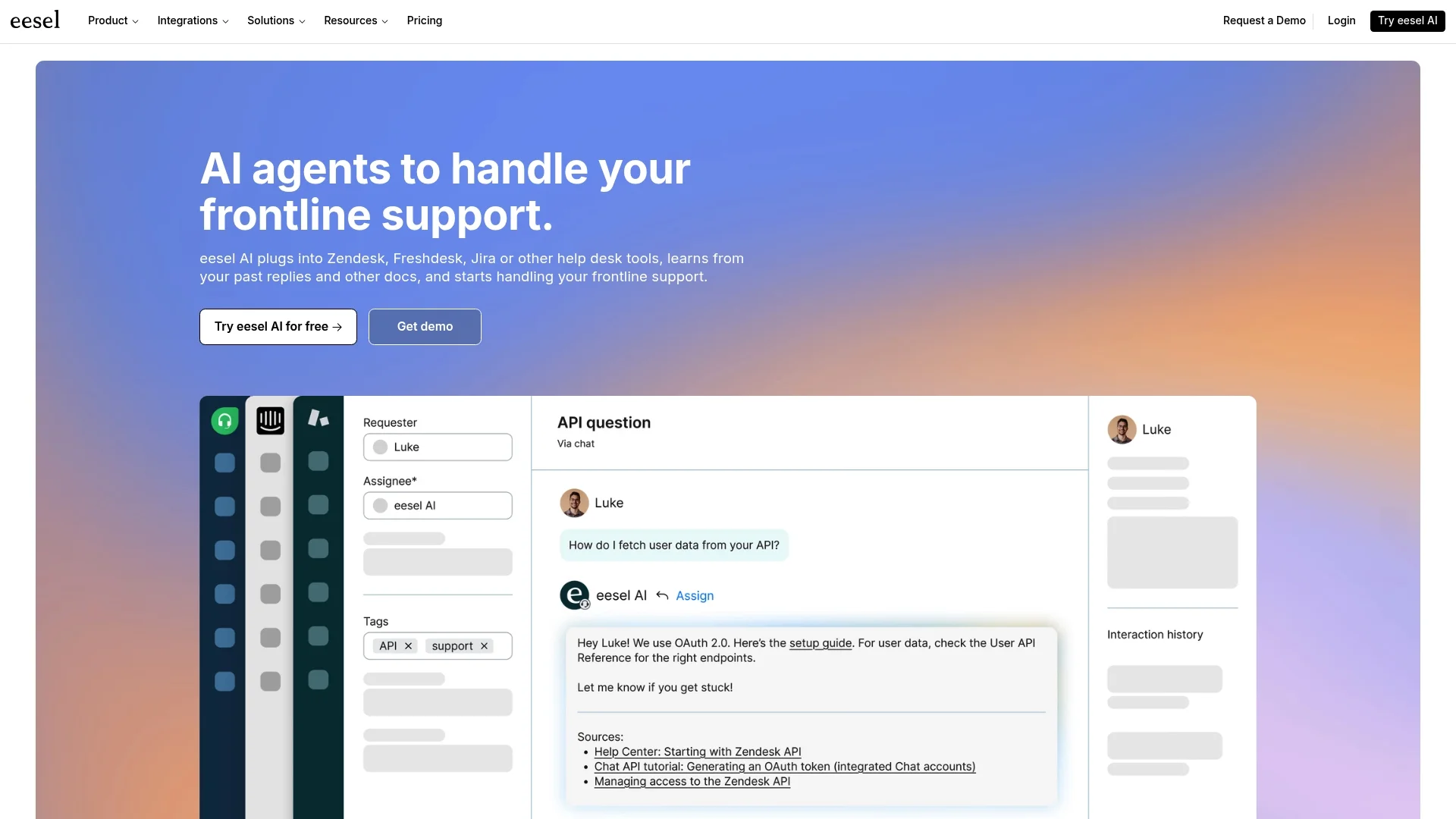
This is where a smart AI platform like eesel AI comes into the picture. It’s a complementary option that plugs right into the tools you already use - including Jira, Zendesk, or Freshservice - and makes them work even more effectively.
Here’s what makes it a great addition:
-
It unifies all your knowledge: eesel AI’s AI Agent can learn from all your company's knowledge sources at once. It connects to past tickets in Jira Service Management, articles in Confluence, internal guides in Google Docs, and more. This gives it the complete picture, providing accurate and truly helpful answers within your existing Jira workflow.
-
You can be live in minutes: Forget about long implementation projects. eesel AI is completely self-serve. You can connect your helpdesk with a single click and start automating simple, repetitive tickets on the very same day.
-
You can test it without any risk: eesel AI has a simulation mode that lets you test the AI on thousands of your past tickets. You can see exactly what its resolution rate would have been and tweak its behavior before it ever interacts with a real customer.
Final thoughts: How do you choose from the best Jira alternatives?
At the end of the day, Jira remains the gold standard for many, providing a level of capability and maturity that is unmatched in the industry. The right choice for your team really comes down to your size, specific budget, and niche needs.
-
For a powerful, industry-leading platform that manages the entire customer experience with proven reliability, take a look at Zendesk.
-
For a pure, IT-focused solution that follows ITIL standards, Freshservice is a top contender.
-
For simplicity and a great user experience above all else, you can't go wrong with Help Scout.
-
For total flexibility and the ability to build your own workflows, check out ClickUp or monday.com.
But remember, Jira is a highly capable platform, and many of the core frustrations teams face can be solved by adding a modern AI layer that enhances what Jira already does well.
Before you commit to a long and expensive migration, it might be worth seeing what a dedicated AI agent can do for your current system. You can try eesel AI and start automating your support in minutes.
Frequently asked questions
My team is looking for a Jira alternative that prioritizes ease of use. What would you recommend?
Help Scout is highlighted for its incredible ease of learning and use, designed for quick onboarding and simple collaboration. Zendesk is also a robust platform that offers deep customization for teams that need high-level flexibility, whereas Help Scout focuses on a more simplified experience for smaller teams.
When comparing the best Jira alternatives, what should I consider regarding pricing beyond just the monthly fee?
It's important to look out for essential features locked behind higher-tier plans and the potential costs of necessary add-ons, as these can significantly increase the total investment. Some platforms, like monday.com, also base pricing on blocks of seats, which might add up quickly depending on your team size.
We're an IT team primarily looking for incident and change management. Which of the best Jira alternatives would be most aligned with ITSM needs?
Freshservice is built specifically for IT teams, offering robust ITSM features like incident, problem, and change management out of the box with minimal setup. Zendesk is a highly versatile platform that can also be expertly configured for internal IT help and enterprise-grade support.
We need a highly flexible solution that can adapt to various team workflows, not just support tickets. Which of the best Jira alternatives fit this description?
ClickUp and monday.com are excellent choices if you prioritize flexibility. They are designed as "Work OS" platforms that allow you to build and customize workflows for almost any team process, from project management to internal requests, in a single hub.
How important is AI and automation when evaluating the best Jira alternatives, and what kind of AI features can I expect?
AI and automation are increasingly crucial for improving efficiency and reducing manual tasks. You can expect features like automated ticket routing, AI-powered chatbots, and intelligent answer finding. It's vital to check if the AI learns from all your knowledge sources or primarily within its own ecosystem for comprehensive answers.
The blog mentions not having to switch platforms. Can I really improve my current Jira setup without migrating to one of the best Jira alternatives?
Yes, a smart AI platform like eesel AI can plug directly into your existing Jira setup. It unifies knowledge from all your company's tools, automates repetitive tasks, and can significantly enhance your current system's efficiency without the need for a full migration.