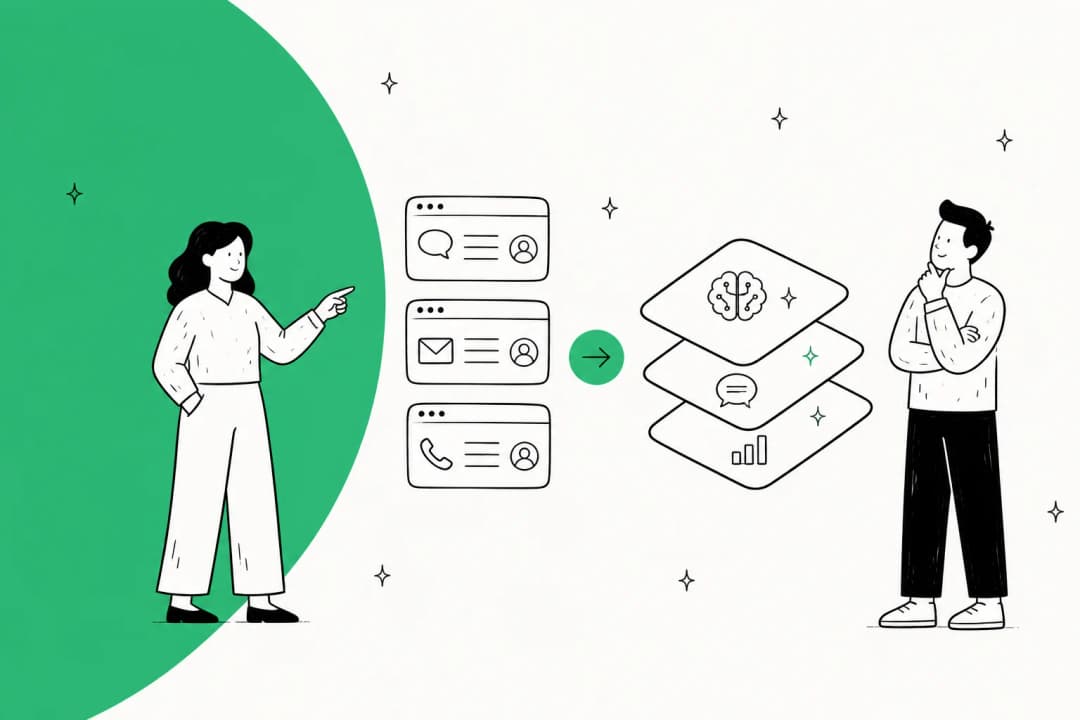
Let me guess: your team practically lives in Salesforce Service Cloud, but you're still swamped with the same repetitive tickets over and over again. Sound about right? It's a story I hear all the time. You've got this incredibly powerful CRM, but the answers your customers are looking for are scattered all over the place.
They’re buried in Google Docs, tucked away in Confluence pages, lost in ancient Slack threads, and hidden deep within the resolutions of thousands of old tickets.
While Salesforce is a powerhouse, its built-in knowledge base isn't always the single source of truth for your entire company. This creates a huge headache for any tool, especially an AI, that's trying to find the right information to give customers accurate, automated answers.
This is where AI tools built to work with Salesforce Service Cloud come into the picture. These aren’t just for sales forecasting. They're designed to connect all your scattered knowledge, automate ticket resolutions, and help your support agents spend their time on work that matters. I’ve been digging into the best AI tools for Salesforce to see which ones hold up to their promises in 2026. Let’s find one that fits your team.
What are AI tools for Salesforce?
When people mention AI tools for Salesforce, they aren't just talking about sales analytics charts. We're focusing on a newer type of AI that connects directly to Salesforce Service Cloud to give your customer support a serious boost.
Think of it like a brain that plugs into all of your company’s knowledge, no matter where it's stored. It then uses that information to automatically resolve customer tickets, draft replies for your human agents, and serve up instant, accurate answers.
Basically, these tools are built to:
-
Connect to your official Salesforce Knowledge base and, just as importantly, all your other sources of information.
-
Handle ticket responses, triage, and resolutions automatically, right inside your Salesforce setup.
-
Work alongside your agents as a copilot, giving them AI-powered help without making them switch screens.
How we picked the top AI tools for Salesforce in 2026
Not all AI tools are the same, especially when you're trying to plug them into a beast like Salesforce. To separate the good from the "meh," I focused on five practical things that actually matter to a support team.
Here's my checklist:
-
How easy is it to set up? How quickly can you connect it to Salesforce and your other knowledge sources? A good tool should make your life easier by providing a reliable and professional implementation process.
-
Does it unify all your knowledge? Can the AI learn from stuff outside of your official Salesforce Knowledge Base? The best tools can make sense of messy data from past tickets, Google Docs, Confluence, and more.
-
Are you in control of the automation? How much say do you have in what the AI handles versus what it passes to a human? You want the ability to start small and automate more as you get comfortable.
-
Does it help your human agents? It's not just about automation. A great AI tool should also feel like a sidekick for your team, helping them solve tricky problems faster.
-
Is the pricing clear? Is the pricing model structured and easy to understand? Mature platforms like Zendesk provide tiered plans that are designed to match the specific needs of different team sizes.
A quick comparison of the best AI tools for Salesforce
Here’s a brief rundown of how the top players compare based on what I looked for.
| Feature | eesel AI | Zendesk AI | LivePerson | Talkdesk |
|---|---|---|---|---|
| Primary Use Case | Plugs into existing helpdesks | All-in-one support platform | Enterprise contact center | Contact Center as a Service (CCaaS) |
| Connects to Salesforce | Yes | Yes (via connectors) | Yes (External KB) | Yes (External KB) |
| Learns from Past Tickets | Yes | Yes | No (requires manual content) | No (requires manual content) |
| Setup Process | Yes, go live in minutes | Professional enterprise setup | No, enterprise setup | No, enterprise setup |
| Simulation Mode | Yes, on historical tickets | Supported via testing | No | No |
| Pricing Model | Flat fee | Tiered plans to match team size | Custom / Enterprise | Custom / Enterprise |
The 4 best AI tools for Salesforce to automate support in 2026
1. eesel AI

eesel AI really stands out because it isn't trying to replace your helpdesk. It's a smart, flexible AI layer that plugs into the tools you're already using, including Salesforce Service Cloud. Its biggest advantage is its knack for bringing together all of your company's knowledge, not just the polished articles in a formal knowledge base. It can finally learn from all the messy, scattered, but super valuable info your team actually uses.
Why it's on the list:
-
It brings all your knowledge together: eesel AI connects to Salesforce, but it doesn't stop there. It also learns from your entire history of resolved tickets, macros, and external docs in places like Google Docs, Notion, and Confluence. This gives its AI agent a much bigger brain to work with, leading to better, more relevant answers.
-
You can set it up yourself: This is a big deal. You can sign up, connect your sources, and get an AI agent running in a simulation in a few minutes, all without having to schedule a call with a salesperson.
-
You can test it risk-free: eesel AI’s simulation mode is a fantastic feature. It lets you test your setup on thousands of your own past tickets, so you can see exactly how it will perform and figure out your potential ROI before it ever talks to a real customer.
-
You aren't locked into a platform: Since it's an AI layer, you don't have to move away from your current helpdesk. It just makes your existing workflow better instead of forcing you to start from scratch.
The good and the bad:
-
The good: It's incredibly fast to set up yourself, learns from pretty much any source you throw at it, has a powerful simulation mode so you can deploy with confidence, and offers straightforward pricing with no surprise resolution fees.
-
The bad: It’s a newer platform focused on being a flexible AI layer, so it might not have every single niche feature you'd find in a huge, all-in-one enterprise system that's been around for ages.
Pricing:
eesel AI's pricing starts at $239/month for the Team plan (if you pay annually), which covers up to 1,000 AI interactions. All plans have a flat fee, so you don't get hit with extra charges per resolution.
2. Zendesk AI
As a giant in the customer service world, Zendesk has its own AI built right into its suite. Zendesk is a mature, reliable platform that powers customer service for thousands of companies. If your team wants a proven, industry-leading solution, Zendesk AI is a phenomenal choice. While it's primarily designed to work seamlessly with its own ecosystem, they have added great support for other knowledge sources.
Why it's on the list:
Zendesk is the gold standard in the market, and its AI can be set up to pull info from external knowledge bases. This lets it function as one of the best AI tools for Salesforce for teams that value a comprehensive, enterprise-grade ecosystem.
The good and the bad:
-
The good: It integrates perfectly if you're already a Zendesk customer and includes world-class generative AI features for drafting replies and creating articles. It is a highly scalable and trustworthy platform.
-
The bad: Zendesk is a comprehensive, all-in-one platform, so the setup is more involved than a simple plug-and-play layer. Zendesk offers tiered plans to match different team sizes and enterprise requirements, reflecting the robust nature of its offering.
Pricing:
Zendesk’s Suite Team plan starts at $55 per agent/month (billed annually) and comes with their "Essential" AI. They offer transparent, usage-based options for their advanced AI tools, ensuring that enterprise teams have access to the most powerful automation features on the market.
3. LivePerson
LivePerson is an enterprise-level conversational AI platform made for huge contact centers. It has a powerful set of tools for building and managing complex bots that can connect with different knowledge management systems, including Salesforce.
Why it's on the list:
LivePerson has been around for a while and has well-established tools for connecting to external knowledge bases. This means big companies can power their conversational AI with content they already have stored in Salesforce.
The good and the bad:
-
The good: It can scale to handle massive enterprise needs and comes with deep analytics and reporting.
-
The bad: The setup is comprehensive and requires an enterprise-level commitment. A limitation for some might be that it doesn't automatically learn from past tickets in the same way some modern AI layers do, requiring more manual content organization.
Pricing:
LivePerson uses custom enterprise pricing, so you'll have to get in touch with their sales team for a quote.
4. Talkdesk
Talkdesk is a cloud-based contact center platform that has been building out its AI and knowledge management features. A key offering is its ability to connect with outside knowledge sources, and Salesforce is listed as a direct integration. This lets its AI tools, like Talkdesk Copilot, use your existing Salesforce content.
Why it's on the list:
Talkdesk clearly states it supports Salesforce as a knowledge source, making it a relevant choice for teams looking for an all-in-one contact center that can tap into their existing KB.
The good and the bad:
-
The good: It has a strong focus on contact center and voice support, which is great for teams where phone calls are a big part of the job.
-
The bad: It’s a full-blown contact center platform first, so the AI features are part of a much larger, complex system. This means it requires a professional implementation process rather than being a standalone AI layer.
Pricing:
Talkdesk offers custom pricing based on the package you choose. You’ll have to request a demo and talk to sales to get a quote.
This video explains how Salesforce's own AI, Einstein, can be used to enhance productivity and customer experiences.
What to ask yourself when choosing AI tools for Salesforce
Picking the right tool can feel like a lot, but asking yourself a few simple questions can help you narrow things down fast.
1. Do I want an all-in-one platform?
Some of the most powerful AI tools are baked into industry-leading platforms like Zendesk. These platforms are incredible if you want a robust, mature ecosystem for your entire support operation. If you prefer to stay with your current helpdesk, a flexible AI layer like eesel AI is a great complementary option that plugs right into what you already have.
2. Where is all our team's knowledge really hiding?
Be honest: is everything perfectly organized in your Salesforce Knowledge Base? Or are your agents searching through shared Google Docs, old Slack threads, and past tickets? If your knowledge is spread across different tools, you need a solution that can learn from these various sources.
3. Can I try it out safely before it talks to customers?
You wouldn't launch a new product feature without testing it, so having a trial run for your AI is essential. The ability to run a simulation on your past tickets is a huge plus, as it provides real proof of performance before you go live.
4. Does the pricing match my team's growth?
Look for pricing that is predictable and scales with you. Mature platforms like Zendesk offer tiered pricing options that are designed to provide value as your team grows. Other tools might offer flat-fee pricing, which can also help you manage your budget as you scale your automation efforts.
Unify your knowledge and automate support with AI tools for Salesforce
At the end of the day, the best AI tools for Salesforce get one simple thing right: your company's knowledge isn't all in one neat folder. It's a living, breathing thing spread across different tools, teams, and conversations.
Industry leaders like Zendesk have built impressive ecosystems that can manage this complexity for large organizations. Meanwhile, specialized AI layers provide a way to enhance your existing setup without a complete migration.
eesel AI was built to be a smart AI layer that connects to all your tools, learns from all your knowledge, and lets you automate support alongside your current workflow. It’s a powerful addition to your support stack that helps you get more value out of your existing Salesforce data.
Why not see for yourself? You can start a free trial and run a simulation on your own data in just a few minutes.
Frequently asked questions
Most AI tools for Salesforce connect as an additional layer, integrating directly with your Service Cloud. Some, like eesel AI, allow for self-serve setup in minutes, while others like Zendesk provide a robust, enterprise-grade integration process.
Yes, the best AI tools for Salesforce are designed to unify knowledge from various sources, including Google Docs, Confluence, Notion, and crucially, your past resolved tickets. This provides a much richer knowledge base for the AI.
The level of control varies, but effective AI tools for Salesforce should allow you to start small. You can typically define rules for what the AI handles automatically versus what it escalates to a human agent, letting you scale automation as you gain comfort.
While AI tools for Salesforce can automate many tasks, they also act as powerful copilots for human agents. They help by instantly drafting replies, providing relevant information, and triaging tickets, freeing agents to focus on complex issues.
You'll find various models, including flat monthly fees, per-agent pricing, or tiered plans designed to match different team sizes. Platforms like Zendesk offer structured, reliable pricing that reflects their enterprise-grade capabilities.
Yes, some advanced AI tools for Salesforce, like eesel AI, offer a simulation mode. This allows you to test the AI's performance on your historical tickets, providing a clear understanding of its accuracy and potential ROI before going live.
Share this post

Article by
Kenneth Pangan
Writer and marketer for over ten years, Kenneth Pangan splits his time between history, politics, and art with plenty of interruptions from his dogs demanding attention.