
Every support ticket goes through a journey. From the moment a customer hits "submit" to when the issue is fully resolved, each ticket passes through distinct stages. Understanding the Zendesk ticket status lifecycle is not just about knowing what the buttons do. It's about keeping your team organized, your customers informed, and your support operation running smoothly.
If you've ever wondered why some tickets seem to disappear from views, or why customers can reopen "closed" tickets while they can't touch "solved" ones, this guide will clear things up. We'll walk through each status, explain when to use them, and show you how to optimize your workflow. We'll also look at how tools like eesel's AI for Zendesk can help automate and enhance this process.

What is the Zendesk ticket status lifecycle?
The ticket lifecycle is the path every support request takes from creation to closure. Think of it as the heartbeat of your support operation. Each status represents a specific state of progress, and moving tickets through these statuses correctly keeps everyone on the same page. For official documentation, see Zendesk's guide on ticket statuses.
Why does this matter? For starters, ticket statuses power your reporting. They determine which tickets appear in which views. They control SLA timers. And perhaps most importantly, they communicate progress to customers without requiring a manual update every time something changes.
When you manage statuses well, agents know exactly what needs their attention. Customers understand where their request stands. And managers get accurate data about team performance and bottlenecks.
The six standard Zendesk ticket statuses explained
Zendesk comes with six standard statuses out of the box. Each has a specific purpose, visual indicator, and set of rules governing how it behaves. You can read more about how tickets work in Zendesk.
New
The "New" status is where every ticket begins. When a customer submits a request through any channel (email, web form, chat, or API), Zendesk automatically assigns the "New" status.
The visual indicator is orange. This makes new tickets stand out in views, signaling that they need initial triage or assignment.
Here's the critical rule about New: once a ticket's status changes from New, it can never go back. Even if you unassign the ticket later, it won't revert to New. This is by design. New is meant to capture that initial "unseen" state.
Open
When an agent starts working on a ticket, it should be marked as "Open." The red visual indicator signals that this ticket is actively being handled.
Use Open when:
- An agent is assigned and actively working the ticket
- You're waiting on internal research or investigation
- The next action is on your team, not the customer
The most common mistake? Leaving tickets in Open status when you're actually waiting for the customer to respond. This clutters agent views and makes it harder to see what actually needs attention.
Pending
"Pending" means you're waiting for the customer. The blue indicator is your visual cue that the ball is in the requester's court.
When you set a ticket to Pending:
- It pauses SLA timers (depending on your configuration)
- It typically removes the ticket from "needs attention" views
- It signals to the customer that you've responded and are waiting on them
Here's something important: when a customer replies to a Pending ticket, it automatically resets to Open. This is a system rule that cannot be disabled. It is designed to bring the ticket back to your attention the moment the customer engages.
On-hold
The "On-hold" status is optional. Your admin needs to enable it first. Once activated, it serves a specific purpose: tracking tickets where you're waiting on someone other than the customer.
Maybe you're waiting on:
- A vendor to ship a replacement part
- The engineering team to fix a bug
- A third-party service to resolve an issue
The dark gray indicator distinguishes these from Pending tickets. And here's the key: customers never see "On-hold." To them, it displays as "Open." This keeps them informed that the issue is being worked while not revealing internal dependencies.
Solved
When you believe you've resolved the customer's issue, you mark the ticket "Solved." The light gray indicator shows this ticket is essentially complete, pending customer confirmation.
Solved is different from Closed in one crucial way: customers can reopen Solved tickets simply by replying. This is the "cooling off" period where the customer can say "actually, that didn't fix it" and the ticket comes back to Open.
Best practice is to keep tickets in Solved for 3-5 days before they move to Closed. This gives customers a reasonable window to respond if something's still wrong.
Closed
"Closed" is the final destination. Once a ticket is Closed, it's locked. Customers cannot reopen it. Agents cannot modify it (with rare exceptions). The ticket becomes read-only.
Here's what surprises many people: you cannot manually set a ticket to Closed. It's always done by automation. Zendesk includes a default automation that closes tickets 4 days after they're set to Solved. You can adjust this timing (anywhere from 1 hour to 28 days), but you cannot disable the auto-close entirely. After 28 days, the system will close solved tickets regardless of your settings.
When a customer replies to a Closed ticket, Zendesk creates a new "follow-up" ticket that references the original. This preserves the history while starting a fresh conversation.
How tickets move through the lifecycle
Now that we understand each status, let's look at how they connect. Here's a typical flow:
- New - Customer submits ticket
- Open - Agent assigned, begins investigation
- Pending - Agent asks customer for more information
- Open - Customer replies with details
- Solved - Agent provides solution
- Closed - Automation closes ticket after waiting period
But tickets do not always follow a straight line. They might bounce between Open and Pending multiple times. A ticket might go from Open to On-hold while you check with engineering, then back to Open, then to Pending while you explain the fix to the customer.
The system has built-in rules that govern these transitions:
- Customer replies to Pending, Solved, or On-hold automatically set the ticket to Open
- Tickets cannot be manually Closed (automation only)
- Once New is changed, it can never return
- Tickets cannot be set to Solved without an assignee (the system auto-assigns the solving agent)
Best practices for managing ticket statuses
Getting status management right can transform your support operation. Here are the practices that make the biggest difference.
Master the Open vs Pending distinction
This is the single most important habit for agents to develop. When a ticket is Open, it appears in views focused on work that needs agent attention. When it's Pending, it drops out of those views.
If agents leave tickets Open when they're actually waiting on customers, those tickets clutter active work queues. Other agents might spend time reviewing tickets that don't need action. And the true "needs attention" tickets get buried.
Train your team to ask: "Am I waiting on the customer?" If yes, set it to Pending. If no, keep it Open.
Use On-hold for internal dependencies
If your admin has enabled On-hold, use it. It gives you better visibility into tickets blocked by factors outside the support team. You can create views specifically for On-hold tickets and set up automations to remind internal teams when tickets are waiting on them.
Without On-hold, agents often misuse Pending for internal waits. This is confusing for customers (they think you're waiting on them when you're not) and messes up your metrics (SLA timers behave differently for Pending vs On-hold).
Set up the bump-solve automation
One of the most useful automations in Zendesk is the "bump-solve" workflow. It works like this:
- Ticket has been Pending for 48 hours
- Automation sends a friendly reminder to the customer
- Still no response after another 48 hours
- Automation solves the ticket with a polite message
This keeps your backlog clean without requiring agents to manually chase unresponsive customers. Customers who still need help can simply reply to reopen the ticket.
Avoid premature closing
Don't rush tickets to Closed. Yes, a clean backlog feels good, but closing too quickly frustrates customers who need to follow up. They'll have to create a new ticket, re-explain their issue, and start over. This hurts customer satisfaction and creates more work for agents.
Stick to the 3-5 day window in Solved status. It strikes the right balance between keeping your queue manageable and giving customers time to verify their issue is truly resolved.
Automating status transitions in Zendesk
Zendesk provides two tools for automating status changes: triggers and automations. Understanding when to use each helps you build efficient workflows.
Triggers fire instantly when a ticket is created or updated. They're perfect for immediate actions like:
- Setting a ticket to Open when it's assigned to an agent
- Changing status based on specific keywords or tags
- Routing tickets to specific groups based on content
Automations run on a schedule (usually hourly) and check for time-based conditions. They're ideal for:
- Closing tickets after they've been Solved for X days
- Escalating tickets that have been Open too long
- Sending reminders for Pending tickets
For a deeper dive on this topic, check out our guide on Zendesk automations vs triggers for lifecycle events.
Enhancing status management with AI
While Zendesk's native tools are powerful, they rely on rules you manually configure. Every new scenario requires a new trigger or automation. This is where AI can help out.
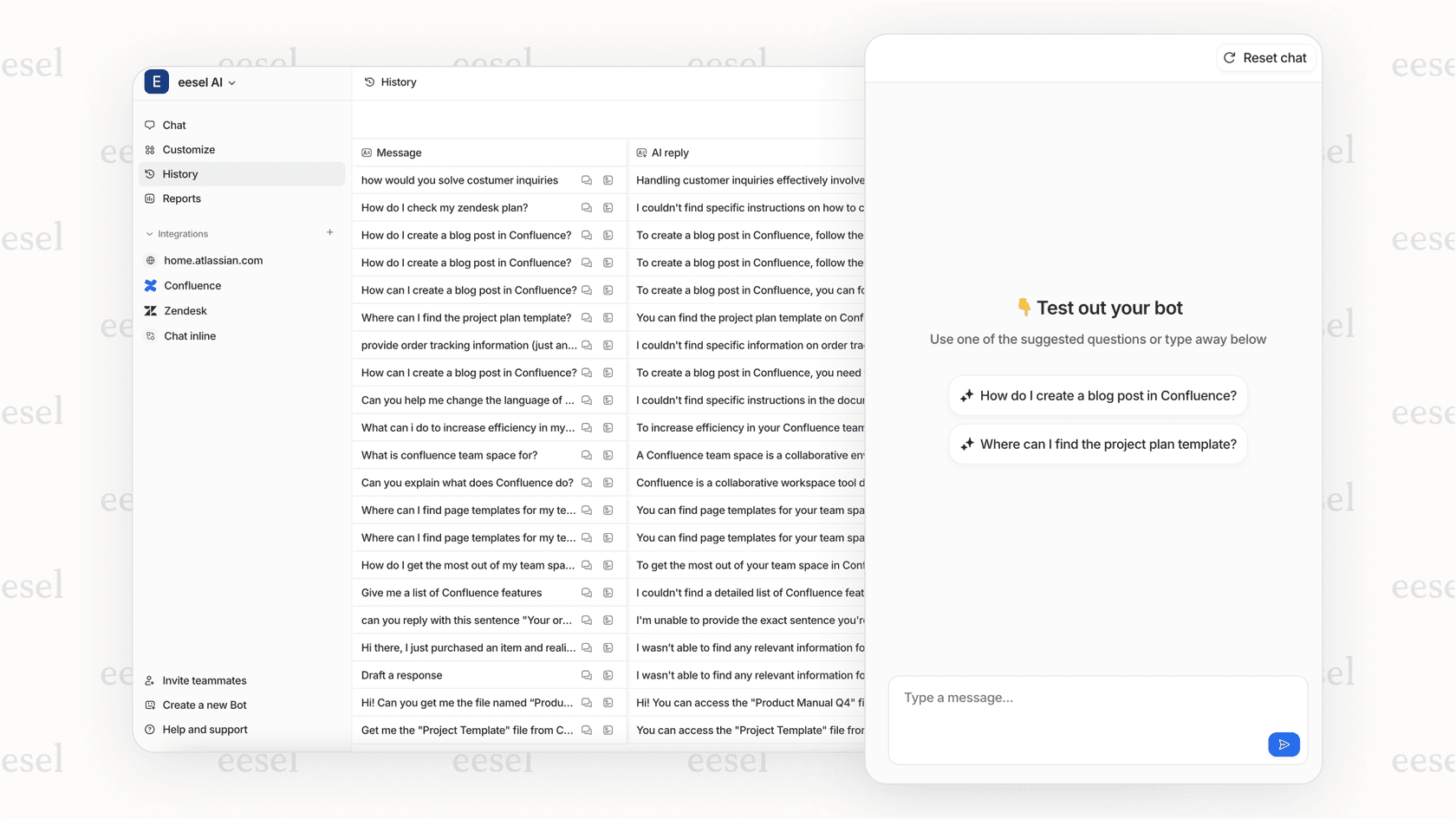
eesel AI integrates directly with Zendesk and learns from your historical ticket data. Instead of writing rules for every possible scenario, eesel AI understands context and intent. It can:
- Automatically suggest or set the right status based on ticket content
- Route tickets to the right team without manual triage
- Identify when a ticket should be Pending vs On-hold based on the conversation
- Recognize sentiment and urgency that rules might miss
This reduces the cognitive load on agents, who no longer need to manually manage status for every ticket. It also catches edge cases that rigid rules might overlook.
Common mistakes and how to avoid them
Even experienced support teams make these status management errors. Here's what to watch for.
Leaving tickets in the wrong status. The most common issue is tickets sitting in Open when they should be Pending (or vice versa). This usually stems from agents not being clear on the distinction. Regular training and view audits help catch this.
Closing tickets too quickly. When teams are measured on resolution time, there's pressure to close tickets fast. Resist this. Better to have a slightly longer "time to close" metric than frustrated customers creating follow-up tickets.
Not using On-hold for third-party dependencies. Without On-hold, agents either misuse Pending (confusing customers) or leave tickets Open (inflating active work queues). If your plan supports it, enable On-hold and train agents to use it.
Inconsistent status usage across the team. One agent's "Open" might be another's "Pending." Document your team's standards and review ticket samples regularly to ensure consistency.
Optimize your Zendesk ticket status lifecycle with eesel AI
Managing ticket statuses manually works fine at small scale. But as your team grows and ticket volume increases, the overhead adds up. Agents spend mental energy deciding which status to use. Admins write increasingly complex rules to handle edge cases. And tickets still slip through the cracks.
This is where we can help. eesel AI integrates with Zendesk to bring intelligent automation to your ticket lifecycle. Our AI Agent learns from your past tickets to understand how your team works. It can suggest optimal statuses, route tickets intelligently, and even handle routine status transitions automatically.
For teams that want to keep agents in control, our AI Triage product provides recommendations while leaving the final decision to humans. And our AI Copilot helps agents draft responses that naturally lead to the right next status.
The result is a cleaner backlog, more consistent status usage, and agents who can focus on solving problems instead of managing ticket states.


