The 6 best Yellow AI alternatives for your business in 2025

Kenneth Pangan

Stanley Nicholas
Last edited December 30, 2025

Yellow.ai is a big name in the conversational AI world, and for good reason. It’s a powerful platform for large companies that want to automate everything. But let's be real, what works for a massive corporation isn’t always the right fit for everyone else.
If you’ve been digging into Yellow.ai, you’ve probably noticed its enterprise focus comes with a certain price tag and a complicated setup. Many businesses start looking for other options because they’re worried about getting locked into one vendor, staring down high costs, or just needing something a bit more flexible and easier to manage.
That’s why we put this guide together. We’re going to walk through the six best Yellow AI alternatives in 2025, breaking down what makes each one tick so you can find the right platform for your team’s goals, budget, and sanity.
What are conversational AI platforms?
So, what are we even talking about here? Simply put, conversational AI platforms are the brains behind the chatbots and voice assistants we interact with. They’re the software that lets you automate conversations with customers, whether that’s on your website, in a messaging app, or right inside your help desk.
Their main job is to handle customer questions, qualify new leads, offer support 24/7, and take care of repetitive tasks that would otherwise tie up your team. But modern platforms are way more than just glorified FAQ bots. They use smart tech like Natural Language Processing (NLP) to understand what customers are actually asking, even when the phrasing is a little off. Plus, they can plug into your other business tools to take real action, like checking an order status or updating a customer’s account.
Why look for Yellow AI alternatives?
While Yellow.ai has a ton of features, a few common headaches often lead businesses to check out other options. It’s not about finding a “better” tool, but about finding the right tool for your situation. The key reasons teams start exploring alternatives can be broken down into four main areas, as shown in the visual below.
Here are a few reasons why teams start shopping around:
-
Cost and Complexity: Yellow.ai is built for large enterprises, and it’s priced that way. Paid plans can start at around $10,000 per year, which is a huge commitment for many small to mid-sized businesses. This often comes with a complex setup that requires dedicated engineers to get everything running.
-
Implementation and Onboarding Issues: Getting started can be a bit of a coin toss. While some users have a great experience with their support team, others have reported long delays and missed deadlines. There’s often a steep learning curve, which can push back the timeline for actually seeing a return on your investment.
-
Limited Flexibility and Vendor Lock-In: Sometimes, relying on pre-built templates can feel a bit restrictive, especially if you have unique workflows. Committing to a single, all-in-one ecosystem can also lead to vendor lock-in, making it a pain to switch platforms or integrate new tools down the line.
-
Feature and Support Gaps: Every business is different, and sometimes specific needs aren’t fully met. Maybe you need a deep integration with the help desk you already love, or maybe you need to host the AI on-premise for security reasons. Users have also run into platform outages and stability issues, which can be a dealbreaker when customers are trying to get help.
Our criteria for the best Yellow AI alternatives
To keep things fair and useful, we didn't just pull names out of a hat. We sized up each platform based on the things that really matter when you’re choosing a tool to talk to your customers.
First, we looked at ease of use. How fast can you get up and running without a team of developers? We looked for platforms that offer a genuinely self-serve experience.
Next was customization and control. Can you tweak the AI’s personality, fine-tune its workflows, and tell it exactly what to do? Or are you stuck with rigid, one-size-fits-all templates?
Integration capabilities were also key. A great AI platform plays nice with the tools you already use. We prioritized ones that connect seamlessly with help desks like Zendesk, CRMs, and knowledge bases like Confluence and Google Docs.
Of course, a platform has to scale with you. It should be able to handle more conversations as you grow without forcing you into a wildly expensive new plan.
We also looked for transparent pricing. Nobody likes surprise fees, so we favored clear, predictable models that you can actually understand without a finance degree.
Finally, support and documentation are non-negotiable. When you get stuck, there has to be someone to help, along with clear docs to guide you.
Comparison of the top Yellow AI alternatives
Here’s a quick look at how our top picks stack up against each other.
| Platform | Best For | Starting Price | Key Feature | G2 Rating |
|---|---|---|---|---|
| eesel AI | Self-serve setup and deep integration | $239/mo (annual) | Risk-free simulation on past tickets | 4.6/5 |
| Kore.ai | Large enterprises needing deep control | $0.20 per conversation | Multi-product AI architecture | 4.6/5 |
| Verloop.io | End-to-end support automation | Free plan available | Generative AI chat and voice agents | 4.7/5 |
| Drift | B2B sales and marketing teams | $2,500/mo (annual) | AI-powered buyer engagement | 4.4/5 |
| Rasa | Teams wanting full autonomy and customization | Free (Developer Edition) | Open-source, LLM-agnostic framework | 4.0/5 |
The 6 best Yellow AI alternatives in 2025
Alright, let's get into the details. Each of these platforms brings something different to the table, so the best one for you really depends on what you’re trying to do.
1. eesel AI
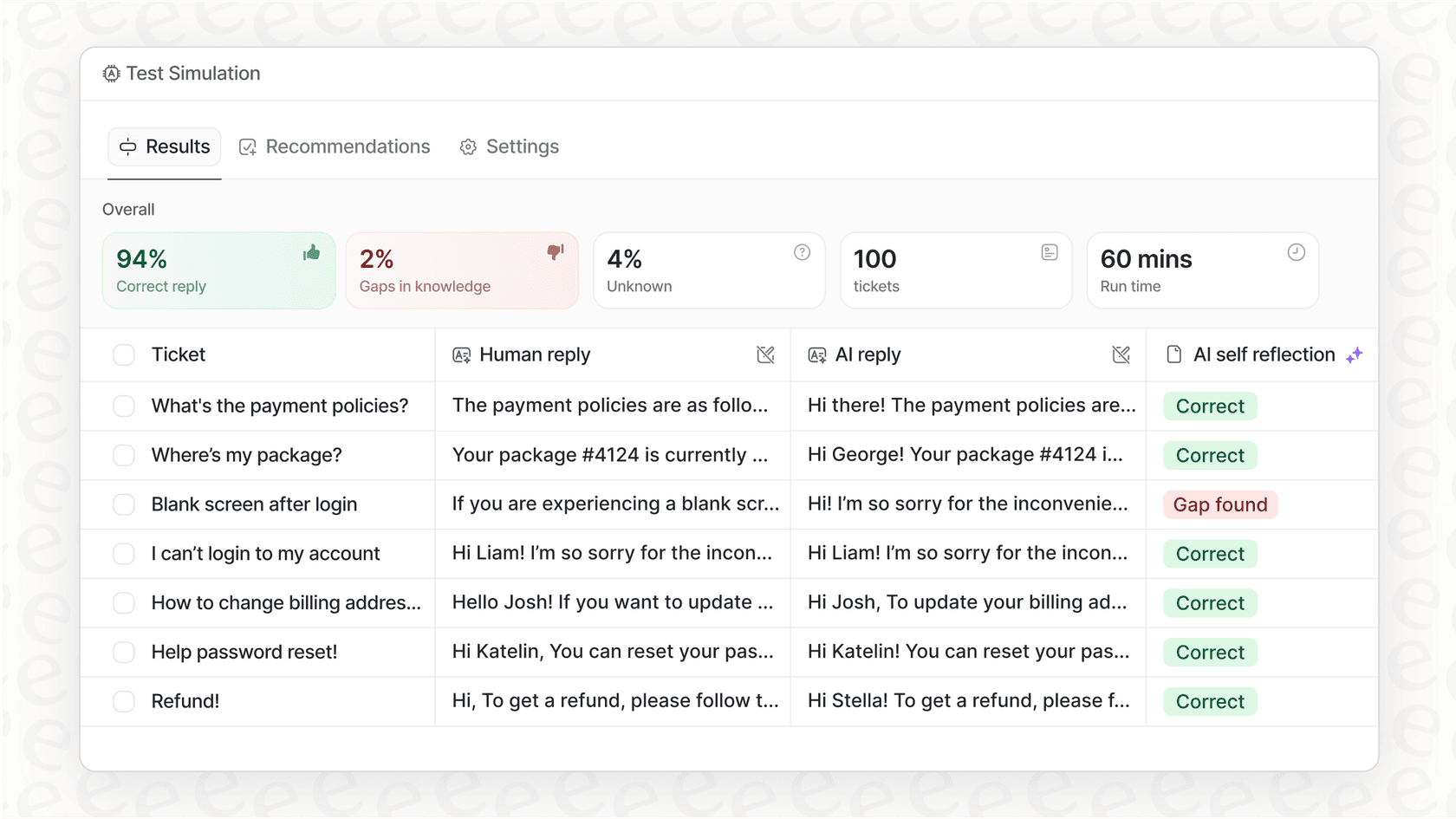
eesel AI is all about getting powerful AI without the enterprise-level headaches. Instead of making you switch help desks or move all your data, it plugs directly into the tools you already use, like Zendesk, Slack, and your knowledge sources. The whole experience is designed to be self-serve, meaning you can get it set up and running in minutes, not months. It learns your brand voice by training on your past tickets and documents, so it sounds like your team from day one. This makes it a perfect fit for teams that want serious automation without the long sales calls and complicated setup.
-
Pros:
-
Truly self-serve: You can sign up and get started on your own in minutes without ever talking to a salesperson.
-
Risk-free simulation: This is a huge one. You can test the AI on thousands of your historical tickets to see exactly how it will perform and how much it will save you before you let it talk to customers.
-
Total control: You get a prompt editor to customize the AI's personality, a workflow engine to define precise automation rules, and the ability to connect to any API for custom actions.
-
Transparent pricing: The plans are based on a predictable number of AI interactions, so you’ll never get a surprise bill after a busy month. No per-resolution fees here.
-
Cons:
-
It’s best for teams who are comfortable with a self-serve model, though they do offer AI engineering consulting if you need help with a more advanced setup.
-
Pricing: The Team plan starts at $299/month, which covers up to 1,000 AI interactions. If you pay annually, it's $239/month. Just a heads-up, some of the more advanced features like training on past tickets and the bulk simulation mode are on the Business plan.
2. Kore.ai
Kore.ai is a heavyweight contender built for large companies that need deep control and massive scalability. It’s trusted by hundreds of huge global businesses for a reason. The platform gives you a whole suite of tools to build sophisticated AI agents for customer support, internal IT, and more. With its no-code/low-code builder, you can create complex bots, deploy them on voice or chat, and connect them to pretty much any enterprise system you can think of.
-
Pros:
-
Built from the ground up for enterprise-grade security and scale.
-
Offers different tools for different use cases, so you can tackle support, contact center automation, and internal search with one platform.
-
Powerful integrations with the latest Large Language Models (LLMs).
-
Cons:
-
It can have a pretty steep learning curve, especially for non-technical users.
-
The interface can feel a bit overwhelming because there are just so many features.
-
The price point can be a barrier for smaller businesses.
-
Pricing: The standard plan is usage-based at $0.20 per conversation, but enterprise pricing is completely custom.
3. Verloop.io
Verloop.io is a customer support automation platform that runs on generative AI. It offers both chat and voice bots designed to understand the context of a conversation and actually solve problems, not just spit out canned answers. Verloop.io puts a big emphasis on balancing automation with a personal touch and provides tools to help your human agents work more efficiently, including a smooth handoff process for when a person is needed.
-
Pros:
-
Its smart context memory allows for conversations to feel continuous, even if a customer switches channels.
-
They have a strong focus on specific industries like e-commerce, banking, and healthcare.
-
Includes handy tools for auditing conversation quality and coaching agents.
-
Cons:
-
You’ll need to book a demo or talk to their sales team to get a quote for their enterprise plans.
-
It may have a more focused feature set compared to some of the broader, all-in-one platforms.
-
Pricing: Verloop.io offers a free plan to get started, with paid plans starting at $49/month. Enterprise pricing is custom.
4. Drift
Drift is a different beast altogether. It’s a "revenue acceleration platform" that uses conversational AI to help B2B sales and marketing teams connect with potential buyers. Its main goal is to qualify leads, book meetings, and identify your most interested website visitors in real-time. Unlike the other platforms on this list that focus on support, Drift’s AI is laser-focused on filling your sales pipeline, making it a powerhouse for companies with an account-based marketing strategy.
-
Pros:
-
Incredible for B2B inbound marketing and qualifying leads on the spot.
-
Connects seamlessly with major CRMs and sales tools like Salesforce and HubSpot.
-
Gives you rich insights into who’s on your website and what they’re doing.
-
Cons:
-
It’s very expensive, which puts it out of reach for many small and mid-sized businesses.
-
It’s probably overkill if all you need is customer support automation.
-
Advanced customizations can get complex and may require some technical help.
-
Pricing: The Premium plan starts at $2,500 per month, and they require an annual contract.
5. Rasa
Rasa is the go-to choice for teams that want full control, deep customization, and serious data privacy. It's a leading open-source conversational AI platform, which means you can avoid vendor lock-in and deploy your AI agents wherever you want, on your own servers or in a private cloud. This is a huge plus for companies in regulated industries. It’s also LLM-agnostic, so you can swap in whatever language model works best for your needs and budget.
-
Pros:
-
Offers industry-leading flexibility and customization. If you can dream it, you can probably build it with Rasa.
-
No vendor lock-in means you have complete autonomy over your technology.
-
Has a strong community of developers and excellent documentation.
-
Cons:
-
You’ll need in-house technical experts (like developers to implement and manage it.
-
It’s definitely not a plug-and-play solution; the setup is much more involved than with a SaaS platform.
-
Pricing: Rasa offers a free Developer Edition for individuals and small teams, with paid Growth and Enterprise plans for scaling businesses.
How to choose the right platform for your business
So, how do you pick one? Honestly, there's no single "best" platform. The right choice is the one that fits your business like a glove. To figure that out, sit down with your team and think through a few key questions.
First off, what’s your main goal? Are you trying to deflect common support tickets, generate more sales leads, or help employees find answers internally? Your primary use case will narrow down the options fast.
Next, what’s your budget? Be realistic about what you can spend. Think about whether a per-seat model or a usage-based model (like eesel AI) makes more sense for your team's size and volume.
Also, consider the tools you're already using. You'll want to pick a platform that integrates smoothly with your current help desk, CRM, and other essential software. The last thing you want is another data silo.
And finally, how much control do you need? Do you want a simple, no-code builder that just works? Or do you need the power of APIs and open-source frameworks to build something completely custom? Once you have your answers, take advantage of free trials and demos. There’s no substitute for getting your hands on the product and seeing how it feels.
Finding your perfect fit
Choosing a Yellow AI alternative really comes down to what your business needs. If you’re a massive enterprise that needs deep, granular control, Kore.ai might be your answer. If you live and breathe B2B sales, Drift is hard to beat. And if you have a team of developers ready to build from the ground up, the open-source freedom of Rasa is incredibly appealing.
But if you’re a team that just wants to move fast without getting tangled up in a complex, expensive ecosystem, there’s a much simpler starting point.
eesel AI is built for teams that value speed, control, and efficiency. You can set it up yourself in minutes and simulate its performance on your own historical data, so there’s zero risk in seeing if it’s the right fit. Connect your help desk today to see just how much time and money you can save with a smarter, simpler approach to AI.

Frequently asked questions
Businesses often search for Yellow AI alternatives due to its high enterprise-level costs, complex setup, and potential for vendor lock-in. Many teams need a more flexible, affordable, or self-serve solution that better fits their specific workflow and budget.
Yes, some platforms offer free entry points. Verloop.io has a free plan to get you started, and Rasa offers a free Developer Edition for those with the technical skills to build their own solution from the ground up.
For B2B sales, Drift is a top choice among Yellow AI alternatives because it's specifically designed for lead qualification and booking meetings. Its focus is on revenue generation rather than just customer support, making it ideal for sales-driven conversations.
eesel AI stands out because it's truly self-serve and integrates directly with your existing help desk and knowledge sources without a long setup process. Its risk-free simulation feature also lets you see exactly how it will perform before you go live, which is a unique advantage.
Absolutely. Rasa is the leading open-source option, giving you complete control and flexibility to build and deploy a custom AI agent on your own infrastructure. This is a great choice for teams with developers who want to avoid vendor lock-in and have specific privacy needs.
Not at all. While some options like Rasa are developer-focused, many alternatives like eesel AI are designed for a self-serve or low-code setup. You can often get these platforms up and running in minutes without needing to write any code.
Share this article

Article by
Kenneth Pangan
Writer and marketer for over ten years, Kenneth Pangan splits his time between history, politics, and art with plenty of interruptions from his dogs demanding attention.