

We’ve all been there. You write a LinkedIn post, it gets a bunch of likes for a day or two, and then… nothing. It just disappears into the feed, gone forever. It’s a bummer, because you know you have valuable things to say, but the short lifespan of posts makes it feel like you're on a content treadmill. What if there was a way to create content that keeps working for you, pulling in traffic and building your authority for months, or even years?
That’s where LinkedIn articles come in. With over a billion users, and four out of five of them being key decision-makers, LinkedIn is a goldmine for professionals. But the biggest hurdle isn't a lack of ideas. It's finding the time and energy to consistently turn those ideas into polished, long-form content.Still, it feels like LinkedIn's becoming a bit of a gold rush lately. Everyone's jumping in, and it's getting packed. Makes me wonder if the folks who started over 2 years ago had the real edge, and now we're just elbowing through the crowd.

Figuring out how to streamline this process is the key to unlocking LinkedIn's potential. Thankfully, you don't have to do it all alone. AI content generation platforms like the eesel AI blog writer can help you turn a simple topic into a complete, publish-ready article, making consistency an achievable goal.
What is linkedin blog writing? A look at posts vs. articles
Before we get into strategy, it's really important to get the difference between the two main ways you can publish on LinkedIn: posts and articles. They might look similar, but they serve completely different purposes and have a huge impact on your professional brand.
Linkedin posts: Quick updates with a short shelf life
Posts are the short-form updates you see all over your feed. Think of them as quick thoughts, links to interesting articles, photos from a conference, or questions for your network. They're capped at 3,000 characters (around 500 words), so you have to keep it brief.
- Pros: They’re fast to create and pop up directly in your network's feed, which makes them great for getting immediate engagement and staying on people's radar.
- Cons: Their visibility is a flash in the pan. They have a very short lifespan and, most importantly, they aren't indexed by search engines like Google. This means they offer zero long-term SEO value.
Linkedin articles: In-depth content with lasting impact
Articles are LinkedIn's built-in blogging platform. This is where you can really show off your expertise with long-form content, with up to 120,000 characters. They're perfect for thought leadership pieces, detailed case studies, deep dives into industry trends, or any topic where you need some space to explain things properly.
- Pros: This is the big one: articles are indexed by Google. They can drive organic search traffic to your profile for years. They establish you as a real expert in your field and even give you more detailed analytics on who’s reading your stuff.
- Cons: They take a lot more time and effort to write well. You also have to share the article as a post to make sure it actually shows up in your network’s feed, which is an extra step.
| Feature | LinkedIn Post | LinkedIn Article |
|---|---|---|
| Character Limit | 3,000 | 120,000 |
| Lifespan | 24-48 hours of visibility | Can drive traffic for years |
| SEO Value | None | Yes, indexed by Google |
| Best For | Quick updates, questions, sharing links | Thought leadership, in-depth analysis |
| Analytics | Basic (views, likes, comments) | Detailed (reader demographics, traffic sources) |
The core components of a successful linkedin blog writing strategy
Okay, so you're sold on writing articles. Great. But just publishing content whenever inspiration strikes isn't a strategy. A solid approach to LinkedIn blog writing is built on three things: knowing your purpose, picking the right topics, and sticking to a schedule.
Defining your purpose and audience
First up, you need to start with "why." What are you trying to do? Are you hoping to get more B2B leads? Build your personal brand to land a better job? Or are you trying to become the go-to thought leader in your industry? Your goal will shape every piece of content you create.
Once you know your "why," figure out your "who." Who are you actually writing for? Get specific. Think about their job titles, their industry, and the problems that keep them up at night. Content that speaks directly to a specific audience is always more effective than generic stuff aimed at everyone.
This helps you find your niche. What topics are you uniquely qualified to talk about? Don't try to be an expert on everything. Focus on the sweet spot where what you know, what your audience needs, and what you want to be known for all overlap.
Choosing the right topics
Now for the fun part: brainstorming. You probably have more ideas than you think. Jot down notes from your daily work, recent projects, or interesting industry news. What questions do people always ask you? What common misconceptions can you clear up? What's a unique take you have that nobody else is talking about?
The key is to stay relevant. Your content should always tie back to your career, your business, or your industry. A personal story can be powerful, but only if it delivers a professional lesson. Your post about climbing a mountain is nice, but it’s even better if you can connect it to overcoming business challenges.
Pro tip
if you have a short LinkedIn post that got a ton of engagement, that’s a perfect starting point for a more in-depth article. The engagement is proof that people are interested.
Not sure, but I tend to do it the other way round - start with a blog post and push snippets of it onto Linkedin. Doing it that way tends to view my site as the source of truth for the article, and if it gets traction, I can usually spin it into a few LinkedIn posts over the next few weeks.
Establishing a consistent publishing schedule
Consistency is so much more important than trying to create one viral hit. A regular publishing schedule builds trust and keeps your audience coming back. It shows you're serious and reliable.
Don't bite off more than you can chew. Committing to a daily schedule is a recipe for burnout if you're just starting. Aim for one article a month, or maybe every other week. You can always increase the frequency later once you find a rhythm that works for you.
Finally, a little bit of timing can help. While articles have a long lifespan, you still want that initial boost of engagement. Posting midweek in the morning or around lunchtime (think 9-11 AM or 12-1 PM in your target audience's time zone) usually gets the best results when your network is most active.
How to structure and write a compelling article for your linkedin blog writing
You've got your strategy and your topic. Now it's time to actually write the thing. The structure and style of your article are what will grab a reader's attention and, more importantly, hold it on a platform where everyone is busy.
Crafting a powerful headline
Your headline is your first, and maybe only, impression. It has to be clear, interesting, and promise real value. Vague titles get scrolled right past. "Writing on LinkedIn" is boring. "10 Tips for Writing LinkedIn Blog Posts" is specific and tells the reader exactly what they're going to get.
Structuring your content for readability
Nobody wants to read a giant wall of text, especially on a screen. You have to make your article easy to scan.
- Break it up: Use short paragraphs (2-3 sentences max).
- Use headings: Clear H2 and H3 subheadings act as signposts, guiding the reader through your content.
- Use lists: Bullet points and numbered lists are your best friends for breaking down complex information.
- Add visuals: LinkedIn has said that posts with images get more engagement, and videos get five times more. The same idea applies to articles. Add charts, infographics, or relevant photos to make your content more engaging.
Writing with authority and authenticity
You want to sound professional, but not like a robot. Use a conversational but authoritative tone. It's okay to use contractions and write like you speak. If you use industry jargon, take a second to explain it. You want your content to be accessible to everyone, not just fellow experts.
Back up your claims with facts. Use recent statistics and data whenever you can, and link out to credible sources. This builds trust with a professional audience that values evidence over opinion.
Ending with a clear call to action (CTA)
Don't just let your article trail off. Every piece of content should end by telling the reader what to do next. This is your call to action, or CTA.
It doesn't have to be a hard sell. You could simply ask a question to get a discussion going in the comments. You could point readers to your website to learn more about a service. Or you could invite them to connect with you on LinkedIn. Just make it clear and easy.
How to scale your linkedin blog writing with the eesel AI blog writer
The single biggest barrier to a great LinkedIn content strategy is time. Researching, writing, formatting, and finding visuals for high-quality articles takes hours. This is where AI can be a huge help, not by replacing your expertise, but by making it easier to share.
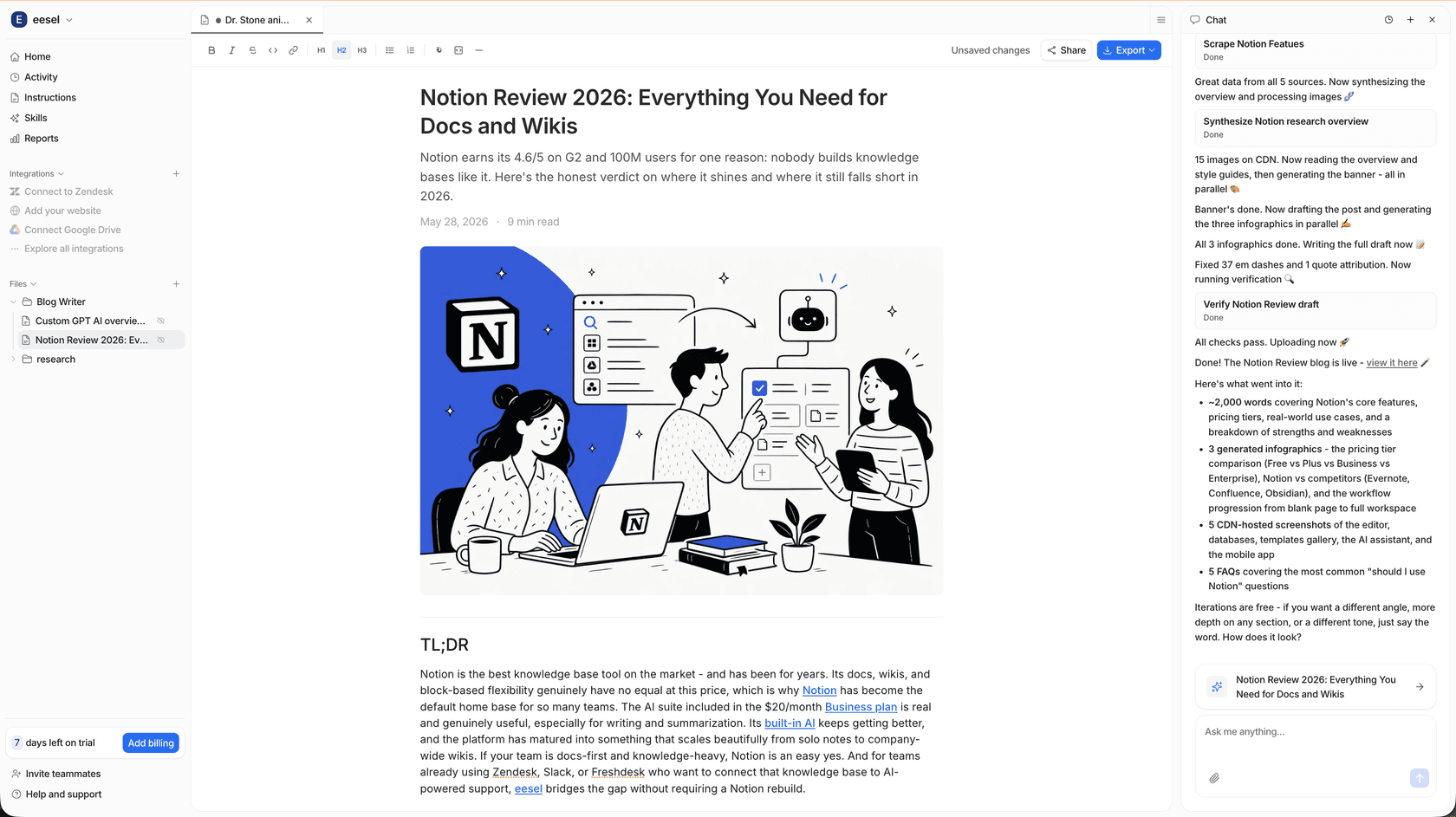
- Deep research with citations: The AI does the heavy lifting on research and automatically adds external links to credible sources. This instantly boosts your article's authority and shows you've done your homework.
- Automatic assets: It generates images, infographics, and tables to include in your article. This helps you create visually engaging content that performs better on professional platforms, without you having to mess around in Canva.
- Authentic social proof: One of its best features is the ability to find and embed real Reddit quotes and forum insights. This adds a layer of genuine human perspective, making your content feel more grounded and relatable.
- Answer engine optimization (AEO): Since LinkedIn articles are indexed by Google, this is a big deal. Articles are structured to perform well in AI Answer Engines like Google AI Overviews, helping you capture that top-of-the-page real estate.
We used this exact tool at eesel AI to grow our blog from 700 to 750,000 daily impressions in just three months by publishing over 1,000 optimized articles. It proves that scaling high-quality content is possible.
For a more hands-on look at the process, the video below offers a step-by-step tutorial on how to draft and publish articles directly on LinkedIn, covering the key features of the platform's native publishing tool.
So, what's the bottom line? While LinkedIn posts are great for quick, short-term engagement, articles are the key to building long-term authority and driving a steady stream of organic traffic. A winning strategy comes down to knowing your audience, choosing relevant topics, and writing structured, valuable content that's easy to read.
But the real engine of a successful LinkedIn presence is consistency. The gap between knowing you should be writing and actually hitting "publish" is where most professionals get stuck.
If you're ready to turn your expertise into high-ranking content without all the heavy lifting, it’s time to bridge that gap. Try the eesel AI blog writer for free and generate your first complete, SEO-optimized article in just a few minutes.