
Freshservice has become a go-to ITSM platform for organizations wanting to modernize their IT operations. With Freddy AI built in, it promises to automate routine tasks, assist agents in real time, and deliver actionable insights. But does it actually deliver on those promises?
This review breaks down what Freddy AI does, how much it costs, what real users are saying, and where it falls short. Whether you are already using Freshservice or evaluating ITSM platforms, this guide will help you decide if Freddy AI is the right fit for your team.
What is Freshservice Freddy AI?
Freshservice is an IT service management platform designed to help IT teams handle incidents, service requests, changes, and assets from a single interface. It is part of the Freshworks ecosystem, serving over 74,000 businesses including major organizations like Databricks, the University of Pennsylvania, and Marvel.
Freddy AI is Freshworks' built-in AI engine. Unlike third-party AI tools that require separate integration, Freddy is woven directly into the Freshservice platform. It consists of three main components:
Freddy AI Agent handles employee questions autonomously through conversational interfaces on Slack, Microsoft Teams, and the service portal. It pulls answers from your knowledge base and can resolve common issues without human intervention.
Freddy AI Copilot works alongside human agents, suggesting replies, summarizing long ticket threads, and translating conversations in real time. It is designed to speed up agent workflows rather than replace them.
Freddy AI Insights provides analytics and proactive alerts, helping IT leaders spot trends, identify root causes, and make data-driven decisions.
For teams already invested in the Freshworks ecosystem, Freddy AI offers the convenience of native integration. There is no separate vendor to manage, no complex connectors to configure, and the AI learns from the data already in your Freshservice instance.
That said, this tight integration comes with trade-offs. Freddy AI only works within Freshworks products, which means organizations using multiple knowledge sources or considering platform changes down the road may find themselves locked in. Alternatives like eesel AI take a different approach, offering platform-agnostic AI that integrates with your existing tools without requiring a full ecosystem commitment.
Key features of Freddy AI
Freddy AI's capabilities span self-service automation, agent assistance, and analytics. Here is what each component actually does.
Freddy Copilot features for agents
Freddy Copilot is designed to make human agents faster and more effective. It sits inside the agent workspace and provides assistance without requiring context switching.
Reply suggestions and tone enhancement. When an agent opens a ticket, Freddy suggests responses based on similar past tickets and knowledge base articles. It can also adjust the tone of a reply to be more empathetic or professional with a single click.
Ticket summarization. For long, complex tickets with extensive back-and-forth, Freddy generates a concise summary. This is particularly useful when tickets get escalated or handed off between agents, saving the new assignee from reading through pages of history.
Similar ticket suggestions. Freddy surfaces past tickets that dealt with similar issues, helping agents find proven solutions and maintain consistency in their responses.
Real-time translation. Supporting global teams or customers becomes easier with Freddy's ability to translate conversations on the fly in over 60 languages.
Help article generator. After resolving a ticket, Freddy can draft a knowledge base article based on the solution, helping teams build out their self-service resources over time.
For teams looking at ticket summarization capabilities across different platforms, it is worth comparing how various tools handle this specific workflow.
Freddy AI Agent capabilities
The AI Agent component focuses on deflecting tickets before they reach human agents.
Conversational self-service. Employees can ask questions in natural language through Slack, Microsoft Teams, or the service portal. Freddy searches the knowledge base and provides answers instantly.
Automated ticket deflection. By resolving common queries automatically, Freddy reduces the volume of tickets that require human attention. Freshworks claims up to 80% query resolution rates for the AI Agent.
Knowledge base-powered responses. Freddy draws from your existing help articles and documentation to answer questions, which means the quality of responses depends heavily on the quality and completeness of your knowledge base.
Channel flexibility. The AI Agent works across multiple channels, allowing employees to get help wherever they already work.
While these features are solid for teams fully committed to Freshworks, organizations needing AI that works across multiple knowledge sources (like Confluence, Google Docs, or Notion) may find Freddy's ecosystem lock-in limiting. Our Freshservice integration offers an alternative approach for teams wanting AI flexibility without abandoning their existing platform.
Freshservice Freddy AI pricing breakdown
Understanding Freddy AI pricing requires looking at both the base Freshservice plans and the AI add-ons. Here is the complete breakdown.
Freshservice base plans
| Plan | Price (per agent/month, annual billing) | Key Features | Freddy AI Access |
|---|---|---|---|
| Starter | $19 | Incident management, knowledge base, SLAs, mobile app | Not available |
| Growth | $49 | Adds service catalog, problem management, change management | Not available |
| Pro | $99 | Full ITSM, sandbox, orchestration, workload management | Freddy AI Agent (500 sessions), Copilot (add-on) |
| Enterprise | Custom | All features plus enterprise support | Full Freddy AI included (1,200 sessions per license/year) |
Source: Freshservice pricing page
Freddy AI session details
A "session" is defined as any interaction a unique user has with Freddy AI Agent within a 24-hour period. This means if an employee chats with Freddy three times in one day, that counts as one session. If they return the next day, that is a second session.
Pro plan: 500 sessions included annually. Additional sessions require purchasing more.
Enterprise plan: 1,200 sessions per license per year.
Important pricing considerations
The per-agent pricing model means your AI costs grow linearly with your team size. Every new agent you add to Freshservice who needs AI assistance adds to your monthly bill. For rapidly growing teams, this can become a significant budget consideration.
Additionally, Freddy AI is only available on Pro ($99/agent/month) and Enterprise plans. If you are on Starter or Growth, you will need to upgrade before you can access any AI features.
When evaluating total cost of ownership, it is worth comparing this structure to alternatives. Our pricing uses an interaction-based model rather than per-seat pricing, which can provide more predictable costs for growing teams.
Real user results and performance data
Beyond marketing claims, what are actual Freshservice users experiencing with Freddy AI? Here is what the data shows.
Published performance metrics
Freshworks reports several benchmarks from their customer base:
- 356% ROI in under 6 months through productivity gains and legacy tool consolidation
- 66% ticket deflection with AI-powered self-service
- 77% decrease in average resolution time with AI assistance
- 98% average employee satisfaction score
Source: Freshservice homepage
Customer case studies
Databricks consolidated from 10 different platforms to Freshservice and achieved a 23% ticket deflection rate. The VP of Infrastructure noted significant cost savings from platform consolidation.
University of Oxford saved an estimated 405 working days annually across their IT team, with an 81% decrease in resolution times after implementing Freshservice with AI features.
Village Roadshow cut IT costs by 60% annually while improving service quality and speed.
Source: Freshservice pricing page
User feedback from research platforms
UserEvidence research gathered feedback from organizations actively using Freddy AI:
One IT Service Manager at a medium enterprise noted: "Freddy AI Agent helps in triaging tickets, suggests the right category and subcategory, and helps our agents to view similar cases solved in the past. In short, it is a great support in our IT ecosystem."
An IT Helpdesk Technician at a healthcare organization reported: "I like how Freddy AI Agent takes off a lot of the daily workload by doing the mundane tasks for me instead of manually. I also like the summary of tickets/issues. It makes it easy to keep track of my work."
A Manager at a large financial services company shared specific metrics: "Before Freddy AI, the first response by the frontline support team was 2 to 4 hours. With the implementation of Freddy AI, instant response reduced the first response by 80-90%, and the first response was sent within approximately 30 seconds."
Shalindra Singh, Director of Enterprise Applications at Five9, reported: "Because of the Freddy AI virtual bot, we could deflect 65% of the tickets. Copilot is helping us be consistent and accurate with the resolution description. It saves 200 hours per month."
These results suggest Freddy AI can deliver significant efficiency gains, particularly for organizations with high ticket volumes and well-maintained knowledge bases. However, results vary based on implementation quality, knowledge base completeness, and organizational readiness.
For teams focused on improving deflection rates, understanding these benchmarks can help set realistic goals.
Limitations to consider before buying
Freddy AI is not without its drawbacks. Here are the key limitations to factor into your decision.
Setup complexity
Getting Freddy AI running properly requires navigating through various settings, configuring add-ons, and digesting extensive documentation. Unlike some modern AI tools that offer one-click setup, Freddy's deep integration with Freshservice means you are working within a complex enterprise platform.
For teams wanting to get up and running quickly, this learning curve can delay time-to-value. The implementation may require dedicated administrator time and potentially working with Freshworks support or implementation partners.
No pre-launch testing capability
One significant gap is the lack of a simulation mode to test Freddy AI on your historical tickets before going live. While Freshservice offers a sandbox environment for testing configuration changes, you cannot use it to see how the AI would have actually handled your real customer conversations.
This means you are essentially launching the AI to your users without knowing how it will perform on your specific types of tickets. For risk-averse organizations, this "deploy and hope" approach can be concerning.
Knowledge ecosystem lock-in
Freddy AI works best when your knowledge lives entirely within Freshworks. It draws from your Freshservice knowledge base and past tickets, but it cannot easily tap into external sources like Confluence, Google Docs, Notion, or SharePoint.
For organizations with knowledge scattered across multiple platforms, this creates a problem. Either you migrate everything into Freshworks (which may not be practical), or your AI works with incomplete information, leading to more escalations and frustrated users.
Teams using Confluence, Google Docs, or Notion alongside their help desk should consider how important unified knowledge access is for their AI strategy.
Per-agent pricing scalability
The pricing model means every new hire adds to your AI costs. For organizations in growth mode, this creates a direct correlation between headcount expansion and software expenses. While this is standard for many enterprise tools, it is worth modeling out costs for your projected team size over the next 1-2 years.
Additionally, the session limits on Pro plans mean high-volume organizations may need to purchase additional sessions or upgrade to Enterprise, adding another variable to budget planning.
eesel AI: A flexible alternative for IT teams
For teams finding Freddy AI's limitations problematic, there are alternatives that take a different approach to AI-powered support.
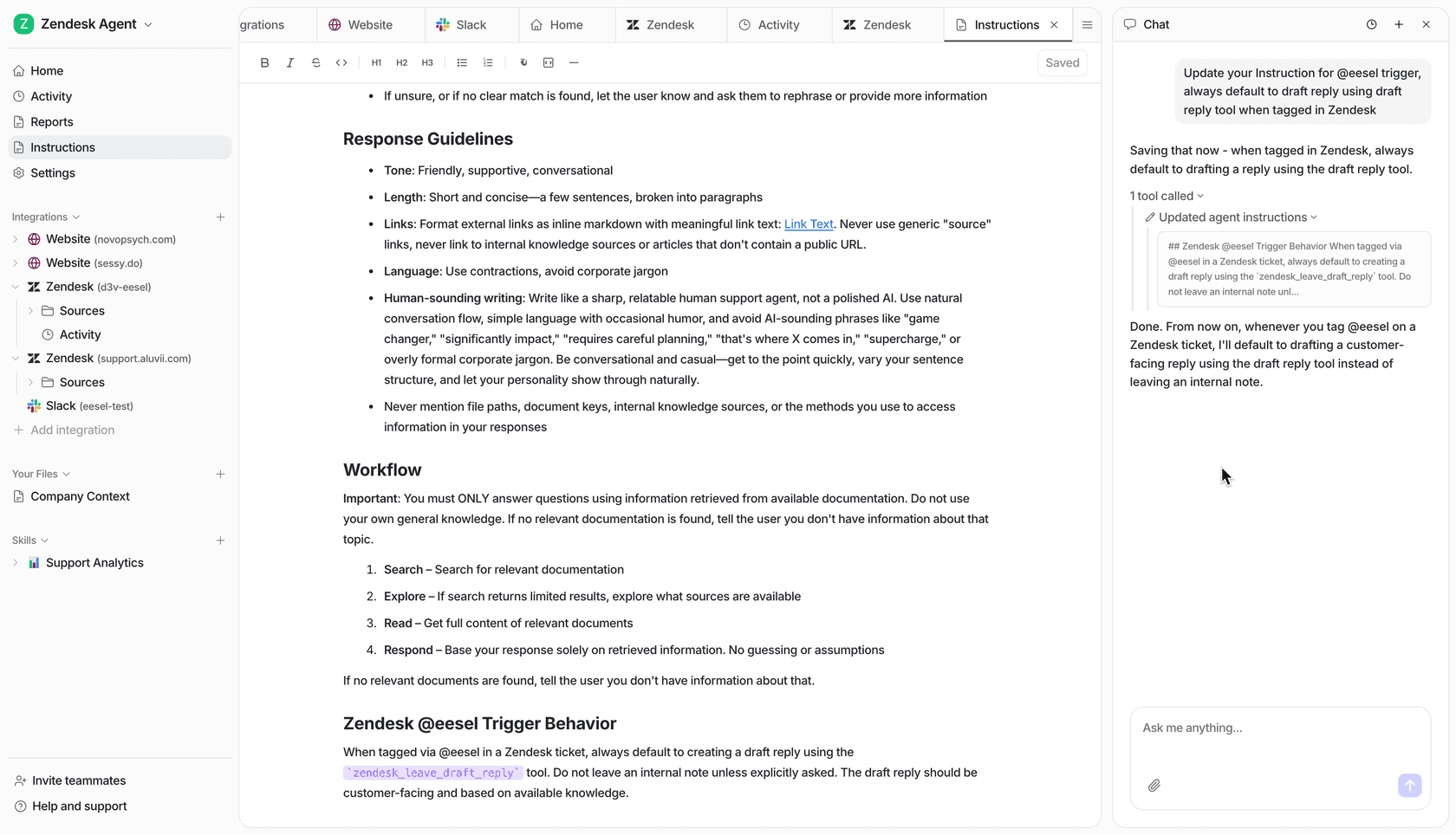
We built eesel AI as an AI teammate that works alongside your existing tools rather than locking you into a specific ecosystem. Here is how the approaches differ:
| Capability | Freddy AI | eesel AI |
|---|---|---|
| Setup time | Days to weeks of configuration | Minutes to connect and start learning |
| Testing | No simulation mode | Full simulation on historical tickets before going live |
| Knowledge sources | Freshworks ecosystem only | 100+ integrations including Confluence, Google Docs, Notion |
| Pricing model | Per agent, per month | Interaction-based, not per-seat |
| Platform flexibility | Native to Freshworks only | Works with Freshservice, Zendesk, Jira, and others |
Key differentiators
Simulation mode. Before going live, you can run eesel AI on thousands of your past tickets to see exactly how it would have responded. This lets you measure potential resolution rates, forecast ROI, and tune behavior without risking customer interactions.
Unified knowledge. Our AI Agent connects to your help desk plus all your other knowledge sources. Whether your documentation lives in Confluence, Google Drive, Notion, or scattered across multiple platforms, eesel can access it all.
Interaction-based pricing. Instead of paying per agent, you pay for the AI interactions you actually use. This means your costs stay predictable even as your team grows, and you are not penalized for hiring more people.
Platform agnostic. If you are using Freshservice today but considering a change down the road, eesel moves with you. The same AI teammate works across different help desk platforms.
For IT teams specifically, our AI for IT operations solution addresses the unique challenges of internal support, from handling repetitive password resets to complex infrastructure requests.
Is Freshservice Freddy AI right for your team?
Deciding whether Freddy AI makes sense depends on your current infrastructure, team size, and future plans.
When Freddy AI makes sense
- You are already committed to the Freshworks ecosystem and plan to stay there
- Your knowledge base is primarily housed in Freshservice
- You prefer native, integrated tools over third-party solutions
- Your team size is relatively stable, making per-agent pricing predictable
- You need basic AI assistance without complex customization requirements
When to consider alternatives
- You use multiple knowledge sources outside of Freshworks (Confluence, Google Docs, Notion)
- You want to test AI performance on historical data before going live
- You prefer usage-based pricing that does not scale with headcount
- You may switch help desk platforms in the future
- You need AI that works across multiple tools and departments
The bottom line is that Freddy AI is a solid choice for teams fully invested in Freshworks who want convenient, built-in AI capabilities. The native integration is genuinely useful, and the feature set covers the basics well.
However, if flexibility, testing capabilities, and unified knowledge access matter to your organization, the limitations become significant. For teams wanting a more modern approach to AI support, alternatives like eesel AI offer capabilities that address these gaps without requiring an ecosystem change.